I agree with Searle although not always with how he says it. He is a "biological naturalist" which, as far as I am concerned, is a kind of materialist. Searle rejects "materialism" but only because he identifies it with mechanistic reductionism. He is unaware of Engels' dialectical materialism. Searle thinks that we will:
Tuesday, 14 September 2021
Philosophy Of Consciousness
Thursday, 30 January 2020
Philosophy And Fiction
Searle asks:
"...does the digital computer give us the right picture of the human mind? And why is it that the social sciences in general have not given us insights into ourselves comparable to the insights that the natural sciences have given us into the rest of nature?"
-John Searle, Minds, Brains And Science (London, 1984), ONE, p. 13.
Dominic Flandry converses with a:
"'High-grade central computer - consciousness grade...'"
- Poul Anderson, A Circus Of Hells IN Anderson, Young Flandry (Riverdale, NY, 2010), CHAPTER TWO, p. 210.
Searle argues that any computer, however fast or powerful, merely manipulates symbols according to a programmed set of rules and that this process involves neither consciousness in general nor, more specifically, any knowledge or understanding of the meanings of the symbols. In order to become conscious, an artifact would have to duplicate brain processes.
Liquidity or wetness is a feature of water and is caused by interactions between many water molecules none of which is individually liquid or wet. Similarly, consciousness, including subjectivity, is a feature of a brain and is caused by interactions between many objectively observable neurons none of which is individually conscious. Artificial neural networks would be conscious.
Searle's second question above is relevant to Anderson's Psychotechnic History.
Sunday, 1 October 2023
Not Science Or Philosophy
"Of course as a science-fiction fantasy we can imagine conscious thermostats, but science fiction is not science. And it is not philosophy either." (p. 170)
Searle sounds dismissive of sf. Science fiction is neither science nor philosophy but is a kind of fiction that locates human beings not only within their own social structures but also within the scientifically understood universe of physical laws and cosmic spaces. Deploying his knowledge of the relevant sciences, Poul Anderson, in his Technic History, speculates about xenobiology:
how intelligent beings might be able to fly in terrestroid conditions;
how tripartite intelligence might evolve on Dido;
why two populations of Diomedeans, while remaining a single species, might develop life-styles that seem alien to each other.
This is more than fantasy although Anderson wrote that also.
I think that Philosophy and Literature would make a good combined University course. At Lancaster University, one Professor of Philosophy had only a BA in English. I think that he made the switch via Aesthetics. Poul Anderson's novels about post-organic intelligences dramatize the philosophy of consciousness as discussed by Searle, one point being that mere computer programs are definitely not conscious but maybe some other kinds of artefacts could be.
Saturday, 30 September 2023
Betrayal
Friday, 31 January 2014
Fantasy In The Age Of Science
"Emotions seem to be functions of chemistry, the brain seems closely analogous to a computer, one entire school of psychology even denies that the word 'consciousness' has any meaning." (p. 282)
Emotions, even if functions of chemistry, are conscious events that it is helpful to understand. If the word 'consciousness' had no meaning, then we would not be conscious of the fact. I have been persuaded by John Searle's argument that brains are not analogous to computers. Computers, whether mechanically or electronically, manipulate symbols without knowledge of their meanings whereas brains generate consciousness which understands symbols and knows their meanings.
"Many [sensible people] will tell you, for instance, in considerable detail, that the Resurrection of Christ is better attested than most events we take to be historical." (p. 270)
Some of those people are doing what I used to do, rationalizing their indoctrination. My attempt to understand the origin of the Resurrection story is in "Evidence for the Resurrection" on my Religion and Philosophy blog.
I fully endorse Anderson's warning in this article that the causes of Naziism are unfortunately still with us.
Thursday, 24 September 2020
Cosmos And Mind
Today, I bought:
Rival Theories Of Cosmology (London, 1960) by H. Bondi, W.B. Bonnor, R.A. Lyttleton and G.J. Whitrow -
- which covers relativistic theories, the steady-state theory, the notion of an electric universe and a discussion of the rival theories.
We can imagine travelers from each of these universes meeting, and arguing about cosmology, in Poul Anderson's inter-cosmic inn, the Old Phoenix.I also bought:
The Physical Basis Of Mind (Oxford, 1962), edited by Peter Laslett -
- which covers thought, the brain, the mind, calculation, consciousness, speech and the cerebral cortex.
This book may be relevant to any future discussions of AI, a recurrent issue in Anderson's works.
We are not dead yet.
Wednesday, 7 January 2015
Brains III
-Poul Anderson, The Van Rijn Method (New York, 2009), p. 582.
Here is the philosophical mind-body question again. See here. A hypothetical alien might have a smaller brain containing fewer neurons. However, his neurons, being more efficient, might exchange electrochemical signals of greater intensity and/or with greater rapidity than ours. Thus, he might be equally intelligent and therefore able to understand, e.g., the proof that there is no highest prime number. However, neuronic interactions on the one hand and conscious reflection on a mathematical proof on the other hand are not only different processes but even different kinds of processes although the former somehow causes the latter.
As John Searle suggested, we need to study psychology and study neurology and find out how they connect. Maybe this third inquiry is philosophy.
Friday, 8 June 2012
Aliens and AI
(Parenthetically, in Anderson's Time Patrol series, we think that our evolutionary successors, the Danellians, remain organic, not post-organic. When I first read The Guardians Of Time, I thought that the Danellians were the time travel equivalent of aliens. As space travellers might meet extraterrestrials, so time travellers might meet "extratemporals"?)
Philosophically, I accept John Searle's argument that computers merely simulate intelligence but that a different kind of artifact might indeed duplicate the brain functions of consciousness and intelligence. It would follow that AI is not an immediate prospect and that it will not emerge simply from a few more generations of computers.
The Boat Of A Million Years is an intermediate work addressing both aliens and AI. Its aliens are less numerous and more alien:
physically, less humanoid, departing from the biped with torso, arms, head and face model;
psychologically and intellectually, far less easy to establish regular communication with;
socio-politically, when contacted at last over vast distances and with advanced technology, not rival imperialists but fellow explorers.
The problem in Boat is that interstellar explorers are mostly robotic, ultimately AI's, and that they can cope with data from only about a hundred light years away so will not explore further except in exceptional circumstances. Meanwhile, Anderson suggests, they will absorb their creators into their intellectually superior systems and will direct their attention away from organic life while the few remaining organic beings turn inward and away from cosmic exploration. Anderson and his leading characters want humanity to survive, to remain active and to move outwards so, of course, they find a way to do this: interstellar exploration by human and other organic beings - more expensive and difficult than with robots but infinitely more worthwhile.
Sunday, 1 September 2013
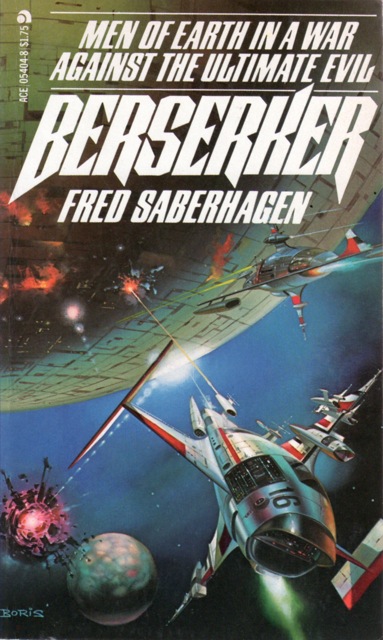
Berserkers
"...it was nonhumans that had built the first berserkers, untold ages ago, and programmed them to destroy everything alive, as a weapon in a damned forgotten war of their own."
-Poul Anderson, "Deathwomb" (IN Anderson, Space Folk, 1989, pp. 195-238 AT p. 207).
Some organisms, called "goodlife" by the berserkers, cooperate with berserkers but I do not yet know the basis of this cooperation.
"Deathwomb" is Anderson's berserker story. The viewpoint character, Sally Jennison, thinks of:
"...the whole hollow universe as a womb engendering the agents of death, which later came back and impregnated their mother anew." (p. 220)
- this "impregnation" is by berserker auxiliaries mining planets and asteroids to make new machines programmed with the same code.
It seems that each writer of a berserker story can imagine new planets for human beings and berserkers to fight on and around. Anderson presents yet another of his astronomical oddities - a double planet at just the right distance from a red dwarf star for one of the planets to have life, their locked orbit maintaining atmospheric circulation. The inhabited planet, Ilya, has a Highroad River like Daedalus in Anderson's The Game Of Empire. As on many other fictitious planets, Anderson describes the local equivalent of grass:
"...springturf, a living recoil beneath the feet, purple studded with tiny white flowers." (p. 211)
In the opening passage, an automatic space courier carries a message from some human beings to a berserker. The omniscient narrator, having applied the words "...motivated...", "...fear..." and "...proud..." to the berserkers, then comments:
"Motivation; fear; pride - nonsense, words, when used about a set of computer-effector systems, unalive, belike unaware..." (p. 196)
"...belike unaware..."? Are they or are they not aware?
The philosopher John Searle presented two arguments -
(i) Rule-governed manipulation of symbols is not knowledge of their meanings and simulation is not duplication, therefore analog computers are not conscious. To be conscious, an artifact would have to duplicate, not merely simulate, brain functions and therefore would be an artificial brain, not an analogue computer.
(ii) However, a sufficiently complex and correctly programmed analogue computer would be able to pass the Turing Test, conversing and behaving indistinguishably from an intelligent, self-conscious being.
I accept (i) but not (ii). If (ii) were true, then how would any of us know that every other human being was not an unconscious automaton? At present, this is an academic question but, if anyone were to introduce an entity that passed the Turing Test but could then be shown to be an elaborate analog computer, then I would have a major philosophical problem.
To pass the Turing Test, an entity, on hearing an offensive joke, would have to:
laugh out loud or
merely smile or chuckle or
not get the joke or
understand the joke but not find it funny or
be very offended or
say, "That is offensive," "That is in bad taste" etc and explain why or
storm out of the room or
threaten legal action or
become offensive or even violent in return or
something else...
This at least shows that no one is yet close to constructing a computer capable of passing the Turing Test.
This is all relevant because the automatic courier and the berserker give every appearance of passing the Turing Test. They converse with questions and answers. Is it plausible either that the berserker is not conscious or that it is merely a computer?
Saturday, 2 October 2021
A Persistent Puzzle
Individual experience is subjective, meaning inaccessible to anyone else. Scientists rightly study the objective, meaning the publicly accessible, because only thus can observations be verified. But, if scientists are able to study only the objective, then are they also able to study the objective-subjective link/connection/causal relationship? Psychologists study subjective states but can they make their study scientific in the sense of objective?
Can the studies of the objective and the subjective become a single study? This is as close as I can come to formulating the question coherently.
Monday, 14 September 2020
AI In SF
First:
Artificial intelligence (AI) refers to the simulation of human intelligence in machines that are programmed to think like humans and mimic their actions.
-copied from here.
Currently at least, machines do not "think" consciously but, at most, "simulate" or "mimic" intelligent thought.
Secondly, when I discuss "AI," I refer to the important philosophical distinction between consciousness and unconsciousness. Thus, I am primarily interested in whether an artifact can be conscious - and hopefully also intelligent. Such an artifact would not simulate but duplicate consciousness and conscious intelligence.
Isaac Asimov and Arthur C. Clarke thought that computers could be conscious. John Searle has argued not. Poul Anderson's sf covers every option with AI in either sense.
Perhaps the most advanced discussion and speculation about conscious AI is summarized in "The Man Who Would Be Kzin":
"The conscious brain is a computer,..." (p. 308)
I would have said not but let us see where this discussion goes:
"...but one of a very special kind." (ibid.)
A very special kind: it not only performs some computational functions but also is conscious.
"Not anything like a digital system;..." (ibid.)
Precisely. That is why I would not call it a computer.
"...that was one reason why true Artificial Intelligence had taken so long to achieve, and had proven so worthless once found." (ibid.)
This refers to other MKW stories co-written by Stirling.
"Consciousness does not operate on mathematical algorithms, with their prefixed structures." (ibid.)
No, because the workings of such algorithms and structures can be fully described without ascribing any consciousness to them.
"It is a quantum process, indeterminate in the most literal sense." (ibid.)
This seems intuitively plausible. Both quantum mechanics and consciousness are mysterious so might they be aspects of a single mystery? But I do not think that just any quantum event involves consciousness. An electron does not decide which way to jump. At least, we can describe its movements without referring to consciousness. However, on the macroscopic level, organisms (very different kinds of entities from computers) interact with their environments with increasing sensitivity. Complex, mobile organisms have central nervous systems. Within those systems, neuronic interactions might involve undetermined quantum processes. Indeterminacy seems to be an appropriate partial description, although not of course a full definition, of immediate awareness.
"Thoughts became conscious - decision was taken, will exercised - when the nervous system amplified them past the one-graviton threshold level. So was insight, a direct contact with the paramathematical frame of reality." (ibid.)
- including mystical oneness with ultimate reality.
Wednesday, 7 August 2013
Epilogue: Conclusion
no polar caps;
new continents, black and ochre instead of green or brown;
sea level temperatures from 80 to 200 Fahrenheit;
no atmospheric oxygen;
a cloudy atmosphere of nitrogen and its oxides, ammonia, hydrogen sulfide, sulfur dioxide, carbon dioxide and steam;
no chlorophyll or other complex organics;
metallic ground cover;
"This was no longer Earth." (p. 191)
This alone would not have been enough to tell us that a machine ecology has evolved but the description of Earth is in section II. Section I had already presented a robotic viewpoint character.
How plausible is what I call the "mechology"? The mineral-gathering sea rafts were already self-propelling and self-propagating and their templates were changed by the radiation of a nuclear war. Consequently, some changes were going to occur but surely their direction would have been unprecedented rather than an exact parallel of the now defunct biological evolution? It is plausible that some mechanisms would specialize in reproduction but far less plausible that they would develop sexual reproduction.
How plausible is consciousness? Mere computation is insufficient. Years ago, the philosopher John Searle remarked that a computer can be constructed from anything, for example from beer cans. However, beer cans are not the sort of things that can be conscious. A quantitative increase in the number of interactions between beer cans cannot lead to the qualitative change from unconsciousness to consciousness. What is needed is sensitive interaction with an environment leading to a central nervous system with at least an equivalent of neuronic interactions.
Mere computation is unconscious whereas neurons, as we know, generate consciousness. Thus, contra Asimov, a brain is more or other than a computer; a conscious robot is not just a mobile computer - and indeed Asimov's robots are described as possessing artificial brains. So the question is whether a robotic "brain" can duplicate, not merely simulate, animal or human brain functions. (I do not think that an immaterial soul is necessary.)
The robots think that the weak invasive "units" (human beings) were constructed by "persons" like themselves but how do they account for their own evolution from inanimate matter? If they were able to trace their evolution back to the sea rafts, then they would still have confronted a mystery.
Thursday, 3 March 2022
Subjective Experience
Saturday, 1 February 2020
A Science Of Humanity
His argument, if I understand it:
Geology and meteorology can be grounded in physics because rocks and weather are determined by interactions between particles whereas economics cannot be grounded in physics because coins, notes or other artifacts are money only if they are believed to be money and, since "...money can have an indefinite range of physical forms..., it can have an indefinite range of stimulus patterns on our visual systems" (FIVE, p. 80) and these patterns cannot produce "...exactly the same neurophysiological effect on the brain." (ibid.)
OK?
Monday, 20 September 2021
Philosophy Of Consciousness II
Thursday, 9 April 2020
Limits On Psychotechnics
In his debate with Elena, Dalgetty specifies two limitations. First, social forces are so great that the Institute could be overwhelmed before it can accomplish anything.This is the comparison with the engineer and the avalanche again. See Limits Of The New Sciences.
Secondly:
"'...there are plenty of things we still don't know. It will take decades, perhaps centuries, to work out a complete dynamics of man. We're one step beyond the politician's rule of thumb, but not up to the point where we can use slide rules. We have to feel our way.'" (VI, p. 138)
But "'...one step beyond the politician's rule of thumb...'" sounds like no distance whatsoever! In any case, John Searle argues that slide rules are impossible with society. See A Science Of Humanity.
Before long, I will reread The Snows Of Ganymede. From what I remember of that installment, the two limitations converge. Thus, the psychotechnicians are overwhelmed not just by great social forces but also by their inability to process all the incoming data.
The dichotomy between the study of society and of individual psychophysical organisms is highlighted when Dalgetty says that Tighe studies mass psychology whereas many of his colleagues focus on individual psychology and neurology. See Psychotechnic Theory Of Mind. By comparison, if one guy studies the expressiveness and symbolism in a painting whereas another focuses on the chemistry of individual pigments of paint, then how can these two understandings be synthesized?
Maybe less posts today than recently but let's see how it goes.