"The gods themselves fought the first war that ever was."
-Poul Anderson, War of The Gods (New York, 1999), Chapter I, p. 9.`
There is a beginning.
"Saxo places Hadding three generations before Hrolf Kraki."
-War Of The Gods, Afterword, p. 301.
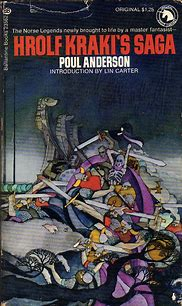
Thus, War Of The Gods, about Hadding, precedes Anderson's Hrolf Kraki's Saga.
"Great and rich was the Thraandlaw, a home for heroes. Hither had come Hadding from the South, to fell a giant, and win a king's daughter. Hence had gone Bjarki to the South, he who became the right hand of Hrolf Kraki."
-Poul Anderson, Mother Of Kings (New York, 2003), Book Two, Chapter XXII, p. 184.
Thus, Mother Of Kings, about Gunnhild, comes third.
"'It's said he fathered Gunnhild, the queen of King Eirik Blood-ax -'
"Skafloc gripped the tiller hard. 'The witch-queen?'
"Mananaan nodded. 'Yes...'"
-Poul Anderson & Mildred Downey Broxon, The Demon Of Scattery (New York, 1980), p. 193.
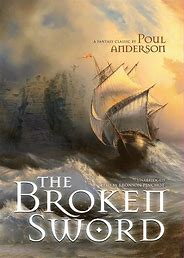
Skafloc and Mananaan converse in the untitled Prologue and Epilogue of The Demon Of Scattery during their voyage to Jotunheim described in The Broken Sword. Thus, The Broken Sword and The Demon Of Scattery are, chronologically, the fourth and fifth volumes of this sequence although everything in ...Scattery between Prologue and Epilogue is an extended flashback.
Mananaan's father, Lir, was a God of the City of Ys and Skafloc sees:
"...the drowned tower of Ys..."
-Poul Anderson, The Broken Sword (London, 1977), Chapter V, p. 31.
Thus, Poul and Karen Anderson's four-volume The King Of Ys precedes The Broken Sword and, indeed, since it features the decline of the Roman Empire, is set several centuries before Mother Of Kings and about a century before Hrolf Kraki's Saga.
The title character of Anderson's The Last Viking Trilogy is Eirik Blood-Ax's father's great-great-grandson, Harald Hardrada, who refers somewhere in the Trilogy to Gunnhild and falls in battle in 1066.
Skafloc also saw:
"...the sea maidens tumbling in the sea and singing..." (ibid.)
Christian priests drive the last merpeople from Europe in the fourteenth century in Anderson's The Merman's Children.
One long literary sequence alternating between historical fiction, historical fantasy and heroic fantasy.
Showing posts sorted by relevance for query Hrolf Kraki. Sort by date Show all posts
Friday, 30 October 2015
Sunday, 23 September 2012
Literary Styles
Poul Anderson's The Broken Sword (London, 1977; original publication, 1954) begins and ends in the style of a saga:
"There was a man called Orm the Strong, a son of Ketil Asmundsson who was a yeoman in the north of Jutland." (p. 15)
"Here ends the sage of Skafloc Elven-Fosterling." (p. 208)
His Hrolf Kraki's Saga (New York, 1973) begins and ends in the same style:
"There was a man called Eyvind the Red, who dwelt in the Danelaw of England while Aethelstan was king. His father was Svein Kolbeinsson, who had come there from Denmark..." (p. 3)
"Here ends the saga of Hrolf Kraki and his warriors." (p. 261)
Chapter I of his War Of The Gods (New York, 1999) begins with the subject matter of an Edda:
"The gods themselves fought the first war that ever was." (p. 9)
However, its human action begins, in Chapter II, in the style of a novel:
"Up into the hills that rise north of the Scania lowlands came a small troop riding." (p. 15)
Let us compare the three texts so far. In The Broken Sword, Hrolf Kraki's Saga and War Of The Gods, Chapter I, a narrator directly addresses the reader and starts his story at the beginning. The gods are close to the beginning of all things and here they begin war, an important social institution for the Vikings. Neither Orm nor Eyvind will turn out to be our hero. Orm is Skafloc's father. Eyvind's Danish wife will recount Hrolf Kraki's Saga. These are the things that we need to be told first.
By contrast, War Of The Gods, like Paradise Lost after its opening invocation, "plunges into the midst of things" (in media res). We have yet to learn who the "...small troop..." are. We soon learn that this troop, en route to visit a giant, guards the two sons of a recently slain king. Thus, we learn what is going on while it is going on. Major events, including a battle, have already occurred but one of the characters soon recounts this to another and thus to the reader.
In accordance with the conventions of a novel, we expect the narrative, even if it is in the third person, to be presented from the point of view of a single one of its protagonists. The likeliest candidate is Braki Halldorsson, who fares at the head of the troop. Our expectation is only partly fulfilled. Certainly, we do not hear the voice of a distanced story-teller informing us equally about all of the characters and events. On the other hand, the point of view remains collective:
"...uneasiness was upon them." (p. 16)
"...Braki and his following...sat down, feeling bolder than before." (p. 19)
"Braki's followers loosened their grip on their weapons. Things were going as he had promised them." (p. 18)
Thus, when, after this third quotation, the text relates:
"Once this giant had murderously raided farms..." (p. 18)
it is telling us what Braki's followers knew and could reflect on as they relaxed while his earlier promise to them was fulfilled. This is different from a literary style in which the narrator or story-teller simply recounts the giant's deeds directly to the reader.
In War Of The Gods, the human story ends with the hero's followers finding his body. There is no conclusion in which we could be told about the succession or subsequent events. The novel as a whole ends in novelistic style with dialogue when Njord of the Vanir tells Odin of the Aesir:
" '...from this day to the last, we are brothers.' " (p. 298)
"There was a man called Orm the Strong, a son of Ketil Asmundsson who was a yeoman in the north of Jutland." (p. 15)
"Here ends the sage of Skafloc Elven-Fosterling." (p. 208)
His Hrolf Kraki's Saga (New York, 1973) begins and ends in the same style:
"There was a man called Eyvind the Red, who dwelt in the Danelaw of England while Aethelstan was king. His father was Svein Kolbeinsson, who had come there from Denmark..." (p. 3)
"Here ends the saga of Hrolf Kraki and his warriors." (p. 261)
Chapter I of his War Of The Gods (New York, 1999) begins with the subject matter of an Edda:
"The gods themselves fought the first war that ever was." (p. 9)
However, its human action begins, in Chapter II, in the style of a novel:
"Up into the hills that rise north of the Scania lowlands came a small troop riding." (p. 15)
Let us compare the three texts so far. In The Broken Sword, Hrolf Kraki's Saga and War Of The Gods, Chapter I, a narrator directly addresses the reader and starts his story at the beginning. The gods are close to the beginning of all things and here they begin war, an important social institution for the Vikings. Neither Orm nor Eyvind will turn out to be our hero. Orm is Skafloc's father. Eyvind's Danish wife will recount Hrolf Kraki's Saga. These are the things that we need to be told first.
By contrast, War Of The Gods, like Paradise Lost after its opening invocation, "plunges into the midst of things" (in media res). We have yet to learn who the "...small troop..." are. We soon learn that this troop, en route to visit a giant, guards the two sons of a recently slain king. Thus, we learn what is going on while it is going on. Major events, including a battle, have already occurred but one of the characters soon recounts this to another and thus to the reader.
In accordance with the conventions of a novel, we expect the narrative, even if it is in the third person, to be presented from the point of view of a single one of its protagonists. The likeliest candidate is Braki Halldorsson, who fares at the head of the troop. Our expectation is only partly fulfilled. Certainly, we do not hear the voice of a distanced story-teller informing us equally about all of the characters and events. On the other hand, the point of view remains collective:
"...uneasiness was upon them." (p. 16)
"...Braki and his following...sat down, feeling bolder than before." (p. 19)
"Braki's followers loosened their grip on their weapons. Things were going as he had promised them." (p. 18)
Thus, when, after this third quotation, the text relates:
"Once this giant had murderously raided farms..." (p. 18)
it is telling us what Braki's followers knew and could reflect on as they relaxed while his earlier promise to them was fulfilled. This is different from a literary style in which the narrator or story-teller simply recounts the giant's deeds directly to the reader.
In War Of The Gods, the human story ends with the hero's followers finding his body. There is no conclusion in which we could be told about the succession or subsequent events. The novel as a whole ends in novelistic style with dialogue when Njord of the Vanir tells Odin of the Aesir:
" '...from this day to the last, we are brothers.' " (p. 298)
Sunday, 24 April 2022
Two Frodis
War Of The Gods.
Apparently, Saxo Grammaticus wrongly identified Hrolf Kraki's great-uncle Frodi with Hadding's son of the same name. Thus:
"Saxo places Hadding three generations before Hrolf Kraki." (Afterword, p. 301)
If we accepted Saxo's chronology, then we would read Poul Anderson's War Of The Gods (1997) before his Hrolf Kraki's Saga (1973). However, the latter reads like what it is, a retold saga, whereas the former reads more like a modern, although not of course contemporary, novel.
For more on chronological links between Poul Anderson's works of historical fiction and historical fantasy, see:
I have to refer to these posts to remember what all the links were.
Wednesday, 8 June 2016
Grallon, Hadding And Hrolf
Maybe, in light of the previous post, a rereading of Poul and Karen Anderson's story of Grallon should be followed by a rereading of Anderson's stories of Hadding and Hrolf Kraki?
Here are some relevant data -
"...Hrolf flourished...when Rome had gone under..."
-Poul Anderson, Hrolf Kraki's Saga (Ballantine Books, New York, 1973), p. xviii.
"He became to the North what Arthur did to Britain and Charlemagne, later, to France." (ibid.)
Hrolf Kraki's Saga and Beowulf "...include a number of the same people...," (p. xvii), including Beowulf.
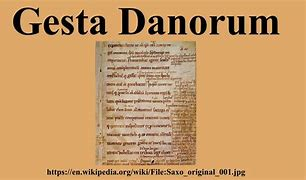
The Gesta Danorum of Saxo "...includes the oldest extant account of Hamlet [and] tells the story of Hrolf." (p. xviii)
Saxo (wrongly) identifies Hadding's son Frodi with Hrolf's great-uncle of the same name.
-Poul Anderson, War Of The Gods (Tor Books, New York, 1999), p. 301.
How many names to conjure with?
The stories of Grallon, Hadding and Hrolf are of the fourth, fifth and sixth centuries. Next, Anderson has six volumes set in the tenth and eleventh centuries, then three in the fourteenth.
Here are some relevant data -
"...Hrolf flourished...when Rome had gone under..."
-Poul Anderson, Hrolf Kraki's Saga (Ballantine Books, New York, 1973), p. xviii.
"He became to the North what Arthur did to Britain and Charlemagne, later, to France." (ibid.)
Hrolf Kraki's Saga and Beowulf "...include a number of the same people...," (p. xvii), including Beowulf.
The Gesta Danorum of Saxo "...includes the oldest extant account of Hamlet [and] tells the story of Hrolf." (p. xviii)
Saxo (wrongly) identifies Hadding's son Frodi with Hrolf's great-uncle of the same name.
-Poul Anderson, War Of The Gods (Tor Books, New York, 1999), p. 301.
How many names to conjure with?
The stories of Grallon, Hadding and Hrolf are of the fourth, fifth and sixth centuries. Next, Anderson has six volumes set in the tenth and eleventh centuries, then three in the fourteenth.
Wednesday, 15 June 2016
Krakis And Anachronisms
"...a kraki [was] a fir trunk whose stubbed-off limbs made a kind of ladder."
-Poul Anderson, Hrolf Kraki's Saga (New York, 1973), p. 17.
Is our hero named after a ladder or is the similarity between these words accidental? At this stage of the narrative, Hrolf is still two generations in the future.
Elsewhere, Poul Anderson gives us dates for the viking period:
"The period lasted some three hundred years. The first recorded raids on England and Ireland took place in the late eighth century."
-Poul Anderson, "THE NORSE" IN Poul Anderson & Mildred Downey Broxon, The Demon Of Scattery (ACE Books, New York, 1980), pp. 200-207 AT p. 200.
"The last Norse attack on Ireland was by King Magnus Barefoot who fell there in 1103." (ibid., p. 207)
It follows that Anderson's War Of The Gods and Hrolf Kraki's Saga, which place vikings in the third and fourth centuries, are anachronistic. Following his sources, Anderson writes heroic fantasy, not historical fantasy. In his Afterword to War..., Anderson writes that the background of the story:
"...is frankly anachronistic - not the Germanic Iron Age, in which the story ostensibly takes place, but the viking era. Societies, technologies, horizons, and doings belong, in an ahistoric fashion, to the ninth or tenth century, as they do in Saxo."
-Poul Anderson, War Of The Gods (New York, 1999), p. 302.
"'Shall I go in viking?'" (War..., p. 267)
"...Haven was a base for warcraft which lay out on watch lest vikings slip by to harry the Danish coasts." (...Saga, p. 23)
Thus, Anderson has eight Viking volumes, the first two anachronistic:
War Of The Gods
Hrolf Kraki's Saga
The Demon Of Scattery
Mother Of Kings
The Broken Sword
The Last Viking (3 volumes)
The title character of The Last Viking, Harald Hardrada, died in the fateful year of 1066. Our British monarchy is descended from William of Normandy, not from Hardrada. The eight volumes are a mixture of heroic fantasy, historical fantasy and historical fiction. Hardrada is a historical figure and Anderson's trilogy about him is historical fiction.
-Poul Anderson, Hrolf Kraki's Saga (New York, 1973), p. 17.
Is our hero named after a ladder or is the similarity between these words accidental? At this stage of the narrative, Hrolf is still two generations in the future.
Elsewhere, Poul Anderson gives us dates for the viking period:
"The period lasted some three hundred years. The first recorded raids on England and Ireland took place in the late eighth century."
-Poul Anderson, "THE NORSE" IN Poul Anderson & Mildred Downey Broxon, The Demon Of Scattery (ACE Books, New York, 1980), pp. 200-207 AT p. 200.
"The last Norse attack on Ireland was by King Magnus Barefoot who fell there in 1103." (ibid., p. 207)
It follows that Anderson's War Of The Gods and Hrolf Kraki's Saga, which place vikings in the third and fourth centuries, are anachronistic. Following his sources, Anderson writes heroic fantasy, not historical fantasy. In his Afterword to War..., Anderson writes that the background of the story:
"...is frankly anachronistic - not the Germanic Iron Age, in which the story ostensibly takes place, but the viking era. Societies, technologies, horizons, and doings belong, in an ahistoric fashion, to the ninth or tenth century, as they do in Saxo."
-Poul Anderson, War Of The Gods (New York, 1999), p. 302.
"'Shall I go in viking?'" (War..., p. 267)
"...Haven was a base for warcraft which lay out on watch lest vikings slip by to harry the Danish coasts." (...Saga, p. 23)
Thus, Anderson has eight Viking volumes, the first two anachronistic:
War Of The Gods
Hrolf Kraki's Saga
The Demon Of Scattery
Mother Of Kings
The Broken Sword
The Last Viking (3 volumes)
The title character of The Last Viking, Harald Hardrada, died in the fateful year of 1066. Our British monarchy is descended from William of Normandy, not from Hardrada. The eight volumes are a mixture of heroic fantasy, historical fantasy and historical fiction. Hardrada is a historical figure and Anderson's trilogy about him is historical fiction.
Saturday, 22 September 2012
Hrolf And Hadding
King Hadding of Denmark had a son called Frodi;
Hrolf Kraki, the hero of a saga, had a great-uncle called Frodi;
Saxo Grammaticus identified the Frodis;
Poul Anderson thought that this identification was mistaken;
Anderson retold Hrolf Kraki's Saga in 1973;
twenty four years later, he retold the story of Hadding as War Of The Gods.
In terms of Anderson's development as a writer, War Of The Gods is clearly a much later work - and I think better written although I have yet to reread Hrolf Kraki's Saga. For the purpose of arranging Anderson's heroic fantasies into a sequential reading order, it makes sense, even if we do not accept the identification of the Frodis, to go with Saxo's chronology for Hrolf and Hadding and thus to place Saga before War.
Both Hrolf and Hadding are Skjoldungs so it makes sense to know which came first. I expect to know more after rereading both books.
Wednesday, 26 September 2012
Magic Swords
Sighurd's Gram;
"...Tyrfing the accursed...";
Skofnung, given to Hrolf by an elven woman;
Lovi, of which more will be told later in the Saga (p. 129).
Magic swords never rust and always bite although Excalibur is not listed here.
Poul and Karen Anderson wrote a King of Ys tetralogy;
The Broken Sword refers to Ys;
The Demon Of Scattery refers to The Broken Sword;
War Of The Gods, like The Broken Sword, features Odin;
Hrolf Kraki's Saga, like War Of The Gods, describes Odin's descendants;
Hrolf Kraki's Saga refers to the broken sword.
Thus, here are eight connected volumes: four by Anderson; four by the Andersons.
Monday, 24 September 2012
Ravens II
When reading Poul Anderson's War Of The Gods, I noted that the sail of the Danish King Hadding's ship bore the emblem of a raven which is also the symbol of Odin. This is explained in Anderson's earlier work Hrolf Kraki's Saga (New York, 1973) where a later Danish king also has "...raven sail unfurled..." (p. 54) War... tells us that the Danish kings were Skjoldungs, but the Saga adds that their ancestor, Skjold, was believed to be a son of Odin.
War Of The Gods explains a phrase used in the Saga. The Danish kings' enemies have reason to fear not only "...a raven banner..." but also "...a host in the swine-array of battle..." (p. 62). The swine-array, taught by Gangleri/Odin to Hadding, is a wedge shaped formation so named because it rips through an unprepared host like a boar's tusks.
In Hrolf Kraki's Saga, Chapter II, "The Tale of Frodhi," the usurper Frodhi is overthrown by his nephews Hroar and Helgi. In Chapter III, "The Tale of the Brothers," Helgi, reigning jointly with his brother, begets Yrsa who, according to the family tree at the beginning of the book, will become the mother of the title character, Hrolf Kraki. Thus, although Hrolf is not yet on stage, Chapter II (of VIII) has brought him significantly closer. However, as Anderson says in the Foreword, the real hero of the saga is Skjold's line of descent, not any single Skjoldung.
Saturday, 25 June 2016
Interweaving Strands or Everything Comes Together
Poul Anderson, Hrolf Karki's Saga (New York, 1973).
The title tells us that Hrolf will acquire the name "Kraki." (p. iii)
The contents page tells us to expect a character called Vogg. (p. vii)
Part II tells us that "...a kraki..." is "...a fir trunk whose stubbed-off limbs made a kind of ladder." (p. 17)
On pp. 206-207, Yrsa introduces a servant called Vogg to King Hrolf.
On p. 207, Vogg compares the thin Hrolf to a kraki and the King's men accept this humorous nickname for their lord. Hrolf comments:
"'You've given me a name which may well stick to me.'" (p. 207)
This completes the origin story of Hrolf Kraki. We began to wonder about this a week ago. See here.
The title tells us that Hrolf will acquire the name "Kraki." (p. iii)
The contents page tells us to expect a character called Vogg. (p. vii)
Part II tells us that "...a kraki..." is "...a fir trunk whose stubbed-off limbs made a kind of ladder." (p. 17)
On pp. 206-207, Yrsa introduces a servant called Vogg to King Hrolf.
On p. 207, Vogg compares the thin Hrolf to a kraki and the King's men accept this humorous nickname for their lord. Hrolf comments:
"'You've given me a name which may well stick to me.'" (p. 207)
This completes the origin story of Hrolf Kraki. We began to wonder about this a week ago. See here.
Thursday, 16 June 2016
Dark Ages
Poul Anderson acknowledges (see here) that War Of The Gods is anachronistic because it puts vikings into the fourth century - as does Hrolf Kraki's Saga. However, in another respect, ...Saga is authentic:
"Hrolf Kraki lived in the midnight of the Dark Ages. Slaughter, slavery, robbery, rape, torture, heathen rites bloody or obscene, were parts of daily life."
-Poul Anderson, Hrolf Kraki's Saga (New York, 1973), p. xix.
Loyalty was to kin, chief and friends. Everyone else was foe or prey.
"To us, their behavior seems insanely egoistic..." (p. xx)
Anderson refused to sentimentalize the characters:
"If nothing else, we today need a reminder that we must never take civilization for granted." (pp. xix-xx)
Anderson, also a science fiction writer, had another way to remind us of this. His Psychotechnic future history has a Second and a Third Dark Ages while his History of Technic Civilization has a Time of Troubles and a Long Night. Anderson refers to "...the midnight of the Dark Ages..." (above) and to a future Long Night. In such an age, we will not be able to do what we are doing now: write or read a blog over breakfast.
"Hrolf Kraki lived in the midnight of the Dark Ages. Slaughter, slavery, robbery, rape, torture, heathen rites bloody or obscene, were parts of daily life."
-Poul Anderson, Hrolf Kraki's Saga (New York, 1973), p. xix.
Loyalty was to kin, chief and friends. Everyone else was foe or prey.
"To us, their behavior seems insanely egoistic..." (p. xx)
Anderson refused to sentimentalize the characters:
"If nothing else, we today need a reminder that we must never take civilization for granted." (pp. xix-xx)
Anderson, also a science fiction writer, had another way to remind us of this. His Psychotechnic future history has a Second and a Third Dark Ages while his History of Technic Civilization has a Time of Troubles and a Long Night. Anderson refers to "...the midnight of the Dark Ages..." (above) and to a future Long Night. In such an age, we will not be able to do what we are doing now: write or read a blog over breakfast.
Friday, 17 June 2016
Beowulf In Hrolf Kraki's Saga
Staying with the theme of the previous post, advertisements for the film Gods Of Egypt proclaim that "The Battle for Eternity begins!" A Battle for Eternity! What can possibly follow that?
I have reread Poul Anderson's Hrolf Kraki's Saga to the point where it suddenly hits us that the Hroar whom I have been praising is that king whose splendid hall was terrorized by the monster Grendel who was then killed by the hero Beowulf. However, I find that I have posted on this "Unexpected Crossover" before.
Beowulf is Hroar's brother-in-law, the son of that father-in-law, Aegthjof, whom Hroar had helped. See here. Thus, when Aegthjof says:
"'I hope I or child of mine may someday do the like for you.'" (Hrolf Kraki's Saga, p. 59) -
- this hope prefigures the story of Beowulf. Helgi is away, therefore cannot deal with Grendel, but "...Bjovulf of Gotaland, the man that in England they call Beowulf..." (p. 65) comes instead. Beowulf is summarized on pp. 65-66.
I have reread Poul Anderson's Hrolf Kraki's Saga to the point where it suddenly hits us that the Hroar whom I have been praising is that king whose splendid hall was terrorized by the monster Grendel who was then killed by the hero Beowulf. However, I find that I have posted on this "Unexpected Crossover" before.
Beowulf is Hroar's brother-in-law, the son of that father-in-law, Aegthjof, whom Hroar had helped. See here. Thus, when Aegthjof says:
"'I hope I or child of mine may someday do the like for you.'" (Hrolf Kraki's Saga, p. 59) -
- this hope prefigures the story of Beowulf. Helgi is away, therefore cannot deal with Grendel, but "...Bjovulf of Gotaland, the man that in England they call Beowulf..." (p. 65) comes instead. Beowulf is summarized on pp. 65-66.
Tuesday, 17 November 2015
The Viking Era
Poul Anderson, "THE NORSE" IN Poul Anderson & Mildred Downey Broxon, The Demon Of Scattery (New York, 1980), pp. 200-207.
(The title page of this edition says "SF ace books," which is inaccurate.)
According to Anderson's historical note:
The "Vikings" were not a people and the word should not be capitalized. The earliest recorded viking raids on England and Ireland occurred in the late eighth century. (Thus, Hrolf Kraki, in the mid-sixth century, was much earlier. See "The History of Hrolf Kraki: a Foreword by Poul Anderson" IN Poul Anderson, Hrolf Kraki's Saga (New York, 1973), pp. xvii-xxi AT p. xviii.)
The viking period lasted for about three centuries:
England, Ireland, France, Germany and the Low Countries were attacked repeatedly;
in 845, Paris and Hamburg were captured;
at least one expedition plundered in the Mediterranean;
Finns, Lapps and Balts were attacked but had no one to record it;
the attackers were from Scandinavia or from their colonies, including Iceland;
the probable causes were population pressure, ambition and greed;
some bands would sow, go in viking and return for harvest;
"viking" is probably derived from "...'vik,' meaning a narrow bay..." (p. 202), because raiders would wait in such a bay to attack passing cargo ships;
"viking" rhymed with "seeking";
kings and jarls discouraged such attacks at home but did not object to attacks on foreign countries;
some huge fleets wintered abroad, then colonized in England, Ireland, Normandy etc.
(The title page of this edition says "SF ace books," which is inaccurate.)
According to Anderson's historical note:
The "Vikings" were not a people and the word should not be capitalized. The earliest recorded viking raids on England and Ireland occurred in the late eighth century. (Thus, Hrolf Kraki, in the mid-sixth century, was much earlier. See "The History of Hrolf Kraki: a Foreword by Poul Anderson" IN Poul Anderson, Hrolf Kraki's Saga (New York, 1973), pp. xvii-xxi AT p. xviii.)
The viking period lasted for about three centuries:
England, Ireland, France, Germany and the Low Countries were attacked repeatedly;
in 845, Paris and Hamburg were captured;
at least one expedition plundered in the Mediterranean;
Finns, Lapps and Balts were attacked but had no one to record it;
the attackers were from Scandinavia or from their colonies, including Iceland;
the probable causes were population pressure, ambition and greed;
some bands would sow, go in viking and return for harvest;
"viking" is probably derived from "...'vik,' meaning a narrow bay..." (p. 202), because raiders would wait in such a bay to attack passing cargo ships;
"viking" rhymed with "seeking";
kings and jarls discouraged such attacks at home but did not object to attacks on foreign countries;
some huge fleets wintered abroad, then colonized in England, Ireland, Normandy etc.
Monday, 24 September 2012
An Unexpected Crossover
According to Geoffrey of Monmouth, King Arthur Pendragon of Britain conquered Ireland. According to Irish mythology, the hero Fionn MacCuhaill defeated an invasion by Arthur, son of Britt. Thus, Arthur "crosses over" from British to Irish mythology, like Superman appearing in a Captain Marvel comic. Alan Moore colourfully explains the concept of comic book crossovers:
"For those more familiar with conventional literature, try to imagine Dr Frankenstein kidnapping one of the protagonists of Little Women for his medical experiments, only to find himself subject to the scrutiny of a team-up between Sherlock Holmes and Hercule Poirot." (1)
Moore himself wrote a comic book script in which Jules Vernes' Nautilus fights HG Wells' Martians in the Thames.
Poul Anderson, faithfully following his sources for Hrolf Kraki's Saga (New York, 1973), presents us with a mythological crossover before we have realised that it is happening. When he has got us used to the idea that the brothers Hroar and Helgi jointly ruled as kings in Denmark, he tells us that Hroar erected a hall of which "...men said no goodlier home had been in the North since Odin dwelt on earth." (p. 64) Because of "...mighty antlers..." on its beam-ends, the hall was called Hart, which meant nothing to me when I read it. (p. 64)
Next, however, a monster hight Grendel terrorises the hall until stopped by "...Bjovulf of Gotaland, the man that in England they call Beowulf." (p. 65) Then we realise that, with a change of vowels, "Hart" becomes "Heorot." Google confirms that Hroogar (who must be Hroar) was lord in Heorot which means "Hall of the Hart." The google article even begins, "It has been suggested that Beowulf and Hrolf Kraki be merged into this article or section. Discuss."
Suddenly, Hrolf Kraki, of whom I had not heard except in this book by Anderson, assumes a greater significance. The story of Beowulf is summarized on pages 65 and 66 of the Saga.
(1) Moore Alan, Introduction IN Alan Moore, Stephen Bissette, John Totleben, Saga Of The Swamp Thing, New York, 1987, pp. v-ix AT p. vii.
Sunday, 26 June 2016
Old Times
On the eve of their last battle, Hrolf Kraki's men "...talked of olden days..." (Hrolf Kraki's Saga, p. 245)
After the battle:
"Nothing but a tale was left of a day which had been.
"Here ends the saga of Hrolf Kraki and his warriors." (p. 261)
After the Roman Empire:
"...among the memories is that there was, for a while, a life not given over entirely to naked survival." (Time Patrol, p. 604)
"The Bronze Age, the new age was coming...
"In the end it would go down, before the cruel age of iron. Yet a thousand fortunate years were no small achievement; and the spirit they brought to birth would endure. Through every century to come, the forgotten truth that men had once known generations of gladness must abide and subtly work."
-Poul Anderson, The Corridors Of Time (Frogmore, St Albans, Herts, 1968), p. 204.
"'It was in Britain after the Romans were gone, at the court of a warlord...he staved off the English invaders. His name was Artorius.'"
-Poul Anderson, The Boat Of A Million Years (London, 1991), p. 229.
After the Terran Empire:
"...a man from Atheia, which was supposed to have retained or regained almost as many amenities as Old Earth knew in its glory..." (Flandry's Legacy, p. 665)
For the good times...
After the battle:
"Nothing but a tale was left of a day which had been.
"Here ends the saga of Hrolf Kraki and his warriors." (p. 261)
After the Roman Empire:
"...among the memories is that there was, for a while, a life not given over entirely to naked survival." (Time Patrol, p. 604)
"The Bronze Age, the new age was coming...
"In the end it would go down, before the cruel age of iron. Yet a thousand fortunate years were no small achievement; and the spirit they brought to birth would endure. Through every century to come, the forgotten truth that men had once known generations of gladness must abide and subtly work."
-Poul Anderson, The Corridors Of Time (Frogmore, St Albans, Herts, 1968), p. 204.
"'It was in Britain after the Romans were gone, at the court of a warlord...he staved off the English invaders. His name was Artorius.'"
-Poul Anderson, The Boat Of A Million Years (London, 1991), p. 229.
After the Terran Empire:
"...a man from Atheia, which was supposed to have retained or regained almost as many amenities as Old Earth knew in its glory..." (Flandry's Legacy, p. 665)
For the good times...
Wednesday, 8 June 2016
Hloch And Saxo
Tariat, Wyvan of Stormgate Choth on Avalon, asked Hloch to compile The Earth Book Of Stormgate, which is a major part of Volumes I-III of Poul Anderson's History of Technic Civilization. Archbishop Absalon asked Saxo to write Gesta Danorum, which is the only source for Anderson's War Of The Gods.
To compare some legendary, historical and fictional dates -
Grallon, former King of Ys, became Duke of Armorica in 407.
Grallon's successor, King Salaun, reigned 421-435.
The source of the Arthurian legend was in the mid-400's, 450-455. See combox here.
The reign of the last Western Roman Emperor ended in 476. See here.
"Saxo places Hadding three generations before Hrolf Kraki."
-War Of The Gods (New York, 1999), p. 301.
Anderson dates Hrolf Kraki twenty or thirty years after 512-520.
-Hrolf Kraki's Saga (New York, 1973), p. xviii.
To compare some legendary, historical and fictional dates -
Grallon, former King of Ys, became Duke of Armorica in 407.
Grallon's successor, King Salaun, reigned 421-435.
The source of the Arthurian legend was in the mid-400's, 450-455. See combox here.
The reign of the last Western Roman Emperor ended in 476. See here.
"Saxo places Hadding three generations before Hrolf Kraki."
-War Of The Gods (New York, 1999), p. 301.
Anderson dates Hrolf Kraki twenty or thirty years after 512-520.
-Hrolf Kraki's Saga (New York, 1973), p. xviii.
Friday, 28 September 2012
Hrolf And His Warriors
Appropriately, Poul Anderson's Hrolf Kraki's Saga (New York, 1973) ends:
"Here ends the saga of Hrolf Kraki and his warriors." (p. 261)
- because the novel is not just about its title character. He is born at the mid-point of Chapter III, becomes King aged 16 in Chapter IV and dies in battle at the end of Chapter VII. Thus, he is King of Denmark, though even then not the central character of the novel, in just four of the eight chapters.
After the short explanatory Chapter I, "Of The Telling," each chapter is entitled "The Tale Of..." followed by a name or, in one case, a description. Chapter III is "...Of The Brothers." The names are Frodhi, Svipdag, Bjarki, Yrsa, Skuld and Vogg. The soap-operatic relationships between these characters define the episodic plot, reconstructed by Anderson from diverse sources:
Frodhi overthrew his brother Halfdan but was in turn overthrown by Halfdan's sons, Hroar and Helgi (the "Brothers"), who then ruled jointly;
when Helgi, then Hroar, had died, they were succeeded by Hroar's son, Hrorik, who however was overthrown in favour of Helgi's and Yrsa's son, Hrolf, whose warriors Svipdag and Bjarki married his daughters;
by witchcraft, Skuld, Helgi's daughter, enabled her husband to defeat Hrolf who, however, was immediately avenged by Vogg;
a further relationship is that Yrsa was Helgi's daughter although they had married and had a son before their close kinship was disclosed.
Thus, Helgi is kind of the unifying character:
Halfdan's son;
Hroar's brother;
Frodhi's nephew;
Yrsa's father;
for a time, Yrsa's husband;
Hrolf's father;
Skuld's father.
"Here ends the saga of Hrolf Kraki and his warriors." (p. 261)
- because the novel is not just about its title character. He is born at the mid-point of Chapter III, becomes King aged 16 in Chapter IV and dies in battle at the end of Chapter VII. Thus, he is King of Denmark, though even then not the central character of the novel, in just four of the eight chapters.
After the short explanatory Chapter I, "Of The Telling," each chapter is entitled "The Tale Of..." followed by a name or, in one case, a description. Chapter III is "...Of The Brothers." The names are Frodhi, Svipdag, Bjarki, Yrsa, Skuld and Vogg. The soap-operatic relationships between these characters define the episodic plot, reconstructed by Anderson from diverse sources:
Frodhi overthrew his brother Halfdan but was in turn overthrown by Halfdan's sons, Hroar and Helgi (the "Brothers"), who then ruled jointly;
when Helgi, then Hroar, had died, they were succeeded by Hroar's son, Hrorik, who however was overthrown in favour of Helgi's and Yrsa's son, Hrolf, whose warriors Svipdag and Bjarki married his daughters;
by witchcraft, Skuld, Helgi's daughter, enabled her husband to defeat Hrolf who, however, was immediately avenged by Vogg;
a further relationship is that Yrsa was Helgi's daughter although they had married and had a son before their close kinship was disclosed.
Thus, Helgi is kind of the unifying character:
Halfdan's son;
Hroar's brother;
Frodhi's nephew;
Yrsa's father;
for a time, Yrsa's husband;
Hrolf's father;
Skuld's father.
Saturday, 18 June 2016
Historical Names And Dates
Poul Anderson, Hrolf Kraki's Saga (New York,, 1973), pp. xvii-xviii; pp. 74-75.
Anderson's Foreword and his text converge. Some time between 512 and 520 AD, the Gota-King Hugleik fell in battle against the Franks. One of the few Gota to escape from the Franks was Bjovulf/Beowulf. Returning home, he declined the kingship but guided the kingdom. This happened shortly after Hrolf's birth.
"Thus Hrolf flourished two or three decades later." (p. xviii)
Hugleik, Beowulf and Hrolf are historical.
And:
"Saxo places Hadding three generations before Hrolf Kraki."
-Poul Anderson, War Of The Gods (New York, 1999), p. 301.
Hrolf's saga is dated to the mid-sixth century. If we call that 550 and a generation twenty years, then Hadding is dated about 490. However:
"...the tale of Hadding is not properly even a legend. It is a myth." (ibid.)
Since one scholar identified King Hadding with the god Njord, Anderson novelized Hadding as an incarnation of Njord. Anderson's tale of Hadding begins not in the late fifth century but with "...the first war there ever was..." (p. 9) - between the gods.
Anderson's Foreword and his text converge. Some time between 512 and 520 AD, the Gota-King Hugleik fell in battle against the Franks. One of the few Gota to escape from the Franks was Bjovulf/Beowulf. Returning home, he declined the kingship but guided the kingdom. This happened shortly after Hrolf's birth.
"Thus Hrolf flourished two or three decades later." (p. xviii)
Hugleik, Beowulf and Hrolf are historical.
And:
"Saxo places Hadding three generations before Hrolf Kraki."
-Poul Anderson, War Of The Gods (New York, 1999), p. 301.
Hrolf's saga is dated to the mid-sixth century. If we call that 550 and a generation twenty years, then Hadding is dated about 490. However:
"...the tale of Hadding is not properly even a legend. It is a myth." (ibid.)
Since one scholar identified King Hadding with the god Njord, Anderson novelized Hadding as an incarnation of Njord. Anderson's tale of Hadding begins not in the late fifth century but with "...the first war there ever was..." (p. 9) - between the gods.
Sunday, 19 June 2016
What Comes Next
I have reread Poul Anderson's Hrolf Kraki's Saga (New York, 1973) as far as pp. 74-75: Hrolf is born, Hugleik dies and Beowulf has another adventure. Now, in pp. 76-261, Hrolf must grow up, rule, acquire the name "Kraki," fight and die until:
"Here ends the saga of Hrolf Krali and his warriors." (p. 261)
We will be with Hrolf for quite a while yet. Although he is the title character of the saga/novel, Hrolf does not have a chapter named after him. The chapters are:
I. OF THE TELLING.
II. THE TALE OF FRODHI -
- which we have read -
III. THE TALE OF THE BROTHERS -
- which we are reading -
IV-VIII. THE TALE(S) OF SVIPDAG, BJARKI, YRSA, SKULD and VOGG.
We know Yrsa, Hrolf's mother. We see from the genealogy on p. xv that Skuld is Hrolf's half-aunt or something. No gods have appeared in the narrative yet but give them time. I am involved in family activities here...
"Here ends the saga of Hrolf Krali and his warriors." (p. 261)
We will be with Hrolf for quite a while yet. Although he is the title character of the saga/novel, Hrolf does not have a chapter named after him. The chapters are:
I. OF THE TELLING.
II. THE TALE OF FRODHI -
- which we have read -
III. THE TALE OF THE BROTHERS -
- which we are reading -
IV-VIII. THE TALE(S) OF SVIPDAG, BJARKI, YRSA, SKULD and VOGG.
We know Yrsa, Hrolf's mother. We see from the genealogy on p. xv that Skuld is Hrolf's half-aunt or something. No gods have appeared in the narrative yet but give them time. I am involved in family activities here...
Monday, 24 September 2012
How They Connect
The picture, taken from Wikipedia, shows Helgi and Yrsa who marry not knowing that they are father and daughter. Thus, the title character of the Saga is born perhaps sooner than expected in Chapter II which, according to the family tree in the beginning of the book, still deals with Skjoldungs two generations prior to Hrolf.
For me at least, the close connection with Beowulf came as a surprise as did something else. Of Helgi, we are told:
"Himself he poured water upon the boy and named him Hrolf." (p. 74)
I had not known that Pagan naming ceremonies involved pouring water on the baby. I do not think that modern Pagans do this but will ask.
Sunday, 26 June 2016
A Happy Ending Or A Good End
here.
Hrolf Kraki almost does manage to do both. His peaceful, prosperous reign of seven years would have been a happy ending if the narrative had ended then. But we know that a happy ending has to be followed by the character's death. The only question is how he will die. Hrolf, of course, makes a good end.
A legend is complete when it incorporates death:
"All our best and oldest legends recognize that time passes and that people grow old and die. The legend of Robin Hood would not be complete without the final blind arrow shot to determine the site of his grave. The Norse Legends would lose much of their power were it not for the knowledge of an eventual Ragnarok, as would the story of Davy Crockett without the existence of an Alamo...
"With Dark Knight, time has come to the Batman and the capstone that makes legends what they are has finally been fitted."
-Alan Moore, "The Mark of the Batman: An Introduction" IN Frank Miller with Klaus Janson and Lynn Varley, The Dark Knight Returns (London, 1986), pp. iv-vii AT p. vii.
A Ragnarok-like "last battle" awaits Hrolf.
Let us pause to list our names to conjure with:
Authors
Lord Macaulay
Poul Anderson
Alan Moore
Frank Miller
Characters
Horatius
Hrolf Kraki
Robin Hood
the Norse gods
Davy Crockett
the Batman
Another quiz question: where does Anderson mention Crockett?
Subscribe to:
Posts (Atom)