Showing posts sorted by relevance for query Everard's apartment. Sort by date Show all posts

Friday, 17 June 2022

Everard's Apartment

In The Shield Of Time, Guion twice visits Manse Everard in the latter's New York apartment and Wanda Tamberly twice telephones Everard in his apartment. Guion's second visit, in PART FIVE, is destined to be the last time that we see the apartment.

In The Guardians Of Time, Everard is alone in his apartment, then is visited respectively by Cynthia Denison and John Sandoval.

In "The Sorrow of Odin the Goth," Carl Farness twice visits Everard's apartment in 1980. In "The Year of the Ransom," Carlos Navarro once visits Everard's apartment.

Thus, ten scenes are set in the apartment.

1954 Everard alone
sometime between '54 and '60 Cynthia Denison, then John Sandoval
1980 Carl Farness twice
24 May 1987 Carlos Navarro
1987 Guion
1988 Tamberly phones
1990 Tamberly phones
1990 Guion 

Friday, 28 February 2014

Everard's Apartment II


See here.

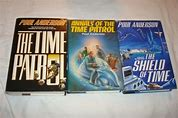
Poul Anderson, The Shield Of Time (New York, 1991).

In spring 1987, it has rained and scents of blossoms and green plants enter the open windows of Manson Everard's New York apartment. Everard mixes Scotch and soda at the bar for himself and one guest. (Scotch saved the universe in an earlier story!)

In 1988, Everard listens to Bach's St Mark Passion, recorded in Leipzig Cathedral on Good Friday 1731. Wanda, hearing it in the background when she rings Everard's unlisted number, realizes that he is not a "'...simple Garrison Keillor farmboy..." (p. 101). (I had to google "Garrison Keillor.")

In 1990, the little bar and the crossed spears and helmet are still in the apartment but the floor is bare. The rug had got scruffy and visitors had reproached him for it. His study's dummy computer conceals Patrol technology.

Later in 1990, there is lightning at night, matching Everard's mood. More Scotch and soda from the bar. Our last sight of Everard in the apartment is of him looking through an open window at wind and lightning.

We want to see more but Everard could not have stayed in that apartment indefinitely if the series had continued. In 2000, he would be officially seventy six and would have come to the end of the 1850-2000 Patrol milieu. So where-when next?

Wednesday, 23 September 2015

Everard's Apartment IV


See here.

How often do we see Manse Everard alone in his New York apartment? After returning from the Time Patrol Academy, he must read a dozen newspapers a day to look for indications of unauthorized time travel. What indications? He has been trained to spot them but we are not told what they are. Is unauthorized time travel that common? Or is he being given make-work until he initiates the sequence of events that will cause him to be promoted to Unattached status? He is alone and restless in his apartment when, instead of the newspapers, he reads the "...collection of Victorian and Edwardian stories..." (Time Patrol, p. 18) that does in fact generate his first job.

We learn that the apartment includes a study where a dummy computer conceals Patrol technology that seems to be voice-controlled:

"'Give me the file to present date on Specialist Wanda May Tamberly,' he ordered, adding sufficient information to identify." (The Shield Of Time, p. 177)

This passage presents nearly three pages of Everard alone in the apartment whereas usually when we see him there he is receiving a guest and, when that guest is Carl Farness, Carl narrates so that we cannot before or afterwards see Everard alone. By phone, Everard arranges to meet Wanda in San Francisco at three o'clock the following afternoon. Next day, he works till dusk in the apartment before going to city headquarters to check out a hopper and jump back in time to three o'clock in San Francisco. However, we are not told the nature of the work that kept him in his apartment into the evening.

Friday, 28 February 2014

Everard's Apartment


Poul Anderson, Time Patrol (New York, 2006).

Manson Everard lives in a New York apartment when, at the age of thirty, he is recruited into the Time Patrol in 1954 and still lives there when we last see him in 1990 but by then he is much older than sixty six because of all his time traveling. However, this affects neither his appearance nor his energy because he has benefited from the Patrol's longevity treatment.

From his window, he sees a crowded street though not "...the towers of Manhattan..." (p. 17). The apartment has a bookshelf (p. 18) and a bar (p. 55). Above the latter:

"He had hung two crossed spears and a horse-plumed helmet from the Achaean Bronze Age..." (ibid.)

On the floor is "...the polar bear rug, which Bjarni Herjulfsson had once given to Everard..." (pp. 129-130). Standing on this rug and looking out the apartment window, John Sandoval sees that:

"Towers were sharp against a clear sky; the noise of traffic was muted by height." (p. 130)

By 1980, there is dirt, disorder, danger and decay in New York but Everard needs a twentieth century pied-a-terre and "...had grown used to these lodgings..." (p. 352).

"On a high floor, [the apartment] was an oasis of quiet and cleanliness." (p. 353)

Bookshelf-lined walls, three excellent pictures, Bronze Age spears and a polar bear rug from tenth-century Greenland. A local saloon serves a free lunch in the 1890's.

Later in 1980, snow falls outside while Everard and his guest hear a recorded medieval Japanese koto (traditional stringed instrument) performance (p. 385).

On 24 May 1987, Everard sits "...in his shabby old armchair." (p. 726) The apartment is "...comfortable with souvenirs..." (ibid.), including:

" - Bronze Age helmet and spears above the bar, polar bear rug from Viking Age Greenland on the floor..." (ibid.)

Sunday, 26 July 2015

Through Time

Poul Anderson appropriately begins his Time Patrol series with an introductory short story, "Time Patrol," that alternates between several periods and locations:

a Time Patrol recruitment office in New York, 1954;
the Time Patrol Academy in the American Oligocene;
Everard's apartment in New York, 1954;
a warehouse in London, 1947;
Dalhousie & Roberts, Importers, the London Patrol office in 1894;
a London street scene in 1894;
a train, a sleepy village station and the Wyndham estate in 1894;
fifth century Britain and Canterbury (Cant-wara-Byrig);
London, 1944.

Everard's apartment becomes a base location with extra details added as the series progresses. When Everard returns from the Oligocene to 1954, he reads the headlines knowing in general what is to come next. Thus, he already knows the outlines of the second half of the twentieth century that Anderson and many of his readers then proceeded to live through although, of course, we do not read the name Gorbachev until a Time Patrol novel is published in 1990.

At the end of the story, Everard returns from 1944 to 1954:

"Everard climbed weakly aboard the hopper. And when he got off again, a decade had passed." (Time Patrol, p. 53)

The temporal vehicle, a literary descendant of Wells' Time Machine, is not yet called a "timecycle." We are made to feel that Everard has aged a decade because of his experiences in this story. The passage is subjectively instantaneous, unlike Wells', but nevertheless Everard seems to bear the weight of that ten years between '44 and '54.

Tuesday, 4 March 2014

Everard's Apartment III


See here.

Poul Anderson, The Shield Of Time (New York, 1991).

Manson Everard of the Time Patrol:

has a date with Wanda Tamberly in 1988;
then has two missions for the Patrol;
could have returned to 1988 after the first mission;
however, instead, sublet his apartment to another Patrol agent who needed such a base from 1988 to 1990;
returned to New York in 1990 after the second mission;
therefore, was in his apartment shortly after Wanda had phoned in 1990 but had not experienced as much duration as her since 1988.

It is meaningless to say that Everard sublet his apartment while he was on the two missions. Probably, the missions were in different historical periods and therefore were completed long before his birth. If not for the sublet, he would have returned to 1988 after the first mission and maybe to that same year after the second. In that case, an older Everard would have responded to Wanda's recorded telephone message in 1990.

When I say that their date was in 1988, I mean that she returned to her parents' home after the date in that year but they had had dinner in Paris in 1925.

"...the Rive Gauche..." (p. 180) is the Left Bank;
"...the Deux Magots..." (ibid.) is a famous cafe formerly frequented by many artists and intellectuals, more recently a tourist destination;
Everard mentions Wanda's and his "...Alphonse-Gastonette act..." (p. 181). I took this to be a reference to a couple in French literature. However, Alphonse and Gaston were two male cartoon characters in the New York Journal.

Tuesday, 25 August 2015

A Comprehensive Series

In Poul Anderson's Time Patrol series, we appreciate:

many passages set in fully realized historical or prehistorical periods;

past Patrol bases that become familiar locations;

comfortable twentieth century settings where Patrol agents can safely discuss the problems of the past;

a single passage set on the Moon in 2319;

hints at many other future periods;

glimpses of potential histories that remain unrealized but  nevertheless influence the Time Patrol timeline - in particular, Veleda does not change the Germanic religion but might have done.

Like one facet in a jewel, this series reflects the comprehensiveness of Anderson's fictional canon.

The main past bases are the Academy in the Oligocene and the Lodge in the Pleistocene. The many future periods include the Martian war of 3890, the Second Asteroid War and the Era of Oneness preceding the Danellians. Twentieth century locations include:

Everard's apartment with its polar bear rug and Achaean Bronze Age spears;
the Farness' flat overlooking Central Park in the 1930s;
a Caribbean restaurant in Amsterdam;
Nick's antiquarian bookshop;
Wanda's student apartment in Palo Alto with its shabby furniture and a National Wildlife Federation poster.

Manse and Wanda are in her apartment when the unsuspecting younger Wanda is away. I used to leave a one-room apartment empty at weekends in Merseyside. With a timecycle, I would now be able to make use of that room on all those weekends.

Wednesday, 28 March 2012

The Structure Of A Series: Poul Anderson

The Technic History (futuristic sf)

The Technic History series is elaborately constructed and “more than the sum of its parts.” (I did once read a series that was less than some of its parts.)

Beginnings:

“The Saturn Game” describes interplanetary exploration.
“Wings of Victory” and “The Problem of Pain” introduce Ythrians.
“Margin of Profit” and The Man Who Counts introduce Nicholas van Rijn.
“How To Be Ethnic In One Easy Lesson” introduces Adzel.
“The Three-Cornered Wheel” and “A Sun Invisible” introduce David Falkayn.

Thus, seven short stories and one novel introduce the series.

The Main Period:

Van Rijn features in “Hiding Place” and “Territory” and receives employees’ reports in “Esau” and “The Master Key."

Falkayn, Adzel and Chee Lan work for van Rijn in “The Trouble Twisters,” “Day of Burning,” Satan’s World, “Lodestar” and Mirkheim. “The Season of Forgiveness” and “A Little Knowledge” are two further League stories.

Thus, nine short stories and two novels continue and complete the series.

Sequels:

 Ythrians and Falkayn-led human beings share the planet Avalon in “Wingless” and “Rescue on Avalon.”

The Terran Empire is founded in “The Star Plunderer,” is described further in “Sargasso of Lost Starships,” fails to annex Avalon in The People Of The Wind and is defended by Dominic Flandry in several works.

The post-Imperial Long Night is described in two short stories and one novel.

The later Commonalty is described in one short story.

Thus, after all that time, there is a new beginning. That is quite some mega-series. This summary emphasizes the Polesotechnic, rather than the Imperial, period because my appreciation of the former has increased since re-reading its opening stories in the new Baen edition.

I think that there could be an easier way to collect the complete Technic History:

five stories and one novel about van Rijn could be collected in one volume;

three stories and two novels about Falkayn working for van Rijn could be collected in one volume;

eight other stories set before Avalonian colonization could be collected in one volume to be read before or alongside van Rijn and Falkayn;

one volume of four stories and one novel would cover the Avalon and early Empire period;

three volumes for the later Empire (four novels and one story in the first volume; seven stories of different lengths in the second; three novels in the third);

one volume of three stories and one novel would cover the post-Imperial period.

Total: eight volumes with easily demarcated contents.

Of this suggested sequence:

the first volume introduces Ythrians, League, Adzel and Falkayn;

the second introduces van Rijn;

the third introduces Falkayn and Adzel working for van Rijn;

the fourth starts with Falkayn’s grandson and Ythrians on Avalon and ends with the Imperial war on Avalon;

the remaining volumes cover the Empire and after.

The King of Ys (historical fantasy)

(with Karen Anderson)

This series is four novels with the legendary city of Ys flooded at the end of the third novel. The tetralogy shows the simultaneous decline and conversion of the Roman Empire. In the first volume, the future King of Ys hopes that, if he serves Mithras, and another serves Christ, this will not matter if both serve Roma Mater: a sensible attitude unacceptable to the Christian regime.

Because the series is a fantasy, Christian saints work miracles but the gods of Ys, regarded by Christians not as non-existent but as demonic, also show their power until they abandon their city. In the fourth volume, the Dark Ages begin and the seeds of the Middle Ages are sown. Paganism becomes witchcraft. The former King of Ys, feeling abandoned by Mithras, accepts Christianity instead of philosophical paganism.

The series evokes its historical period, the beauty of the towered city of Ys and the diversity of its inhabitants.


The Last Viking (historical fiction)

This is a trilogy about King Harald Hardrada (1046-1066). Because, unlike other Norse-inspired works by Anderson, the trilogy is not a fantasy, Harald’s Arctic expedition finds ice bergs and a whale, not Jotunheim or the World Serpent.

The Time Patrol (historical sf)

The First Volume:

The original Time Patrol series was four short stories collected in one volume, Guardians Of Time, which was first published in Britain in 1961:
.
“Time Patrol” (May 55): Manson Everard’s recruitment, training, first case and promotion to Unattached status which he retains for the rest of the series.

“Brave To Be A King” (Aug 59) and “The Only Game In Town” (Jan 60): two further cases for Everard.

“Delenda Est” (Dec 55): a culmination, in which history has been changed but Everard and the Patrol change it back.

The order of stories was changed to make “Delenda Est” the culmination. References to “earlier” stories were added to “later” stories to unify the series. Thus, the slightly revised “Delenda Est” refers to the central characters of the previous three stories and “The Only Game In Town” refers to the central character of “Brave To Be A King."

The Fifth Story:

“Gibraltar Falls” (1975) was added to later editions of Guardians of Time, now The Guardians of Time, but as Part III, not Part V, in order to preserve the status of “Delenda Est” as a culmination. “Gibraltar Falls” centrally features another Time Patrolman, Tom Nomura, who was recruited at a younger age and a later date than Everard, in 1972. This story gives Everard a sort of “elder statesman” role and reflects on the upheavals separating the 70s from the 50s while placing both in a longer historical perspective. Thus, I think that the story would have fitted better as an epilogue or a coda rather than as an arbitrary insertion into the middle of the collection.

The Second Volume:

From now on, all new Time Patrol stories appear first in books, not in magazines. The Guardians of Time remains the complete collection of all Time Patrol stories that were originally published in The Magazine of Fantasy and Science Fiction.

The second collection, but of original and longer stories, was Time Patrolman (1983).

“Ivory, and Apes, and Peacocks”: another case for Everard who has traveled to 950 BC, apparently from the 1980s.


“The Sorrow of Odin the Goth”: a second story featuring a different Time Patrolman and again giving Everard “elder statesman” status. Everard, from 1980, occasionally oversees Carl Farness, who, from his base in the 1930s, visits 300-372.

(“Gibraltar Falls” could have been collected here rather than in later editions of the first volume.)

Observations So Far:

Carl Farness’ story contains the single visit in the entire series to our future: 2319, too far ahead for us to disprove Anderson’s account simply by living long enough. Anderson while writing the series kept Everard’s present simultaneous with that of the author and the readers. Thus, to anticipate a later volume, The Shield Of Time, published in 1990, refers to Gorbachev whom Time Patrolmen would have known of but did not happen to mention back in the 50s.

Rooms in the Time Patrol Academy in the Oligocene period contain the sort of gadgets “…you would have expected by, say, AD 2000…” including “…screens which could draw on a huge library of recorded sight and sound for entertainment.” (1)

Everard, part of a group recruited from between 1850 and 1975, or from between 1850 and 2000 depending on which edition you read, wonders when a fellow recruit is from:

“…the girl with the iridescent, close-fitting culottes and the green lipstick and the fantastically waved yellow hair…” (2)

Shortly afterwards, there is a reference to “…the girl from 1972…” (3) So is that her?

In Guardians of Time (1961), Everard’s class was recruited from and studied the period 1850-1975. In The Guardians of Time (1981), they were recruited from 1850-2000 but studied 1850-1975. In Time Patrol (2006), they are recruited from and study 1850-2000. Thus, the text of the first story, “Time Patrol” (1955), is edited before our eyes. I thought that I remembered a discrepancy but did not find it until I had compared different editions.

The Third Volume:

The next Time Patrol episode was a juvenile novella, “The Year of the Ransom,” originally published as a single volume in 1988. Everard is present but as only one of the characters. The heroine, Wanda Tamberly, caught up in a time travel conflict in the 1980’s, helps to thwart one of the villains and is recruited to the Patrol. This story continues the convention, begun in “The Sorrow of Odin the Goth,” of a date heading for each new section of narrative. Because the main villain, Merau Varagan, had been apprehended by Everard at the end of “Ivory, and Apes, and Peacocks,” this new story fits between the two previous volumes.

The Fourth Volume:

The fourth volume was The Shield of Time (1990), a long novel written as a unit but comprising three long, consecutive stories. Wanda is a main view point character and starts a relationship with Everard at the end of the novel. For Everard, The Shield of Time begins immediately after the end of “Ivory, and Apes, and Peacocks” and we are now told that the events of “The Year of the Ransom” had occurred immediately before that. Two early Chapters of Shield… are flashbacks linking this novel to those stories.

Varagan belonged to a group of time criminals called “Exaltationists.” “Ivory…” includes a flashback to Everard’s first encounter with Varagan and Shield…begins with Everard’s pursuit of the remaining Exaltationists. Thus, Everard encounters Exaltationists four times but in three stories and eventually, when the series is complete, in two volumes.

Omnibus Volumes:

A volume called Annals Of The Time Patrol had collected the five stories from The Guardians of Time and the two from Time Patrolman. Now, a volume called The Time Patrol collected the seven stories from Annals Of The Time Patrol and the one from The Year of the Ransom with an original short novel, “Star of the Sea.” Regular readers who had missed the juvenile story when it was a separate volume had two new stories to read in this new collection.

In “Star of the Sea,” Everard returns as a leading character while retaining his “elder statesman” role towards the female colleague with whom he has an affair but this ends at the end of the story, thus clearing the way for Everard to meet Wanda for the first time later that same year, 1986. During “Star of the Sea,” Everard refers back to the events of “The Sorrow of Odin the Goth.” Thus, “Star of the Sea” has been carefully written to fit between two earlier stories and not to advance the increasingly consecutive narrative beyond the end of The Shield of Time.

The two stories in Time Patrolman should now be read in reverse order with two later written stories between them. These four stories form two pairs. “The Sorrow of Odin the Goth” and “Star of the Sea” both deal with Northern European mythology and could be collected under the title, The Gods of Time. “Year of the Ransom” and “Ivory, and Apes, and Peacocks” both deal with Exaltationists and could be collected as The Thieves of Time.

The Last Story:

One further Time Patrol story, “Death and the Knight” (1995), was written for an original anthology on the Knights Templar and included in a later edition of The Time Patrol, now entitled simply Time Patrol. Until then, “Time Patrol” had been a short story, The Time Patrol had been an omnibus collection and the Time Patrol series had been that collection plus one long novel. Now, Time Patrol is the omnibus collection.

“Death and the Knight” interrupts the holiday that Everard and Wanda had started in early January 1990 at the end of The Shield of Time. Thus, despite its 1995 publication date, this last story does not advance Everard’s career beyond March 1990. He was born in 1924, entered the Patrol at age thirty and has had an apartment in New York since at least 1954 but, in 1990, is a lot older than sixty six because he has time traveled a lot. Patrol medical treatment prevents aging but Everard would soon have had to move to a different time and place in order not to appear unnaturally young to his New York contemporaries, from whom the fact of time travel must be concealed. Everard’s relocation would have been a major turning point in the series.

General Observations:

Time Patrolmen live for centuries unless they die by accident or violence. For the period 1850-1975 (or 2000), the Patrol has head offices in London, Moscow and Peiping in 1890-1910, with smaller offices in other decades. Thus, service in all three head offices for the entirety of their existences could be just one part of a Patroller’s career. At the Academy, Everard’s class numbers about fifty. His training is completed in three months by hypnotic conditioning. The Academy exists for half a million years before being carefully demolished so that no trace of it will remain. Does this mean that the Academy can have had one hundred million graduates with indefinite life spans? They guard a million years of history and claim to be chronically understaffed.

Living past 2000 would automatically take Everard out of the Patrol “milieu” administered from 1890-1910. Perhaps, to maintain his base in this milieu, he would, like Farness, have moved to an earlier decade of the twentieth century? With some Patrol disguise and a change of name, he might even have been the previous occupant of his own apartment.

As an Unattached agent, Everard is confined neither to his birth milieu nor to a Specialist period but it is obviously convenient for him to be based in familiar surroundings. From his base in 1954-1990, he operates in the past three millennia. The background of the series implies that other Unattacheds work in periods of similar lengths throughout a million years and that there are future periods when time travel is not a secret so that the existence of the Patrol need not be concealed. Citizens of such periods might apply for membership instead of being recruited by tests which are not explained until they pass them. However, Anderson used the Time Patrol premise to realize historical periods, not to speculate further about the future, which he does in other works.

The Correct Reading Order:

Since “Death and the Knight” occurs immediately after The Shield of Time, it should be collected as an epilogue to Shield…, not at the end of Time Patrol. If “Death and the Knight” were removed, then the last story in Time Patrol as it stands would be “The Year of the Ransom.” This story was placed at the end of The Time Patrol in the mistaken belief that, since it introduces Wanda, who features in Shield...,it was a direct prequel to Shield...

In fact, as we have seen, “Ivory, and Apes, and Peacocks” occurs between “The Year of the Ransom” and Shield... Time Patrol simply reproduces the order of the stories in Guardians…and Time Patrolman instead of revising that order in accordance with the contents of the stories. “Ivory, and Apes, and Peacocks” should be moved from before “The Sorrow of Odin the Goth” to the end of volume. Also, I think, as argued earlier, that “Gibraltar Falls” should be placed after “Delenda Est,” in which Everard’s home base date is 1960.

It would then finally be possible for a new reader to read the entire series in the right order, as experienced by Everard. That is the order in which the stories were written unless the stories themselves indicate otherwise. There are two factors here. First, the original quartet was revised and its order changed for book publication. Secondly, after Time Patrolman, Anderson consciously fitted new stories into a sequence relating them to earlier stories but not necessarily in a growing linear order. Thus, The Year Of The Ransom, published after Time Patrolman, is set before the first story in Time Patrolman but after the second and “Star of the Sea,” published later again, is set between the second story in Time Patrolman and The Year Of The Ransom.

For Everard, from the beginning of “Star of the Sea” to the end of “Death and the Knight” is almost an uninterrupted sequence of events. Between earlier stories, the gaps were longer and Everard dealt with cases some of which are referred to though not described.

The complete collection of Time Patrol stories has grown from four to five to seven to nine to ten stories and has changed its title from Guardians Of Time to The Guardians of Time to Annals Of  The Time Patrol to The Time Patrol to Time Patrol. The entire series is now complete in two long volumes. I suggest that these volumes should be read after five others:

A Connecticut Yankee in King Arthur’s Court by Mark Twain;
The Time Machine by HG Wells;
Lest Darkness Fall by L Sprague de Camp;
Bring the Jubilee by Ward Moore;
Past Times by Poul Anderson.

Past Times should be revised to exclude non-time travel items and to include “The Man Who Came Early,” a short story that follows from and indirectly comments on Twain and de Camp.

These five volumes present a conceptual sequence of speculations on travel to historical periods and, to a lesser extent, on technological time travel. An initial discussion of the problems of traveling to historical periods does occur, briefly, in The Time Machine.

Anderson’s future humanity evolves into Danellians instead of devolving into Morlocks and Eloi. Anderson’s high tech mass-produced timecycles are conceptual successors to the Time Traveler’s elaborate nineteenth century contraption.

I exclude from this list Anderson’s three other time travel novels because, although these works are also historical, they are contributions to the ornamental garden of the circular causality paradox. As such, they belong to a secondary time travel tradition from “The Chronic Argonauts” by HG Wells to The Time Traveler's Wife by Audrey Niffeneger. In such works, causality violation is impossible whereas Time Patrollers do close causal circles but precisely in order to prevent causality violations which otherwise would and sometimes do occur. Thus, the Time Patrol series synthesizes fictional treatment of both causality paradoxes.

Development of Ideas:

“Delenda Est” was a culmination because it dramatized, instead of merely discussing, causality violation and because, to do this, it introduced a collective villain, the Neldorians, who, like Moriarty, had almost the status of a continuing villain despite appearing in only one story. The Patrol had had trouble with them “before.” The concluding section of Shield…is a similar culmination because it also presents a, much more elaborate, causality violation together with deeper reflection on the earlier case. However, the second temporal change is effected not by a time traveling villain but by a space-time-energy fluctuation: a new concept in time travel fiction. The fluctuation is embodied in a medieval knight who becomes a personal causal nexus, thus as dangerous an opponent as a Neldorian or an Exaltationist, though without realizing it. He thinks that a Patroller trying to dissuade him from a particular course of action by appearing as an angel is a demon or magician and fights to the death.

The idea of a continuing collective villain was developed further but separately and with Exaltationists instead of Neldorians. The campaign against the Exaltationists is a series within the series beginning with the flashback in “Ivory…,” then “The Year of the Ransom," then the main story in “Ivory…” and, finally, the first part of Shield…When “Ivory…” concluded with the observation that the escaped Exaltationists would be hunted, I suspect that Anderson meant to convey only that the task of the Patrol would continue, not that this observation would lead straight into a sequel, but then he did come to write a sequel and the Exaltationists provided perfect material for it. When imagining a female clone mate for Varagan, Anderson gave her the name of a spear carrying character in “The Year of the Ransom,” thus giving an earlier detail greater significance.

When the Patrol lays a trap for the Exaltationists, it does so by publishing, in a period that it was known some Exaltationists had visited, fake evidence for the pivotal significance of an ancient battle. If the Exaltationists took the bait, then they would try to affect the outcome of that battle and thus would enter a period when waiting Patrollers might be able to apprehend them. Thus, the Time Patrol, knowing what had occurred in earlier episodes, can use that knowledge to mislead its opponents at an earlier time. Anderson’s presentation of time travel becomes more elaborate. Although Everard and Wanda begin a relationship and a holiday in early January 1990, they had, earlier on their world lines, met and conversed in February 1990 and possibly in later months of that year. But, whatever the month, 1990 remains the last year in which we know anything about Everard. Unfortunately, this is simply because Anderson did not live long enough to write a concluding volume for the series.

Everard’s apartment becomes a familiar setting during the series. It acquires Bronze Age spears and helmet on the wall, then a tenth century polar bear rug on the floor, then loses the rug. (Twentieth century visitors reproached him for it and it became scruffy.) The apartment is visited by other characters, including Guion who guards the history of the Patrol as the Patrol guards the history of mankind.

Other settings that recur as the series continues are the Academy and the Pleistocene lodge. Shield…belatedly informs us in its final section that the Patrol emblem, an hourglass in a shield, is cast in brass on a lodge wall. The emblem is mentioned here because it will be used as a signal later in the story. Any visual adaptation of the series should display the emblem from the earliest scenes in the Academy. A faithful TV or graphic adaptation of the series could be extended almost indefinitely: “The Sorrow of Odin the Goth” alone follows four generations of one Gothic family. One setting that is not revisited is the office of Gordon, the agent who recruits Everard, because, when Everard becomes Unattached, he ceases to be accountable to the local office.

When the last Academy graduate retires, then the history of the Patrol is complete but that last graduate must not relate the organization’s history to his earlier colleagues. They must perform their tasks without knowing the outcomes in order to avoid the paradox of circular causality. (Causal circles may be completed in order to prevent causality violations but, otherwise, both paradoxes must be avoided.) The Danellians, living later, must know the full history but there is a perennial quantum uncertainty. Whenever a time traveler returns from visiting his past, it is always possible that he will arrive in an altered version of his present, will have to travel past-wards again to try to re-adjust the timeline and might fail. This can happen even when the timeline in which he initially set out to travel into the past had contained a record of his successful return to his unaltered present.

It seems to me that the Danellians can avoid this danger simply by ceasing to time travel. It makes sense to say that someone who visits his past may return to the wrong present but it makes no sense to say that the Danellian Era may exist until a particular moment but may then, at that moment, cease having existed until that moment. Of course, maybe the Danellians have good reason to continue time traveling. Another possible hazard for time travellers is unintended self-duplication. When Everard persuades Carl that he must return to the Gothic period in order to play the role of Odin betraying his followers, this is because, in their timeline, that betrayal has already occurred.

Thus, if Carl refuses to return, the first problem will be the arrival in the twentieth century of that Carl who did appear in the Gothic period and enact the betrayal. Carl’s current intransigence would have prevented his departure from the present but not his arrival in the past because that had happened earlier. I quote the rules of time travel taught in the Academy.

Everard tells Carl that an incipient causal loop can set up a resonance which can produce catastrophically multiplying historical changes. He does not tell us what a resonance is but could it mean this? - Carl’s refusal to conduct the mission of betrayal duplicates Carl; then, if either Carl travels further into the past than the Gothic period, there is the danger that, when he returns to the twentieth century, it will be to the twentieth century of a timeline in which Odin’s descendants were not betrayed, did defeat their enemy and did bring it about that an entirely different story was recorded in the Volsungasaga, thus preventing the history in which a Carl Farness sets out to track down the origin of the story of Odin’s betrayal.

Earlier, Carl had decided against jumping back through time to change a minor incident. It was just as well that he decided this because to make the change would have been to duplicate himself. The careful reader can find other cases where time traveler duplication could or even should have occurred.

Everard rescues the missing Keith Denison from ancient Iran and brings him home even though Records in 1890-1910, when asked, had said that he had never come home. Did Records lie, knowing that this would make Everard look for Keith and bring him home?

Guion, mentioned earlier, must seek for evidence that a causality violation may be imminent even when there is no evidence for it…There is some evidence of minor fluctuations not caused by time travelers. Even Temporal, the Patrol language with tenses for time travel, cannot express this attempt to anticipate causality violations. Guion seeks clues to “…the hypermatrix of the continuum…” but acknowledges that this is a misleading term. (3) He speaks of the coherence of chaos and interviews Patrollers whose world lines interact with many others. He uses their languages because they would not be able to express their experience fully in Temporal.

The personal causal nexus mentioned earlier seems to be the sort of thing that Guion was looking for but what else might happen? A renegade Danellian freeing the Nine, the Neldorians, the Exaltationists and other time criminals from the exile planet and dispatching them on multiple missions to disrupt evolution or even the formation of the universe? (Anderson’s imagination was more restrained and subtle than this. When asked to write about the Knights Templar, he did not make them anything dramatic like agents of the Patrol but did write a causal circle into their known history.)

Guion is introduced only as a unifying element in the long novel, The Shield of Time. He appears between the main sections speaking to Everard, to Wanda and again to Everard but is not present when Everard battles Exaltationists, when Wanda intervenes in prehistory or when Everard and Wanda together tackle the personal causal nexus. Thus, Anderson need not have revived Guion in any subsequent novel but, hopefully, would have revealed more about the Danellians. Guion refers to the Middle Command of the Patrol. He does not explain this phrase but obviously means that the Middle Command is human.

Like good historical fiction, each Time Patrol story evokes the spirit and atmosphere of the period in which it is set. The series contains many quotable passages that could be collected and published in an appropriately illustrated volume, e.g., from Guion:

“…think of the countless world lines intermeshed throughout the continuum as a spiderweb…There are occasions when we know only that the web is troubled, not where or when the source of the disturbance lies; for that source perhaps does not exist in our yet, in our reality. We can only try to trace it back up the threads-“ (4)

The Four Series

To list the series in a slightly different order, they comprise:

historical fantasy;
historical fiction;
historical science fiction;
futuristic science fiction, specifically a “future history”.

The future history describes fictitious historical events. The remaining three series set fictitious events in historical periods. “Historical science fiction” is a less familiar category but the Time Patrol does fit this category since it is equally historical fiction and science fiction.

    Anderson, Poul. Time Patrol, 2006, Riverdale, NY, p. 8.
    ibid, p. 6.
    Anderson, Poul. The Shield of Time, 1991, New York, p. 8.
    ibid, p. 135.
Sunday, 26 July 2015

Through Time II

See here.

The following stories each focus more closely on a single location. Thus, in the original Time Patrol tetralogy:

Everard travels from his apartment to Persia 542 BC to rescue Keith Denison;

Everard and John Sandoval travel from Everard's apartment to North America 1280 AD to prevent a Mongol invasion;

Everard and Piet Van Sarawak travel from the Patrol's Pleistocene Pyrenees lodge to an alternative 1960, back to the lodge, then to the Academy, then to the Battle of Ticinus to prevent Carthaginian victory in the Second Punic War. (Ticinus is the only historical location in this story.)

I could proceed through the series. Readers who are already familiar with it will know that it becomes more complicated. In "Star Of The Sea," Everard and Janne Floris follow the life of a pagan prophetess back through time until they themselves unintentionally trigger the event that makes her a potentially history-changing prophetess worthy of their investigation.

Can any subsequent sf writer possibly surpass Time Patrol and The Shield Of Time as a time travel series?

Thursday, 13 February 2014

22 and 23 May 1987

Poul Anderson, Time Patrol (New York, 2006).

Luis Catelar's verdict on what he sees of the twentieth century:

an electrically lit city seen from above at night is "'...a blaze of glory...'" (pp. 699-700), like the dwelling place of saints or "'...the gates of Heaven...'" (p. 707);
but thousands of rushing, roaring, demonic engines are more like Hell;
language and ways are foreign;
heresy and shamelessness are rampant;
Wanda is an infidel defying God's laws for women!

We have learned to comprehend that tempora mutantur nos et mutamur in illis (times change and we change with them), whereas Luis' period preceded that understanding. Talking to him, Wanda comes to understand him:

unyielding but polite;
killer, racist, fanatic;
"a man of his word, fearless, ready to die for king or comrade" (p. 706);
humorless and romantic;
good by his own standards, like a medieval warrior whom Wanda is yet to meet.

(If there is any deity that judges us after death, then he is going to have to judge our actions by a whole lot of historically differing standards.)

Wanda had to convince him that the vacuum cleaner was not a gun and, indeed, she does wield it as a weapon, stunning Luis to gain a moment in which to phone Everard. In The Shield Of Time, Everard, grabbing a stolen Time Patrol communicator from an Exaltationist, has only a moment in which to request help. He manages:

"'Unattached Everard. Come immediately. Combat.'"
- Anderson, The Shield Of Time (New York, 1991), p. 113.

Similarly, Wanda, speaking into Everard's answering machine, has time for:

"'Wanda Tamberly. Palo Alto. Time traveler...Friday night before Memorial Day. Help!'" (p. 713)

The answering machine would record time and date so five of her words are unnecessary. In both cases, the short message is enough. Time traveling help arrives immediately.

And in the next section, headed "23 May 1987," we are back to third person narration from Everard's point of view with Wanda for the first time described as seen by somebody else. A first task is to tidy the apartment so that the earlier Wanda returning on Monday evening will not see any signs either of occupancy or of conflict. The present Wanda remembers that she did not notice anything untoward.

For over ten years, I lived in Lancaster but commuted once or twice weekly to work in Merseyside, spending three or four nights in a cheap one-room apartment. Perhaps two or three times, I had reason to spend part of a weekend there. For all the rest of that time, the apartment is empty at weekends unless my future self finds a way to time travel to it.

Saturday, 25 February 2017

3147 miles

Previous outings and holidays within England have generated relevant blog posts, e.g.:

Greystoke Castle and Hadrian's Wall (see here);
York;
Portmeirion, which I compared with Ys;
Caernarfon;
Lichfield;
King's Lynn;
Norwich;
Heysham;
Morecambe.

This week, we visited Land's End which is 3147 miles from New York. That city exists in many works of fiction and drama. For me, it is significant as James Blish's flying city and as the setting both of Manse Everard's apartment and also of the Farness' apartment overlooking Central Park in the 1930s. How is Land's End relevant? It is the westernmost point of England and has a signpost pointing across the Atlantic at New York. We visit Land's End and think of New York - and I wonder what Manse Everard is doing in 2017.

Sunday, 6 August 2017

Fictional Representations Of New York


New York is a regular setting in Poul Anderson's Time Patrol series:

Manse Everard's apartment from 1954 till at least 1990;
the Farnesses' apartment overlooking Central Park in the 1930s;
Central Park where the Farnesses walk in March, 1935.

Ian Fleming's Live And Let Die, published in 1954, begins with James Bond arriving in New York:

there are Civil Defence warnings;

Bond remarks that the city is an atomic bomb target;

he sees "...the stark fingers of the trees in Central Park" (Chapter 1, p. 006);

he stays at "...the best hotel in New York, the St Regis, at the corner of Fifth Avenue and 55th Street" (p. 005) and looks towards Harlem;

he thinks that, "Hardly anywhere in the world will you find a negress driving a car." (p. 006)

The past is another country. M and Bond talk about "negroes" like a sub-species.

Monday, 5 June 2023

The Past In The Time Patrol Series: Various Years

"The Sorrow of Odin the Goth."

1935
New York, autumn. Not many cars. Roast-chestnut carts. A large apartment overlooking Central Park where it is safe to stroll in the evening. A doorman who need not also be an armed guard.

300
The Vistula, winter, when almost no one travels and strangers are welcomed. The chief wants to see even a gangrel. 

1890s
Everard, based in New York, 1980, changes clothes because he knows of a good free lunch in a local saloon.

1980
New York, winter. Snow tumbling past the window makes Everard's apartment a white cave.

337
Goth infantry withstand Hun horse. Arrows darken the sky. Banners stream. Earth shakes. Weapons gleam. Bows twang. Sling-stones fly. Horns bray. Goths win. Their leader dies.

1858
Berlin, summer twilight on Unter den Linden. Fragrant trees, horse-drawn vehicles, tall hats, Prussian officers, a nightingale in a rose garden, a spacious house full of books and bric-a-brac where a maid in a black dress with white cap and apron serves coffee, cakes and cognac.

1934
New York, December, cold, dark, Salvation Army, Santa Clauses, Depression.

1935
New York, March, a walk in Central Park.

372
Goths, rain, wind, an end.

43
Hawaii before the Polynesians, quicksilver sea, the evening star above Mauna Kea, peace.

A time traveller goes back and forth. Poul Anderson goes way beyond Wells' original concept.

Saturday, 27 June 2026

Places In Time

Places That Are Realized In Two Time Travel Works

In Poul Anderson's Time Patrol Series

In Anderson's There Will Be Time

Manse Everard is often shown in his apartment. He is trained in the Academy in "Time Patrol" and attends an emergency meeting there in "Delenda Est." Wanda Tamberly is trained there in The Shield Of Time. Everard vacations at the lodge with Piet Van Sarawak in "Delenda Est" and with Wanda in The Shield...

Senlac, Jack Havig's home town, is realized in detail whereas his time travel base, although I have listed it here, is really only described telegrammically despite its being the main equivalent of the Academy in a different timeline. There Will Be Time is a thin and terse novel whereas the same narrative could have been presented and elaborated in a much longer volume.

Monday, 27 July 2015

Increasing Complexity II

Poul Anderson, The Shield Of Time (New York, 1991).

See here.

My present purpose is not to summarize The Shield Of Time in its entirety but to examine beginnings. Is Manse Everard on-stage from the beginning and, if not, how is he involved later? (There could have been a Time Patrol story without Everard in it but there wasn't.) As before, we find increasing complexity.

Part One:

1987 A.D. Everard and Guion in Everard's New York Apartment.

Part Two:

1985 A.D. Yuri Alexeievitch Garshin in the Hindu Kush.
209 B.C. Everard by the River Bactrus.
Garshin was used to lay a trap for the Exaltationists and Everard is on their trail in Bactria.

Part Three:

31,275,389 B.C. Wanda and Guion at the Time Patrol Academy. (By now, we know Wanda, Guion and the Academy so the Time Patrol universe is becoming quite familiar.)

Part Four:

13,212 B.C. Wanda in Beringia.
Later, she will ask Everard for help.

Part Five:

1990 A.D. Everard and Guion in Everard's New York apartment.

Part Six:

1137alpha A.D. Emil Volstrup in Palermo.
1765 B.C.-15,926 B.C.-1765 B.C. Keith Denison with a migrating Indo-European tribe, in pre-human North America and under Hammurabi's Babylon.
1980alpha A.D. Denison in Paris.
18,244 B.C. Everard and Wanda at the Time Patrol's Pleistocene Pyrenees lodge.
Everard will address the problem of the alpha timeline.

Friday, 18 September 2015

Manse Everard And Wanda Tamberly II

We first encounter Wanda Tamberly as the first person narrator of the opening section of Poul Anderson's "The Year Of The Ransom." The section is headed 10 September 1987 and set in "...the Galapagos, the Enchanted Islands" (Time Patrol, p. 641) (see image). Carl Farness and Wanda Tamberly are the only first person narrators in the Time Patrol series and neither narrates their entire story.

Wanda meets Manse Everard on 30 October 1986 when he interviews her while investigating the disappearance of her uncle, Stephen Tamberly. Wanda does not yet know that there is a Time Patrol let alone that Mr. Everard and Uncle Stephen belong to such an organization although Everard's seriousness and warning of danger make her suspect the CIA. In earlier eras, mysterious comings and goings suggest "the gods."

Their second conversation is in her apartment on 23 May 1987. Everard appeared in the apartment on 22 May 1987 to rescue Wanda from a time traveling Conquistador but she passed out and slept for fourteen hours. 22 May 1987 is Wanda's narration whereas 23 May 1987 is third person narration from Everard's point of view. Complicated. Even more complicated: on p. 717, the narrative skips over part of their conversation but we read some of the missing dialogue under the heading 1987 A.D. on pp. 26-33 of The Shield Of Time.

When Everard returns on 24 May 1987, still with third person narration from his point of view, Wanda tells him where/when to apprehend the Conquistador. Finally in "The Year Of The Ransom," and back with Wanda's narration, on 25 May 1987, they go out to dinner and he recruits her to the Patrol.

That is "The Year Of The Ransom" but I will post separately about the remaining conversations in The Shield Of Time and "Death And The Knight."

Tuesday, 12 August 2014

Weather And The Seasons

In Poul and Karen Anderson's King of Ys Tetralogy as in Poul Anderson's "The Sorrow of Odin the Goth" and "Star of the Sea," chapters often begin by describing seasonal changes and weather, e.g.:

"Winter descended and then slowly, in surges of wind, snow, icy rain, drew back." (Time Patrol, p. 362)

This is because people in former ages lived with the elements:

"Nature - the wilderness, the mysteries of day and night, summer and winter, storm, stars, growth, death - pervaded [this archaic land] and the souls of the folk." (TP, p. 539)

Time travelers can alternate between archaic lands and modern cities. I mentioned Amsterdam in "Star of the Sea." In "The Sorrow of Odin the Goth," Carl Farness travels back and forth between the fourth century Goths upon whom "Winter descended..." and 1930's New York:

"I came out of the New York base into the cold and early darkness of December..." (TP, p. 407)

"Laurie and I went walking in Central Park. March gusted boisterous around us." (TP, p. 422)

And, on a visit to 1980:

"Winter had fallen uptime. Snow tumbled past the windows of [Everard's] apartment, making a cave of white stillness for us." (TP, p. 385)

First century Germans, fourth century Goths and Ysans, experienced the elements in a very different way from that of modern city dwellers. Nevertheless, the descent of winter and the sight of falling snow unite us across the ages. 

Wednesday, 8 June 2022

Time Patrol Series, Characters And Settings


Guardians Of Time
"Time Patrol"
"Brave To Be A King"
"The Only Game In Town"
"Delenda Est"

The Guardians Of Time = Guardians Of Time + "Gibraltar Falls"

Time Patrolman
"Ivory, and Apes, and Peacocks"
"The Sorrow of Odin the Goth"

Annals Of The Time Patrol = The Guardians Of Time + Time Patrolman

The Time Patrol = Annals... + "Star of the Sea" + "The Year of the Ransom"

Time Patrol = The Time Patrol + "Death and the Knight"

The Time Patrol series = Time Patrol + The Shield Of Time

Characters from Time Patrol reappearing in The Shield Of Time
Manse Everard (in every episode)
Keith Denison ("Brave To Be A King")
Merau Varagan ("Ivory, and Apes, and Peacocks"; "The Year of the Ransom")
Wanda Tamberly ("The Year of the Ransom")

Settings from Time Patrol reappearing in The Shield Of Time
Everard's apartment (in many episodes)
The Academy ("Time Patrol"; "Delenda Est")
The Pleistocene lodge ("Delenda Est")

Friday, 27 October 2017

New York In Space And Time


As the narrator/heroine of Ian Fleming's The Spy Who Loved Me drives into New York State, we reflect on New York in fiction - which however is too big a subject to address here.

For me, New York makes two major appearances in science fiction. The first is as the location of Manse Everard's apartment in Poul Anderson's Time Patrol series. See here. Secondly, in James Blish's Cities In Flight, Manhattan flies between stars faster than light and winds up on New Earth in the Greater Magellanic Cloud.

Until just now, when I searched the blog for New York, I had forgotten about Niyork.