Monday, 21 October 2013
Between The Dark Ages
"Gypsy";
"Star Ship";
"Virgin Planet";
"Teucan";
"The Pirate";
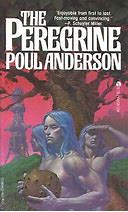
The Peregrine.
"Virgin Planet" begins with quotations from:
the Argus 293 Region Pilot's Manual;
the General Encyclopedic Dictionary;
the Argus 293 Region Coordination Service Chief's Diary.
However, the central character, Davis Bertram, is a stellagraphic survey man, not, as I had thought, a Cordy. Thus, this is not really a Coordination Service story.
However, three of the six works do form a triad:
the Nomads begin in "Gypsy";
Trevelyan Micah is a Cordy in "The Pirate";
Micah joins the Nomads in The Peregrine.
Because of faster than light travel, all of these works are set outside the Solar System. Only the two Trevelyan Micah stories show their central character as on Earth before he embarks on an interstellar mission. After eight centuries, Earth is no longer the scene of ideological conflict and global chaos that it was immediately before the Second Dark Ages. In fact, it sounds like the quiet, studious Earth of Anderson's non-series novel, World Without Stars. Trevelyan appreciates Earth's "...quiet..." and "...intellectuality..." (Star Ship, New York, 1982, p. 212). Homes are scattered over the green landscape of western North America (The Peregrine, New York, 1978, pp. 23-24). There is an "Arctic Resort," as in some other Anderson works.
Comparing the stories, I find another connection. The Cordy Chief on Nerthus reflects that, if Davis finds either an intelligent species or a colonizable planet, then "...he will go down in history with Carsten." (Star Ship, p. 88) And a Service machine directs Trevelyan to "'The planet Carsten's Star III, otherwise called Nerthus...'" (The Peregrine, p. 23).
Anderson devised a consistent background, which readers may or may not notice, for each of his many series.
Wednesday, 16 December 2015
The Pirate And The Peregrine
Poul Anderson wanted to make a point about the importance of valuing the past (see The Pact) and the Coordination Service suited this point so this story got written. It was not intended to add to the History as such.
"The Pirate"/The Peregrine diptych forms the culmination of the Stellar Union period of the Psychotechnic History. This period is characterized by the Coordination Service, which tries to prevent chaos, but also by the Nomads who cause it - or who at least travel and trade freely without any thought of the long term consequences. The novel describes a fruitful collaboration between one Cordy and a Nomad crew who come to realize that they face a common threat to humanity.
We have come a long way from the covert war between the UN and its protean enemy but this is an authentic fictitious history.
Wednesday, 20 September 2017
Solman
Now imagine that some human beings have been living elsewhere in the galaxy for a very long time and that, when you travel there, you are identified as - a Solman! (Or Solwoman.) That is what happens in Poul Anderson's The Peregrine.
Peregrine Thorkild Sean is responsible for bringing both an Alorian and a Cordy onto the Peregrine. Is it just coincidence that both the Cordy Trevelyan and the Peregrine are investigating a possible threat to humanity and that the Peregrine is the Nomad ship that Trevelyan deliberately gets himself shanghaied onto? I am not going to find the answer at this time of night.
My night time prayer or invocation, if anyone wants to share it, is:
"From delusion, lead us to truth;
"From darkness, lead us to light." (three times)
I adapted it from an Upanishad. In the morning, I say:
"We meditate on the lovely light of the god, Savitri; may it stimulate our thoughts."
Saturday, 23 September 2017
Virgin Planet, Chapter II
This chapter is rich in future historical background details:
Davis Bertram (surname first, given name second, see here);
the Coordination Service;
a facetious reference to "the Cosmic All" (there is a Cosmic religion);
the planet Nerthus, a thousand light years from Sol, on the edge of the known, recently colonized;
local Cordy headquarters in Stellamont on Nerthus;
city spires and plains beyond;
an "infomaster" (p. 16) instead of an infotrieve;
the (Stellar) Union dominated by Earth;
a dangerous "vortex" near Delta Wolf's Head;
cities, outgrown on Earth, have returned on the frontier;
colonists had disliked Terrestrial civilization (see here);
the local Cordy chief must approve stellagraphic voyages;
there are rules about how to handle primitives.
Thus, Davis Bertram flies towards the "Virgin Planet."
Wednesday, 16 December 2015
The Pact
"We guard the great Pact: the young generation, the folk of the star frontier, so often do not understand."
-Poul Anderson, Starship (New York, 1982), p. 211.
What "Pact"? The Social Contract? A Constitution? A Pax? A Pax enforced by nuclear or other futuristic weapons? (Remember the Space Patrol in Robert Heinlein's Future History or the Lunar Guard earlier in Anderson's Psychotechnic History.)
In this story, a planetary population has been killed by radiation. The title character aims to get rich quick by selling the idyllic planet with its empty dwellings to would be colonists. The Cordies say no, first, scientists and scholars need as long as it takes to study the dead civilization. The story ends as its narrator explains what he meant by the Pact:
"We guard the great Pact, which is the heart of civilization, of society, and ultimately of life itself: the unspoken Pact between the living, the dead, and the unborn, that to the best of our poor mortal abilities they shall be kept one in the oneness of time. Without it, nothing would have meaning and it may be that nothing would survive. But the young generations so often do not understand." (p. 251)
Anderson had to put the narration into the mouth of another Cordy. The omniscient narrator would not have been able to preach or philosophize like this. Having read to the end, surely we realize that "The Pact" would have been a more appropriate title?
Wednesday, 1 February 2023
More About Nerthus
Poul Anderson, Virgin Planet (London, 1966) -
- where we seek further information about the planet Nerthus.
Monday, 13 February 2023
Mystery And Investigation
The Peregrine, CHAPTER II.
This chapter refers to Galactic Survey which, of course, features in Virgin Planet.
Spaceships, although not those of either the Coordination Service or Galactic Survey, have been quietly disappearing in a particular volume of space. The Tiunran response is to avoid that volume. The human response, both Cordy and Nomadic, is to investigate, surely a wiser policy or am I biased? Not entirely. The threat, whatever it is, might grow. Some attitudes have a higher survival value than others.
Neither the characters nor the readers realize that the threat is already present on Rendezvous and will infiltrate the Nomad ship that is conducting the investigation. That ship will also be joined by the Cordy investigator. Everything comes together when the author knows what he is doing.
Saturday, 4 February 2023
The Venturers Beyond
Anderson's Psychotechnic History presents an impressive list of venturers beyond the frontier:
Tuesday, 29 October 2013
Cordies, Nomads And Galactics
"Virgin Planet" shows us what a Cordy Chief thinks of a stellagraphic survey man;
"Teucan" tells us what a Trader thinks of Cordies;
"The Pirate" shows us how Cordy field agent Trevelyan Micah deals with an entrepreneur;
The Peregrine shows us how Trevelyan cooperates with and later joins the Nomads.
Thus, this one Service introduces us to four other sections of interstellar society. The Service cannot survive the collapse of the Union or the subsequent Third Dark Ages but the Nomads, especially when guided by Trevelyan and other ex-Cordies, are equipped to survive and to influence later civilizations.
The Nomads, like James Blish's Okies, perpetually travel through space, trading and stopping on planets but never to stay. In Blish's Cities in Flight, cities, lifted by antigravity and an FTL drive, leave Earth for economic reasons, thus de-urbanizing Earth. In Anderson's Psychotechnic History, Earth is de-urbanized because technological communication makes cities redundant but they re-emerge on the frontier as spaceports. Much later, in Galactic Civilization, cities are even rarer when individuals are able to cross space without vehicles by controlling cosmic energies.
Saturday, 14 February 2026
Guarding The Pact
Something similar although on a much smaller scale happened in Anderson's Psychotechnic History. "Gypsy" and The Peregrine are two instalments about the Nomads. The latter also features Trevelyan Micah of the Stellar Union Coordination Service. "The Pirate" is a later written story about Trevelyan set between "Gypsy" and The Peregrine but it also contains an extra layer of commentary contributed by its first person narrator who remains off-stage and speaks from one generation later than the events involving:
Thursday, 21 September 2017
"Any Hyperdrive Ship"
"It had the elongated shape necessary to any hyperdrive ship, where field generators must be mounted fore and aft. But it was no vessel of man's building. The cylinder was beveled into flat planes; the stern bulged, and the nose held a spear-shaped mast of some kind. Its metal was a coppery alloy, flaming ruddy in the harsh sunlight, and they could see that the hull was patched and pitted - old."
-Poul Anderson, The Peregrine (New York, 1979), Chapter XIV, p. 123.
Sf fans have been reading about hyperdrive spacecraft all our lives but did we know that any hyperdrive ship must be elongated with field generators at each end? No but Poul Anderson makes us believe this. We view the alien craft through the eyes of a Nomad crew and one Cordy.
I have already discussed hyperspace in the Psychotechnic History and another (humorous) kind of elongated spaceship here.
Saturday, 26 October 2013
Interstellar Society
Nomads;
colonists;
natives;
entrepreneurs, including "Traders";
Cordies (Coordination Service field agents);
stellagraphic survey men.
These social groups are not presented in a linear sequence but weave in and out of the narrative:
Nomads, introduced in the opening story of the period, and a Cordy, introduced in an intermediate story, join forces in the concluding novel of the period;
colonists and natives interact in two of the stories;
a survey man discovers an unusual isolated colony in "Virgin Planet," which exists both as a story and as a novel;
one story features one Trader who disparages Cordies but would have benefited from their advice.
Clearly, this period could have been expanded indefinitely.
The successive periods of the History are:
World War III aftermath;
UN world government;
Solar Union;
Second Dark Ages;
early FTL;
Stellar Union;
Third Dark Ages;
interstellar Empires not covered by any of the stories;
Galactic Civilization.
Anderson compares his "Traders," who flourish in the Stellar Union period, to the Vikings, who were celebrated in the First Dark Ages, and to the Martian war lords, who were celebrated in the Second Dark Ages, so, by implication, these Traders will be celebrated during the Third Dark Ages. Ironically, Anderson gives us several volumes about Vikings but no story about his Martian war lords.
The outcome of "Teucan," the story about the Trader, is entirely predictable so it is to Anderson's credit that he is able to keep the story going interestingly for seventeen pages.
Wednesday, 16 December 2015
The Psychotechnic History II
See The Psychotechnic History. In Poul Anderson's Psychotechnic History, clones (not yet called that) are grown exogenetically, not in a host mother.
On reflection, this History should definitely be collected in two omnibus volumes:
Vol I, THE SOLAR UNION - the entire contents of The Psychotechnic League and Cold Victory plus The Snows Of Ganymede;
Vol II, THE STELLAR UNION - the entire contents of Starship plus "The Acolytes," "The Green Thumb," the longer version of "Virgin Planet" and The Peregrine but maybe minus "The Chapter Ends."
For comparison, the first three omnibus volumes of the Technic History should be:
RISE OF THE POLESOTECHNIC LEAGUE;
DECLINE OF THE POLESOTECHNIC LEAGUE;
RISE OF THE TERRAN EMPIRE -
- and we know that the political framework of the League is the Solar Commonwealth. Thus, in Anderson's first future history, the Solar Union is succeeded by the Stellar Union whereas, in his second, the Solar Commonwealth is succeeded by the (interstellar) Terran Empire.
Recently, when I began to reread this future history, I became entirely focused on the future historical content of its opening three stories:
Etienne Fourre;
Stefan Rostomily;
political gangsterism;
the protean enemy;
the Pacific Colony;
the three class education system.
However, this post-World War III period is dwarfed by the much vaster context of two Dark Ages and two periods of interstellar civilization. The Un-man, Naysmith, flies his air boat to the Rockies; the Stellar Union Coordination Service field agent (Cordy), Trevelyan, flies his air car to that same mountain range but over a thousand years later in a different civilization facing different problems.
Naysmith identified the UN's protean enemy as man himself. This "enemy" destroys the Solar Union. Trevelyan, psychologically integrated, instead confronts the external problem of cosmic complexity overwhelming any cerebral or computational attempt to coordinate it. This problem destroys the Stellar Union.
Sunday, 3 May 2020
Nerthus And Thunderhouse
is newly settled in "The Acolytes" and "The Green Thumb";
has been settled for barely two generations and is the local Cordy HQ in Virgin Planet;
is a port of call for a Nomad ship in The Peregrine;
is Dunham's base planet in "Symmetry";
is briefly mentioned in "The Pirate."
Thunderhouse has:
a notoriously slack astronautical academy in Virgin Planet;
the Half Moon bar by the Grand Canal in The Peregrine.
These places are not as solid as Hermes, Avalon, Dennitza etc in the Technic History but they do make acceptable future historical background locations, nevertheless. I do not think that we are finished with Poul Anderson's Psychotechnic History just yet.
Friday, 20 February 2026
This One
Friday, 18 October 2013
Three Periods
UN: 4 works about political conflicts;
Solar Union: 3 about social conditions + 4 about political conflicts;
FTL: 4 about Nomads, Cordies or both + 5 others.
In "Gypsy," Nomad culture begins;
in "Virgin Planet" and "The Pirates," Cordies (members of the Coordination Serice) address interstellar problems;
in The Peregrine, a Cordy cooperates with, then joins, the Nomads.
The Psychotechnic Institute has only one story, in the UN period, but psychotechnics as a science of society is a major issue throughout the series. The parallel Institute of Human Biology is mentioned only once, leaving a problem that we do not see resolved.
The Order of Planetary Engineers gets two stories in the Solar Union period but, we infer, ceases to exist during the Second Dark Ages, as do the Cordies during the Third Dark Ages which, presumably, the Nomads are equipped to survive.
Thursday, 24 August 2023
Polesotechnic League Or Coordination Service
Wednesday, 8 February 2023
Cordies And Other Facets
"...knew enough Union law to be sure that just about anything he did to the Doctors would be all right with the Coordination Service." (CHAPTER XVIII, p. 133)
Thus, Davis is not a Cordy but is constrained by the laws that they enforce. We are shown different facets of life in the Stellar Union. One major cultural conflict is between the Cordies and the Nomads and Trevelyan will later change sides.
A future history series written over several years presents earlier and later stages of its author's development as a writer. "The Pirate" is a much later work than the rest of the series. Its narrator begins:
Thursday, 19 February 2026
Six Instalments
The Peregrine, CHAPTER II.
Peregrine Joachim Henry tells the Nomad Captains' Council:
"'I even talked my way into the Cordy office on Nerthus, and got a look at their Galactic Survey records." (p. 11)
The Nomads were founded in "Gypsy."
Nerthus was introduced in two stages in "The Acolytes" and "The Green Thumb."
The Coordination Service office on Nerthus had to deal with a Galactic Survey man in Virgin Planet.
Coordinator Trevelyan Micah, having already appeared in the chronologically earlier "The Pirate," will shortly join the Nomad ship, the Peregrine, when it stops at Nerthus.
Thus, these six instalments form a closely integrated future history series. They are not the whole of this second part of the Psychotechnic History but they are most of it.
Sunday, 3 May 2020
Three Narrative Modes
In chronological order of fictitious events, although not in the order of publication, "The Pirate" introduces Trevelyan Micah, a Coordination Service field agent or "Cordy."
In The Peregrine, Trevelyan travels with Nomads and reads Thorkild's memoirs which include the text of "Gypsy."
Thus, these three works form a triad although each has a different narrative mode. Listing them this time in order of publication:
"Gypsy," first person narration;
The Peregrine, third person narration;
in "The Pirate," there is a first person narrator but he is not the central character, Trevelyan, and is evident only in the opening and concluding passages. Otherwise, the story is a third person narrative about Trevelyan.
"We guard the great Pact: but the young generations, the folk of the star frontier, so often do not understand."
-Poul Anderson, "The Pirate" IN Anderson, The Complete Psychotechnic League, Volume 3 (Riverdale, NY, 2018), pp. 137-165 AT 137.
A generation after the events of the story:
"...I can tell you about Trevelyan Micah..." (ibid.)
"I suspect [Trevelyan] also wanted to renew his humanity at the wellspring of humankind..." (ibid.)
"We guard the great Pact... But the younger generations so often do not understand." (p. 165)
The unusual perspective enables this first person narrator to comment in a way that is closed to the omniscient narrator.