Showing posts with label Star Ways. Show all posts

Thursday, 17 December 2015

Interstellar Fiction

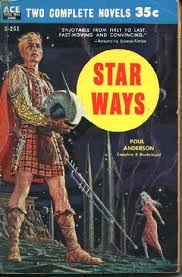
Poul Anderson's The Peregrine, about the interstellar Nomads, was originally called Star Ways. Two of the Nomad spaceships are called Trekker and Voyageur. Anderson wrote this novel decades before the existence of Star Wars, Star Trek or Star Trek: Voyager. However, certain words and terminologies recur in an interstellar sf context.

We recognize the scenario from Star Trek and from other sf works, e.g., by James Blish. A large spaceship with a crew of hundreds or thousands enters a planetary system and goes into orbit around an inhabited or colonized planet. Crew members shuttle to the surface in ship's boats. Star Trek introduced the transporter (teleporter) in order to avoid scenes involving boats. Extrasolar planets are either colonized from Earth or inhabited by surprisingly humanoid natives. One Nomad "marries" (not legally) a very beautiful native woman with white skin and long silver hair.

Thankfully, at least, the Nomad and his new wife are not interfertile - although Star Trek does allow even that in the case of Vulcan. The Vulcans should have been a separated colony, not the result of independent evolution, just as the Time Lords should have been not aliens but future humanity.

Poul Anderson is able to write convincingly and to address significant issues despite such sf cliches, which he later transcended.

Wednesday, 16 December 2015

The Pirate And The Peregrine

"The Pirate" is a prequel to The Peregrine, although the latter was the earliest written installment of the Psychotechnic History and the former was the last. "The Pirate," as a new installment of this future history, has to account for faster than light interstellar flight in terms of "hyperspace" but adds the phrase, "...the tachyon mode...," (Starship, p. 219). This mode gives "...only a weak emission of super-light particles..." (ibid.) but nevertheless enables a Cordy ship to track a suspect.

Poul Anderson wanted to make a point about the importance of valuing the past (see The Pact) and the Coordination Service suited this point so this story got written. It was not intended to add to the History as such.

"The Pirate"/The Peregrine diptych forms the culmination of the Stellar Union period of the Psychotechnic History. This period is characterized by the Coordination Service, which tries to prevent chaos, but also by the Nomads who cause it - or who at least travel and trade freely without any thought of the long term consequences. The novel describes a fruitful collaboration between one Cordy and a Nomad crew who come to realize that they face a common threat to humanity.

We have come a long way from the covert war between the UN and its protean enemy but this is an authentic fictitious history.

Clues

(i) The Nomads have lost ten ships in five years.
(ii) All disappeared in the direction of Sagitarii.
(iii) No mechanical cultures have been found in that region.
(iv) Otherlings have also lost ships in that region.
(v) Coordination Service and Galactic Survey have not.
(vi) There are many apparently uninhabited Earth-like planets.
(vii) Natives on some inhabited E-planets seemed familiar with spaceships -
(viii) - but had never before been visited from the Stellar Union.
(ix) There were surprisingly similar plants on some supposedly uninhabited E-planets.
(x) Galactic Survey had found a dozen identical plants on six uninhabited planets.
(xi) Tiunrans, from an M-planet beyond Vega, passed through that region four centuries previously but had not transplanted plants and had lost four ships.

Nomads and Cordies investigate.

Tuesday, 15 December 2015

With Trevelyan Micah

The first three novels written (not published) by Poul Anderson were:

The Broken Sword (fantasy);
Vault Of The Ages (juvenile sf);
Star Ways/The Peregrine (a volume of his first future history).

A future history is event-driven, not character-driven. In this, the Psychotechnic, future history, three characters appear twice and that is it as far as character continuity goes:

"Un-Man," about clones of the dead but well remembered Stefan Rostomily, cameos Fourre;

"Marius," written later but set earlier is about Fourre and cameos Stefan;

in Star Ways, Trevelyan Micah of the Stellar Union Coordination Service bids farewell to Braganza Diane before departing on a mission;

in "The Pirate," written many years later but set a few years earlier, Micah again bids farewell to Diane before departing on a mission.

Thus, Fourre, Micah and Diane each appear twice.

Trevelyan refers to the Second Dark Ages which happened between "Brake" and "Gypsy." When he visits Port Nevada, we read one of Anderson's list-descriptions:

"...humans and nonhumans hustled, jostled, chiseled, brawled, clashed, stole, evangelized, grew rich, grew poor, came, went, and were forgotten..."
-Poul Anderson, Starship (New York, 1982), pp. 213-214.

Trevelyan's nonhuman colleague says of the man whom they are investigating:

"'Our information concerning his world line is fragmentary, and zero about its future segment.'" (p. 220)

Of course information about the future is zero! But does Smokesmith imply that his species does sometimes have information about future segments of world lines? The very fact he (?) discusses a man in terms of his world line is suggestive.

"...the mother-of-pearl iridescence on [Smokesmith's] rugose torso was lovely to watch." (p. 221)

(I took "rugose" to mean "red.")

Nerthus, like Tyrfing, is a name that links Anderson's hard sf to his mythological fiction.

Sunday, 8 September 2013

The Peregrine

Poul Anderson's first three novels were:

The Broken Sword (adult fantasy);
Vault Of The Ages (juvenile sf);
Star Ways (adult sf).

Star Ways, not Star Wars. Never heard of it? Don't panic.

A publisher commissioned and accepted Star Ways but delayed publication for so long that Anderson's agent offered it to another publisher who:

cut the text to fit an exact page number;
cut erotic passages;
changed a character's name;
added chapter titles.

In 1978, when Ace Books reissued the novel, Anderson was able to remove the chapter titles but not to restore the text because he no longer had the manuscript. Finally, the novel was re-entitled The Peregrine because meanwhile Star Wars had been released. (When I googled "Poul Anderson Star Ways," I was asked whether I had meant "Poul Anderson Star Wars.")

I do not know whether Anderson changed that character's name back. However, since he supposed that the name had been changed because "...it looked too Russian..." (The Peregrine, New York, 1979, Introduction), the question becomes whether there is now a Russian-looking name in the book - "Petroff" (p. 73)?

In the 1979 edition, the list of "Books by POUL ANDERSON" includes:

The Saga of Dominic Flandry:
ENSIGN FLANDRY
FLANDRY OF TERRA

Just two volumes, one novel and one collection! The Flandry series grew to become six novels and two collections and also became just one part of the much longer Technic Civilization History.

I think that the evocative title Star Ways should be restored. The novel is a substantial installment of Anderson's first, Psychotechnic, future history, which has yet to be collected in a single complete edition as Baen Books did with the Technic History.

The Nomad culture starts in "Gypsy" when sixteen families become interstellar wanderers in the single spaceship Traveler under Captain Erling Thorkild. Three centuries later in Star Ways/The Peregrine, when the many ships periodically meet on the Earth-like planet Rendezvous, the President of the Captains' Council is by tradition the captain, still a Thorkild, of Traveler III.

Chapter I, a two page description of Rendezvous, tells us that, although the Nomads appreciate this clement planet, they sense the many differences from Earth and further informs us that the knowledge that this is not Earth "...becomes a hunger in you..." (p. 2) I question this statement. Human beings have adapted to many different environments even on Earth and they usually feel at home wherever they have grown up, however different that is from whatever their ancestors had experienced.

Three installments of the Polesotechnic History form a triad:

"Gypsy" introduces the Nomads;
"The Pirate" introduces Trevelyan Micah of the Coordination Service;
in The Peregrine, Trevelyan works with, then joins, the Nomads.
Friday, 23 August 2013

Space And Stars

Space Folk and Starfarers are two similar Poul Anderson titles. (A third evocative title was Star Ways but that had to be changed for republication to avoid apparent plagiarism of Star Wars.) However, Starfarers is a novel incorporating two of the three Kith short stories whereas Space Folk is a collection of twelve short stories, including:

the prequel to Tau Zero;
the sequel to The High Crusade;
a story set against the background of Anderson's Psychotechnic future history although not fully consistent with that series;
the, to me problematic, "Murphy's Hall," which is in other collections and which I discussed recently.

That leaves eight stories in Space Folk that I will read or reread for posting purposes.

Meanwhile:

the remaining Kith story, "The Horn of Time the Hunter," should be published as an Epilogue to future editions of Starfarers;
"Pride" should be published as a Prologue to future editions of Tau Zero;
"Quest" has rightly been published as an Epilogue in a later edition of The High Crusade.

Space Folk (New York, 1989) seems to be remarkably free of the duplication of contents that plagues Anderson collections. Glancing ahead, I have found, in the opening sentence of "Horse Trader", one of Anderson's characteristically unfamiliar terms, "...aeolipile..." (p. 261).

Regular blog readers might like to google this before I do?