I have recently referred to two World Science Fiction Conventions attended by Poul Anderson: one real (I attended it); the other fictional (I read about it). However, the fictional Con was held in a divergent timeline so maybe it is real? Fascinating fiction-reality interfaces have been perfected by various fantasy writers. (Our reality is a dream within Neil Gaiman's The Sandman which is a fiction within our reality which means that our reality is within itself.)
Living within a single universe, we imagine and even postulate other universes and can then turn this situation on its head, i.e., characters in a fictional multiverse might encounter our universe among all the others ("An Earth where not even one person has gained superpowers? Seems unlikely!").
Two short stories by Poul Anderson are set in an inter-universal inn and the first person narrator of these stories seems to come from a world like ours. Is it safe to identify this narrator with the author - as we identify Dante the poet with Dante the day-tripper to the hereafter? Commenting on the two Old Phoenix stories from the memory of having read them, I would say that the narrator could be the author although, if I were to reread the stories closely, I might find some reason why not? But, for the time being, I am content to remember rather than to reread.
Saturday, 4 April 2015
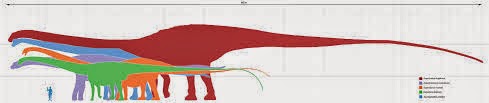
Bruhathkayosaurus
I saw "'Bruhathkayosaurus?'" on p. 260 of SM Stirling's The Sky People (New York, 2006) and thought that he was making it up. Then I googled and all was light. In Stirling's text, these massive animals look slow because they move their legs slowly but the legs are so long that their stroll is faster than a smaller animal's gallop.
Historical and prehistorical fictions are excellent educational instruments. We can be introduced, e.g.:
to Cyrus the Great by Poul Anderson's "Brave To Be A King;"
to the Punic Wars by Anderson's "Delenda Est;"
to ancient Tyre by his "Ivory, And Apes, And Peacocks;"
etc -
- and can, from these fictional readings, gain enough interest to pursue non-fiction texts. One project, which I will not take up right now, would be to list all of the dinosaurs mentioned in time travel stories by Anderson and in Stirling's The Sky People and to differentiate them according to their size and other characteristics. As mentioned here and previously, Stirling at least presents some that I had never heard of.
Late Night Preview
Yielding to curiosity, I have looked ahead to the preview of SM Stirling's In The Courts of The Crimson Kings at the end of his The Sky People. At the World Science Fiction Convention in Chicago, 1962, the following individuals watch and discuss video pictures as they are received from the surface of Mars:
Fred
Carol
Poul
Ted
Jack
Bob
Bob's red-headed wife
Arthur
Larry
Catherine
Isaac
Frank
Beam
Ray
Sprague
the editor of Astounding
Leigh
Two processes occur during the preview:
we receive confirmations of the identities of some of the named individuals - Bob has written about Mars, Fred has a low opinion of advertising men etc;
the sf writers interpret what they see of a Martian canal, humanoids etc.
An amusing opening no doubt but the body of the novel is bound to present more substantial contents than these few names and speculations! And again we have come full circle. The blog has currently shifted its focus from Poul Anderson to SM Stirling as a worthy successor of Anderson and now we find this same Anderson as a character in a novel by Stirling. I could not have invented any of this but I am content to be here to read and post about it.
Fred
Carol
Poul
Ted
Jack
Bob
Bob's red-headed wife
Arthur
Larry
Catherine
Isaac
Frank
Beam
Ray
Sprague
the editor of Astounding
Leigh
Two processes occur during the preview:
we receive confirmations of the identities of some of the named individuals - Bob has written about Mars, Fred has a low opinion of advertising men etc;
the sf writers interpret what they see of a Martian canal, humanoids etc.
An amusing opening no doubt but the body of the novel is bound to present more substantial contents than these few names and speculations! And again we have come full circle. The blog has currently shifted its focus from Poul Anderson to SM Stirling as a worthy successor of Anderson and now we find this same Anderson as a character in a novel by Stirling. I could not have invented any of this but I am content to be here to read and post about it.
Friday, 3 April 2015
Among The Dinosaurs
SM Stirling, The Sky People (New York, 2006).
It is Friday so we saw our Muslim neighbors emerging from the mosque and it is also Good Friday so we know that our Christian neighbors will have congregated in the Priory Church, the Cathedral etc. The rest of Easter Weekend may be busy so let's try for one more post this evening.
Words
"'...ceratopid...'" (p. 259);
"...peristaltic..." (p. 262);
"...carnosaur..." (p. 263).
Both the word ending and the context make clear that a "carnosaur" was a kind of dinosaur but it remains one that I had never heard of before, despite there having been an sf film with that word as its title. Do some authors naturally have a more extensive vocabulary than their readers or do they research new words while writing?
Walking carefully through a herd of titanosaurs, Marc knows "'...what it feels like to be a mouse.'" (p. 264) Not a bad perspective for a human being to experience. This scene is well observed because we are told that:
the biggest dinosaurs hardly notice anything as small as a human being so that it is unnecessary to hide or keep quiet;
cow- or horse-sized dinosaurs are more dangerous because they are "...close enough in scale to see humans..." (p. 266) and also more agile;
it is hard to gauge where the moving titanosaur legs are going to come down;
it feels as though the legs are always toppling down;
the footfalls like rumbling thunder cause mini-Venusquakes;
a man can walk under a titanothaur without stooping;
the 'saur's cat-sized lice are dangerous.
That is what it would be like. All of these effects would have to be reproduced in any screen dramatization of The Sky People - and let us haste to see it.
It is Friday so we saw our Muslim neighbors emerging from the mosque and it is also Good Friday so we know that our Christian neighbors will have congregated in the Priory Church, the Cathedral etc. The rest of Easter Weekend may be busy so let's try for one more post this evening.
Words
"'...ceratopid...'" (p. 259);
"...peristaltic..." (p. 262);
"...carnosaur..." (p. 263).
Both the word ending and the context make clear that a "carnosaur" was a kind of dinosaur but it remains one that I had never heard of before, despite there having been an sf film with that word as its title. Do some authors naturally have a more extensive vocabulary than their readers or do they research new words while writing?
Walking carefully through a herd of titanosaurs, Marc knows "'...what it feels like to be a mouse.'" (p. 264) Not a bad perspective for a human being to experience. This scene is well observed because we are told that:
the biggest dinosaurs hardly notice anything as small as a human being so that it is unnecessary to hide or keep quiet;
cow- or horse-sized dinosaurs are more dangerous because they are "...close enough in scale to see humans..." (p. 266) and also more agile;
it is hard to gauge where the moving titanosaur legs are going to come down;
it feels as though the legs are always toppling down;
the footfalls like rumbling thunder cause mini-Venusquakes;
a man can walk under a titanothaur without stooping;
the 'saur's cat-sized lice are dangerous.
That is what it would be like. All of these effects would have to be reproduced in any screen dramatization of The Sky People - and let us haste to see it.
Dilemma
I enjoy posting on this blog - otherwise, I would not be doing it - but I need a continual supply of material to post about. This is easy to find with relevant reading. However, I also want to make progress with rereading Stieg Larsson's third novel. I can point to some parallels with Anderson:
Swedish setting;
fictional treatment of intelligence services;
social issues of freedom and security.
There are also some (very remote) personal connections. Larsson, an anti-fascist journalist, worked with Gerry Gable, Editor of British anti-fascist magazine, Searchlight. My son-in-law, Ketlan, is a colleague of Gable. And, since Poul Anderson once briefly addressed me in a hotel room party at a World SF Con, I can claim to be a minor (very minor) link between them!
That last remark is not meant to be taken seriously! But it does emphasize that, while discussing the texts of novels, we can also remember the real life activities and interactions of the interesting and very different men who wrote them.
Swedish setting;
fictional treatment of intelligence services;
social issues of freedom and security.
There are also some (very remote) personal connections. Larsson, an anti-fascist journalist, worked with Gerry Gable, Editor of British anti-fascist magazine, Searchlight. My son-in-law, Ketlan, is a colleague of Gable. And, since Poul Anderson once briefly addressed me in a hotel room party at a World SF Con, I can claim to be a minor (very minor) link between them!
That last remark is not meant to be taken seriously! But it does emphasize that, while discussing the texts of novels, we can also remember the real life activities and interactions of the interesting and very different men who wrote them.
Lewis, Anderson, Blish And Stirling
The Problem Of Pain by CS Lewis and "The Problem of Pain" by Poul Anderson share a title and a theological argument.
Perelandra by Lewis and The Game Of Empire by Anderson each address the question of God's relationship to extraterrestrial intelligences.
Perelandra by Lewis and A Case Of Conscience by James Blish are each set on a sinless planet.
In Perelandra, a demon speaks through the possessed body of Edward Weston but Weston momentarily breaks through:
"...for one second something like the old Weston reappeared - the old Weston, staring with eyes of horror and howling, 'Ransom! Ransom! For Christ's sake don't let them -'"
- CS Lewis, Voyage To Venus (London, 1978), p. 86.
In The Sky People (New York, 2006) by SM Stirling, also set on Venus, an alien mechanism speaks through the controlled brain of Franziskus Binkis but Binkis momentarily breaks through:
"For a moment Franziskus was her man again...'Help me, Judviga! Help me!'" (p. 216)
Four neat parallels?
Perelandra by Lewis and The Game Of Empire by Anderson each address the question of God's relationship to extraterrestrial intelligences.
Perelandra by Lewis and A Case Of Conscience by James Blish are each set on a sinless planet.
In Perelandra, a demon speaks through the possessed body of Edward Weston but Weston momentarily breaks through:
"...for one second something like the old Weston reappeared - the old Weston, staring with eyes of horror and howling, 'Ransom! Ransom! For Christ's sake don't let them -'"
- CS Lewis, Voyage To Venus (London, 1978), p. 86.
In The Sky People (New York, 2006) by SM Stirling, also set on Venus, an alien mechanism speaks through the controlled brain of Franziskus Binkis but Binkis momentarily breaks through:
"For a moment Franziskus was her man again...'Help me, Judviga! Help me!'" (p. 216)
Four neat parallels?
Thursday, 2 April 2015
Battle On Venus
SM Stirling, The Sky People (New York, 2006).
Terrans and Cloud Mountain People defeat attacking Neanderthals, using several to me unfamiliar words in the process:
septum (p. 241);
knobkerrie (p. 241);
bracer (p. 242);
to noogie on... (p.246);
sangar (p. 248).
It pays to google. Sometimes, I guess a meaning from context, then learn that the guess was wrong. Thus, an exciting account of a battle is combined with an extension of the reader's vocabulary.
Edgar Rice Burroughs would have given us little more than a colorful setting and exciting battle scenes whereas SM Stirling also develops the mystery of the "Lords of Creation" who have terraformed planets and can control brains.
I do not really buy Stirling's idea, on pp. 229-230, of sf becoming the dominant form of prose fiction. Sf remains a small part of world literature and it would take more than an inhabited Mars and Venus to change this. Of course, his reference to "...resentment in some literary circles..." (p. 230) is mainly a joke at the expense of Norman Mailer and Truman Capote whose fame has declined because of the new respectability of "...pulp trash..." (ibid.)
Terrans and Cloud Mountain People defeat attacking Neanderthals, using several to me unfamiliar words in the process:
septum (p. 241);
knobkerrie (p. 241);
bracer (p. 242);
to noogie on... (p.246);
sangar (p. 248).
It pays to google. Sometimes, I guess a meaning from context, then learn that the guess was wrong. Thus, an exciting account of a battle is combined with an extension of the reader's vocabulary.
Edgar Rice Burroughs would have given us little more than a colorful setting and exciting battle scenes whereas SM Stirling also develops the mystery of the "Lords of Creation" who have terraformed planets and can control brains.
I do not really buy Stirling's idea, on pp. 229-230, of sf becoming the dominant form of prose fiction. Sf remains a small part of world literature and it would take more than an inhabited Mars and Venus to change this. Of course, his reference to "...resentment in some literary circles..." (p. 230) is mainly a joke at the expense of Norman Mailer and Truman Capote whose fame has declined because of the new respectability of "...pulp trash..." (ibid.)
Wednesday, 1 April 2015
Manipulation Of History
I asked here: in which three stories by Poul Anderson do aliens among us manipulate Terrestrial history for good or ill? The stories that I had in mind were:
"No Truce With Kings"
"Details"
"Interloper"
Sean M Brooks suggested:
The War Of Two Worlds
"No Truce With Kings"
The Avatar
"Peek! I See You!"
I agree with the inclusion of The War Of Two Worlds.
However:
in The Avatar, do the aliens merely observe?;
in "Peek! I See You!," do the aliens merely trade with one isolated community without intervening elsewhere?
More Powerful Races
SM Stirling, The Sky People (New York, 2006).
I have heard of a "babble" though not of a "brabble" (p. 219). However, googling confirms that the latter is indeed a word.
I am all set to post links to earlier posts about the three stories mentioned in the previous post but am delaying because I expect a response from at least one blog reader...
Meanwhile, here is another question: in how many works does Poul Anderson show us humanity encountering an intelligent species that is either inherently or at least technologically superior? I ask this because SM Stirling's "Lords of Creation" are at least technologically superior. They have terraformed Venus and Mars and can imprint a language on a brain. (This is a convenient skill for some of Anderson's time travelers (see also here) as well as for the Doctor's Time Lords.)
I am beginning to wonder how superior Stirling's "Lords of Creation" are. There are Earth-like planets orbiting nearby stars. Might the "Lords" have terraformed those planets as well? Are they literally Lords of Creation? Only further reading will tell.
I have heard of a "babble" though not of a "brabble" (p. 219). However, googling confirms that the latter is indeed a word.
I am all set to post links to earlier posts about the three stories mentioned in the previous post but am delaying because I expect a response from at least one blog reader...
Meanwhile, here is another question: in how many works does Poul Anderson show us humanity encountering an intelligent species that is either inherently or at least technologically superior? I ask this because SM Stirling's "Lords of Creation" are at least technologically superior. They have terraformed Venus and Mars and can imprint a language on a brain. (This is a convenient skill for some of Anderson's time travelers (see also here) as well as for the Doctor's Time Lords.)
I am beginning to wonder how superior Stirling's "Lords of Creation" are. There are Earth-like planets orbiting nearby stars. Might the "Lords" have terraformed those planets as well? Are they literally Lords of Creation? Only further reading will tell.
Non-Interference
SM Stirling, The Sky People (New York, 2006).
Good morning. A new month and a new post.
"...Non-interference as far as humanly possible was official doctrine..." (p. 208)
Sounds familiar - Prime Directive, Starfleet, Time Patrol, Okies. It is as if this principle has proliferated between universes. However, Poul Anderson also presents the opposite perspective. His Allied Planets set out to re-civilize human populations that had been isolated during the Long Night and, in at least three different Anderson stories that have been discussed on this blog, aliens among us secretly manipulate Terrestrial civilization for good or ill.
Which stories? This time, instead of listing titles or giving links, I invite page viewer participation in remembering three - or maybe more? - stories that fit this description. Meanwhile, SM Stirling's "Lords of Creation" series - a designation bestowed on the mysterious planet designers by the viewpoint character, Marc - continues to be an enjoyable read. I have yet to finish reading the first of the three installments.
Good morning. A new month and a new post.
"...Non-interference as far as humanly possible was official doctrine..." (p. 208)
Sounds familiar - Prime Directive, Starfleet, Time Patrol, Okies. It is as if this principle has proliferated between universes. However, Poul Anderson also presents the opposite perspective. His Allied Planets set out to re-civilize human populations that had been isolated during the Long Night and, in at least three different Anderson stories that have been discussed on this blog, aliens among us secretly manipulate Terrestrial civilization for good or ill.
Which stories? This time, instead of listing titles or giving links, I invite page viewer participation in remembering three - or maybe more? - stories that fit this description. Meanwhile, SM Stirling's "Lords of Creation" series - a designation bestowed on the mysterious planet designers by the viewpoint character, Marc - continues to be an enjoyable read. I have yet to finish reading the first of the three installments.
Subscribe to:
Posts (Atom)