Showing posts sorted by date for query civilization-cluster. Sort by relevance Show all posts

Thursday, 19 March 2026

Poul Anderson's Wars


Attached is the back cover blurb of my edition of Poul Anderson's World Without Stars. It summarizes the premises and some of the plot and ends with a reference to "...a world-wide war." We remember Brian Aldiss saying that Anderson tells us a dozen ways to get to another planet but then we find the same kinds of things happening when we get there.

See:

Aldiss, Amis, Anderson, Asimov, Lewis

The crew of the Meteor become involved in the war between Pack and Herd on the planet between galaxies.

Nicholas van Rijn becomes involved in the war between Flock and Fleet on Diomedes.

The crew of the USS Benjamin Franklin become involved in the war between Vorlak and Kandemir in the local civilization-cluster.

So, yes, there was something to what Aldiss said. But Anderson's wars are better than many others. 

Monday, 16 March 2026

Excellence

We are searching this blog and gathering evidence for human uniqueness and/or superiority in Poul Anderson's After Doomsday.

See:

Credible Aliens? II

The Second Civilization-Cluster

Human Superiority

Superiority

If we find anything more, then we will add it either here or in a later post but that is a lot already.

Can human beings excel in as many ways as that? Well, as we point out, Anderson also wrote stories in which other intelligent species excelled. And covering every option is one way in which he himself excelled. Others ways were making other planetary environments real and sympathetic treatment of characters that he disagreed with.

Excelsior! (I am not quite sure what that means but it is certainly appropriate.)

Saturday, 14 March 2026

Galactography

After Doomsday.

Of the million civilization-clusters, several are Uru-speaking.

In Our Uru-Speaking Cluster
Vorlak is:

"Nearly two hundred light-years from Earth, in the direction of Scorpio..." (5, p. 48)

"The hot F6 dwarf that was Kandemir's sun lay about 175 light-years from Vorlak, northward and clockwise." (6, p. 50)

"The nearest strong Kandemirian base to Vorlak was forty light-years off, at a star the Vorlakkar called Mayast." (6, p. 51)

If there is any galactographical information about Monwaing and its colonies, then we will have to find this while rereading.

In A Second Uru-Speaking Cluster
The planet, Zatlokopa, is:

"...ten thousand light-years distant..." (8, p. 66)

- from Earth.

OK. Not much but something and we will record any more such details that show up.

Friday, 13 March 2026

Other Planets In The Civilization-Cluster

After Doomsday, 6.

On Kandemir, fertile plains facilitated a nomad culture which domesticated animals, invented writing, government and technology and conquered cities where helots then worked at immobile tasks such as mining. 

A hundred years ago, T'sjuda discovered Kandemir and hired Kandemirians as mercenaries for imperialism on primitive planets, also practiced by Xo and some other planets. Kandemirians became interstellar conquerors still held to their home planet by seasonal rites and even defeated and subordinated T'sjuda but the Vorlakka Draga then headed an opposing coalition.

I have to break off because we are getting ready to go out to The Hunt for Moriarty.

Keep rereading Anderson and Conan Doyle.

Uru

After Doomsday, 5.

Carl Donnan, now Captain of the USS Benjamin Franklin, converses with Hlott Luurs, the Draga of Tolbek on Vorlak and president of the Dragar Council.

"They both spoke in Uru, a modified form of the language used by the first interstellar visitors to this region. Some such lingua franca was necessary throughout a cluster; every spaceman mastered it as part of his training. Uru was flexible, grammatically streamlined, and included standardized units of measurement. Any oxygen breather could pronounce its phonemes, or at least write its alphabet, well enough to be understood. In fact, several other clusters, their own civilizations first seeded by explorers of that ancient race, had adopted the same auxiliary speech." (p. 43)

("Cluster" means "civilization-cluster," not "galactic cluster.")

This admirable summary deserved to be quoted in full. Imagine spacefarers learning a lingua franca as part of their training. This language has been modified and streamlined. In its inter-species use, it has probably departed far from its original form.

The scenario in After Doomsday is indeed unique.

Wednesday, 11 March 2026

Civilization-Clusters; Dandelion Seeds: A Unique Interstellar Setting

After Doomsday, 3.

As a matter of fact, World Without Stars and After Doomsday each have a unique setting. In World Without Stars, a spaceship can make an instantaneous jump not only to another planetary system but even to another galaxy but must first accelerate to the relative velocity of its destination system or galaxy. Thus, any space journey does after all take time. However, human beings have unlimited time because, thanks to the antithanatic, they die only by accident or violence, not from disease or old age, and memories must be artificially edited so that a lot of people write journals. How long would they remain recognizably human?

In After Doomsday, a spaceship can cross the galaxy in months although there is no mention of any extra-galactic travel because there is more than enough to occupy a space travelling species not only within this galaxy but even in an immediate vicinity within the galaxy. There are a hundred billion stars, at least half of them with at least one life-bearing planet and many of these bearing intelligent life.

The superlight drive was invented once or many times. Some species explore. Others learn from the explorers. There is usually nothing to fear. There is room for all. Each planet is economically and politically self-sufficient. Most races are primitive or uninterested in space travel. However, among the few that are industrialized and outward looking, superlight tech spreads randomly like dandelion seeds. There is tourism and trade in non-essentials but each planet deals regularly only with others in its own immediate civilization-cluster because anything more than that would be too much. There are a million clusters numbering anything from one to one hundred planets.

A hundred and fifty years ago, a race that had been exploring space for centuries discovered Monwaing. Twenty years ago, the Monwaingi discovered Earth. A language of the first spacefaring race in a cluster is adapted for inter-species communication. Goldberg has studied scientific texts in Tantha and Uru as well as in translation. There is a sudden explosion of knowledge.

This novel is right about the size of the galaxy but optimistic about superlight and the number of intelligent species.

Tuesday, 20 August 2024

A Long Way

Years ago, the BBC showed all four of Wagner's Ring operas with sub-titles so I followed the story and was able to summarize it to someone else afterwards although I cannot remember the details now. A guy commentating on it remarked, "What a long way we have come..." He meant from the Rhine maidens to the Gotterdamerung and it was a long way. This is part of the background of Poul Anderson's "The Sorrow of Odin the Goth" which also comes a long way, through four generations of a Gothic family, yet is just one instalment of Anderson's history-spanning Time Patrol series.

Another long way is taken by Anderson's History of Technic Civilization, from the exploration of the Saturnian system in the twenty first century to the exploration of the Cloud Universe cluster in another spiral arm of the galaxy several millennia in the future. Technic civilization has risen, fallen and been replaced between these two end-points. I reread the Technic History - and Stieg Larsson's Millennium Trilogy - the way some people reread The Lord Of The Rings.

Wednesday, 27 March 2024

Beyond Contact

The Long Way Home.

A spaceship or even a space fleet of fugitives from the Solar System can make a subjectively instantaneous but objectively light-speed jump across any distance, let us imagine twenty thousand light-years. Thus, they effectively put themselves beyond any further contact. First, they will almost certainly have ensured that no one else knows which way or how far they have gone. Secondly, even if it were known, a pursuit fleet sent to take any kind of action against them would not be able to return to the Solar System for another twenty thousand years. I suppose that a fanatical suicide mission is just about imaginable - but then no one back home would know whether that mission had succeeded. And the fugitives, if they survive, cannot retaliate for another twenty thousand years.

In Poul Anderson's After Doomsday, there was a superlight drive and a million civilization-clusters in the Milky Way and the Magellanic Clouds with very little inter-cluster contact simply because they were too many. The Long Way Home invites us to imagine an unknown number of colony planets and civilizations at different distances with no contact because of the light-speed limitation. Solar civilization does have contact, whether direct or indirect, with only about a dozen now independent human states within about two hundred light-years. Is that a diameter or a radius? Either way, it seems vast in the circumstances.

Sunday, 17 March 2024

Three Years

After Doomsday.

The text is very condensed. Three years pass between two chapters. In that time, human beings have led their allies to victory in the war against Kandemir. Grateful freed beings have let Donnan make his base on their planet. There has been time for the "The Battle of Brandobar" ballad to be composed and to be sung in another civilization-cluster where it is heard by the women of Terran Traders. 

Several TV series could be set in those three years (a "three year mission"):

the War against Kamdemir
Terran Traders
Songs sung and tales told in Yotl's Nest
What happened to the Russian ship
What happened to the Chinese ship with its sexually mixed crew
the British Commonwealth ship
Other human ships

Very like the way Star Trek developed.

Saturday, 16 March 2024

Ingenious Schemes

After Doomsday.

Chapter 8 is an interesting change, about the European women running Terran Traders, Inc., in an expanding free enterprise civilization-cluster but two of the eight pages are a fight scene. By innovating with profit sharing, systems analysis and motivational research, the women hope to become rich enough quickly enough to hire enough spaceships to search the galaxy for other human survivors. Meanwhile, Donnan hopes, by participating in the Kandemir-Vorlak war, to become notorious enough to attract the attention of any other human beings. Are there other human crews with similar schemes? It seems that some of them will succeed in overcoming the obstacles to the perpetuation of their species. In any case, in this particular fictional scenario, the million civilization-clusters in the Milky Way and the Magellanic Clouds would continue as before even if the human race were exterminated to its last member.

Friday, 15 March 2024

Propaganda

After Doomsday.

Within the local civilization-cluster, Kandemir and Vorlak, two planets orbiting different stars, are at war. The Kandemirians are:

"'Imperialists. They've already overrun a dozen worlds.'" (4, p. 37)

Maybe that bestows some spurious credibility on the wording of a secret treaty between Vorlak and the Soviet Union:

"-common cause of the peace-loving peoples against imperialist aggressors...unity in the great patriotic struggle-'" (5, p. 46)

The Vorlakka show this as evidence that it was not they that had destroyed Earth. Carl Donnan rightly:

"...didn't think that any nonhuman could have done the phrasing that exactly." (ibid.)

Poul Anderson, however, does a good job of reproducing Russian propaganda! That "...peace-loving..." is an empty phrase is shown by the terms of the treaty:

"'The Soviet Union was to produce for [the Vorlakka] a large amount of arms in certain categories, at a favorable price; and numerous of their military personnel were to serve [the Vorlakka] as auxiliaries, thereby gaining experience in modern warfare.'" (ibid.)

Donnan judges that the purpose was that:

"...the Soviets could quietly get ahead of every other country in the development of a really up-to-date war machine." (ibid.)

Add to all this that the treaty was signed not with representatives of any social class corresponding to a Vorlakkan proletariat but with "...Vorlak's warlords." (p. 42)

Peace-loving? War waging.

Donnan reflects that:

"The Communists never had given up their ambitions, even when the fluid situation after the Monwaingi arrived forced them to pull in their horns while they reassessed matters."  (p. 46)

Here "The Communists..." clearly refers to the group ruling the Soviet Union at the time of the Monwaingi arrival. Has this word ever referred to another group of people with other aims? It has. Do we want to revive old arguments? I think not. But the issues are always with us and Poul Anderson's works cover the issues.

Wednesday, 13 March 2024

Three Scenarios

We are rereading works by Poul Anderson that involve faster than light interstellar travel and alien contact but that are not part of his Technic History. World Without Stars, After Doomsday and the Technic History each describe a different interstellar scenario.

The Technic History
Human beings invent the hyperdrive and build Technic civilization which influences many other intelligent species. Thus, several interstellar realms, mainly Terran, Ythrian and Merseian, overlap with the larger Dispersal of Ymir and occupy many planets that had previously belonged to the extinct Chereionite civilization but there is no knowledge of conditions elsewhere even in this one spiral arm. 

World Without Stars
Human beings live indefinitely extended lifespans and can make instantaneous jumps even across intergalactic distances. Thus, most people live off Earth and exploration is never-ending.

After Doomsday
Superlight travel, discovered once or many times, spreads like dandelion seeds. Explorers contact many species some of which become independent interstellar travellers. Planets remain self-sufficient but can benefit from wider contacts. Contact for trade or other purposes is usually within a local civilization-cluster because the galaxy as a whole is too big.

We would like to read future history series set in the second and third scenarios.

Thursday, 23 November 2023

Five Thousand Years

"'...five thousand years of interstellar travel...'"
-Poul Anderson, "Starfog" IN Anderson, Flandry's Legacy (Riverdale, NY, June 2012), pp. 709-794 AT p. 717.

Interstellar travel has not yet started around 2055 in "The Saturn Game" but must start not too long after that. Call 2100 a round figure - in which case 7100 as the date for "Starfog" in Sandra Miesel's Chronology of Technic Civilization is spot on. The Technic History covers just over five thousand years from the exploration of the Solar System in the twenty-first century to the exploration of the Cloud Universe star cluster at the far end of another spiral arm of the galaxy in the seventy-second century. Often we focus on environmental details in a particular period but sometimes we contemplate the history in its entirety.

Wednesday, 12 April 2023

Interstellar Empires And Cosmic Events

Interstellar sf need not be about clashes between interstellar empires! See Poul Anderson's:

Rustum History
Kith History
Tau Zero
Starfarers
Geneisis
Harvest of Stars Tetralogy

All of these works involve slower than light interstellar travel which tends to rule out imperialism. Future histories involving faster than light travel are more likely to feature interstellar empires. Despite his much smaller output, James Blish has more such empires than Anderson. Blish argued that interstellar distances meant that such conflicts could remain inconclusive.

Blish's "This Earth of Hours" ends as conflict is about to begin between the telepathic Central Empire and the Terrestrial Matriarchy.

Blish's second Jack Loftus novel ends as conflict is about to begin between the Heart Stars and a new alliance led by Earthmen, dolphins and energy beings called Angels.

In Blish's "A Style in Treason," there is a long term stand-off between the Green Exarchy and High Earth.

In Blish's Cities in Flight, Arm II of the galaxy is successively ruled by an unnamed civilization, by the Vegan Tyranny, by the Earthman culture and by the Web of Hercules. While Earth is ascendant, it favours interstellar trade by flying cities as against several interstellar empires proclaimed by rebel Admirals etc.

In Anderson's Technic History, the Terran Empire and the Merseian Roidhunate wear each other out so that neither of them is still around in a story set several centuries later.

Anderson also focuses on cosmic events:

Beta Centauri captures rogue planets;
a rogue planet orbits close to Beta Crucis;
a supernova covers a planetary core with supermetals;
a rogue planet impacts the star Saxo;
another star passes through the system of Siekh, disrupting planetary orbits;
a supernova blasts the hydrogen and helium away from a super-Jovian planet;
a globular cluster on an eccentric orbit between the galactic centre and the rim periodically gathers interstellar matter which condenses into new stars whose close proximity causes intense radiation and frequent novae. 

The Beta Crucis rogue, the supermetals planet and the globular cluster are sources of immense wealth.

Anderson excels with these events.

Monday, 31 October 2022

Arrogance And Complacency

Arrogance and complacency: two deadly sins or wrong thoughts and wrong actions to use Buddhist terminology.

CS Lewis's novel, That Hideous Strength, shows some of his characters inwardly deceiving themselves in subtle ways. In Poul Anderson's Technic History, the first story in The Earth Book Of Stormgate and the last story in The Technic Civilization Saga both present clear examples of arrogance.

In "Wings of Victory," Webner arrogantly denies that the large winged organisms on Ythri can be intelligent. Turekian realizes not only how the larger flyers can be intelligent but also that they are about to attack and must mutiny against Webner to make his point.

In "Starfog," Vandange arrogantly denies that the Kirkasanters can have come from a "universe" such as they describe, where space is a bright fog. By going there, Laure discovers that the "Cloud Universe" is a globular cluster whose orbit takes it into the inner galaxy where it periodically collects new stars and stellar matter.

Complacency is splendidly displayed by Lord Hauksberg who, when Flandry has revealed that the Merseians had gone to great lengths to conceal the imminent destruction of the star, Saxo, and of the Terran Fleet with it, by a rogue planet, has the gall to say:

"'Ease down. I'm sure they'd no such intention. It was a weapon to use against us if we forced 'em to. Nothin' else. If we'd shown a genuine desire to cooperate, they'd've warned us in ample time.'"
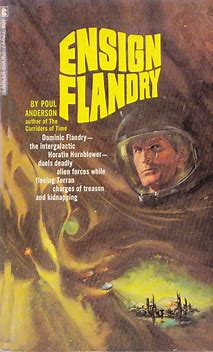
-Poul Anderson, Ensign Flandry IN Young Flandry (Riverdale, NY, January 2010), pp. 1-192 AT CHAPTER EIGHTEEN, p. 188.

Hauksberg should be summarily dismissed from any role as a diplomat or as a representative of Terra.

I recently encountered both arrogance and complacency in an Evangelical who dismissed all other spiritual philosophies without wanting to hear anything about them but I really must stop referring to those guys here.

Tuesday, 19 April 2022

Poul Anderson On Hyperspace


Poul Anderson, Is There Life On Other Worlds? (New York, 1968), Chapter 9, pp. 166-169.

It seems that there was already some evidence for extra-solar planets when this book was first published in 1963.

A Fold In Space
An insect can step directly from one corner of a large sheet of paper to the opposite corner if someone folds the sheet. However, an insect is a three-dimensional organism walking on a two-dimensional surface whereas a spaceship is comparable to a two-dimensional picture that is part of the sheet. Such a picture cannot step from corner to corner.

Quantum Hyperspace
"It may be possible to make a very large number of small quantum jumps per second." (p. 166)

As in Anderson's Technic History.

Civilization Clusters
Several civilizations in each cluster interact but many do not. Inter-cluster contact is tenuous. Explorers, missionaries etc make occasional long trips. This scenario, in Anderson's After Doomsday, is plausible and should have been the basis of an entire series.

Sunday, 28 November 2021

Technic Civilization In Its Galactic Context

"Hiding Place."

"'Our intelligence reports, interrogation of prisoners, evaluation of explorers' observations, and so on, all indicate that three or four different species in this region possess the hyperdrive. The Adderkops themselves aren't certain about all of them. Space is so damned huge.'" (p. 567)

OK. We get it that space is big. But three or four species with hyperdrive? On "'...the very fringe of human civilization...'"? (p. 564) Then how many in the galaxy? Why do they not overlap and interact like the civilization-clusters in Poul Anderson's After Doomsday?

The Aenean rebels exiled by Dominic Flandry flee into another spiral arm. Do they enter another civilization-cluster? Why do exiles or explorers not arrive in known space from further away? Why not some very occasional intergalactic travel?

Intergalactic travel occurs:

in Anderson's Tau Zero, with relativistic acceleration;
in Anderson's World Without Stars, with instantaneous spatial jumps;
in James Blish's Cities In Flight, with spindizzies moving the mass of a planet.
 
It would be a very long journey requiring many stops for refueling and repairs with the quantum hyperdrive but it could be done.

Monday, 29 March 2021

Two Culminations

I know that I keep saying this in different words but I still think that seven volumes culminating in The Earth Book Of Stormgate followed by ten volumes culminating in the post-Flandry collection make for one very impressive future history series, way ahead of any of its competitors, also that each of these culminations is highly appropriate.

In the Earth Book, the editor, Hloch, having recounted the history of the Polesotechnic League as far as van Rijn's arrival at Mirkheim, has reminded his readers of the eventual Babur War and then concluded with two Avalonian tales both told from youthful hover-points even though the first was written in her high old age by Judith Dalmady/Lundgren who was then drawing on the fresh memories of the protagonist, David Falkayn's grandson. Youth and age and beginnings and endings interact throughout the History. Hloch comments that The Earth Book Of Stormgate is ended, wishes his readers fair winds forever and flies above Mount Anrovil in the Weathermother. He has completed the story of the beginning of the colonization of Avalon. 

In the concluding installment of the Technic History:

human civilizations have spread through several spiral arms of the galaxy;

a planetary population descended from the Aenean rebels who were expelled by Dominic Flandry rejoins interstellar civilization even though meanwhile its members have ceased to be human;

a new source of immense wealth, the "Cloud Universe" globular cluster, is about to be opened up to human prospectors and miners.

After seventeen volumes, a new beginning...

Friday, 5 February 2021

Known And Unknown Spaces

In Poul Anderson's Technic History, there is interstellar civilization at one end of one spiral arm of the galaxy because human beings developed the hyperdrive and other nearby intelligent species acquired it from them. Chereinonite civilization had covered a vaster volume of space and the Dispersal of Ymir still does. Merseians deal with planetary civilizations beyond their border opposite to that with the Terran Empire but have any of those civilizations independently developed the hyperdrive? We think not. What will happen if and when two already established interstellar civilizations encounter and interact with each other?  That does not happen in the Technic History with the single exception of the hydrogen-breathing, gas-giant-planet-inhabiting Ymirites with whom interaction is minimal to the point of nonexistent.

For oxygen-breathers, could there be a number of overlapping known spaces such that the Terrans know the Merseians who know X etc? In Anderson's After Doomsday, the galaxy is full of civilization-clusters. For convenience, interstellar travelers usually do business within their local cluster although they are free to visit others and even to explore the Magellanic Clouds but that is possible only because their superlight drive is many times faster than the Technic History hyperdrive. In Anderson's World Without Stars, space travel is faster again with instantaneous jumps even between galaxies in addition to which human lifespans have been extended indefinitely.

The Technic History is bound by a set of assumptions that limit both the speed of its characters' interstellar journeys and the lengths of their lives. However, within those limits, a massive history unfolds.

Saturday, 3 October 2020

The Nine And The Nest

Searching for something, we find other things of the same name. Searching this blog discloses that there are two groups called the Nine and two places called the Nest, three of the latter if we include Yotl's Nest (scroll down), a multi-species bar in another civilization-cluster in After Doomsday. This in turn displays the breadth of Poul Anderson's imagination. The two Nines and three Nests are scattered across:

"Time Patrol," the opening story of the Time Patrol series;

the King Of Ys Tetralogy, historical fiction with an element of fantasy, co-written by Karen Anderson;

"The Nest," a time travel short story;

The People Of The Wind, one volume of the History of Technic Civilization;

After Doomsday, an sf novel.

In The People Of The Wind:

The Nest, a tavern for ornithoids, is the tallest building in Centauri with a gravshaft to its rooftop for humans who have not brought flying gear. It is unwalled, protected from rain by a vitryl canopy. Insectoids circle fluoroglobes and a service robot serves New African beer.
-copied from here. (See: In The People Of The Wind, Chapter Six.)