Operation Luna, 25, p. 234.
The speaking sword, Fotherwick-Botts, says that dwarves made:
Sigurd's dragon-killer;
Skofnung (scroll down);
Tyrfing;
himself.
All of this has been said before as the links show but I do not remember it over the years.
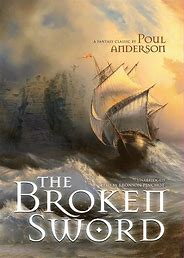
Recent references to Stamford Bridge and to the Varangian Guard (see The Sword) linked Operation Luna to Poul Anderson's The Last Viking Trilogy. Skofnung (see the Wikipedia article, here) is a link to Anderson's Hrolf Kraki's Saga whereas Tyrfing (Wikipedia, here) is a link to his The Broken Sword.
Thus, even more than before, Operation Luna feels like a later installment of a single long series although at the same time each of these works is complete in itself:
The Last Viking is historical fiction;
Hrolf Kraki's Saga is an adapted saga;
it and The Broken Sword are heroic fantasies;
Operation Luna is an alternative history novel and, I think, is sf, not fantasy, because its magic is scientifically rationalized;
Operation Luna is also part of a longer sequence, as we know.
Showing posts sorted by date for query Tyrfing. Sort by relevance Show all posts
Friday, 5 June 2020
Saturday, 17 August 2019
Swords
Perish By The Sword, 5, pp. 47-49.
In these pages, Poul Anderson, through his character, Trygve Yamamura, summarizes considerable information about Japanese swords, the sort of information that I usually summarize further here. However, Anderson's presentation is already so condensed that I will simply refer blog readers to Anderson's text.
It is satisfying that the Japanese-Norwegian Yamamura also refers to, and summarizes the story of, the sword Tyrfing which has already received much blog coverage. See here. Everything comes together.
I continue my quest for "time and place" in Perish By The Sword.
In these pages, Poul Anderson, through his character, Trygve Yamamura, summarizes considerable information about Japanese swords, the sort of information that I usually summarize further here. However, Anderson's presentation is already so condensed that I will simply refer blog readers to Anderson's text.
It is satisfying that the Japanese-Norwegian Yamamura also refers to, and summarizes the story of, the sword Tyrfing which has already received much blog coverage. See here. Everything comes together.
I continue my quest for "time and place" in Perish By The Sword.
Saturday, 7 October 2017
Magic Swords And Future Histories
Who writes both?
HG Wells wrote a fictional history of the period, 1933-2106.
Olaf Stapledon, following Wells, wrote a complete future history, then a cosmic history.
CS Lewis wrote a theological reply to Wells' and Stapledon's anthropocentric future histories.
Robert Heinlein wrote not a fictional historical text book but a series of stories and novels covering successive future periods.
James Blish wrote a future history series and a post-Lewis theological trilogy.
Poul Anderson wrote several future history series, addressed theological issues and continued the stories of the magic swords, Tyrfing and Cortana. (See also here.)
SM Stirling's alternative future history series features emergent deity, eclectic theology and the magical sword, Kusanagi.
Thus, two authors, Anderson and Stirling, have written both about magic swords and about future histories. Kusanagi is in Stirling's Emberverse History whereas Anderson's wielders of magic swords and inhabitants of future histories have to meet in the inter-cosmic inn, the Old Phoenix.
Lewis comes close because, in Volume III of his Ransom Trilogy, Merlin returns although Arthur, wielder of Excalibur, remains on Venus. Volume III, set in a near future, is not itself a future history but does address the issue of the ultimate future of mankind. Volume II had included a prophecy of cataclysmic events twenty thousand years hence.
HG Wells wrote a fictional history of the period, 1933-2106.
Olaf Stapledon, following Wells, wrote a complete future history, then a cosmic history.
CS Lewis wrote a theological reply to Wells' and Stapledon's anthropocentric future histories.
Robert Heinlein wrote not a fictional historical text book but a series of stories and novels covering successive future periods.
James Blish wrote a future history series and a post-Lewis theological trilogy.
Poul Anderson wrote several future history series, addressed theological issues and continued the stories of the magic swords, Tyrfing and Cortana. (See also here.)
SM Stirling's alternative future history series features emergent deity, eclectic theology and the magical sword, Kusanagi.
Thus, two authors, Anderson and Stirling, have written both about magic swords and about future histories. Kusanagi is in Stirling's Emberverse History whereas Anderson's wielders of magic swords and inhabitants of future histories have to meet in the inter-cosmic inn, the Old Phoenix.
Lewis comes close because, in Volume III of his Ransom Trilogy, Merlin returns although Arthur, wielder of Excalibur, remains on Venus. Volume III, set in a near future, is not itself a future history but does address the issue of the ultimate future of mankind. Volume II had included a prophecy of cataclysmic events twenty thousand years hence.
Tuesday, 27 June 2017
Magic Swords II
See Magic Swords. (Also here and here.)
In SM Stirling's The Sword Of The Lady, Chapter Seventeen, p. 523, Father Ignatius mentions Arthur's Excalibur and Roland's Durendal and Harberga mentions cursed Tyrfing. She is glad that the Sword sought by Rudi Mackenzie is not Tyrfing but what is it? How can mere possession of a particular sword make such a difference? The characters accept that this is the case because of a vision but I don't have visions! (My thought processes are verbal, not visual.)
While questing for the Sword, Rudi skirmishes with and weakens his enemies and also forges mighty alliances in every territory across the breadth of the former United States and the future Montival. Is this the significance of the Sword? It is at least part of it.
Poul Anderson never told us what became of Tyrfing.
In SM Stirling's The Sword Of The Lady, Chapter Seventeen, p. 523, Father Ignatius mentions Arthur's Excalibur and Roland's Durendal and Harberga mentions cursed Tyrfing. She is glad that the Sword sought by Rudi Mackenzie is not Tyrfing but what is it? How can mere possession of a particular sword make such a difference? The characters accept that this is the case because of a vision but I don't have visions! (My thought processes are verbal, not visual.)
While questing for the Sword, Rudi skirmishes with and weakens his enemies and also forges mighty alliances in every territory across the breadth of the former United States and the future Montival. Is this the significance of the Sword? It is at least part of it.
Poul Anderson never told us what became of Tyrfing.
Seidh II
"There was a man called Orm the Strong..."
-Poul Anderson, The Broken Sword (London, 1977), I, p. 15.
"There was a man named Orm the Strong..."
-SM Stirling, The Sword Of The Lady (New York, 2009), Chapter Seventeen, p. 501.
A heroic fantasy novel on Earth Real becomes a chanted ancestral epic in the Emberverse. There are two versions of the text. I have a copy of the revised text whereas the Emberversers remember the original words.
Impressive Seidh (clairvoyance):
the repetition of "'...Would you know more?'" (Stirling, p. 511) is from Voluspa;
"'The sword he seeks is more potent than Tyrfing...'" (p. 514) (see also here and here);
Mathilda intends to attend but not participate but instead questions Odin who manifests through the medium;
when, later, the enemy of mankind is identified as Loki (p. 521), this name is used because it fits with the local mythology.
Do Wiccans go to the Summerland and Asatruar to Valhalla? I am all for a "many mansions" approach to the hereafter.
-Poul Anderson, The Broken Sword (London, 1977), I, p. 15.
"There was a man named Orm the Strong..."
-SM Stirling, The Sword Of The Lady (New York, 2009), Chapter Seventeen, p. 501.
A heroic fantasy novel on Earth Real becomes a chanted ancestral epic in the Emberverse. There are two versions of the text. I have a copy of the revised text whereas the Emberversers remember the original words.
Impressive Seidh (clairvoyance):
the repetition of "'...Would you know more?'" (Stirling, p. 511) is from Voluspa;
"'The sword he seeks is more potent than Tyrfing...'" (p. 514) (see also here and here);
Mathilda intends to attend but not participate but instead questions Odin who manifests through the medium;
when, later, the enemy of mankind is identified as Loki (p. 521), this name is used because it fits with the local mythology.
Do Wiccans go to the Summerland and Asatruar to Valhalla? I am all for a "many mansions" approach to the hereafter.
Tuesday, 23 August 2016
Magic Swords Again
Poul Anderson, Operation Luna (New York, 2000), Chapter 25, p. 234.
The magic sword stolen and used by the Matucheks, incredibly both conscious and vocal, refers to four dwarf-forged swords:
Sigurd's dragon-killer;
Skofnung (scroll down);
Tyrfing;
himself -
- thus linking Anderson's Operation... series to the same author's heroic fantasies and even indirectly to his Time Patrol series.
Exorcised demons are colonizing the Moon so human beings need to get there soon but as yet lack an adequate space vehicle. The sword advises: get the dwarf Fjalar to forge a steel broomstick. Anderson is unfailingly consistent in deducing the consequences of even the most absurd of fantasy premises.
The magic sword stolen and used by the Matucheks, incredibly both conscious and vocal, refers to four dwarf-forged swords:
Sigurd's dragon-killer;
Skofnung (scroll down);
Tyrfing;
himself -
- thus linking Anderson's Operation... series to the same author's heroic fantasies and even indirectly to his Time Patrol series.
Exorcised demons are colonizing the Moon so human beings need to get there soon but as yet lack an adequate space vehicle. The sword advises: get the dwarf Fjalar to forge a steel broomstick. Anderson is unfailingly consistent in deducing the consequences of even the most absurd of fantasy premises.
Sunday, 10 July 2016
The End Of The Broken Sword
Poul Anderson, The Broken Sword (London, 1977).
What else can we glean from Odin's explanation and Imric's feelings?
Two of Anderson's novels, this one and War Of The Gods, are propelled by schemes of Odin;
there could/should have been a novel about Skafloc's son wielding Tyrfing;
Odin offered a way out - if Freda were to return to Skafloc... - but, because of Tyrfing, that backfires;
Skafloc is fey - I have just googled this word and learned that its meanings include "fated to die";
Imric says: "'Happier are all men than the dwellers in Faerie - or the gods, for that matter...Better a life like a falling star, bright across the dark, than a deathlessness which can see naught above or beyond itself." (p. 207)
Here, Imric assumes that this life is all we have. Elsewhere in the text, it is assumed that human beings have immortal souls. These two views of human life can alternate in a single text - and also in many people's minds. Anderson's alien character, Aycharaych, says that death is completion and that an immortal being is to be pitied. However, in some of Anderson's sf works, indefinitely extended lifespans can be meaningful.
What else can we glean from Odin's explanation and Imric's feelings?
Two of Anderson's novels, this one and War Of The Gods, are propelled by schemes of Odin;
there could/should have been a novel about Skafloc's son wielding Tyrfing;
Odin offered a way out - if Freda were to return to Skafloc... - but, because of Tyrfing, that backfires;
Skafloc is fey - I have just googled this word and learned that its meanings include "fated to die";
Imric says: "'Happier are all men than the dwellers in Faerie - or the gods, for that matter...Better a life like a falling star, bright across the dark, than a deathlessness which can see naught above or beyond itself." (p. 207)
Here, Imric assumes that this life is all we have. Elsewhere in the text, it is assumed that human beings have immortal souls. These two views of human life can alternate in a single text - and also in many people's minds. Anderson's alien character, Aycharaych, says that death is completion and that an immortal being is to be pitied. However, in some of Anderson's sf works, indefinitely extended lifespans can be meaningful.
Odin
Poul Anderson, The Broken Sword (London, 1977), Chapter XXVI.
I meant to summarize Odin's explanation (see here). However, that explanation is already a summary. I would merely have been repeating his phrases in list form so let's just quote his dialogue:
"'Not yet is this game between Aesir and Jotuns and the new gods played out. Tyrfing still gleams on the chessboard of the world. Thor broke it lest it strike at the roots of Yggdrasil; I brought it back and gave it to Skafloc because Bolverk, who alone could make it whole again, would never have done so for As or elf. The sword was needed to drive back the trolls - whom Utgard-Loki had been secretly helping - lest Alfheim be overrun by a folk who are friendly to the foemen of the gods. But Skafloc cannot be let keep the sword, for that which is in it will make him seek to wipe out the trolls altogether; and this the Jotuns dare not allow, so they would move in, and the gods would have to move against them, and the doom of the world would be at hand. Skafloc must fall, and this child whom I wove my web to have begotten and given to me must one day take up the sword and bear it to the end of its weird.'" (p. 196)
That is complicated and will require some discussion. Odin mentions "...the new gods..." but still does not explain how they fit in with everything else.
I meant to summarize Odin's explanation (see here). However, that explanation is already a summary. I would merely have been repeating his phrases in list form so let's just quote his dialogue:
"'Not yet is this game between Aesir and Jotuns and the new gods played out. Tyrfing still gleams on the chessboard of the world. Thor broke it lest it strike at the roots of Yggdrasil; I brought it back and gave it to Skafloc because Bolverk, who alone could make it whole again, would never have done so for As or elf. The sword was needed to drive back the trolls - whom Utgard-Loki had been secretly helping - lest Alfheim be overrun by a folk who are friendly to the foemen of the gods. But Skafloc cannot be let keep the sword, for that which is in it will make him seek to wipe out the trolls altogether; and this the Jotuns dare not allow, so they would move in, and the gods would have to move against them, and the doom of the world would be at hand. Skafloc must fall, and this child whom I wove my web to have begotten and given to me must one day take up the sword and bear it to the end of its weird.'" (p. 196)
That is complicated and will require some discussion. Odin mentions "...the new gods..." but still does not explain how they fit in with everything else.
Tuesday, 15 December 2015
With Trevelyan Micah
The first three novels written (not published) by Poul Anderson were:
The Broken Sword (fantasy);
Vault Of The Ages (juvenile sf);
Star Ways/The Peregrine (a volume of his first future history).
A future history is event-driven, not character-driven. In this, the Psychotechnic, future history, three characters appear twice and that is it as far as character continuity goes:
"Un-Man," about clones of the dead but well remembered Stefan Rostomily, cameos Fourre;
"Marius," written later but set earlier is about Fourre and cameos Stefan;
in Star Ways, Trevelyan Micah of the Stellar Union Coordination Service bids farewell to Braganza Diane before departing on a mission;
in "The Pirate," written many years later but set a few years earlier, Micah again bids farewell to Diane before departing on a mission.
Thus, Fourre, Micah and Diane each appear twice.
Trevelyan refers to the Second Dark Ages which happened between "Brake" and "Gypsy." When he visits Port Nevada, we read one of Anderson's list-descriptions:
"...humans and nonhumans hustled, jostled, chiseled, brawled, clashed, stole, evangelized, grew rich, grew poor, came, went, and were forgotten..."
-Poul Anderson, Starship (New York, 1982), pp. 213-214.
Trevelyan's nonhuman colleague says of the man whom they are investigating:
"'Our information concerning his world line is fragmentary, and zero about its future segment.'" (p. 220)
Of course information about the future is zero! But does Smokesmith imply that his species does sometimes have information about future segments of world lines? The very fact he (?) discusses a man in terms of his world line is suggestive.
"...the mother-of-pearl iridescence on [Smokesmith's] rugose torso was lovely to watch." (p. 221)
(I took "rugose" to mean "red.")
Nerthus, like Tyrfing, is a name that links Anderson's hard sf to his mythological fiction.
The Broken Sword (fantasy);
Vault Of The Ages (juvenile sf);
Star Ways/The Peregrine (a volume of his first future history).
A future history is event-driven, not character-driven. In this, the Psychotechnic, future history, three characters appear twice and that is it as far as character continuity goes:
"Un-Man," about clones of the dead but well remembered Stefan Rostomily, cameos Fourre;
"Marius," written later but set earlier is about Fourre and cameos Stefan;
in Star Ways, Trevelyan Micah of the Stellar Union Coordination Service bids farewell to Braganza Diane before departing on a mission;
in "The Pirate," written many years later but set a few years earlier, Micah again bids farewell to Diane before departing on a mission.
Thus, Fourre, Micah and Diane each appear twice.
Trevelyan refers to the Second Dark Ages which happened between "Brake" and "Gypsy." When he visits Port Nevada, we read one of Anderson's list-descriptions:
"...humans and nonhumans hustled, jostled, chiseled, brawled, clashed, stole, evangelized, grew rich, grew poor, came, went, and were forgotten..."
-Poul Anderson, Starship (New York, 1982), pp. 213-214.
Trevelyan's nonhuman colleague says of the man whom they are investigating:
"'Our information concerning his world line is fragmentary, and zero about its future segment.'" (p. 220)
Of course information about the future is zero! But does Smokesmith imply that his species does sometimes have information about future segments of world lines? The very fact he (?) discusses a man in terms of his world line is suggestive.
"...the mother-of-pearl iridescence on [Smokesmith's] rugose torso was lovely to watch." (p. 221)
(I took "rugose" to mean "red.")
Nerthus, like Tyrfing, is a name that links Anderson's hard sf to his mythological fiction.
Thursday, 5 November 2015
Early Church-State Conflict
"The Church was a weapon, [Gunnhild] thought, or a tool, for a king to quell an unruly folk; but like the dwarf-forged sword Tyrfing, it could become its owner's bane. Then the next king would be the underling of the bishop's rich kindred.
"Yet without the Church, she thought bitterly, a king must always fear the ill will of the yeomen."
-Poul Anderson, Mother Of Kings (New York, 2003), Book Four, Chapter XXIV, p. 375.
The Church is not a weapon and should not be owned. But, if rulers thought like Gunnhild, then it is no surprise that, when the "unruly folk" demanded a say in government, they challenged not only kings but also bishops. There were Revolutions and a Reformation.
Gunnhild's reflections prefigure the Investiture Contest, the strife between King and Archbishop in England and between Emperor and Pope in Europe. And that returns us the theme of the concluding section of Anderson's The Shield Of Time. (It's "All One Universe.")
"Yet without the Church, she thought bitterly, a king must always fear the ill will of the yeomen."
-Poul Anderson, Mother Of Kings (New York, 2003), Book Four, Chapter XXIV, p. 375.
The Church is not a weapon and should not be owned. But, if rulers thought like Gunnhild, then it is no surprise that, when the "unruly folk" demanded a say in government, they challenged not only kings but also bishops. There were Revolutions and a Reformation.
Gunnhild's reflections prefigure the Investiture Contest, the strife between King and Archbishop in England and between Emperor and Pope in Europe. And that returns us the theme of the concluding section of Anderson's The Shield Of Time. (It's "All One Universe.")
Tuesday, 1 October 2013
Perish By The Sword
(Will be away 4-14 Oct.)
I do not make this stuff up. Poul Anderson books really are this interesting to read and discuss.
A novel about contemporary scientists and their current work is fiction about science but is not "science fiction" so what is it? (Someone once told me that she was not a "girl friend" but a "girl who is a friend.") Poul Anderson's Perish By The Sword (New York, 1959) is a detective novel about science with the information about Japanese swords adding almost a historical fiction element and even a fantasy element if we heed the legends about the swords. The Norse sword, Tyrfing, which features in Anderson's historical fantasy, is mentioned for comparison.
The detective is Trygve Yamamura but a surprising number of chapters are narrated from the point of view of his friend, Michael Stefanik. Stefanik is attacked with a stolen sword and I wondered if one chapter was going to end with his death. But things get more complicated.
Maybe an established science fiction writer should avoid references to sf when writing in another genre? For instance:
"(Part of Yamamura wondered why a terminated human being always appeared so much more dead than an animal, and thought that perhaps it was because man had no fur to cover his poor waxen skin, and speculated that a race of furry intelligent beings might be less afraid of their dead than man is.)" (p. 78)
That is just the sort of speculative detail that Anderson does include in his hard sf but does it fit here?
When confirming an alibi, one character says:
"'I wish I were enough of a scientist to invent a time machine and be in two places at once, but I'm afraid such talents as I have are more for business.'" (p. 89)
Exactly. This book is about business, not time travel! Readers unfamiliar with sf might ask, "How could a time machine let him be in two places at once?" If he travels back twenty four hours, then he necessarily coexists with his younger self of one day ago. I know from experience that some people would not understand this or would say that it was impossible or might even argue that his younger self was there yesterday but now his older self is so his younger self can't be as well. Or something.
It is good that different works interconnect and cross-refer even across genres but maybe, when immersed in a mystery novel, we are better off not being too directly reminded of issues in sf?
I do not make this stuff up. Poul Anderson books really are this interesting to read and discuss.
A novel about contemporary scientists and their current work is fiction about science but is not "science fiction" so what is it? (Someone once told me that she was not a "girl friend" but a "girl who is a friend.") Poul Anderson's Perish By The Sword (New York, 1959) is a detective novel about science with the information about Japanese swords adding almost a historical fiction element and even a fantasy element if we heed the legends about the swords. The Norse sword, Tyrfing, which features in Anderson's historical fantasy, is mentioned for comparison.
The detective is Trygve Yamamura but a surprising number of chapters are narrated from the point of view of his friend, Michael Stefanik. Stefanik is attacked with a stolen sword and I wondered if one chapter was going to end with his death. But things get more complicated.
Maybe an established science fiction writer should avoid references to sf when writing in another genre? For instance:
"(Part of Yamamura wondered why a terminated human being always appeared so much more dead than an animal, and thought that perhaps it was because man had no fur to cover his poor waxen skin, and speculated that a race of furry intelligent beings might be less afraid of their dead than man is.)" (p. 78)
That is just the sort of speculative detail that Anderson does include in his hard sf but does it fit here?
When confirming an alibi, one character says:
"'I wish I were enough of a scientist to invent a time machine and be in two places at once, but I'm afraid such talents as I have are more for business.'" (p. 89)
Exactly. This book is about business, not time travel! Readers unfamiliar with sf might ask, "How could a time machine let him be in two places at once?" If he travels back twenty four hours, then he necessarily coexists with his younger self of one day ago. I know from experience that some people would not understand this or would say that it was impossible or might even argue that his younger self was there yesterday but now his older self is so his younger self can't be as well. Or something.
It is good that different works interconnect and cross-refer even across genres but maybe, when immersed in a mystery novel, we are better off not being too directly reminded of issues in sf?
Friday, 22 February 2013
Flying Mountains IV
That it is a future history, not just a futuristic series, is established when the narrator informs us:
"Thanks to antisenescence, we have a number of persons aboard who experienced those days of more than a hundred years ago." (p. 43)
Thus, the series covers more time than a single normal lifespan.
("Antisenescence" also occurs in Anderson's History of Technic Civilization, which covers thousands of years although no one in it lives that long.)
The narrator refers to the spaceship Tyrfing, obviously a Norse name, incorporating Tyr, the war god. Thinking that Tyrfing sounded familiar and wanting to check its source, I googled "Poul Anderson Tyrfing" and was referred to my own article, "Tyrfing," on this blog, September 2012. The cursed sword Tyrfing featured in an Eddaic poem, in a Saga and in Anderson's heroic fantasy novel, The Broken Sword. Now, a spaceship is named after it in Anderson's sf series, Flying Mountains.
A character refers to "Mohammedanism" (p. 15) whereas Muslims of course prefer "Islam."
Friday, 5 October 2012
Retellings And Reconstructions
Secondly, Anderson wrote not another heroic fantasy but a historical science fiction novel, The Dancer From Atlantis. Thus, the hero is not Theseus but Duncan Reid, a twentieth century man displaced in time and trying to return home. Theseus becomes a minor villain by conspiring against the Minos with the Ariadne (see below) who has the benefit of foreknowledge imparted in good faith by Reid.
Since the novel is not fantasy but historical sf, it presents possible sources for several elements of the Theseus myth:
not a king called Minos but kings whose title is "the Minos";
not a king's daughter called Ariadne but high priestesses whose title is "the Ariadne";
the Minotaur as the annual sacrificial bull, not a bull-headed man;
the Labyrinth as the Minos' palace, not the Minotaur's lair;
Athenian hostages not sacrificed to the Minotaur but indoctrinated and returned home.
Anderson adopted both of these approaches to Odin, presenting the god's original in a historical novel and the god in the heroic fantasies about Hrolf, Hadding and the cursed sword Tyrfing.
Blogging while rereading, I must sometimes correct details. I said earlier that, apart from Chapter Two, which introduces Reid's traveling companions, The Dancer From Atlantis is narrated entirely as from Reid's point of view. Contradicting this, Chapter Fifteen returns to Erissa's viewpoint in order to recount what she does while separated from Reid.
Sunday, 30 September 2012
The Strands Come Together
" 'The sword Tyrfing goes about in the world, and each owner gets victory from it, but he becomes an evildoer and in the end the sword is his bane.' " (p. 223)
Thus, he summarizes Anderson's first fantasy novel, The Broken Sword.
At last, away from bewitchment and with the benefit of hindsight, Hrolf begins to recognize the yeoman Hrani:
" 'That could have been old Odin. Truly - only now do I know what I saw - he was a man with one eye.' " (p. 224)
Too late to regain Odin's good will, the Danes decide to avoid battle "...for Odin is the Father of Victories..." although Hrolf comments, " ' His own doom sets the life of every man, and not yonder spook.' " (p. 224)
So now, thanks to all their fighting, Denmark have seven years of peace. We would regard this as a positive outcome but to them it is also negative. At peace, they can no longer win wealth or fame in battle and Odin may now be against them. The Saga draws to its end. We may expect a last battle in which the heroes meet their doom.
Wednesday, 26 September 2012
Magic Swords
Sighurd's Gram;
"...Tyrfing the accursed...";
Skofnung, given to Hrolf by an elven woman;
Lovi, of which more will be told later in the Saga (p. 129).
Magic swords never rust and always bite although Excalibur is not listed here.
Poul and Karen Anderson wrote a King of Ys tetralogy;
The Broken Sword refers to Ys;
The Demon Of Scattery refers to The Broken Sword;
War Of The Gods, like The Broken Sword, features Odin;
Hrolf Kraki's Saga, like War Of The Gods, describes Odin's descendants;
Hrolf Kraki's Saga refers to the broken sword.
Thus, here are eight connected volumes: four by Anderson; four by the Andersons.
Odin
(ii) In his science fiction, a time traveler regularly visiting a Dark Age tribe is mistaken for Odin and has to play that role to the end.
(iii) In his heroic fantasy, Odin connives to get the Eddic sword Tyrfing reforged and also prevents a second War between Aesir and Vanir.
Thus, we encounter the original of Odin, a man mistaken for Odin and Odin. The god permeates three genres and four works.
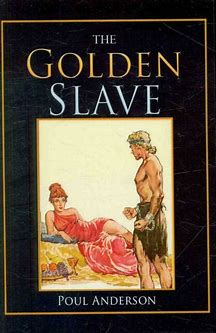
In (i) the historical novel, The Golden Slave (New York, 1980), the central character, leading a slave mutiny, is helped by a large man with red hair and beard who grabs and kills with a hammer, then declares:
" 'They call me Tjorr...' " (p. 128)
I immediately thought, "OK. Where's Odin?" He had been with us from the beginning. The central character, introduced in the second sentence, is called "Eodan." Tjorr goes on to say something equally significant, although I did not realize this on first reading:
" 'I am of the Rukh-Ansa...' " (p. 128)
"Ansa" is another name for "Aesir." As Anderson writes in the Epilogue:
"It was told from olden days, and written in the books of Snorri Sturlason, that the Asa or Ansa folk fared from the land of Tanais to the North. They soon became overlords...who themselves came to be worshiped as gods after they died. The first Asa king was called Odin, and he was the chief of the gods." (pp. 281-282)
And the Author's Note at the beginning of the novel informs us that the "...tradition described in the epilogue may be found..." in the Heimskringla and Saxo Grammaticus. (p. 6)
Thus, Saxo, a source for Anderson's fantasies featuring Odin as a god, is cited here instead as a source for the idea that Odin was a man, later deified. We read in Anderson's Hrolf Kraki's Saga (see here) that there was a temple of the high gods at Upsala but, according to the tradition described in the epilogue, Upsala was first the center from which the human Ansa ruled.
In the novel, we see Eodan lead his men from Tanais. He has encountered Zoroastrianism and we are to understand that the good-evil conflict in that religion informs the gods-giants conflict in Norse religion. Of necessity, Eodan loses an eye during the novel. He says at the end:
" 'I gave it for wisdom.' " (p. 279)
Tuesday, 18 September 2012
Tyrfing
The novel is Poul Anderson's The Broken Sword (London, 1977), where the giant Bolverk says:
" 'Me it was whose help Dyrin and Dvalin besought, when they must make such a sword as this to ransom themselves from Svafrlami...' " (p. 163)
The attached image shows Odin's grandson Svafrlami securing Tyrfing.
Anderson's novel accurately reproduces the properties of the sword, the nature of its curse and eventually even its name as given in the Elder Edda. Thus, Anderson not only bases his heroic fantasy generally on Norse mythology but also more specifically presents a continuation or direct sequel to the Edda and the saga. Odin gives Tyrfing to Anderson's hero Skafloc because this superior weapon will enable Skafloc Elven-Fosterling to drive back the trolls who might otherwise overrun the elven realm, Alfheim. (The trolls are secretly aided by the gods' enemies, the giants, whereas Alfheim is potentially friendly or at worst indifferent and neutral.)
The Broken Sword, a thin paperback of fantastic content, is deceptive in appearance because the reader must look beneath its surface to find that it does not merely imitate Norse mythology; it also continues a story begun in the Elder Edda.
Subscribe to:
Posts (Atom)