Showing posts sorted by date for query Thor. Sort by relevance Show all posts

Saturday, 10 October 2026

Dunne, Rhine And Mitchell

Poul Anderson, "The Long Remembering" IN Anderson, Homeward And Beyond (New York, July 1976), pp. 22-36.

I wanted to comment on Poul Anderson's reference to JW Dunne but find that I have already done so at some length. See here. But there are two other references. The first is to Rhine.

The second, to quote the entire passage, is as follows:

"'I've done nothing more than systematize the work of predecessors, from as long ago as Dunne and Rhine if not further. I owe a tremendous debt to Mitchell and his colleagues; in fact, what I've done amounts largely to fusing their discoveries in noetics with some new concepts of physics and cosmology, and using modern laboratory equipment to check out the hypotheses that followed.'" (p. 25)

I took Mitchell to be a fictional future researcher like the speaker, Rennie, or like James Blish's Adolph Haertel and Thor Wald. However, in his introduction to another story collected later in Homeward And Beyond, Anderson writes:

"When an Edward Mitchell sees fit to found a school of noetics, I pay respectful attention. He's been on the Moon." (p. 166)

See IONS.

While trying to track down the references to Dunne, I have only just now, over breakfast, made this connection between the two references to Mitchell in this Anderson collection.

Sunday, 19 July 2026

Time Travel Scenarios

Returned from the Viking Festival, where a guy at a stall blew through a tube to make small pewter Thor's hammers, we resume rereading Tim Powers' The Anubis Gates which remains fascinating although it really belongs on the Logic of Time Travel blog which, however, has effectively transferred its functions here, to the Poul Anderson Appreciation blog. See About Time Travel.

Meanwhile, SM Stirling's The Lords Of Creation, Volume III, The Lords Of Creation, should be en route via eBay. "Poul" and other sf writers have their says at the beginning of Volume I or II as far as I can remember without being able to check the text momentarily.

Contemporary fiction has a single premise: that the contemporary world exists as it does because history occurred as recorded. Sf varies its premises. Poul Anderson's Time Patrol would be unnecessary in The Anubis Gates. How would the Patrol respond to the events of SM Stirling's To Turn The Tide? As a matter of fact, in the Patrol timeline, there is not, as far as we know, any world-wide nuclear war in 2032. Therefore, the Patrol would prevent such a war from occurring and would also, of course, try to prevent any time travellers from changing history in the second century CE.

Good guys in one scenario are bad guys in another.

Wednesday, 20 May 2026

A Magic Sword

The Broken Sword, XXIII.

John Carter, the self-proclaimed best swordsman of two worlds, could defeat any number of sword-wielding antagonists. He thought that he and his friend, Tars Tarkas, would have been able to fight their way across Mars killing all before them.

Some fantasy heroes are not only blessed with fighting skills but also cursed with magical swords. (I do not honestly know how many magical swords are cursed but Skafolc's is.) Shortly after he has attacked and killed six trolls, Skafolc is stalked by two more. He hews through the shield, shoulder and heart of the first and the second spits himself on the upraised sword which simultaneously gives Skafloc an "...unearthly strength..." (p. 169) enabling him to withstand the impact.

Again, two perceptions of reality: snow-devils whirl on a mountain and trolls storm an elvish fortress. Skafloc's horse leaps a ravine and gallops through the troll camp as Skafloc burns the tents. He kills three besieging trolls while his horse tramples three. He mows trolls down. They cannot touch his iron. He severs a head, opens a belly and cleaves through a helmet, skull and brain. His horse mortally kicks and bites most of the infantry.

Metal clangs and screeches. Blood steams. Snow is trampled. Corpses wallow. Trolls panic and scramble between burning tents and castle wall, recognizing a Jotun horse and a haunted sword. Skafloc rides back and forth. His mail gleams. Trolls think that he is Odin, Thor, Loki, a possessed man, Death...

Elves sally. The Erlking leads. Swords and axes rise and fall. Metal is shattered. Spears and arrows cloud the sky. Horses trample. Warriors die. Illrede leads a wedge to split the elves. Skafloc charges. Man and troll-king fight. Illrede's axe splits Skafloc's shield and dents his helmet but:

"...the uncanny strength lent by the sword kept Skafloc from swooning." (p. 173)

Axe bursts on sword. Skafloc kills Illrede.

There are nuances but this is a summary.

Before their fight, Illrede says that it was a wicked deed to bring back that sword:

"'Whatever his nature, which the Norns and not himself gave, no troll would do such a thing." (pp. 172-173)

I agree with Illrede that fate or destiny made us what we are. Although I meditate, I do not buy into the idea of previous lives. But we are responsible now for cleansing our karma. 

Monday, 11 May 2026

Chill Wind And Slow Storm

The Broken Sword, XII.

Skafloc's wizard skis bear  "...him like the wind." (p. 83) He meets Tyr who:

"Despite a chill wind...wore only a wolfskin kilt..." (ibid.)

It is not good to meet the god of war "...alone at dusk..." (ibid.) so, of course, the wind at the time of this meeting is appropriately chill. 

"[Tyr's] voice was as of a slow storm through a brazen sky." (p. 84)

The earliest gods were personifications of natural forces. It would have been imagined that a storm was the voice of a god so, of course, this god's voice sounds like a storm. When society became more complicated so that social forces like wars overwhelmed individuals with the apparent inevitability of natural forces like hostile weather, then social forces also were personified. Thus: Thor, thunder; Tyr, war. Next, personified external forces were unified. Then they came to be understood and therefore no longer personified... However, because external forces remain uncontrollable, resort is still made to spells or prayers.

Poul Anderson's narrative returns us to those ages when a storm was a voice and when men told tales of gods and elves.

Sunday, 3 May 2026

Aesir And Others

The Broken Sword.

The Aesir are the Norse pantheon. As As is a god. "Aesir" is the plural: "gods." Asgard is the enclosure of the gods. Thus, a dweller in Asgard is an As, not an "Asgardian," as in Marvel Comics.

Imric the elf-earl:

hears Thor ("Thunder...great wheels across the sky...," III, p. 23);

sees Odin ("...long gray beard...shadowing hat...spear...single eye...," p. 24);

receives Skirnir ("...messenger of the Aesir...," IV, p. 25).

Although I did not remember Skirnir's name, Wikipedia reminds us that he is in both Eddas.

Odin will reappear in this novel.

The omniscient narrator informs us that gods, giants and trolls are "...others..." (ibid.) of the same sort as elves, whatever sort that is. This sort has in common that they do not age and have:

"...few children, centuries apart..." (ibid.)

The text proceeds to mention dwarves, sprites, gnomes, goblins, a faun, Pan, the new god, dryads, nymphs and Olympians. For some of these beings, see:

Out In The Weather

Wednesday, 14 January 2026

Disappearances And Appearances

In the opening paragraph of "The Problem of Thor Bridge," Dr. Watson refers to:

James Phillmore who stepped back into his house for his umbrella and was never seen again;

the ship, Alicia, which sailed into a patch of mist and was never seen again;

Isadora Persano who was found insane in front of a matchbox containing a worm unknown to science.

These seem to me to be cases not for Manse Everard of the Time Patrol but for Valeria Matuchek, explorer of the multiverse. Phillimore and the Alicia departed into other universes. The worm came from another universe. There are few imaginary or speculative scenarios that cannot find an explanation in Poul Anderson's multiverse. Phillimore might have passed through the Old Phoenix either into a very different universe or into one so similar that he was not aware of any difference.

Those who leave Neil Gaiman's Inn of the Worlds' End return to the world of their origin or to one very similar.

Saturday, 10 January 2026

Against The Universe?

"Territory."

"Joyce shivered. 'This is a cruel cosmos. That's what we believe in on Esperance - fighting back against the universe, all beings together.'
"'It is a very nice philosophy, except that all beings is not built for it.'" (p. 83)

See The Enemy.

"All beings together against a cruel cosmos" sounds like pieces of two different philosophes spliced together somehow.

The universe can be regarded as hostile or maternal depending on which of its aspects we emphasize. On the one hand, we evolved and are sustained in this universe, not anywhere else. On the other hand, we can survive in only a very narrow range of environments. But, on the other hand, the rest of the universe, the stars with their life-giving heat and light, are necessary to sustain the life-bearing planetary environments. 

My pantheon includes Indra who sends rain, Prometheus who controls fire and Thor who kills giants of ice and frost.

We belong here despite ice and fire.

"All beings together" if they can see it that way.

Merseians can see it that way although they were originally introduced as cliched pulp green alien hostiles.

Tuesday, 7 October 2025

Out Of The East

"Star of the Sea."

"Out of the east, the morning behind them, rode the Anses into the world." (II, p. 557)

The Anses are the Aesir whom we know as Odin, Thor etc. The Wanes or Vanir resist them before making peace.

Jens Ulstrup, Patrol ethnographer, explains to Everard and Floris that the Indo-Europeans:

"'...brought their characteristic warlike, masculine sky-gods, the Anses or Aesir. Dim memories of the conflict between cultures survived in myths of a war between the two divine races, which was finally settled by negotiations and intermarriage.'" (11, pp. 565-566)

Poul Anderson's text presents both a version of the mythical war and an ethnographer discussing that war. In Anderson's The Corridors Of Time, time travellers supervise the integration of Indo-European invaders into Northern Europe and the intermarriage of the pantheons so we wind up viewing the same events from different angles.

Monday, 7 July 2025

Gods Again

We are busy here. I have not got back into reading yet. Why do I focus so much on gods in Poul Anderson's works?

(i) I do not believe that gods literally exist.

(ii) I do believe that they are an important part of our imagination and that, in that sense, we would not exist without them.

(iii) We know Odin as a character in the Eddas and in works of fiction by Poul Anderson and Neil Gaiman.

(iv) Thor is mentioned in Anderson's War of The Gods and there are different versions of him in Gaiman's The Sandman and in Marvel Comics.

(v) We see the human originals of Odin and Thor in Anderson's The Golden Slave.

(vi) Although a Christian monotheist, CS Lewis gives a surprising degree of autonomy to Greek gods in Narnia and Ransom.

Saturday, 3 May 2025

Dark Home And Real Estate

Mirkheim, II.

In Norse mythology, Myrkheimr means "dark home," although it has halls of gold. It is the abode of dwarves.

In Poul Anderson's "Lodestar" and Mirkheim, Mirkheim is an uninhabitable, now sunless, planet coated in supermetals more valuable than gold.

"'And Mirkheim is real estate that everybody wants.'" (p. 55)

That sentence might remind some readers of Hell in Neil Gaiman's The Sandman: Season Of Mists. When Lucifer Morningstar retires and expels demons and damned from Hell, he locks his now empty realm and gives the key to Morpheus, Lord of Dreams. Hell now becomes desirable supernatural real estate and "everyone," including Odin, Thor and Loki for the Aesir, makes offers to Morpheus... The Aesir might evade the Ragnarok by sheltering in Hell...

Thus, this version of Hell is supernatural like Myrkheimr and coveted like Mirkheim.

Gaiman's fantasy matches Anderson's.

Wednesday, 26 March 2025

The God

I find that I have posted no less than three times about a cartoon in which a man praying to "God" is answered by Thor. See here.

If there are many gods, then each needs a name but, if there is only one, then "God" becomes a name just as extraterrestrials might address the last surviving male human being indifferently either as "John" or as "Man." The need for a distinguishing name becomes redundant. The need to address an invoked entity by the correct name persists in demonology.

However, in Poul Anderson's Technic History, the monotheists of the Merseian Roidhunate refer not to "God" but to "the God," implying, I think, a lack of personal relationship to this single deity. We know that at least the Vach Urdiolch has "Secret Prayers" and we do not know what is said in them. (They are secret.)

The phrase, "...THE GOD..." occurs twice on p. 422 of James Blish's After Such Knowledge (London, 1991). A demon, speaking in capitals, refers contemptuously to "THE GOD" Who does not appear and Who, allegedly, is dead. Apparently, that being no longer warrant a Name...

There is no remotest connection between Blish's demon and Anderson's Roidhunate - except that at least one sf fan, reading of one, thinks of the other. Everything connects in our minds.

Tuesday, 4 March 2025

Weather

Starfarers, 30.

When Yu comes to tell Sundaram about the threat to reality, there is appropriate weather: rain, wind, lightning and thunder. When she enters and closes the door, a gust tries to seize it. When it has become clear that she has something terrible to relate, wind hoots. When he holds her hand, it is colder than that external weather. When he protests that living beings, less than dust motes, cannot menace creation, lightning blazes, darkness returns and thunder sounds like monstrous wheels. (Thor?) When she has explained more and he sits mute, rain slashes and wind keens.

This weather is the continual backdrop to the discussion summarized in the two previous posts. My summary is a mixture of paraphrase and quotation. Of course I urge blog readers to read or reread Poul Anderson's text.

Tuesday, 5 November 2024

Gods

See:

Cosmos And Life

Cosmos And Joe

A Christian or a secularist will ask whether Joe believes that his little local gods of life literally exist whereas a modern Pagan will say that it does not matter. The gods can be personifications. When I hear thunder and say that Thor is passing overhead, I know that this statement is mythological and metaphorical, not metaphysical or meteorological.

Christians made an issue of belief, proclaiming a creed, then dividing humanity first into believers and non-believers, then into true believers and heretics.

As philosophical sceptics, we can participate in rituals celebrating the passage of the seasons personified as deities.

Where I disagree with Joe in his counter-position of Cosmos to gods of life. We live in an ecology and in the cosmos! We are living beings and cosmopolites. 

Saturday, 20 July 2024

Local And Future History


OK. Poul Anderson's History of Technic Civilization has an intricate structure which is not only fascinating but also somehow dynamic at least when the reader's attention shifts back and forth between the two equally valid reading orders for the first main section of the history. Either we begin and end this section with the earlier published collections, Trader To The Stars and The Earth Book Of Stormgate, or instead we read through the first twenty four instalments in their fictional chronological order as presented in Baen Books' The Technic Civilization Saga, Volumes I-III (of VII).

When I posted earlier today, I had just returned from the Heysham Viking Festival which has a ship and people in costume practising crafts in tents. Many wear Thor's hammer as a medallion. St. Peter's Church in Heysham is over a thousand years old and there is also a ruined St. Patrick's Chapel overlooking Morecambe Bay. We live and breathe history and project future history.

Thursday, 13 June 2024

Not The Universe


Fire Time, XIII.

"'Having yarned with a lot of outsiders, I knew our gods did not rule the universe.'" (p. 148)

The pagan attitude. As a matter of fact, Larreka had come to doubt whether the gods "'...were more than a story.'" (ibid.) But, even if they are real, they do not rule the universe. 

Buddhism spread to different countries, leaving the local gods in place. A Christian who visited our particular Buddhist Priory was told that she would continue to believe that and the monks would teach her how to meditate.

I say that thunder is Thor passing overhead and know that this language is mythological but also that we would not be human beings without imagination, myth, story and fiction.

Sunday, 31 March 2024

Populations

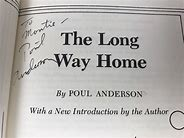
The Long Way Home.

We have to remember that:

the Solar Technarcy rules the populations of Earth, Mars, Venus and the Jovian moons;

the Council of the League of Alpha Centauri rules the populations of five Centaurian planets;

the bureaucracy of the Commercial Society rules entire populations inhabiting a fleet of large interstellar spaceships.

What do we see of these populations apart from a few individuals? We are shown a Commons street scene on Earth. The Centaurian ambassador to Sol reminisces about his life on the planet, Thor. We do not see inside any Society ship - as far as I have reread and as far as I can remember - but maybe they would be similar to the Nomad and Kith ships that we see in other Andersonian future histories?

"...the Society...really was a nomad culture, patriarchal and polygamous..." (CHAPTER ELEVEN, p. 102)

A few phrases convey compact information.

Saturday, 30 March 2024

The Interstellar Regimes

The Long Way Home.

Valti's offer to Langely includes:

"'...you can be set up on some human-colonized planet beyond the region known to Sol and Centauri. There are many lovely worlds out there, a wide cultural variety, places where you can feel at home again. Your monetary reward will give you a good start.'" (CHAPTER EIGHT, p. 82)

Brannoch's offer:

"'I'm prepared to offer a very generous payment, protection, and transportation to a world of your choice...'" (CHAPTER NINE, p. 91)

Despite the light-speed limit, despite also the many farther away civilizations that have become what I call "beyond contact," there is nevertheless a large number of inhabited planetary systems that are in regular contact with each other. And there are both human colonials and "Eties."

Alpha Centauri A has two humanly colonized planets, Thor and Freyja. Alpha B has two planets being gradually terraformed. The red dwarf, Proxima Centauri, also part of the triple star system, Alpha, has an inhabited gas giant, Thrym. The League of Alpha Centauri comprises Thorians and Thrymans with the latter possibly more powerful. A Thryman is a six-foot disc with six legs, head and sense organs in bulges at the centre of the disc. They are telepathic.

We have yet to summarize the set-up either in the Solar Technarchy or in the Commercial Society.

Friday, 29 March 2024

Holatans And Commons

I had not rated The Long Way Home as a significant novel by Poul Anderson and have reread and blogged about it at least once before but look how much we can still out of it:

the peculiarities of the interstellar superdrive
the two theories of how it functions
the "beyond contact" civilizations that it generates
the planet, Thor
the Holatans
the Solar Technarchy
the Commercial Society
the Commons
the paramathematical theory of man

A crucial point is reached when it is acknowledged that man has not been liberated. Why not and how might he have been?

Holatan life is grounded in family rites and pantheism. Commons families chant hymns to Father in a temple. Could there be some common ground between them? Holatans and Commons do have a single creator: Poul Anderson. 

Tuesday, 26 March 2024

Thor, The Planet

The Long Way Home, CHAPTER TWO.

The Alpha Centaurian ambassador to the Solar Technate reminisces about his home planet, Thor. Regular readers recognize this as a familiar kind of Andersonian colony planet:

steep, windy mountains;
whistling, stormy skies;
heaths;
forests;
broad plains;
grey seas pulled by three moons;
higher gravity;
an ancestral hall;
stone;
timber;
smoky rafters;
ancient battle flags;
horses;
hounds;
hunting;
proud nobles;
solid yeomen;
winter snow;
green spring.

Will human beings be able to reproduce their history like this on an extra-solar planet? Doubt it.

Friday, 26 January 2024

Thor And Ansa

The People Of The Wind, IV.

The Terran fleet includes:

"...the Planet-class cruisers, Thor and Ansa..." (p. 477)

Thor, of course, is a Norse god, mentioned in Poul Anderson's War Of The Gods. Ansa is a planet forcibly annexed by the Terran Empire in the previous Technic History instalment, "Sargasso of Lost Starships." However, that planet was named after:

"'...warlike, masculine sky-gods, the Anses or Aesir.'"
-Poul Anderson, "Star of the Sea" IN Anderson, Time Patrol (Riverdale, NY, December 2010), pp. 467-640 AT 11, p. 465.

And Thor was an Ansa or As. (Plurals: Anses; Aesir.)

Thus again, names encapsulate much history and, in this case, both refer back to Norse mythology.