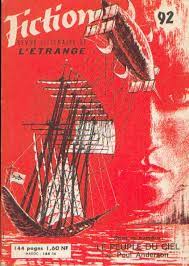
This article was unsuccessfully submitted for publication elsewhere. Since then, several of its themes have been presented separately in posts on this blog. For what it is worth, here is the original article.
Although Poul Anderson's History of Technic Civilization is a long series, forty three fictional works of different lengths, it is economically written. The History divides into several periods each of which could have been treated at greater length. Six works about Master Merchant Nicholas van Rijn of the Polesotechnic League lead to five about one of van Rijn's trader teams, then to five about the aftermath and consequences of the van Rijn period. Thus, these three divisions, comprising sixteen works, are less than half the total.
The trader team of the series is:
the human Hermetian colonial
David Falkayn, Master Merchant, Polesotechnic League;
the dinosaur-like male Wodenite Adzel, planetologist;
the squirrel-like female Cynthian Chee Lan, xenobiologist;
the consciousness-level computer, "Muddlehead," in the spaceship,
Muddlin' Through.
One story had already introduced Adzel and the League and two had introduced Falkayn so we are now considering nineteen works.
The five about the team are:
"Trader Team"/"The Trouble Twisters"
"Day of Burning"
Satan's World
"Lodestar"
Mirkheim
"Trader Team" was re-entitled "The Trouble Twisters" when it was re-published in a three-story collection called
The Trouble Twisters. However, the other two collected stories describe earlier events in Falkayn's career, not later adventures of the team. Thus, "The Trouble Twisters" is not the opening story, Part I, but the culmination, Part III.
The story, published in 1965, provides an illuminating example of how future histories are written. It informs us that the dragon-like Adzel sang Fafnir and paraded at Chinese New Year while a student on Earth. This information is imparted along with some characterization. Adzel affirms his appreciation of other cultures by mentioning his singing of Fafnir, Chee snidely retorts by mentioning the less dignified street parades and Falkayn tells them to stop squabbling. But the information provides the basis for a later written story. "How To Be Ethnic In One Easy Lesson," published in 1974, narrated by human student James Ching, who is never seen again in the History, tells us how James', his girlfriend's and Adzel's problems were all solved by Adzel's dragon performances.
In "Trader Team"/"The Trouble Twisters":
van Rijn explains the trader team or "trade pioneer crew" idea to Falkayn;
the team has its first adventure, on the planet Ikrananka;
afterwards, Falkayn defines their new profession:
"...we're a new breed. Not troubleshooters. Trouble twisters. I suspect our whole career is going to be a sequence of ghastly situations that somehow we twist around to our advantage." (1)
The team does not explore new planets beyond the frontiers of known space. Explorers had already bypassed many planetary systems as not of immediate interest. Van Rijn's Solar Spice & Liquors Company sends robot probes to these nearer systems. The team explores any that seem promising. But "The Trouble Twisters" is the only story in which we see them do this. In "Day of Burning," they are on Merseia which had been visited two centuries before during the Grand Survey. Merseia will be devastated by a nearby supernova unless League merchants supply force screens that will both protect Merseian civilization and enable Technic scientists to use Merseia and its moons as bases for study of the supernova.
Muddlin' Through happened to be the nearest League ship when the dual problem of how to study the supernova and how to protect Merseia was identified. Divisions between Merseians cause problems obliging the team to "trouble twist." Falkayn tells a Merseian leader that he has seen planets devastated by nuclear wars, the only time in the series when we are told this. Potentially, a story could have been told about one of these.
Satan's World differs again. The team seeks intelligence by consulting a data-processing firm within the Solar System where Falkayn is both lionized and spied on because he is:
"Right-hand man and roving troubletwister for Old Nick." (2) ("Trouble twister" has become a single word.)
So a lot more has occurred than merely the two adventures of which we have been informed. Van Rijn and his team must now address not "trouble" on one planet, another Ikrananka or Merseia, but a threat to Technic civilization. Van Rijn splits the team, keeping Adzel with him but sending the others elsewhere. The two teams re-join on a hostile planet from which they might not escape. This third episode potentially ends the trader team sub-series. First the team is split, then it might not survive and indeed its entire civilization is endangered. Although an immediate end is averted, the external threat from the Shenna has served as a warning that Technic civilization is not as secure as it seems.
Satan's World was potentially a turning point and we will see that the remaining two works are indeed turning points. Further, civilization is threatened not only by external enemies but also by its internal contradictions.
At the very end of
Satan's World, as
Muddlin' Through accelerates outwards, Falkayn remarks:
"I don't know why we're starting out again when we're rich for life." (3)
Chee replies:
"I know why you are...Any more of the kind of existence you've been leading, and you'd implode...And me, I grew bored. It'll be good to get out under fresh skies again." (3)
Adzel, the Buddhist convert, adds:
"And find new enlightenments..." (3)
Falkayn concedes:
"Yes, of course...I was joking. It sounded too pretentious, though, to declaim that the frontier is where we belong." (3)
And Muddlehead resumes the poker game. With the crisis averted, they leave the Solar System and return to "troubletwisting." However, again, we do not see them doing it. The next time we see the team, at the beginning of "Lodestar," they have taken a few days off at the League outpost on the planet Tametha - where, however, they do encounter some unexpected trouble, a native uprising against exploitation by League companies. Here, not "troubletwisting" but mere combat skills and Muddlehead's ability to take off fast are essential.
"Lodestar" is equally a trader team story and a van Rijn story. When the team has escaped from Tametha, the scene shifts to van Rijn ten years later. We are informed both that nearly a decade has passed since the Satan episode and that:
"...pioneers like the
Muddlin' Through team...kept finding him profitable new lands." (4)
But we do not see them doing it. Van Rijn takes to space again. (In his own series, he had been in space in four works and had received employees' reports in two.) Here, he seeks a source of industrially valuable supermetals and learns that his team had discovered such a source ten years earlier on "Eka-World" but had given it to the poorer planets, not to him. Falkayn had sought a supermetal source on his own initiative, not in response to data from a SS&L robot probe. And he has broken his oath of fealty to van Rijn. This potential conflict is the turning point of the series. Exploitation on Tametha had made Falkayn reflect on problems in the League and he has tried to address some of the problems by helping races that are being left behind by Technic civilization.
There are anticipations of the future. Hirharouk, the Ythrian captain of the ship in which van Rijn had traveled sees the shadow of God the Hunter (we might say the shadow of death) on van Rijn's way of life and advises:
"Let the new come to birth in peace." (5)
When Falkayn started to reflect on the problems, Chee had asked him whether he would prefer the Terran Empire - which does not yet exist, Chee is merely speculating - to free enterprise. On a personal level, van Rijn had been accompanied by his granddaughter, Coya Conyon, who, we realize, is attached to Falkayn. En route to their climactic confrontation with Falkayn, Coya had reflected that League self-regulation was breaking down and that competition was becoming more cutthroat.
"The Pax Mercatorica was drawing to an end and, while she had never wholly approved of it, she sometimes dreaded the future." (6)
The story shows the passage of time for the characters. Falkayn feels old, though he is not yet, and Coya sees that van Rijn is. The Ythrian spaceship crew links this story back to two earlier stories that had introduced this species so we are now considering twenty one works, just under half of the forty three in the Technic History.
Finally,
Mirkheim is a definitive conclusion to the trader team sub-series, therefore a turning point for the Technic History. In fact, it begins with the team's days already over and informs us of events that we have missed between "Lodestar" and
Mirkheim:
Falkayn married Coya;
Coya joined the team for five years;
the Falkayns retired when their daughter was born;
they have lived in the Solar System for three years;
Chee joined another trade pioneer crew;
Adzel has been a lay brother in a Buddhist monastery in the Andes for three years;
Coya is pregnant again;
van Rijn re-assembles the team minus Coya to investigate the planet Babur, introduced in a van Rijn story, which has suddenly claimed the right to take possession of the supermetal source, now called Mirkheim, thus precipitating an interstellar crisis.
So the old team sets out again but not as before.
"And so we fare forth again, we three and our ship, like our young days come back," Adzel sighed, "except that this time our mission is not into the hopeful yonder." (7)
Anderson simultaneously writes both a trader team novel and a post-trader team novel! The Baburites occupy not only Mirkheim but also Falkayn's home world, Hermes, in the process killing Admiral Michael Falkayn of the Hermetian Space Navy. Thus, the younger brother, David Falkayn, is drawn into these epochal events not only as van Rijn's employee but also as the new president of the Falkayn domain according to the constitution of the Grand Duchy of Hermes. The characters' lives have changed and will change again.
Muddlin' Through, returning from missions to Babur and Mirkheim, is commandeered under emergency powers by the government of the Solar Commonwealth so that the trader team must use a Hermetian naval vessel to smuggle Falkayn home. Again, the team has to be divided. When Falkayn returns to Earth with the intelligence that some League companies have secretly armed Babur, there is literally civil war in the League, a mortal wound for the institution, even though the conspirators are defeated, their lightly defended properties easily attacked by Hermetians and by independent merchants.
The malcontents within Technic civilization, who provide a mercenary army for the invasion of Hermes, include some Merseians, members of that species which will be the main opponent of the Terran Empire, the League's successor, later in the History. Falkayn and Chee in combat on Hermes for me evoked the human and non-human members of the Green Lantern Corps, a comic book sf superhero team, recently filmed. For anyone who knows both series, the comparison is unavoidable. There was even a squirrel-like GL, just like Chee, and, like the GL's, Chee flew, in her case with a gravity harness, on Merseia. But there is a more general point here. The Technic History is comparable to several better known sf series:
Star Trek,
Star Wars,
Foundation and
Dune. Like them, it presents a fictitious history of interstellar wars and empires but Anderson's series is more imaginative and substantial. It is more firmly grounded in knowledge of both the physical and the social sciences. It is also comparable to the original Future History of Robert Heinlein but performs the same task, presentation of a pyramidal structure with earlier stories providing the basis for later stories, on a vaster spatiotemporal scale.
After the Babur War:
Hermes gains the stewardship of Mirkheim and the protectorate of Babur;
Hermetian aristocratic society will continue to be democratized (everything changes and the History as a whole is about social change);
the Falkayns will look for somewhere to begin afresh;
Adzel and Chee will return to their home planets but will continue to confer about the futures of their respective races in the times ahead;
van Rijn in
Muddlin' Through might lead an expedition outside known space...
The characters sum everything up -
Adzel (shortly before Chee and he return to their respective home planets): "...those were good years...I will miss my partners." (8)
Chee: "We can't go home to what we left when we were young; it may still be, but we aren't, nor is the rest of the cosmos...We enjoyed the trader game as long as that lasted." (9)
Van Rijn: "You take the Long Trail with me!...A universe where all roads lead to roaming. Life never fails us. We fail it, unless we reach out." (10)
The novel ends: "Above the cliffs, a few eastern clouds turned red." (11)
This is mixed symbolism. Red is the color of sunsets. Something is ending. But these are eastern clouds. This is a morning. Something is beginning. We will see what when we turn to the next work in the History.
The next five works are:
"Wingless"
"Rescue on Avalon"
"The Star Plunderer"
"Sargasso of Lost Starships"
The People of the Wind
Nicholas van Rijn was the personal link between the van Rijn series and the trader team series. Nicholas Falkayn, great-grandson of Nicholas van Rijn and son of David Falkayn, is born near the end of
Mirkheim and addresses his own young son in "Wingless." Thus, this second Nicholas is the personal link between the trader team series and what comes next and we now learn where the Falkayns began afresh. The opening paragraph of "Wingless" informs us that Avalon was the first planet jointly colonized by two species. The second paragraph informs us that the two species are human beings and Ythrians. In an earlier story, members of both these species had explored an as yet unnamed planet which
The Earth Book of Stormgate informs us was Avalon.
At least three generations, David, Nicholas and Nat, live in the Hesperian Islands on Avalon although Nicholas, an engineer, is among those who plan the colonization of the Coronan continent. Ivar Holm works in an Andromeda Mountains Rescue Station when the two Avalonian authorities, the Parliament of Man and the Great Khruath of the Ythrians, divide the continent between the species. Christopher Holm and Tabitha Falkayn marry in a later period when the Terran Empire, founded in "The Star Plunderer" and expanding in "Sargasso of Lost Starships," has lost its war to annex Avalon so that the colony remains independent as its Founder, David Falkayn, would have wanted.
When Avalon resists Terra, the Great Khruath is addressed electronically from "...the olden site, First Island in the Hesperian Sea..." before the house of David Falkayn. (12) But we have not seen the Falkayns living in this house. That would have happened off-stage during "Wingless." This "olden site" is new to us, although we have read of the Hesperian Islands.
Anderson, whose descriptive passages always vividly evoke several of the senses, directs our attention to the sky at the end of
The People of the Wind, as he had done at the end of
Mirkheim:
"The sun stood up in a shout of light.
"
High is heaven and holy." (13)
Falkayn informed Coya and thus us that he had been dealing with nonhumans for over thirty years and that Adzel, Chee and he were an efficient unit. Entire additional series could theoretically have been written about:
the early days of the trader team;
James Ching's adventures in the League;
the team's further adventures between the Satan and "Lodestar" incidents;
the five years when Coya joined the team;
the other trade pioneer crew that Chee joined;
the Falkayns' early days on Avalon;
van Rijn's expedition outside known space;
the colonization of the Hesperian Islands and Corona.
The later History also contains several potential series. We read most of the career of Dominic Flandry, who defended the Empire, but only the beginning of the career of his daughter, Diana Crowfeather. We read only one episode in the life of Roan Tom, star rover during the post-Imperial Long Night, and one in the life of Daven Laure, "Ranger" in a much later and larger interstellar civilization. We are not told what became of the Merseians, Wodenites, Cynthians or Ythrians or whether Flandry's opponent Aycharaych survived Flandry's destruction of his home planet, Chereion. Before that, we had learned that Aycharaych was the last living Chereionite but not how the rest of his species had died. Further potential series are:
Diana Crowfeather and her crew who are similar to Falkayn's, including a Wodenite;
Roan Tom and the Long Night;
other species after the Fall of the Terran Empire;
Aycharaych and the Chereionites;
Daven Laure and his organization, the Commonalty;
the Allied Planets period between the Long Night and the Commonalty (two works are set in this intermediate period).
But no one could have written all that and also written all the other works that Anderson did write. Thus, the works mentioned cover several incidents in depth but also skim the surface of longer periods which unfortunately must remain unchronicled.
(1) Poul Anderson,
The Trouble Twisters, New York, 1966, p. 188.
(2) Poul Anderson,
Satan's World, New York, 1977, p. 3.
(3)
ibid., p. 220.
(4) Poul Anderson, "Lodestar" IN
The Earth Book of Stormgate, New York, 1979, pp. 370-408 AT p. 375.
(5)
ibid., p. 407.
(6)
ibid., p. 385.
(7) Poul Anderson,
Mirkheim, London, 1978, p. 34.
(8)
ibid., p. 216.
(9)
ibid., pp. 217-218.
(10)
ibid., p. 215.
(11)
ibid., p. 218.
(12) Poul Anderson,
The People of the Wind, London, 1977, p. 107.
(13)
ibid., p. 191.