Showing posts sorted by date for query Borges. Sort by relevance Show all posts

Wednesday, 22 April 2026

HARVEST OF STARS: Summary

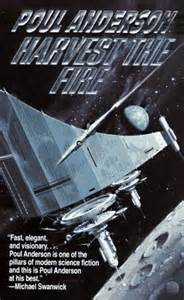
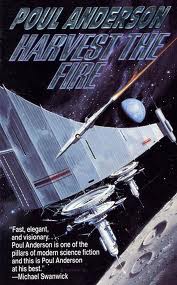
Poul Anderson, Harvest The Fire (New York, November 1997).

In Poul Anderson's Harvest Of Stars Tetralogy, each volume covers a single different period of a future history except Volume II, The Stars Are Also Fire, which covers two periods. Thus, if we read the series in numerical order, then, as we begin Harvest The Fire, PROLOGUE, pp. 9-31, with four pages of illustrations, we are already familiar with the first three of the five periods.

Jesse Nicol, a frustrated poet, seeks inspiration by recounting the future history to date to a simulation of Jorge Luis Borges. Of course the summary in Nicol's mind helps readers whether they have read Volumes I and II or not.

Human beings got into space when the cost of launch had been brought down, mainly by Fireball Enterprises. The Moon was colonized but completion of pregnancy was impossible in Lunar gravity so Lunarians were genetically engineered. Other human species were engineered on Earth and also the Keiki Moana, intelligent seals. 

Robotics became highly developed. Some human personalities, including Anson Guthrie, founder and chief executive of Fireball, were downloaded into artificial neural networks. Lunarians, led by Selenarchs, became independent of the World Federation and colonized Mars, asteroids and outer moons.

Fireball and the Selenarch Rinndalir waged war against the Federation for a reason not stated here. Download Guthrie led dissident Terrans and Lunarians to Alpha Centauri. Terrans colonized Demeter, doomed to be destroyed in a planetary collision in a thousand years, whereas Lunarians colonized Centaurian asteroids. 

The Federation reincorporated Luna and moved an abandoned L-5 colony to Lunar orbit where Terran women from Luna could give birth, thus enabling Terrans to outnumber Lunarians on Luna. The Lahui Kuikawa, comprised of human beings and Keiki Moana, moved to a mid-Pacific island. 

Conscious AI was developed, then developed itself further.

There is some more but I have to go out.

Friday, 5 April 2024

Borges

Poul Anderson, Harvest The Fire (New York, 1997), PROLOGUE, pp. 9-31.

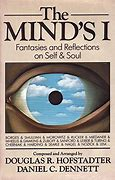
Jorges Luis Borges, Borges and I IN Douglas R. Hofstadter and Daniel C. Dennett (Eds.), The Mind's I (London, 1981) AT I, A Sense of Self, 1, pp. 19-20.

In Anderson (above), Jesse Nicol, while in Argentina, pays to meet and converse with a (conscious?) simulation of the blind Jorges Luis Borges.

In Borges (above), the still sighted Borges writes:

"The other one, the one called Borges, is the one that things happen to. I walk through the streets of Buenos Aires and stop for a moment, perhaps mechanically now, to look at the arch of an entrance hall and the grillwork on the gate; I know of Borges from the mail and see his name on a list of professors or in a biographical dictionary." (p. 19)

Borges differentiates himself as a private person from his public persona whereas Anderson creates a fiction within a fiction.

Saturday, 31 July 2021

Fictions Within Fictions

In Olaf Stapledon's Last And First Men, one of the Last Men on Neptune downloads (so to say) the history of the future into the mind of a twentieth century author who thinks that he is writing fiction and indeed that author's brain distorts its Neptunian inspiration to such an extent that most of what he writes is in fact fiction.

In Poul Anderson's There Will Be Time, the time traveler, Jack Havig, informs Robert Anderson of a future civilization which Robert's relative, Poul, fictionalizes as "the Maurai Federation," making mistakes as often as not when using his imagination to fill in the gaps.

In Anderson's Harvest Of Stars, Jesse Nicol summarizes the future history of Anderson's Harvest Of Stars and The Stars Are Also Fire for the benefit of a virtual reality reconstruction of Jorge Borges who compares the summarized history to a work by Tolkien. Nicol, presenting his account as fiction, reflects that it almost is because it falls so far short of reality.

Tuesday, 6 July 2021

Nansen's Philosophy

Starfarers, 9.

The voyage of Envoy begins. 

Nansen quotes Borges who appears as an emulated (consciously simulated) literary and historical figure in Poul Anderson's Harvest The Fire.  

The Milky Way is described as "...the cold galactic river." (p. 74)

Nansen says:

"'I am a philosophical realist.'" (ibid.)

The context implies that, by "realism," he means the philosophical view that reality is independent of human consciousness. I agree and would add that it is independent of any consciousness.

Nansen:

"'It doesn't seem reasonable to me that [this material universe] so superbly organized, its law reaching down beneath the atom, out beyond the quasars, through all of time, that it should throw up something as rich as life and intelligence by chance.'" (p. 75)

But it does not happen just by chance! Physical laws explain how a simple cosmos became complex. Energized, complex molecules changed randomly until one became self-replicating. Then natural selection operated. Naturally selected organismic sensitivity to environmental alterations quantitatively increased until it was qualitatively transformed into conscious sensation. Central nervous systems reorganized immediate sensations into perceptions of discrete objects - the transformation from feeling hot to seeing a source of heat. Opposable thumbs, developed for grasping, can be used to write poetry, fiction and philosophy and to play musical instruments. Why should laws not apply to atoms and quasars through all of time? Limited lawfulness would be more complicated.

Nansen continues:

"'I think that reality must be better integrated than that, and we are somehow as much a part of it and its course as the galaxies are.'" (ibid.)

But reality is integrated and we are as much a part of it as the galaxies. We and they are transient.

Monday, 30 March 2020

Real And Virtual Books

Three Men

(i) In the Chronos, en route to Saturn, Scobie of necessity screens most of what he wants to read from the data banks but also has a few old books on a shelf, including, despite his agnosticism, an eighteenth century family Bible and also a signed copy of a modern work. See the link.

(ii) The narrator of "The Problem of Pain" takes a "reel" of the Bible with him wherever he goes:

"...for the grandeur of its language if nothing else..."
-Poul Anderson, "The Problem of Pain" IN Anderson, The Van Rijn Method (Riverdale, NY, 2009), pp. 103-134 AT p. 103.

(iii) In Harvest The Fire, Jesse Nicol meets an AI reproduction of Jorge Luis Borges who signs and gives him a copy of El libro de arena although there is no book in Nicol's hand when he leaves the AI machine. A more creative AI technology would have been able to print the book with a facsimile signature on the title page.

Friday, 16 November 2018

Poets

"Once in his drifting to and fro across Earth, Jesse Nicol found a quivira left over from olden times."
-Poul Anderson, Harvest The Fire (New York, 1997), PROLOGUE, p. 9.

A "quivira" is a virtual reality apparatus.

The consistent message of Anderson's "Harvest of Stars" Tetralogy is that, in this future history, mankind is in a long term malaise and decline. Nevertheless, I like the idea of a peaceful Earth where a man can wander to and fro and find high technology from olden times.

Nicol, who wants to be a poet, refers to Homer and quotes Shakespeare, Kipling, Borges and Hopkins. This post is illustrated with lines from a dark sonnet by Hopkins. See here.

Tomorrow: Day trip to London.
Result: Little or no blogging.

Monday, 2 July 2018

Catching Up

It has been a nightmare. Changing broadband suppliers meant first that nothing worked and secondly that getting it fixed was a seemingly endless hassle where nothing that was supposed to work worked and the worst of it was that this was exactly what I had expected to happen and it is not fully fixed yet.

Catching Up
While 'netless, I drafted posts and did other rereading. I wondered how Poul Anderson's different time travelers might tackle the mystery investigated by Mikael Blomkvist in Stieg Larsson's The Girl With The Dragon Tattoo. Then Mikael himself reflected:

"The key to the mystery was what it was that Harriet saw in Hedestad. He would never find that out unless he could invent a time machine and stand behind her, looking over her shoulder."
-Stieg Larsson, The Girl With The Dragon Tattoo (London, 2008), Chapter Sixteen, p. 277.

Thus, a Wellsian concept and phrase are used, and commonly understood, even in a contemporary thriller. (Wells himself referred to "Morlocks" in a contemporary novel. See here.) I will publish a post about how the mystery of Harriet's disappearance might have been investigated either by the Time Patrol or by Anderson's mutant time travelers. (Later: see here.)

The characters in Anderson's Harvest The Fire include a conscious AI simulation of Jorge Luis Borges, who pioneered what I call "approaches to fiction." An "approach" is a statement of a fictional premise that is not developed into a complete narrative. Thus, Borges' "The Approach to Al-Mu'tasim" is not a novel but a fictional review of an imaginary novel although it does summarize the plot of this nonexistent work. There are some "approaches to fiction" on these blogs. I will add one to the Science Fiction blog and another to the Logic of Time Travel blog. On this blog, I will discuss both "Kinds of Timelines" and "Experiences of Time Travelers." I will continue to reread The Dancer From Atlantis and should soon have some previously unread works by Anderson to discuss.

I might continue to lose Internet access and will also be in London from Thursday afternoon until late Sunday. Regular blog readers might recognize this as an annual pilgrimage is not too inaccurate a word.

There has been some creative thinking during the blog absence.

Friday, 25 September 2015

Harvest The Fire, Prologue

See here.

The simulated Borges refers to Martin Fierro, Karnak and Cambaluc.

I have quoted here how World War I came to be called "Terran Planetary War, Phase One" in an unfortunate later addition to Robert Heinlein's Future History. In Anderson's Harvest The Fire, it is called "...the first Global War." (p. 13) Future historians, particularly those for whom Earth is not the only occupied planet, are bound to view WWI and WWII differently. They might have had interplanetary conflicts, not "World Wars" but "Wars Between Worlds."

In the terminology of Anderson's last future history:

a "dreambox" generates a fully realistic virtual reality based on a standard program chosen from "'...many millions of different milieus and situations...'" (p. 13);

a "quivira" generates an equally realistic but entirely new virtual reality by working with the "cybercosm" (the conscious AI internet).

Dreamboxes contain simulations of many historical figures but not of Borges who is by now little known. Therefore, Nicol, using a quivira, pays extra for a sophotect (an AI) to:

scan world databases;
synthesize a personality and a setting.

Nicol meets Borges.

Issues In Fictions

I am extremely impressed with the range of issues covered by the posts so far this month:

time
history
prehistory
civilization
the Aeneid
Greeks and Romans
Tacitus
the sciences
AI
the creation of life
surviving the end of the universe
quantum indeterminacy
chaos
the Crusades
the Knights Templar
Odysseus
Frankenstein
superheroes
future histories

I have begun to reread Harvest The Fire (New York, 1997), Volume III of Poul Anderson's later Harvest of Stars future history. In the Prologue:

Jorge Luis Borges wrote Ficciones

Harvest The Fire is a science fiction novel by Anderson;

in Harvest The Fire, Jesse Nicol, living in our future, experiences the interactive fiction of a virtual reality in which he converses with the simulated Borges;

Nicol presents his real future history to Borges as a work of imaginative fiction;

Borges comments, "'You seem to have invented a world as complete as Tolkien's...'" (p. 21);

Nicol reflects that his account almost is a fiction, "...as far short as it fell of the richness of reality." (p. 28)

How many fictions within fictions are there here? Within Anderson's novel, there is Nicol's virtual reality and, within that, there is Nicol's almost fictitious account of Anderson's fictional future history.

Anderson maintains the consistency of his future history, e.g. p. 6 of Harvest Of Stars (London, 1994) introduces a gadget called a "maintainor" and more of these gadgets appear on p. 10 of Harvest The Fire. Such background details give future histories body and verisimilitude.

Friday, 17 August 2012

Harvest The Fire

Incredibly, Poul Anderson keeps the series going. Despite the cosmic climax of Harvest of Stars and despite the comparable culmination of the succeeding volume, The Stars Are Also Fire, the future history presented in these two long novels provides sufficient background material to generate a narrative framework and what has by now become a familiar setting for two further novels. Of these two additional volumes, the first, Harvest The Fire (New York, 1995), begins:

"Once in his drifting to and fro across Earth, Jesse Nicol found a quivira left over from olden times." (p. 9)

Jesse Nicol is a new character but two features of this opening sentence are familiar: a future Earth on which there is freedom to drift and a virtual reality machine called a "quivira." Nicol generates a virtual interview with Jorge Luis Borges. The cybercosm scans databases "...to synthesize a personality and a setting..." (p. 16) The cybercosm is conscious but it is not made clear whether the simulated Borges has a temporary consciousness of being interviewed by Nicol. Generation of such a temporary consciousness does occur in virtual realities in other Anderson works.

Authentically, the virtual Borges gives Nicol a signed copy of one of his books. Nicol finds this "...heartbreaking.." and afterwards "...glanced down at his hand, as if it held a book." (pp. 29, 30) The cybercosm could have completed the illusion by printing a facsimile book with a forged signature.

Anderson readers are confident that, when this author extends, e.g., the "Harvest Of Stars" sequence or the earlier Technic History, the new work will be a substantial addition to the existing series whereas the appearance of the word Foundation or Dune in a new sf title signifies only the monotony of a recurring decimal.