Showing posts sorted by relevance for query textbooks. Sort by date Show all posts

Monday, 22 June 2020

Textbooks And Files

For four earlier posts quoting Everard and/or Flandry on the limitations of textbooks, see here.
(Scroll down.)

In Stieg Larsson's Millennium Trilogy, Dragan Armansky has employed and worked with Lisbeth Salander whereas Inspector Bublanski has merely read her social welfare agency file. Consequently, their views of her aptitudes and personality are completely contradictory. Armansky comments:

"'Files are one thing. People are something else.'"
-Stieg Larsson, The Girl Who Played With Fire (London, 2010), CHAPTER 13, p. 225.

That reminded me of Everard's:

"'...reality never conforms very well to the textbooks...'"

- sufficiently well to prompt a late night comparative post. Tomorrow, probably, back to Holger Carlsen in the Carolingian universe.

Dig that pile of textbooks.

Monday, 17 February 2020

Everard And Flandry On Textbooks

Why does Manse Everard, quoted here and here, state that:

reality never conforms very well to textbooks;

sometimes, it does not conform to them?

Dominic Flandry explains:

"'...textbooks have little value in practical matters. There is always the subtlety of the individual, which eludes anything except direct intuition based on wide, intimate experience.'"
-"Hunters of the Sky Cave," XII, pp, 244-245.

Since Flandry of Terra is addressing Svantozik of Ardazir, he adds:

"'And you, being nonhuman, cannot ever have such an experience of men.'" (p. 245)

Flandry's wisdom supplements Everard's:

wide, intimate experience;
direct intuition;
individual subtlety;
value in practical matters -

- as against textbook truths.

Read Andersonian space opera, enjoy and learn.

Monday, 10 June 2024

Marrow

See here.

The linked posts quote Manse Everard and Dominic Flandry on why reality does not conform to textbooks. Thus, Everard and Flandry agree with van Rijn quoted here. In particular, both Everard and van Rijn refer to knowing in the marrow.

(What I am doing here, partly, is just experimenting with linking to earlier posts because my linking facility has become iffy.)

Everard and the Technic History guys inhabit different versions of reality but both realities incorporate human history and much experience is common to both.

Sunday, 2 June 2024

Primavera, Sanders And Not Time Travellers

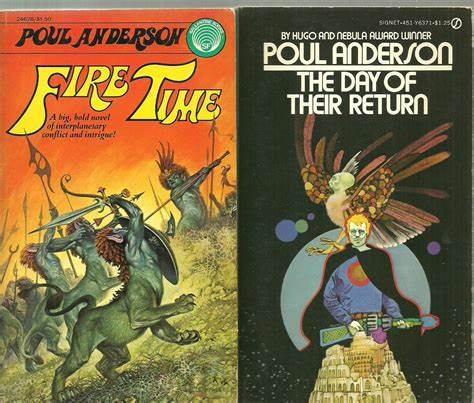
Fire Time, IV.

In orbit around Ishtar, Yuri Dejerine rereads one of his textbooks about the planet. We learn that the human town on Ishtar, Primavera, is named after an explorer, Diego Primavera.

On p. 43, we notice the phrase, "...time travelers...," but then realize that the entire sentence reads:

"However, by that time travelers who had gone elsewhere were bringing a flood of exotic tales...."

We also notice that:

"A scholarly dilettante, Winston P. Sanders..." (ibid.)

- exists in this timeline as well.

And, finally for now, we also notice some repetition on this blog.

Wednesday, 5 March 2014

The Quotable Time Patrol II

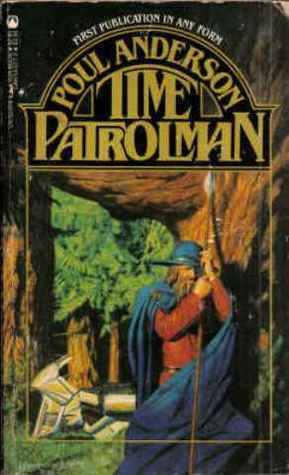
Poul Anderson, Time Patrol (New York, 2006).

The first "Quotable" post addressed the issue of academic and experiential learning. Don't say "academic versus experiential" - both are necessary: theory guides practice; practice tests theory. Almost anyone's life and work experiences are relevant. I happened to quote teacher training. I might add that a student teacher on teaching practice is temporarily in touch with almost everyone else - College tutors, school teachers, school pupils, fellow students, the Head or a Deputy Head of a school, the Heads of maybe two Departments within a school. There are unrivaled opportunities for comparing alternative perspectives while training.

Here is another relevant quotation from Everard in conversation with the narrator of this passage, Carl Farness:

"'You're giving me the standard arguments, Carl...What I'm trying to make you know, not in your fore-brain but in your marrow, is that reality never conforms very well to the textbooks, and sometimes it doesn't conform at all.'
"'I believe I am beginning to see that.' My humility was genuine.'" (p. 387)

And Everad has much to learn:

"'...I've learned to be wary of archetypes. They have more power than any science in history has measured. That's why I've been quizzing you like this, about stuff that should be obvious to me. It isn't, down underneath.'" (p. 391)

Archetypes have power over us - and we are the ones who formulate scientific knowledge which is necessarily measurable, mathematical, abstract, repeatable, not unique or individual.

Tuesday, 6 December 2022

Just One Word

I reread the following three passages in this order over the last two days.

"HB: What can you say about the first story, 'A Tale of Two Cities'?
"NG: It's right in the H.P. Lovecraft vein - I even use the word cyclopean near the end of it."
-Hy Bender, The Sandman Companion (London, 2000), 10, pp. 179-180.

"Above them vast, cyclopean walls loomed and towered..."
-Neil Gaiman, "A Tale of Two Cities" IN Gaiman, The Sandman: Worls' End (New York, 1994), pp. 27-41 AT p. 36, panel 1.

"When he stood on million-year-old snow, watching night creep up like smoke through crystal trees and cyclopean ruins, hearing Juchi chant under a huge green sunset sky, Flandry discovered that scientific explanations were but little of the truth."

It is only a coincidence but also the kind that we usually do not notice unless we are reading texts very closely. For another Andersonian use of "cyclopean," see here.

Flandry realizing that scientific explanations are not the whole truth reminds us of Manse Everard telling Carl Farness that reality does not always conform to the textbooks.

Tuesday, 7 November 2017

God's Joke

Nicholas van Rijn opines:

"'I know - every genuine spaceman knows, down in his marrow like no deskman ever can - how God always makes surprises on us so we don't get too proud, or maybe just for fun. To me it became natural to ask myself: What joke might God have played on the theorists this time?'"
-Poul Anderson, "Lodestar" IN Anderson, David Falkayn: Star Trader (Riverdale, NY, 2010), pp. 631-680 AT p. 661.

Significant points:

van Rijn began his career on prospecting voyages although he has since become not a "deskman" but a lounger man;

he is Catholic so his talk of "God" comes naturally;

however, we can fully agree that the universe is surprising while regarding theistic language as metaphorical;

Manse Everard of the Time Patrol wants Carl Farness to know in his marrow that reality does not conform to textbooks (see here);

when two people converse, three factors are involved - two world-views and the world itself which is bigger than either of them;

theory is grey, life is green.

Wednesday, 7 December 2016

More On Everard

Everard advises Carl Farness:

"'What I'm trying to make you know, not in your forebrain but in your marrow, is that reality never conforms very well to the textbooks, and sometimes it doesn't conform at all.'"
-Poul Anderson, "The Sorrow Of Odin The Goth" IN Anderson Time Patrol (Riverdale, NY, 2006), pp. 333-465 AT p. 387.

In Everard's career, this statement is intermediate between miserly gods and cosmic capriciousness. He is learning. Later still, he learns more, from a Danellian:

"'In a reality forever liable to chaos, the Patrol is the stabilizing element, holding time to a single course...left untended, events would inevitably move toward the worse. A cosmos of random change must be senseless, ultimately self-destructive. In it could be no freedom.'"
-Poul Anderson, The Shield Of Time (New York, 1991), p. 435.

Thus, the Time Patrol universe is anthropic. Intelligence exists because intelligent beings, having come into existence, travel into the past to ensure the conditions for their own existence. They are responsible for any apparent synchronicity. Their role is that of "gods," like the far future beings encountered by a single time traveler in "Flight to Forever."