Tuesday, 15 October 2019
Five Senses And A Meal
"Leaf shadows flickered on the patio outside. Small cottony clouds ran before a wind that made rushing noises in the trees. Coffee and bacon perfumed the mild air. Neither man seemed to notice." (p. 176)
But we notice flickering, rushing, perfume and mildness, in fact five senses because we imagine not only smelling but also tasting the coffee and bacon.
"Darkling, the precipices dropped straight down to the wrath among the reefs." (p. 177)
"Darkling" is an unusual term that I associate with HG Wells but have also found before in Anderson. See here. (Scroll down.)
Larry and Julia share a picnic lunch:
feta cheese;
marinated tomato slices;
salami;
cucumber;
roast beef and horseradish;
sweet-buttered pumpernickel;
Greek olives;
pears;
wine.
(I am just finishing a glass of wine. I now drink a little but not enough to interfere with meditation.)
(Me: cheese, yes; olives, no.)
Friday, 14 November 2014
Luna And Iapetus
This invites a comparison. Wells contented himself with a single description of a first visit to another world, the Moon, whereas Poul Anderson was, of course, a space age sf writer for whom visits to other planets had already become routine, at least in imagination:
"Unlike the large Titan- and Saturn-vicinity explorers, landers on the airless moons were simply modified Luna-to-space shuttles, reliable but with limited capabilities." (p. 16)
CS Lewis either said or quoted that only the first visit to a new world is of interest to the reader of imagination, his point being that, when the new world has become familiar and routinized, then it is no longer a new world. True enough, but Anderson also knew that each entire world retains mysteries and unknowns and is seen afresh not only by each new generation but also by anyone who is able to look with new eyes. This earlier post is relevant.
Sunday, 17 July 2016
Homecoming
"...Herning dropped anchor, one chilly eventide. Eastward the Kattegat glimmered away till it lost itself in dusk. Westward the shore lay darkling. A last smear of sunset cast red across the water, broken by reeds, hummocks, gnarly willows. The land breeze smelled of mire and damp. A bittern boomed, a lapwing shrieked, an owl hooted, lonesome noises." (The Merman's Children, p. 104)
Familiar ingredients:
evening
chill
glimmering
dusk
eastern and western skies
"darkling"
sunset red
light on water
wild vegetation
breeze
two smells from inland
dampness
three bird sounds, differently described
lonesomeness not counteracted but emphasized by the sounds
Poul Anderson could have just told us that the characters unloaded their treasure but first, of course, he sets the scene, appealing to three senses as he does so.
Thursday, 24 October 2019
The Golden Slave, Chapter VI, Concluded
Phryne is awesome, like a vessel of Power. When she laughs, Eodan makes:
"...the sign against trolldom." (p. 82)
She reminds him of a newly initiated "...Cimbrian godwife..." (p. 80) I cannot find "godwife" anywhere else. A godwife is riven by Powers that she must rein and drive.
The word "darkling" occurs again, this time referring to an inner darkness:
"...the darkling Northern part of his soul..." (p. 82)
To disguise Phryne as a boy, Eodan cuts off her hair which she will sacrifice to Hecate. He himself dons a hat and a cloak, takes up a staff and begins to look like Odin although, as yet, this garb is a mere disguise. Phryne dyes his yellow hair black.
Thursday, 7 April 2016
Hunters And Thinkers (In The Dark)
"...the woods loomed darkling..." (Man-Kzin Wars III, p. 169)
It just means "dark" or "in the dark" and is definitely a Wellsian touch.
On Earth, some species hunt - stalk, pounce, kill and eat; one species thinks and reflects. Thus, we distinguish between hunters and thinkers. Poul Anderson's winged Ythrians and Larry Niven's feline kzinti do both.
"A hunter's wind blew...The wish that it roused, to be yonder, to stalk and pounce and slay and devour, grew in Weoch-Captain until he trembled."
-Poul Anderson, "Inconstant Star" IN Larry Niven, Ed., Man-Kzin Wars III (New York, 1990), pp. 167-310 AT p. 169.
His fur stands up. His claws slide out. His fingers bend. But he walks steadily to meet the kzinti High Admiral. As his partial name and rank indicate, Weoch-Captain is a rational animal able, usually, to control his instincts. Those instincts, when unrestrained, will make him run through the forest and attack his prey with claws and fangs like a tiger. Such a combination of hunter and thinker is truly alien.
Saturday, 7 March 2020
"Starfog": Some General Observations III
"'Once a given star disappears in the fog, we can't find it again. Not even by straight-line back-tracking, because we don't have the navigational feedback to keep on a truly straight line.'
"'Lost.' Demring stared down at his hands, clenched on the desk before him." (p. 764)
Spaceships get lost in the "starfog" until Laure solves the problem. But the galaxy and the universe are so big that ships might get lost, anyway. This is the origin of the Nomads in Poul Anderson's Psychotechnic History and there is also a TV series called Lost In Space.
"'...we didn't make this universe. We only live in it.'" (p. 771)
We have heard this before. See here.
A lifeless planet is:
"...a stone spinning around a star." (p. 777)
- which recalls the title of a novel set earlier in the Technic History.
"The sun stood high in a deep purple heaven." (p. 778)
To me, this recalls:
"Snowpeaks flamed. The sun stood up in a shout of light.
"High is heaven and holy."
-Poul Anderson, The People Of The Wind IN Anderson, Rise Of The Terran Empire (Riverdale, NY, 2011), pp. 437-662 AT XIX, p. 662.
- Poul Anderson's best ending of a novel.
The wind has its say:
"The wind yelled." (p.782)
"Wind hooted." (p. 783)
"...the wind had dropped...," "...the wind filled the air outside with dust...," "The wind yammered." (p. 785)
The yelling wind on p. 782 drives dust "...in darkling whirls..." (Scroll down.) "Darkling" is a Wellsian/Andersonian adjective.
Large-scale extraction of minerals from oceans would generate:
"'...so much heat that planetary temperature would be affected.'
"'That sounds farfetched.'
"'No. A simple calculation will prove it. According to historical records, Earth herself ran into the problem, and not terribly long after the industrial era began.'" (p. 790)
"According to historical records..." Thus, a future history series completed thirty-five years ago comments on Earth in 2020. The calculations, made decades ago, were ignored and are denied.
Jaccavrie would like to have grandchildren and Laure replies that no doubt one day she will but he is trying to laugh down his disappointment. In Heinlein's Time Enough For Love - not that I want to promote that novel - a self-conscious "computer" has some of its memories and its sense of identity transferred into a living female human body. It, or rather she, would then be able to have children and grandchildren.
Friday, 29 August 2025
Off Greenland
The Merman's Children, Book Three, VII.
Merfolk brother and sister, Tauno and Eyjan, swim near Greenland. The cold choppy sea water rocks their bodies, caresses their muscles, warms their interiors and tastes not only of salt but also of:
"...life and deeps and distances." (p. 156)
Winds have smelled of distance. Now water tastes of it. This water also whooshes and gurgles around the two merpeople but roars on the shore. As for colours, the blue-black whitecaps shimmer green. Thus, the water generates inner and outer bodily sensations, multiple tastes, sounds and colours.
There are many other sensations. The wind is sharp. Gull wings and cries fill the silver-gray sky where wrack flies like smoke. Cliffs are darkling. Autumnal meadows are yellow. Peaks are snow-covered. Inland ice is bleak but bright. Merpeople live in and with nature.
Tuesday, 20 February 2018
Eyath, Arinnian And Tabitha
Chris/Arinnian and Tabitha are united in a scene that is both Avalonian and multi-sensory:
"Chris and Tabby landed in a sunset whose red and gold ran berserk above a quiet sea."
-Poul Anderson, The People Of The Wind IN Anderson, Rise Of The Terran Empire (Riverdale, NY, 2011), pp. 437-666 AT Chapter XIX, p. 660 -
grass, trefoil and sword-of-sorrow fall steeply down to the immense, glimmering sea;
on the horizon, the sky deepens from violet to black;
there is an evening star among the constellations;
darkling forest is sweet from odors of pine;
the warm breeze makes harp vines ring and brightens the jewelleafs.
Colors, odors, warmth and ringing: four senses.
Tuesday, 30 December 2014
Margin Of Profit: Conclusion
"...the Borthudian frigate...was a darkling shark-form, only half the tonnage of the dumpy merchantman but with gun turrets etched against remote star-clouds."
-Poul Anderson, The Van Rijn Method (New York, 2009), p. 163.
Although I think that Rise Of The Polesotechnic League would be a more appropriate title for Volume I of Baen Books' The Technic Civilization Saga, I increasingly appreciate the pertinence of The Van Rijn Method.
Van Rin tells Torres to "'...pull us up quick...'" (p. 167) but, as we read on, the immediately following "...reversion to normal state..." (ibid.) is described as the Borthudian's "...last, desperate move, killing his oscillations, dropping solidly back into the ordinary condition of things..." (p. 168), out of hyperspace. Pulling apart so quickly would have caused stresses in the linking force-beams that, in turn, would have destroyed both ships. However, the Terran ship has "...a detector coupled to an automatic cutoff, for just this possibility." (ibid.) In that case, why does van Rijn say "'...pull us up quick...'"? Readers without technical backgrounds must struggle with the technicalities, especially when these include technologies like, e.g., hyperspace and tractor and pressor beams, that do not yet exist, although Anderson writes as if he is familiar with them.
In normal space, Mercury's beams hold Gantok so close that the latter's weapons cannot be brought to bear. If the Borthudians try to board, a small pressor can flick them into space. I did not think of these possibilities but Anderson and van Rijn address them in any case. While going out onto the hull to make a repair, van Rijn:
"...was surrounded by a darkness-whitening star-blaze." (p. 166)
Long may we travel through space with van Rijn, Falkayn and Flandry.
Saturday, 24 March 2018
Five Senses On Diomedes
-Poul Anderson, A Knight Of Ghosts And Shadows IN Anderson, Sir Dominic Flandry: The Last Knight Of Terra (Riverdale, NY, 2012), pp. 339-606 AT V, p. 410.
Kossara:
sees dark cliffs, pink trees and snow, red sun, purple sky and a white and green cataract;
feels cold wind and higher gravity;
hears the booming cataract, its sound distorted by the Diomedean atmosphere;
smells and tastes metal.
All five senses are present and accounted for.
Tuesday, 7 August 2018
The Winter Of The World
The reader cannot immediately assimilate all the characters and places referred to but accepts that a complicated social setting will emerge. This novel stands alone and is not part of any future history series although, of course, it assumes a history linking Anderson's twentieth century to that future Ice Age.
Monday, 22 August 2022
Sensory Overload On Diomedes
A Knight Of Ghosts And Shadows, V.
"Cliffs and crags loomed in darkling solidity, here and there a gnarled tree or a streak of snow tinged pink by a reddish sun high in a purple heaven." (p. 410)
We recognize an overload of colours and immediately look for more sensations. Sure enough, the text continues:
"The wind thrust slow, strong, chill; it had not only an odor but a taste like metal." (ibid.)
So far, four senses. Next:
"A cataract, white and green half a kilometer away, boomed loud through thick air that also shifted the pitch and timbre of every sound." (ibid.)
And that is not all because Kossara feels something else:
"Huddled in her parka, she felt how Diomedes drew on her more heavily than Dennitza, nearly two kilograms added to every ten." (ibid.)
Are the sense of balance and the sensation of gravity additional senses?
(We have said all this before but in a slightly different way. See Five Senses On Diomedes.)
Sunday, 30 April 2023
More From The High Sierra
Sunday, 21 December 2025
"Inside Earth"
We have found another description of the Milky Way with something against it:
"Her bow guns were dark shadows against the clotted cold silver of the Milky Way." (in IV.)
There are some good Andersonian descriptions:
"The Rockies are huge and serene, a fresh cold wind blows from their peaks and roars in the pines, brawling rivers foam through their dales and canyons - it is a big landscape, clean and strong and lonely. It speaks with silence." (in II.)
Maine fishermen and artisans are:
"...at home with the darkling woods and the restless sea and the high windy sky." (in III.)
The alien first person narrator is physically so similar to a Terrestrial human being that he can be surgically disguised as one and his mentality is almost indistinguishable. This is one of Poul Anderson's fictional universe where "human beings" somehow already inhabit many planets.
Friday, 22 July 2016
The Novel Winds Down
-Poul Anderson, The Merman's Children, Book Four, Chapter IX, p. 244.
"Ahead of them, high-booted against muck, went a pair of armed linkbearers." (p. 245)
"Ingeborg Hjalmarsdatter was a Jutish woman of about thirty winters. Early one spring she arrived at Hornbaek, a fisher hamlet on the north coast of Zealand..." (Chapter X, p. 246)
"She did not seek out her neighbors, nor invite them oftener than it behooved her..." (ibid.)
"Nearing midsummer, the sun was yet above the Kattegat, over which it threw a bridge of molten gold." (p. 247)
Sun- or moon-light as a bridge across water is a frequent image in Anderson's prose.
"Eastward across the channel its low-flying rays glowed on clouds piled like mountains above Scania, which rested blue on the edge of sight." (ibid.)
Anderson goes on to describe:
wings in a clear sky;
sails of becalmed, toy-like vessels catching the light;
sounds of surf and gulls;
cool air;
tang of sea and kelp;
odors from plowed and common land;
darkling woods.
A day approaches its end as do the novel and its characters' lives.
Thursday, 15 October 2015
Words And Seasons
sedges (p. 12);
stockfish (p. 12);
steading (p. 12);
crock (p. 12);
to handsel (p. 13);
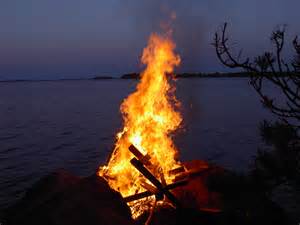
balefire (p. 13);
darkling (p. 13); (+ see here)
aurochs (p. 13);
wadmal (p. 14);
casting runes (p. 14);
spaewives (p. 14);
Saami (p. 14);
the norns (p. 16);
swiving (p. 16);
hoarfrost (p. 16).
Book One, Chapter IV, begins with another seasonal change:
"Summer waned; days shortened; the first sallowness stole over birch leaves; often at sunrise hoarfrost glimmered on the ground. Fields lay harvested..." (p. 16)
As in previous works, Anderson presents lives lived directly with nature and its seasons. Thus, many chapters begin:
"Spring had come..." (p. 5);
"Summer waned..." (p. 16);
"The sun swung onward..." (p. 42);
"Endlessly wheeling through summer, the sun cast light..." (p. 51);
"Winter pressed inward..." (p. 59);
"Spring came slowly..." (p. 63);
"Sunlight from the east seeped through overcast..." (p. 65).
Fast-forwarding between chapters reproduces the experience of Wells' Time Traveler or Anderson's Jack Havig. Both see the sun speed across the sky.
Sunday, 19 August 2012
The Fleet Of Stars II
An Anson Guthrie download, passing through the Alpha Centaurian system en route from Beta Hydri to Sol, sees Demeter, bigger than Earth, molten, glowing red, streaked black with smoke and slag, spinning crazily, racked by mountain-sized fire-geysers, surrounded by randomly orbiting rocks, some crashing down but many forming a ring or thickening into a Luna-sized moon. It sounds as if Demeter has not been destroyed but will reform into a possibly life-bearing planet?
Lunarians, human beings adapted to live and breed in lunar gravity, must spend their entire lives in artificial environments but have the creativity, ingenuity and technology to make their environments spacious and agreeable. They are extinct on Luna but flourish in the Outer Solar System and at Alpha Centauri where one habitat, Zamok Sabely', has spokes a hundred kilometers in length. As often when describing an imagined future society, Anderson conveys social wealth and dynamism although the term "bustling" is inappropriate for the quiet Lunarians. Inside Zamok Sabely':
"Arches opened on arcades, tier above tier, of shops, workplaces, taverns, gambling dens, recreation halls, foodsteads, joyhouses, establishments more esoteric, spacious and gracious or darkling and secretive, often screened by a living curtain or an induced aurora. A fire-fountain leaped and roared in the middle of a plaza. Birds trailing rainbow tails winged down a corridor of crystal." (p. 29)
It does not seem to matter that they must always live surrounded by vacuum.
Monday, 18 May 2015
Details In Starfarers
(i) As suggested by their biochemist, Selim ibn Ali Zeyd, the Envoy crew name an inhabited planet "Tahir" (p. 214), although I am not quite sure why.
(ii) "...albedo..." (p. 208) is one of those words that I read with some vague understanding of its meaning. It made sense to google.
(iii) Other technical terms used are:
"...circadian...," (p. 216);
"'...ionic and osmotic...'" (p. 218);
"'...biomes...'" (p. 219);
"...cyromagnetic...'" and "'...quantum resonances...'" (p. 221);
"'...Hamiltonian, Riemannian...'"...Navier-Stokes...'" (p. 222).
(iv) Foreign language phrases used are:
"'Apa Isten.'" (p. 207) (I can't find it);
"'Dios todopoderoso...'" (p. 209) (I still don't know what it means).
(v) "...darklingly..." (p. 215). I have commented before on the Wellsian adjective, "darkling." Here is the adverb.
(vi) On Tahir, the visiting Terrestrials are not bothered by any "...journalists, curiosity seekers, salespeople, cranks, politicians." (p. 216) Dayan thinks that this suggests a very controlled society but Cleland replies that it may merely be very alien. A society that is uniformly polite and considerate without coercion? Alien indeed.
(vii) I think we are told that, thanks to time dilation, Kenri has been alive for eight hundred years but I would have to reread Chapter 21 to confirm this. He sees murals of historical events that have mostly happened within his lifetime. Imagine that.
(viii) "...from Canda..." (p. 202) is not just an acknowledgment of where someone comes from but part of his name. I will have more to say about this character.
Thursday, 27 April 2017
Manse Everard's Religious Experiences
Near the Rhine, Everard shudders when the wind in the trees speaks with the voices of the darkling gods.
The wind seems to blow keener when Heidhin tells Everard that Edh is the chosen of a goddess.
Everard does not believe in Mithras, the Earth Mother, demons, gods or goddesses but he feels what their believers feel. He shares their experiences.
Monday, 10 August 2015
Roots Of Paganism
"Trees of the grove were huge darknesses, formless save where boughs nearly bare tossed against heaven. Their creakings were like an unknown tongue, answers to the skirl and snarl of the wind." (Time Patrol, p. 494)
People imagine speech in the wind.
"...the wind in their treetops spoke with the voices of the darkling gods. Everard suppressed a shudder." (p. 510)
Even a time traveler from the twentieth century feels it.
"Niaerdh was in [the waves] with dread and blessing." (p. 583)
Persons naturally personify nature. A fictitious character is created by an individual author whereas a deity arises in the collective imagination.