Wednesday, 7 August 2019
Axor And Tipler
The Thomist First Cause argument is completely inadequate. At the secondary school which I attended, a Jesuit presented us with these propositions:
every event is caused;
an infinite regress is impossible;
therefore, there was a first cause, which everyone calls God.
He added, "That then is the argument and the mind accepts that."
Even then, I knew that:
that is not the only, and certainly not the best, argument;
every mind does not accept it;
both premises need to be proved;
if every event is caused by an earlier event, then an infinite regress is not only possible but actual and there can have been no first cause which, in any case, would be a past event, not an eternal person;
there are allegedly uncaused events in quantum mechanics.
Maybe Tipler makes a better case for a First Cause which is also God (two conclusions to be proved) but I need the unmathematical layman's version.
(BTW, the family outing was to the Wolfhouse Gallery (scroll down), then to Wallings Ice Cream.)
Wednesday, 10 August 2016
The Anthropic Cosmological Principle
Anderson discusses The Anthropic Cosmological Principle (1986) by John D Barrow and Frank J Tipler.
Barrow and Tipler ask whether the important quantities in physics are arbitrary. The quantities listed by Anderson are:
the gravitational constant
the fine-structure constant
Planck's constant
the charges of elementary particles
the masses of those particles
the present size of the universe
its present age
This reminds me why I am a philosopher, not a physicist. Like Socrates, I cannot handle all these technical details. But, without them, we would have neither science nor technology. The scientists (natural philosophers) have got it right.
The size and age of the universe are closely related, almost identical, since the universe is expanding. To say that the universe is big is to say that it is old. Or, at least, to say that it has reached a certain size is also to say that it has reached the corresponding age. It is sometimes argued that there must be life elsewhere because the universe is big. However, if the universe needed to reach a certain age before it could contain any life, then maybe we are the first? Elements necessary for life had to be synthesized in a first generation of stars, then had to condense into a second generation of stars and planets - and that took time.
Why are the size and age of the universe listed with the other quantities? They just happen to be the current size and age when we are asking the question. The universe had to reach a certain size and age before anyone could exist in it to ask anything. However, the size and age will continue to increase whereas the other listed quantities will not.
The Weak Anthropic Principle: the universe is the way we perceive it because, if it were otherwise, then we would not exist to perceive it.
If there are universes with physical quantities that are incompatible with life, then no one is perceiving those universes.
The Strong Anthropic Principle: the universe must have properties that allow life to develop.
Anderson tells us that the reasoning involves quantum mechanics and the observer-observed relationship. Philosophically, I believe that there is an objective world that existed before it was observed and that exists independently of being observed. However, I have yet to read Barrow's and Tipler's book.
The Final Anthropic Principle: intelligence must come into existence and will never die out.
Anderson says that this "...is admittedly a non sequitur..." (p. 244) So why is it asserted? The human race could be killed by a comet or a nuclear war and we might be the only intelligent life... But, again, I have yet to read the book.
Anderson writes that: "We can only hope for another Stapledon..." (p. 238) to fictionalize current cosmology "...as he did the cosmology of his period." (ibid.) And, again referring to Stapledon by name, Anderson writes:
"What we now have offered us is an eschatology for today. What we need is a genius who will make a story of it." (p. 245)
Since Anderson's later novels fictionalized all of the cosmological and eschatological speculations summarized in this article, it is clear that Anderson himself was this genius and this new Stapledon.
Dyson imagines intelligence surviving heat-death as "...changeable configurations of leptons." (p. 246) Barrow and Dyson argue that, in the finite time before a cosmic collapse, an infinite number of experiences and thoughts would be possible. How? I need to read their book.
Monday, 5 August 2019
Speculative Fiction And Military Science Fiction
I prefer speculative fiction to military science fiction. I am learning that the latter includes a lot of accounts of military activities both on and off battlefields but that should not surprise me! Like CS Lewis and Brian Aldiss, I want to leave Earth to find the Unearthly.
I will not describe the unsanitary living conditions of the barbarian mercenaries in SM Stirling's and David Drake's The Forge but I will ask:
Would any barbarians live in such conditions?
Would it be possible to survive in such conditions?
Would regular armed forces tolerate such conditions so close to their own camps?
We have a universe to win - although not to conquer.
Saturday, 10 June 2023
The Anthropic Principle
John D. Barrow & Frank J. Tipler, The Anthropic Cosmological Principle (Oxford, 2009).
I am reading the latter, having read about it in the former. Some discussion might be relevant on this blog, especially in relation to Anderson's cosmological sf. Barrow and Tipler make a point that might be relevant to the discussions in our combox:
Tuesday, 31 May 2022
Toward Time Travel
The Shield Of Time, 1987 A. D., pp. 26-33.
Manse Everard speaking to Wanda Tamberly lists modern discoveries that point towards the eventual invention of space-time vehicles:
Thursday, 11 August 2016
Scientific Speculations Incorporated Into Poul Anderson's Works
Freeman Dyson worked on an Orion project which was reflected in Anderson's Orion Shall Rise and Niven's & Pournelle's Footfall.
Dyson foresaw the greening of the universe: Anderson's Harvest Of Stars.
Hans Moravec:
virtual reality;
a fractally dendritic robotic "bush" (!);
human personalities transferred to computer matrices with robotic bodies;
self-improving AI's surpassing and succeeding humanity.
These ideas are variously in Harvest Of Stars, The Boat Of A Million Years and Genesis. Anderson comments:
"It seems unlikely to me that humankind will either go gently into that dark night or settle down as parasites on the machines." (p. 243)
Needless to say, his novels cover both human extinction because of AI's and human independence of AI's.
Tipler demonstrated that FTL and time travel could be compatible with relativity: The Avatar by Anderson and a short story by Niven.
Barrow and Tipler argued that intelligence might be unique to Earth: Harvest Of Stars and Genesis.
To be continued.
Tuesday, 13 June 2023
From The End Of Time To Roma Mater
Sunday, 18 July 2021
Virtual Reality And More On The Holont
Starfarers.
Nansen adventures in virtual reality and wishes he hadn't because his companion in the adventure is the dead Jean Kilbirnie. We also notice that:
"Two condors wheeled on high." (41, pp. 396-397)
See Birds Of Prey.
The Holont receive a message from their future selves.
Hawking thought that, since contradictions are impossible, time travel must also be impossible. However, although a time traveler cannot change the past, his "'...actions can be part of what did happen.'" (42, p. 398)
Kerr, Thorne and Tipler described time machines consistent with relativity but physically impossible, e.g.:
a torus as massive as a giant star with an impossibly large electric charge and magnetic field, rotating at near light speed;
an infinitely long cylinder denser than a nuclear particle, spinning at near light speed.
The Holont:
form massive but stable nuclei;
use electromagnetic forces to spin such nuclei at a required speed, density and field strength;
with this miniature Kerr smoke ring or Tipler cylinder or whatever it is, generate a space-time warp;
send energetic gamma-ray photons through the warp;
modulate the photons to bear information;
instruct their earlier selves in how to communicate with human beings;
know how to communicate with human beings because they remember the instruction that they received.
Sunday, 21 May 2023
The Ground Of Science
Anderson concludes this article by observing that, just as ballet springs:
"...from the everyday dynamics of walking or myth from everyday birth, life, love, death, mystery..." (p. 247)
- in the same way, "...some grand science fiction..." (ibid.) can spring from "...the ground of science..." (ibid.) as imaginatively extrapolated in works like The Anthropic Cosmological Principle (1986) by John D. Barrow and Frank J. Tipler.
My problem with this proposition is that, having read Anderson's summaries of this and some similar works, I am far more interested in contemplating their philosophical implications than in just reading some more science fiction! For previous relevant blog discussion, see here. I stated in a post in 2016 that I had yet to read Darrow's and Tipler's book. I still have yet to read it. What happened? Did I try to get hold of a copy and not succeed or just not try? I will re-address this issue tomorrow when the Public Library opens.
We observe a universe that allows the existence of conscious life because, if the universe did not allow the existence of conscious life, then there would be no one here to observe it but does the universe just happen to be like this or are there many universes of which just a few allow conscious life?
The existence of the universe is necessary for observation of the universe but is observation of the universe also necessary for its existence? How could this be? The observer-observed relationship in quantum mechanics is indeed odd but could it imply the dependence of existence on observation? Do some theoreticians confuse information about reality with reality?
Alan Moore points out that fictional characters "exist" (this word is wrong but I do not think that there is a right one) only because we imagine them but that we exist as human beings only because we exercise our imaginations. Is this relationship similar to the existence-observation relationship?
Philosophically, I am convinced of materialism, that being preceded consciousness, not vice versa. Do philosophers of science stray back into idealism, the primacy of consciousness, through lack of philosophical clarity or because the evidence leads them in that direction? This is only the beginning.
Tuesday, 6 August 2019
Limits To The Multiverse
-Frank J. Tipler, The Physics Of Christianity (Doubleday, New York, 2007), II, pp. 14-15.
See my distinction between realistic and fantastic alternative histories here.
Logically possible universes include all those in which there are, or at least can be, red triangles whereas an example of a logically impossible universe would be one in which there are square triangles. "Is there a red triangle hidden somewhere in this room?" is an empirical question whereas "Is there a square triangle hidden somewhere in this room?" does not succeed in being a question.
Tipler's limitation on the multiverse rules out Robert Heinlein's Magic, Inc. and would have ruled out Poul Anderson's Operation Chaos if Anderson had not subsequently written the sequel, Operation Luna. See the blog search result for Rheatics.
Friday, 9 August 2019
Multiverses
Tipler explains that, in the pre-Copernican conception of the universe:
sublunar objects were composed of varying combinations of the Classical "four elements";
heavenly bodies were composed of the "fifth element";
these two realms obeyed different laws;
this is wrong because "...all reality obeys one, and only one, set of laws." (The Physics Of Christianity, II, p. 16)
Since the Old Phoenix multiverse includes magical realms, it should also incorporate worlds where Terrestrial matter is composed of the four elements and extraterrestrial matter of the fifth element. I would expect such worlds to include the Carolingian universe. Holger applies scientific knowledge in that universe. See Ariel And A Nixie. Following Larry Niven's lead, I speculated here that the mutable timeline guarded by the Time Patrol might culminate in a pre-quantum mechanics timeline. This is comparable to the pre-Copernican universes.
Sunday, 6 September 2020
Glimmerings
These are what Everard calls twentieth-century "glimmerings" (p. 28) of time travel:
non-inertial reference frames;
quantum gravity;
energy from the vacuum;
violation of Bell's theorem;
wormholes in the continuum;
Kerr metrics;
Tipler machines.
Maybe energy from the vacuum answers Wanda's question:
"'Where does the energy come from?'" (p. 27)
The only sensible idea in Isaac Asimov's hopelessly inconsistent time travel novel, The End Of Eternity (see here), was that time travelers used the future energy of Nova Solis. That should be enough.
Meanwhile, so to say, a Time Patrol researcher can immerse himself in an earlier world-view. In 209 B. C. , on p. 47, there are four Buddhist terms:
Buddha;
topes;
stupas;
vihara.
(Gautama, asked if he was a god, replied that he was "awake" (buddha).)
Saturday, 6 March 2021
Ways To Survive An Interstellar Journey
Ensign Flandry, CHAPTER FOURTEEN.
Saturday, 6 August 2022
Temporal Collision
Here are two very different speculative answers for time travellers:
Saturday, 4 August 2018
Into Futurity
the Time Machine
the time projector
time corridors
T machines
the Dirac transmitter
(Wells, Anderson, Tipler and Blish.)
There are many such devices but this post focuses on these five and on the future, not the past.
Usually, fiction is set in its characters' present which can be the readers' past, future or alternative timeline. A narrative is set in its character's future if he time travels, e.g., with the Time Machine etc, or previews, e.g., with the Dirac transmitter. Thus, Wells' Time Traveler travels to 802,701 A.D., then to his "Further Vision," before returning to the nineteenth century when he tells his dinner guests about his passage through "tomorrow" and "into futurity."
The following works are eminently "Wellsian":
Poul Anderson's "Flight to Forever" (see "Flight to Forever" Timeline, Part I here and Part II here);
Anderson's The Corridors Of Time with its future periods of the Wardens and Rangers, then of their successors, the time wardens;
James Blish's The Quincunx Of Time (see Chronology Of The Beep here).
Blish's characters see the future from the comfort of an office instead of traveling into it.
Sunday, 16 March 2025
Remembering THE AVATAR
How much do we remember about Poul Anderson's The Avatar?
It has an Andersonian hero whose name I forget.
It has Andersonian villains: politicians who try to halt interstellar travel or delay it indefinitely because its consequences will be disruptive! (In other words, it will challenge their social control.)
Interstellar travel and exploration are in STL ships but by rotating around Tipler machines. (Is this FTL or not?)
The T-machines have been constructed and deployed by one intelligent species but are used by others.
There really is an Elder Race which the human explorers meet near the monobloc at the start of another universe.
There are interesting space-time jumps to places and times limited only by the author's imagination.
There is intelligence on a neutron star.
This is a single long stand-alone novel, another part of Anderson's imagiverse.
Friday, 9 August 2019
Beyond The Moon
-The Forge, CHAPTER THIRTEEN, p. 235.
An extra-solar colony, isolated after the fall of technological civilization, has reverted to the ancient and medieval dichotomy between sub-lunar and trans-lunar spaces and thus has lost the modern scientific understanding that the laws of physics and chemistry are universal. Frank Tipler summarizes the medieval view in The Physics Of Christianity. CS Lewis tried to restore that view and opposed the Moon landings because they would destroy his illusion. In his sf, evil is confined to within the lunar orbit.
In Poul Anderson's "Starfog," a Ranger exploring a radiation-filled globular cluster is in danger not because of any ignorance of scientific laws but because he cannot know in advance how those laws will transform the properties of matter in unfamiliar conditions. It is one universe but vast.
Monday, 19 August 2013
Requiem For A Universe II
It makes sense in the light of the article, "Wellsprings of Dream," later in the same collection. Freeman Dyson, John Barrow and Frank Tipler reason that, either at or after the heat death of the universe, consciousness will be able to survive, thinking slowly because of reduced energy but remaining alert and accessing knowledge of the entire past, maybe even resurrecting everyone that has lived and died. There are two possibilities here and I do not fully understand either, particularly not the option that fits an infinity of experiences into a finite time.
But this is the point of the ending of "Requiem For A Universe." Someone who expected quiescence after the heat death had not allowed for the activity of conscious beings capable of finding a way to transcend the heat death. Anderson says, "I don't believe in it myself." (p. 247) But we don't know. If this can be imagined now, what might be achieved in the future?
Saturday, 10 June 2023
Chaos And Wishful Thinking Maybe
Thursday, 5 January 2023
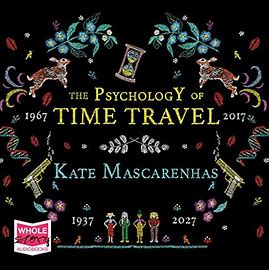
THE PSYCHOLOGY OF TIME TRAVEL by Kate Mascarenhas
Mascarenhas uses "timeline" to mean "period." Her Glossary informs us that Tipler cylinders could not accommodate time travel into the future. In Anderson's The Avatar, T machines are used for futureward travel not only back to the travellers' starting point but also, I think, beyond that.