Showing posts sorted by relevance for query Theater Of Spies. Sort by date Show all posts

Thursday, 21 February 2019

Theater Of Spies: ARC

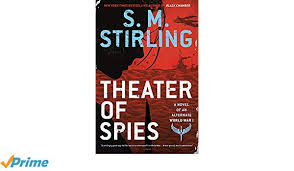
In July 2018, I received a review copy of Black Chamber by SM Stirling. Today, I received an ARC (Advance Reading Copy) of the sequel, Theater Of Spies. The cover is as shown except that the words:

              ADVANCE
        READING COPY
             MAY 2019

- are enclosed within a circle on the right between NG and ER.

The back cover has blurb, excerpts from favorable Wall Street Journal and "The Maine Edge" reviews of Black Chamber, two web addresses (smstirling.com and penguinrandomhouse.com) and publishing information which includes:

                                     UNCORRECTED PROOFS
                                              NOT FOR SALE

                                     Publication Date: May 7, 2019
                                                     Pages: 464

If any material is to be quoted, it must be checked against the finished book.

I will not quote any material.

Earlier posts either about or referring to Black Chamber were:

The Advent Of Black Chamber
Roosevelt And The Timelines
Future Historical References
Alternative Historical References
Black Chamber
Real And Fictional Politics
Common Ancestry
Betrayal
Coincidences
Alternative Lives
Actual To Alternative
People In Different Timelines
Grapple Guns
Across The Atlantic
What Next For The Black Chamber?
Three Fictional Secret Agents

SM Stirling commented on some of these posts. I may refer to Theater Of Spies again but will avoid discussing its contents until after the publication date.

The publisher, Donald A. Wollheim, once said to me, with reference to a new novel by British sf author, Bob Shaw, "My advice is: buy the book. The publishers need the money...," then, seeing Bob Shaw nearby, added, "...and the author does too."

With reference to Theater Of Spies, my advice is: buy the book. It is Volume II of a Trilogy and Volume I was good.

Saturday, 23 February 2019

ARC Letter

Back from Manchester. By popular request - well, by Sean M. Brook's request - I will quote in its entirety the text of the covering letter that accompanied the Advanced Reading Copy of SM Stirling's Theater Of Spies. Such promotional literature is enjoyable to read and imparts some information about the work in question. The letter legitimately compares the novel to Wonder Woman, to The Man In The High Castle and to James Bond, thus to three works that are widely known through their screen adaptations. Sf readers more naturally think of Poul Anderson's sf spy series about Dominic Flandry and also about Anderson's alternative history novels.

See also Interview With S.M. Stirling about Black Chamber.

The Letter
Dear Colleague,

With last year's Black Chamber, New York Times bestselling author S.M. Stirling set the stage for a new Roosevelt mythos and kicked off a series that had history buffs, sci-fi fans, and thriller readers all talking. In this alternate history series, Teddy Roosevelt is serving his third term as president right before WWI breaks out, and he's not afraid to use the Black Chamber, a secret spy network determined to keep America safe. THEATER OF SPIES (Ace Trade Paperback Original; $16.00; On-sale May 7, 2019), is the second installment, and it drops right back into the action with the badass agent Luz O'Malley and budding technical genius Ciara Whelan.

After foiling a German plot to devastate America's coastal cities from Boston to Galvestan, Luz and Ciara have earned a break. But before they can kick back in California, they discover a diabolical new weapon that could give the German Imperial Navy far too much control. Forced to go deep undercover and travel across a world at war, Luz and Ciara find themselves in Berlin attempting to ferret out the project's secrets. German agents are close on their trail, eager to get revenge - and Luz and Ciara's false identities can't hold up forever. From knife-and-pistol duels on airships, to the horrors of the poison-gas factories, to harrowing battles in the North Sea, the fight continues - with the world as the prize.

Wonder Woman meets The Man In The High Castle with a splash of James Bond in this thrilling series - besides the fascinating time period, it boasts stunning exotic locales, death-defying feats and battles, dangerous-yet-sexy agents of foreign powers, and the highest of stakes.

Please enjoy this copy of THEATER OF SPIES. I hope you will consider it for review/feature attention and summer reading roundups. S.M. Stirling is also available for interviews. We're happy to provide a copy of Black Chamber if you haven't read it. Thanks so much for your attention and happy reading!

Best,
Alexis Nixon, Assistant Director of Publicity    Lauren Horvath, Publicity

ABOUT S.M. STIRLING
S. M. Stirling is the author of many science fiction and fantasy novels. A former lawyer and an amateur historian, he lives in Santa Fe with his wife, Jan. Find out more about Stirling online at smstirling.com.

Well, after copying out all that, I am even more enthusiastic to continue reading the book.

20th Century Villains
WWI and II: Germans
Cold War: Russians
James Bond: SMERSH, then SPECTRE, also former Nazis and North American gangsters
Patrick McGoohan's The Prisoner: ambiguous
Stirling's retro-sf: back to WWI!

Sunday, 24 February 2019

Meals And POVs

I am currently rereading Poul Anderson's second Rustum volume, which takes us forwards in time, and reading SM Stirling's second Black Chamber volume, which takes us backwards and sideways in time. (Also other works but let's stay focused.)

In Theater Of Spies, look out for more lovingly described meals (of course). I will not (yet) reproduce the menus here although I have frequently done so before.

Regular readers might remember that I am a pov cop. Pov is narrative point of view. A pov cop is sensitive to any changes in pov or to any apparent breaches of the usually accepted conventions for controlling and presenting povs. We are familiar with first person pov, second person pov and omniscient narrator. The culminating story in Brian Aldiss' single-volume future history has a second person pov:

"You never knew..."
-Brian Aldiss, Galaxies Like Grains Of Sand (London, 1979), NINE, THE ULTIMATE MILLENNIA, p. 157.

- and I attempted a narrative with a second person pov on a smaller scale here.

The omniscient narrator might be appropriate to describe an event like a supernova that had happened long before there were any observers. However, in the opening passage of Mirkheim, Poul Anderson writes:

"There may have been lesser worlds and moons; we cannot now say. We simply know that the giant stars rarely have attendants..."
-Poul Anderson, Mirkheim IN Anderson, Rise Of The Terran Empire (Riverdale, NY, 2011), pp. 1-291 AT Prologue, Y minus 500,000, p. 1.

Thus, this narrator not only acknowledges that he is not omniscient but also identifies himself as one scientifically informed member of Technic civilization addressing fellow members.

The shortest unit of continuous narrative is a section either of a short story or of a chapter in a novel, e.g., Y minus 500,000 is the opening section of Prologue. The second section, Y minus 28, beginning on p. 2, is a third person narrative with Benoni Strang as its pov character.

The usual convention is that each section has a single pov. In Theater Of Spies, look out for a chapter that is narrated from Luz's third person pov but that ends with the omniscient narrator describing a third party observing both Luz and Ciara. We are not given the third party's pov but we are told that he is watching without Luz's knowledge.

For CS Lewis' extraordinary stunts with povs, see The Ransom Trilogy.

Wednesday, 6 March 2019

One Breakfast And Three Alternative Histories

SM Stirling, Theater Of Spies, Advance Reading Copy.

German Farmer's Breakfast
Saute onions in melted butter;
in the same skillet, pan-fry diced cooked potato;
pour on mixed beaten egg, milk, salt, black pepper and diced ham;
stir vigorously;
enjoy the mixed smells while stirring.

(I would substitute strong cheese for ham.)

In one of Michael Moorcock's Oswald Bastable alternative history novels, an aged revolutionary called Vladimir Ilyich Ulyanov (see here) thinks that he missed an opportunity at some stage in his career...

In Poul Anderson's "Details," Lenin gets on the sealed train on schedule.

In Theater Of Spies, something else happens and one of Lenin's own titles is parodied.

Saturday, 23 February 2019

Like Bond

Poul Anderson's Dominic Flandry has some characteristics in common with Ian Fleming's James Bond but was published first. More recently, if a character resembles Bond, it is because the author means him to.

Neither Peter O'Donnell's Modesty Blaise nor SM Stirling's Luz O'Malley is meant to be a female counterpart of Bond. However, Luz's second volume, Theater Of Spies, introduces a male supporting character who not only reminds us of Bond but who also turns out to have more in common with Fleming's character than we probably expect. For now, I say no more. I encourage blog readers to buy Theater Of Spies when it is published.

Tuesday, 26 February 2019

Theater Of Spies: Some Questions

SM Stirling, Theater Of Spies.

Look out for Poul Anderson's names in unusual circumstances.

If a characters is last seen in circumstances that should inevitably lead to his death, is it safe later to assume that he is indeed dead or might there be some ingenious explanation as to why he is still alive? In one kind of popular fiction, this happens all the time: eleven times in a twelve-part cinema serial. (Clone technology helps.)

Are airships less dangerous in alternative timelines - two by Stirling and one by Moorcock - or have people in those timelines just not realized the danger yet?

Sunday, 3 March 2019

Future Facts Of Food

Nicholas van Rijn, Dominic Flandry and many of SM Stirling's characters understand the true value of food. In Theater Of Spies, Stirling addresses the much less humorous issue of war-time food supplies or lack thereof. This has made me focus on the physical act of eating. Years ago, when eating a meal with my family, I suddenly thought and said, "Eating's funny when you think about it: putting things inside yourself through a hole and liking it." I got a surprised laugh from my sister, because she had been doing something all her life and had heard it described for the first time, and a shocked response from my father which was as much as to say, "Certain things may very well be true but that is no excuse for saying them!"

The Venerians in Robert Heinlein's Space Cadet and one race of Neptunians in Olaf Stapledon's Last And First Men would no more eat in front of others than most of us would have sex in front of others. Some young Neptunians almost starve because their elders are too embarrassed to tell them the facts of food. Each child must find his/her way into a private eating cubicle and deduce what it is for.

Discussing food, we have referenced:

Anderson's Technic History;
Heinlein's Juvenile Future History;
Stapledon's Last Men future history;
Stirling's current alternative history trilogy -

- and what more could we ask for?

(Page views are going mad: 992 so far today.)

Friday, 1 March 2019

Real People And A Setting Sun

In historical fiction, we sometimes read about real people in fictional situations:

in Ian Fleming's From Russia, With Love, Serov telephones G, the fictional Head of SMERSH;

Poul Anderson's Manse Everard meets Hiram of Tyre.

In alternative history fiction, we sometimes read about real people in fictional histories. See Prince Rupert, Disraeli and Prince William (here).

I mention this because at least two more historical figures show up in unexpected circumstances in SM Stirling's Theater Of Spies. I say no more now. No images or Wiki links.

Paolo Roberto is not the only public figure to have played himself in a film. Sometimes the hero of one set of narratives is a villain in another.

Looking back at Prince William, reminded me of:

"...the halls of sunken Ys."
-SM Stirling, The Protector's War (New York, 2006), CHAPTER EIGHT, p. 236.

- and:

"...the sun was already setting. It made a path of blood and fire across the water, stretching clouds like hot gold and molten copper along the horizon."
-op. cit., p. 237.

Pure Poul Anderson...

And pure SM Stirling, of course!

Thursday, 21 February 2019

Orbit Unlimited: Endgame

Poul Anderson, Orbit Unlimited, part four, THE MILLS OF THE GODS.

As I have said before, interstellar travel is the ultimate symbol of freedom in American sf. The attached cover image expresses that.

We learn the significance of the title of part four when Joshua Coffin thinks:

"The forest roared with wind. Its velocity was not great, but the pressure made it a near gale.
"Windpower would be valuable when men were finally able to move down off the plateaus. When would that be? Not for many generations, surely. The mills of the gods grind slowly, but they grind exceedingly small. Not always slowly, though. The mills of change had ground faster than the dinosaurs could adapt to an altering climate, faster than science and technology could evolve to keep Earth's exploding population civilized. All Rustum was a millstone, turning and turning among the stars, and the seed of man was ground to powder, for it repented the Lord that He had made man...." (7, pp. 140-141)

The wind is often a presence in Poul Anderson's works. Inheriting words and ideas from different sources, Coffin refers to "the gods" and to "the Lord." His rambling thoughts reflect his physical exhaustion and debilitation.

(I began this post but was interrupted by the arrival of Theater Of Spies. There will be more about "Orbit Unlimited: Endgame.")

Monday, 20 May 2019

The Black Chamber History

SM Stirling's Theater Of Spies has been published so it is OK to write more about it although I should still type SPOILER ALERT for the benefit of anyone who has not yet read the novel.

The heroine-villain interaction is presented with technical precision. The two characters, who have already met, approach each other through the course of the novel and have a big showdown near the end. He is defeated but captured, not killed, and, at the very end, we learn that he has escaped, killing two guards along the way. The Army had not believed the warnings of Intelligence. (This will remind some readers of the policeman who does not heed Blomkvist's warning about a prisoner in Stieg Larsson's Millennium Trilogy.)

Will Horst be killed at the end of Volume III or live to fight in Trilogy II? And how will this alternative twentieth century history unfold? Will the protagonists manage to avoid (their equivalents of) World War II, Holocaust, Dresden, Hiroshima, Nagasaki, nuclear stockpiles, Cold War, terrorism, many major wars despite "deterrence" and ecological catastrophe? Or could even more horrific events occur? Stirling knows how to write dystopias - Draka - although his Conquistador and The Peshawar Lancers are, if not utopian, then at least optimistic in tone. Let us hope that the Black Chamber is able to recover that sense of adventure in a new century and does not follow the path of the Draka into systematic repression.

Wednesday, 27 February 2019

Some Basic Issues

Sf addresses at least three basic issues:

(i) the role of mankind in the universe;
(ii) the role of intelligence, whether human, alien or artificial, in the universe;
(iii) the effects of technology on society.

This post refers, only briefly, to the works of just three successive sf authors:

Robert Heinlein;
Poul Anderson;
SM Stirling.

(i) Anderson's Tau Zero.

(ii) Alien intelligences: Anderson's Technic History, After Doomsday and many other works.

Artificial intelligence: Anderson's Genesis.

(iii) The opening stories of Heinlein's Future History and Anderson's Psychotechnic History. (Issues include nuclear power and technological unemployment.)

(i), (ii) and (iii) Anderson's Harvest Of Stars Tetralogy.

In order to address (iii), it is not necessary to write futuristic sf or even sf. Stirling's Theater Of Spies, set in 1916 (B), describes an early twentieth century city expanding to include new, large, electrically lit factories and smoking chimneys. Stirling conveys the excitement and danger of industrial technology transforming civilization.

Sunday, 10 March 2019

Valhalla

SM Stirling, Theater Of Spies, Advance Reading Copy.

Stirling's heroine wants to kill her adversary but also imagines exchanging confidences with him while drinking Wotan's mead in Valhalla. This is a powerful image. Poul Anderson's Dominic Flandry imagines the Founder of the Terran Empire in a hypothetical hell or Valhalla. See Mythical References In Hard SF, here. Anderson's character, Roan Tom, is imagined in his version of Valhalla where Earthgrown tobacco is available. See A Tragedy Of Errors. For both of these imaginary hereafters, see Meeting Places.

Anyone can wistfully imagine an endless supply of mead or tobacco. But a hereafter has also been embedded in many belief systems. Two Catholic priests met socially at my parents house. When they parted, one of them said, "Well, we'll meet at the Day of Judgment, if not before!" They believed that.

Wednesday, 27 February 2019

1916

(When I googled for images of "1916," what came up, of course, was images of the Dublin Rising in that year. So I googled instead for "1916 trenches" and chose the one that you see.)

OK. I must respond to this challenge. In SM Stirling's Theater Of Spies, our amiable villain, Horst, asks whether, at the end of his 1916 - which we call 1916 (B) but both versions involve a Great War - anyone still believes in international working class solidarity. According to Horst, the war has proved that what matters is blood shared and shed together.

War proves many things to many men. At least a minority did continue to believe in international solidarity and, if a majority had practiced it, then there would have been no war so let's try to do better next time or the time after that. Although I would like to argue with Horst over his black bread, pungent sausage, liver paste and schnapps, I would prefer to argue with Poul Anderson's Nicholas van Rijn over his idea of a modest snack - and Van Rijn would agree with me that war is bad for (his kind of) business and also for the soul.

Tuesday, 2 June 2020

Speculative History

Imagine a history in which:

Einstein and Planck did not cooperate in 1901;

instead of a single theory of rheatics, they developed distinct theories of relativity and quantum mechanics;

transport was by rail, of course, but otherwise mainly by horseless carriages and dirigibles;

witches were charlatans, not professionals;

Africans', Australians' and Native Americans' practical knowledge of magic provided no basis for any negotiations with European invaders;

biologists had no idea what certain parts of some people's DNA was for;

the inevitable early twentieth century European war took a different course with different consequences.

Steve Matuchek's speculations, which I have summarized, do not correspond at every point to Earth Real. However, I have summarized these speculations twice before. See:

Imagining Alternative Histories
Our Alternative History

For whether dirigibles are safe, see:

Theater Of Spies: Some Questions and its combox.

Tuesday, 12 March 2019

Master-Spies

SM Stirling, Theater Of Spies, Advance Reading Copy.

One good thing about blogging is that, if you forget a point, you can just post about it later. In Epilogue I, the British Grand Admiral thinks that the Yanks:

"...did appear to have a thumb on the enemy's pulse this time. God alone knew how; perhaps they had a suave, sinister master-spy like the ones Buchan wrote about."

(Would Buchan have written The Thirty Nine Steps in timeline (B)?)

Of course we are invited to contrast a Buchan master-spy with Stirling's heroine. This is a measure of social and literary change over the past century. See "Buchan, le Carre and Grisham," here.

That recently, hero married heroine and remarried only if heroine died. Then Dominic Flandry and James Bond had a different heroine in every installment. Now Stirling's sinister master-spy is a heroine in a homosexual relationship. What will they think of next?

Wednesday, 27 February 2019

What To Look Out For

When you read SM Stirling's Theater Of Spies, after it has been published on May 7, look out for:

languages, including Latin;
a Biblical quotation;
an exotic travelogue;
not only heroic deeds during a war but also the effects of war;
a returning villain;
a meeting of a German military committee;
patient Empire-building;
no doubt much more because I am less than half way through the book.

We always enjoy reading the deliberations of the other side in a fictional conflict. Poul Anderson gives us the Roidhun's Grand Council on Merseia. Ian Fleming gives us:

Russian intelligence heads (GRU, RUMID, MGB, SMERSH);
Goldfinger's Hoods' Congress, which includes the Mafia;
SPECTRE, chaired by Blofeld;
SPECTRE, chaired by Largo;
The Man With The Golden Gun's Group, which includes the Mafia and the KGB.

(I think that Fleming outdoes his competitors in this department.)

Possible Fates Of A Continuing Villain
killed at the end of the series
lives to fight another day
changes sides (very rare)

I am giving nothing away here because I have no idea what will happen to the Black Chamber's German antagonist.

Sunday, 10 March 2019

Alternative Airship Action

SM Stirling, Theater Of Spies, Advance Reading Copy.

There is airship action. I am not giving away anything by saying that. Airships are the way we imagine spaceships, spacious inside. Might airships, like space travel, return, as in Poul Anderson's Orion Shall Rise?

Do the conventions of action-adventure fiction dictate that the continuing villain must survive at least until the end of Volume III of a Trilogy? (I have not quite reached the end of Volume II.)

Stirling's heroine reads Burroughs, Davis and Buchan. Davis? Burrough's Martians have a version of airships but with a nonsense-science propellant. Burroughs has written John Carter and Tarzan by 1916 (B) but his canon might diverge later.

Friday, 8 March 2019

Siemens, 1916 (B)

SM Stirling, Theater Of Spies, Advance Reading Copy.

Again (see here), futuristic sf is not necessary to address the effects of technology on society. Stirling describes a Siemens plant or "...sprawling complex of plants..." in 1916 (B):

the size of a small city;
a redbrick admin tower;
giant, brilliantly lit, steel-framed, brick buildings;
smaller buildings;
warehouses;
a powerhouse with towering chimneys;
whining turbo-generators;
roads;
trams;
railways;
canal docks;
horses and wagons;
motor trucks;
thousands of pedestrians;
working prisoners of war with military and civilian supervisors;
fewer conveyor belts, hoists etc than in an American factory.

Industrial Hell on Earth.

Friday, 22 February 2019

Theater Of Spies: Prologue

OK. A couple of observations from the Prologue won't reveal any plot developments.

Authors can use alternative history to comment on real history. Thus:

Stirling's President Theodore Roosevelt entertains the "...horrible thought..." that "...if Taft had lived Woodrow Woodenhead Wilson might be president now..."!;

in Poul Anderson's "Eutopia," a cross-time traveler contrasts his North American civilization of Eutopia with "America the Dreadful";

Alan Moore's vigilante, the Comedian, thinks that, if the Americans had lost in Vietnam, they would have gone mad as a nation...

Roosevelt also reflects that HG Wells' The War In The Air "...was starting to look horribly prophetic..." It was prophetic and has been cited on this blog as such. See here. With this reference, Stirling connects his current alternative history novel back to the Homer of sf.

The good folk at Penguin Random House sure know how to write promotional prose. In the covering letter for the Advance Reading Copy:

"Wonder Woman meets The Man in The High Castle with a splash of James Bond in this thrilling series..."

Since the 2017 Wonder Woman film is set during WWI and features General Ludendorff, this comparison is more valid than it might seem.

The Br'ers And Odysseus

Recently, we quoted references to the Br'ers in works by Poul Anderson.

Now Br'er Fox is mentioned in SM Stirling's Theater Of Spies.

And, in Clifford Simak's Out Of Their Minds, fantasy characters, including the Br'ers, somehow come to life. See here.

Yet again, fiction converses with fiction (see here) and I find it difficult to avoid the impression that all of literature is one long series. I have read the suggestion that the Time Traveler's journey in 802,701 AD parallels the Odyssey but I am not going to look for it at this time of night. (For relevant literary references to Odysseus, see Wandering Odysseus, Odysseus and The Ship Of Odysseus.)