Showing posts sorted by relevance for query Quanah. Sort by date Show all posts

Sunday, 26 April 2015

Looking Back

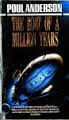
Poul Anderson, The Boat Of A Million Years (London, 1991).

Despite my uncertainty at the time, "li" (p. 208) (see here) is clearly used in the sense of a unit of distance.

"'...by river, lake, portage...the great Dnieper and its falls - hardest of the portages...'" (p. 149)

It occurred to me that I had only a vague idea of what was meant by "portage." However, the meaning, "carrying," can be deduced from the word and its context and is confirmed by google.

"Flambeau flare..." (p. 305) - another word that should have been clear but wasn't fully. (GK Chesterton created an excellent criminal mastermind/continuing villain, "Flambeau," who has the added merit that he is converted to the cause of good by his opponent, Father Brown, and becomes the latter's companion/assistant, as if Moriarty became Watson.)

"...a chromolithograph gazed from its frame..." (p. 312)

I had read of lithographs, without a clear understanding of them, but not chromolithographs.

"'I saw the Cherokees at the end of their Trail of Tears...'" (p. 291)

This was obviously a historical reference that it made sense to google.

Surely Hanno, originally from Tyre, would be too dark-skinned to pass as English? (p. 294)

"'...- native church...'" (p. 312) Peregrino, an immortal, says, "'I found a new faith among the Kiowas and I'm bringing it to the Nermernuth. Do you know the peyote cactus? It opens a way, it quiets the heart -'" (p. 292)

Does Peregrino mean "found" or founded"? He refers to the Native American Church. Peregrino, a fictitious character, helps Quanah Parker, a historical figure. In return, "'Quanah's covered for me...'" (p. 313), which explains why Peregrino's immortality never came to light.

Wednesday, 5 February 2025

Science And Technology

The Boat Of A Million Years, XIV, 3.

Tarrant/Hanno explains to Quanah that a scientist:

"'...is a man who seeks for whatever truth lies hidden behind things. How do the sun and the stars shine? How did the earth and life come to be? What really happened in the past?'" (pp. 287-288)

The past is historical, geological and cosmic. 

Quanah replies that he knows this and he also knows the consequences:

"'Thus you whites have found ways to do and make many terrible things, and the railroad runs where the buffalo grazed.'" (p. 288)

Knowledge is power. Science, "knowledge," has proved itself. After such knowledge, what forgiveness?

Friday, 7 February 2025

Starting Over

The Boat Of A Million Years, XIV.

Hanno and Wanderer work behind the scenes to bring to an end the conflict between whites and Native Americans. Wanderer helps Quanah Parker who covers up for Wanderer's longevity. Quanah knows Theodore Roosevelt. Wanderer is active in the Native American Church which I first read of in a book by Aldous Huxley.

Having done what he can for his people, Wanderer leaves with Hanno, saying:

"'It's time for me to start over.'" (8, p. 314)

Leaving that period of history behind them, the immortals move forward. They will come together. The remaining chapters of Boat are set in:

1931
1938
1942
1975
      ?

Tyre, Carthage, Gallia, Britannia, Roma and Byzantium are gone. The remaining year dates are familiar to Poul Anderson's readers: our twentieth century and a science fictional future.

Sunday, 26 April 2015

Continuing To Learn By Reading A Poul Anderson Novel

Poul Anderson, The Boat Of A Million Years (London, 1991).

I am at the half way point of Boat, realizing how much I missed on previous readings. Chapter XIII refers to both "...the Llano Estacado..." (p. 277) and "...the Staked Plains..." (p. 283), which googling reveals to be the same place.

Because Quanah had turned out to be a historical person, I googled the name of his companion, Wahaawmaw, thus confirming that this is indeed a name, although the first two items on the search list were a relevant passage from a few pages further along in this novel.

Hanno negotiates with Quanah while the latter is besieging a white-owned farm. Rufus is unhappy with this situation (good) but partly because he has been infected with white supremacist ideas (bad). Immortality confers no knowledge of ultimate reality. Rufus has converted to a dozen Christian faiths, wanting something to cling to which, as Hanno points out, immortals can never have. Immortality plus insight would confer the Hindu-Buddhist virtue of non-attachment.

Because of his great age, Hanno had:

"'...always taken slavery for granted, and it was a misfortune that could happen to anybody, regardless of race.'" (p. 294)

Certainly regardless of race in the ancient world. Racism of skin color arose with the trans-Atlantic slave trade.

Neil Gaiman's immortal Englishman, Hob Gadling, becomes riddled with guilt because he owned slave ships. His twentieth century black girlfriend cannot understand why he keeps apologizing to her.

Hidden Histories

Poul Anderson, The Boat of A Million Years (London, 1991).

"...the remuda amounted to just a pair of ponies each and three pack mules." (p. 279)

"...touch of knees and twitch of hackamore..." (p. 281)

"'The Tejanos stole her...'" (p. 285)

Of course I have heard of "...Texas Rangers..." (p. 286) but never knew any details. (The Lone Ranger has the cleverest origin story for a masked avenger.)

Hanno had told Richelieu that he had been under the patronage of Pharaoh Psammetk and now we learn that he knew Benjamin Franklin. He meets Chief Quanah of the Comanches. I had never realized how much history was in The Boat Of A Million Years.

Saturday, 2 May 2015

Leave-Taking

Poul Anderson, The Boat Of A Million Years (London, 1991), Chapter XIX.

Sections 1-8: the eight Survivors' dissatisfactions.
Section 9: their agreement to leave the Solar System if possible.
Section 10: the decision to launch a spaceship.
Section 11: leave-taking.
Section 12: the launch.
Sections 13-34: still ahead.

What a long way we have come from Pytheas' exploratory voyage. En route, we have learned about Taoism, Islam, Nornagest, Starkadh, Kiev, Constantinople, Tibet, Richelieu, Native Americans, Quanah Parker, Voudun, slavery, bureaucracy, Stalingrad and Seattle.

The Survivors' intensely experience aspects of Earth before leaving it forever:

courteous people;
a sail-boat on an ocean;
wheat goldening, rustling and rippling;
bees buzzing;
cows by a chestnut tree;
candles, music, silver, champagne goblets, cream of leek soup;
sky above a canyon;
a shrine maintained without pilgrims;
a forest after rain;
a picture, a table and a book that henceforth will be experienced only as virtual realities;
places revisited to say goodbye to their dead.

Fields or mathematical functions perceive themselves as particles, forces and light (p. 484).