Wednesday, 20 February 2019
Spearfowl
"A spearfowl, big as an Earthly condor, hovered out there. Its feathers were like shining steel."
-Poul Anderson, Orbit Unlimited, part four, 5, p.120.
Yet another passage that resonates with passages already read. If I remember correctly, a spearfowl will play a more active role as the narrative proceeds.
There are Terrestrial hawks, Merseian fangryfs and Rustumite spearfowl. The fictional fangryf obviously borrows part of its name from the mythological gryphon.
Sunday, 16 July 2023
Wind And Hawks
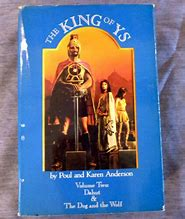
Dahut, XI, 2.
Tommaltach and a hooded Dahut walk in the countryside:
"Ys sank from sight. It was as if they had the world to themselves, they and the wind and a pair of hawks wheeling high above." (p. 242)
Significances:
Tuesday, 20 August 2019
More On The Mixed Ecology II
Bellevuean dactosauroids:
are the size of a man's hand;
have fangs, jewel-like scales, skin wings and long tails with diamond-shaped rudders;
live in nests;
hiss;
fly near a man's face;
bank and glide;
eat insects;
are eaten by red-tailed hawks.
(Google has pictures of red-tailed hawks but not of dactosauroids.)
See Mixed Ecology.
I admit to being less interested in the close details of military life and organization but nevertheless can unreservedly recommend SM Stirling's and David Drake's The General series, of which The Hammer is Volume II, to fans of military sf.
Tuesday, 19 June 2012
The Winter Of The World II
In the novel, the Rogaviki, an entire population who turn out to be a new human species, live by hunting bison, moonhorn cattle, bronco, antelope, wild deer, caribou, moose and elk. This makes them sound like the most primitive of homo sapiens societies.
However, a multi-chimneyed, mostly underground Rogaviki dwelling surrounded by shed, smokehouse, workshop, stable, kennel and mews uses both a sunpower collector and a windmill manufactured in neighbouring urban civilizations and shelves hundreds of books in its principal chamber below.
The largest formal social group is a single family. Associations of families are informal. Households are self-sufficient in necessities but buy finely made goods either imported in exchange for metal salvaged from ancient ruins or manufactured at "Stations," where Rogaviki, frequently traveling alone, can swap ponies and self-employed postal couriers stay overnight. A Station is a set of independent businesses run by single women or misfit men.
Bullgore Station print shop can bind books but buyers usually do this in winter when they practice arts or enjoy idleness. One new pamphlet describes astronomical observations made by a man with an imported telescope and navigator's clock at Eagles Gather. Most paper is imported although Whitewater Station on the Wilderwoods edge has a paper mill. Rogavikian manufacture is expanding and innovative, e.g., a portable loom and a repeating crossbow. All manufacture and trade are private with no government, guilds or laws although no one would sell game meat or hides because they live by the game beasts.
Bullgore makes brandy and distils, from fermented wild grain and fruits, alcohol to fuel blow torches and small machine tools. Although there is a windmill, the main energy source is the solar collector sending water to a subterranean fired clay tank where pressure generates heat used for cooking and warmth. Domesticated horses, hounds and hawks are indistinguishable from their wild counterparts. Rogavikians live healthily on a mainly meat diet by eating the whole animal, adding fish, fowl, eggs, breads, mare's milk and cheese, fruits, herb teas, beer, wine and mead.
One Rogavikian seriously offended by another severs all relationship with the offender. Offenders of too many become Outrunners, vicious bandits.
A kith is a set of families traditionally sharing a single large hunting ground. Territorial herds define each kith's territory which no other kith ever invades although individual travelers are welcome guests and may hunt en route. There are less than a hundred kiths and each has at most three thousand members. Rogaviki women can control their fertility. In a cross-kith marriage, the man joins his wife's. A Rogavikian woman decides whether to become a wife of several husbands or to remain unmarried but with other sexual outlets.
(1) Anderson, Poul, The Winter Of The World, New York, 1976, p. 9.
Sunday, 7 June 2020
On Mount Taylor
Mount Taylor is sacred in Native American traditions.
In Mike Carey's Luficer, the title character, with a local guide, descends through four levels of mythological underworlds from Mount Taylor.
In Operation Luna, Virginia Matuchek and Fjalar the dwarf depart for the Norse mythological universe from Mount Taylor. Before their departure:
"Two or three vultures hovered on broad wings." (p. 349)
- suggesting that they might not return alive.
For other hovering birds in Poul Anderson's works, see:
Hawks
A Hawk High Overhead
Monday, 6 August 2018
Hawks
-Poul Anderson, The Avatar, L, p. 404.
"Far above them, a hawk at hover caught glow on its wings."
-Poul Anderson, The Winter Of The World (London, 1980), I, p. 9.
Compare:
The End Of A Stone In Heaven
Belated Blogging And The Spiral Arm
There is:
a fangryf with light burning gold off its feathers on Merseia;
a bird of prey, its wings made gold by sunlight, on Unan Basor;
a hawk with wings aglow above the High Sierra;
a hawk with wings turned golden by the sun in Ireland;
a hawk catching glow on its wings during the Ice Age.
These hunting birds reflect what intelligent beings are doing on the ground below.
Saturday, 12 September 2020
Birds And Other Life
Wanda Tamberly, She Who Knows Strangeness, and Aryuk of the Tulat walk inland across open marshy country carpeted with herbs interrupted by occasional willows, reindeer moss and invasive birch:
"Two hawks cruised the wind, theirs the only wings in sight; grouse, ptarmigan, and the rest must be lying as low as the muskrat and lemmings. The mammoths moved slowly, feeding..." (I, pp. 145-146)
As ever, we appreciate Poul Anderson's descriptions of nature, of abundant life long before the advent of civilization and of yet another two hovering birds of prey.
(Hopefully, problems with the New Blogger have ended.)
Thursday, 27 February 2014
Gibraltar Falls
Two writers of time travel fiction, Julian May and Poul Anderson, describe the Atlantic pouring into the Mediterranean basin. Anderson tells us that:
"...this event would move the planet from its Miocene to its Pliocene epoch." (p. 119)
Such epochs are mentioned in the Time Patrol series whenever Patrol members travel further back in time than the human history that they guard, in this case to study and experience the origin of the Mediterranean Sea.
The opening five paragraphs of Anderson's "Gibraltar Falls" are a separate section of descriptive prose. The opening sentence:
"The Time Patrol base would only remain for the hundred-odd years of inflow." (p. 113)
- establishes by its first three words that this is a Time Patrol story but Manson Everard does not appear until the beginning of the second section of the story and even then is no longer the viewpoint character.
We are told that:
"...few people other than scientists or maintenance crew would stay there for long at a stretch." (ibid.)
Everard is at the small base on "...the southern end of Iberia..." (ibid.) on holiday. Given Patrol longevity treatment, it would be possible for some scientists to live at the base for the entire century of inflow if that was considered necessary for a full understanding of the epochal event.
Although the sky is cloudless and the land is dry with burnt grass and widely spaced plants, vultures and hawks hover above numerous grazing species and occasionally upright apes.
Tuesday, 21 January 2020
Some Details On Aeneas
"A vulch wheeled into view, wings across heaven." (p. 422)
Compare Hawks.
We are told that Colin is Hugh McCormac's oldest son and therefore will be the next Firstman. He will not - but the consecutive reader does not know that yet.
Colin saw crowds of ordinary citizens beat Snelund's political police to death. It happens.
"Trees grew about, not only the low iron-hard native sorts but imported oak, cedar, and rasmin. The wind carried their fragrances." (p. 423)
I could look it up but am recovering from a busy day so can someone remind me where rasmin comes from?
Sunday, 16 August 2020
"Gibraltar Falls": Scene-Setting
"Hawks and vultures were always at hover in cloudless heaven." (p. 113) (Scroll down)
Other Predators And Scavengers
sabertooths
hyenas
ground apes, sometimes erect
Prey
zebra-striped ponies
primitive rhinoceros
okapi-like ancestors of giraffes
mastodon
"peculiar elephants" (p.114)
Terrain
steep hills
low mountains
canyons
dry country
shrunken streams
burnt grass
Widely Separated Trees And Shrubs
thorn
mimosa
acacia
pine
aloe
palm
fern
orchid
Smells
hay
scorch
baked dung
warm flesh
Sounds
whistling marmots
booming wind
resounding hoofs
clamoring birds
trumpeting beasts
the beginning of a hundred years of thunder
Other Sensations
dust and heat in the face by day
sudden chill at night
many stars in alien constellations
six foot ant hills
We have had two posts about "Gibraltar Falls" but not yet got to the characters.
Saturday, 15 October 2022
Life Forms On Nike
Never assume that there is familiar green grass underfoot on another planet. On Nike:
"...the ground was densely carpeted with a soft mossy growth." (p. 484)
Another native species is a fronded, pale green, although blue-tinted, gymnosperm plant. Dagny assumes that this plant bears chlorophyll despite its paleness and partial blueness.
However, imported Terrestrial species are more highly developed and efficient and therefore have taken over most of the territory traversed by Roan Tom's wives, Dagny and Yasmin. Grass has displaced most of the pseudo-moss which seems to have:
"...a competitive advantage only in the shade." (ibid.)
There are oaks, birches, cedars, primroses, thrushes, bulbuls, hawks, butterflies, bees, mustangs, carabao and a wild boar. Native forms are represented by large, flying insectoids and awkward amphibians. North American mustangs are feral horses descended from domesticated horses imported from Spain. Thus, Nikean mustangs are even further removed from their domesticated ancestors.
Also imported although not from Earth are:
"...an entire herd of antlered six-legged tanithars." (p. 485)
Such devotion to descriptive details is astounding.
Friday, 20 May 2016
Wind And Dahut
"Gorse grew thickly at his feet, rustly beneath the wind that shrilled off the sea."
-Poul and Karen Anderson, Dahut, Chapter XI, section 2, p. 240.
The sea is Lir's and the wind shrills from it. I have become over-sensitized to every textual reference to the wind. Then Tommaltach meets Dahut:
"It was as if they had the world to themselves, they and the wind and a pair of hawks wheeling high above." (p. 242)
OK. Lir's sea wind brought them together? Dahut begins to work on Tommaltach. All that she extracts from him on this occasion is his promise that he will escort her when she goes, masked, to the Hunter's Moon festival in Ys. I now understand the logic of Dahut's position:
the Gods have chosen her to be a Queen of Ys;
she can be Queen only if she consummates her marriage to the King;
but the present King refuses this;
however, any challenger who kills the King in single combat in the Sacred Wood becomes the King;
therefore, she must persuade a strong young man to challenge Gratillonius;
fortunately, from her point of view, it is easy for her to do this.
Neither Aristotle nor Spock of Vulcan would be able to fault this logic.
Addendum: Tommaltach did not merely meet Dahut. She ran "...hastily...through the wind..." (p. 241) to catch up with him.
Sunday, 10 December 2017
Falconry In 1245beta AD And In Change Year 46
A Poul Anderson fan must think of an Ythrian when looking at a falcon. This one seems to have arms and hands.
In 1245beta, when Everard of the Time Patrol hawks with the Emperor Frederick:
the sun casts yellow beams and blue shadows;
the warm air is full of earth odors;
the city gleams - like Ys - while bells peal.
Four senses in three sentences.
Frederick has written a book on falconry and Everard has given him a falcon from the Patrol's pre-Indian North American ranch as well as relating sagas which Frederick likens to another whole universe.
I meant to continue about Emberverse falconry but am interrupted.
Saturday, 30 May 2026
Many Details, Four Senses And One Metamorphosis
There are more descriptive details than you might expect. On pp. 30-34:
Wednesday, 18 July 2018
Bird II
The avatar of Bird, a crow, relates that:
he dreamed;
his universe became empty;
hungry and angry, he tapped and broke the shell;
his eyes were dazzled;
opening his mouth, he was fed but was also crowded by others;
plumed, then shoved from the nest, he learned to fly;
he possessed the sky and raided the earth (Anderson fans remember Ythrians);
belonging to the flock, he watched for hawks or men;
the flock enjoyed life;
caught by a fox, he escaped but lost the power of flight;
darkness approached but the Summoner came and kept him alive for a while.
Tuesday, 25 August 2020
A Condor Wheeled
"A condor wheeled huge, on watch for any death." (p. 276)
There have been a lot of hovering predators and scavengers:
Hawks (scroll down)
Fangryfs (scroll down)
Spearfowl
Swordbeaks (scroll down)
Crows
A Cainite Bird Of Prey
Vultures
An Eagle
A Vulch on Aeneas
A Dactosauroid on Bellevue
Falcons
- and maybe more that I can't remember.
Friday, 29 April 2022
Summer In Haven
War Of The Gods, XIV.
Summer:
Saturday, 21 April 2018
Life On Nike
fronded pale green-blue native gymnosperm plants;
imported oaks, birches, primroses and grass;
pseudo-moss flourishing only in shade;
native insectoid flyers and awkward amphibians;
imported thrushes, bulbuls, hawks, butterflies, bees, boars, mustangs, carabao and six-legged antlered tanithars.
Thus, not all imported species are terrestroid.
(Poul Anderson, "A Tragedy of Errors.")
Sunday, 4 June 2023
The Past In The Time Patrol Series: Miocene-Pliocene Transition
Animal species in the Iberian peninsula:
Sunday, 12 May 2024
In Unknown Roong
The Winter Of The World, XVIII.
(From early Tuesday until late on Thursday or even Friday, we will be out of town and I will be off this blog. A welcome break for everyone.)
Sidir leads his men across tundra, swamp and morraine beside the Ice into Roong in a cleft of the glacier. The Rogaviki mine the Roong "towers" (skyscrapers), salvaging from the top first, in the summer and transport steel beams, copper wire, aluminium sheet and other metals across tundra frozen hard in winter. Sidir climbs a tower and wonders where Donya is so the following chapter opens with her.
Roong is the perfect setting for "giant spiders" (not literally) or other fabulous monsters but the Imperials enter unopposed. Sidir is confident that the Rogaviki will not lurk in ambush and he is right. Roong is common property, not kith territory, therefore not defended fanatically and the Northfolk will not be there while their trade routes are cut off. The Rogaviki have been effective at driving the wild herds beyond the reach of the invaders but Sidir had been careful not to depend on hunting.
The glaciers went round instead of across Roong because the ancients had struggled to preserve it by digging channels and erecting dams. Windows are empty. Gaps in walls are open to weather and rats. Roofs have fallen through multiple floors. Rubbish and soil have buried entrances. Lichen has ascended walls. Hawks and owls inhabit the highest floors.
Sic transit gloria mundi.