Showing posts sorted by relevance for query Epsilon Eridani. Sort by date Show all posts

Saturday, 5 March 2022

Stars In Eridanus II

See Stars In Eridanus.

OK. Here is Epsilon Eridani and here is 82 G. Eridani, also known as e Eridani and not to be confused with Epsilon Eridani. Poul Anderson's point was obviously that they are easily confused. Both stars have exoplanets.

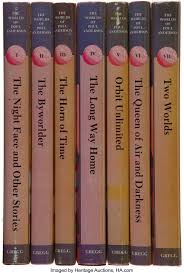
And, in Orbit Unlimited, both stars have been visited. Epsilon Eridani has no useful planets but e Eridani has Rustum. Although there are enormous obstacles to extra-solar colonization, conflicts on Earth can generate reasons for people to leave. Good comes from bad, sometimes.

Sunday, 12 April 2015

Rescue At Epsilon Eridani

Poul Anderson, Starfarers (New York, 1999).

"Far downward, he glimpsed monstrous waves on a sea gone white. A skirling deepened to a cannonade. The hull shuddered. Darkness and fury engulfed him. Rain hammered like bullets. The boat dropped, battled upward again, pitched and yawed." (p. 20)

A Poul Anderson character fights the elements. On a planet of Epsilon Eridani, he flies to rescue a fellow explorer who has crash landed. The downed man theorizes that a native germ has catalyzed a reaction with the supposedly inert material of his flyer. This is a common theme in Anderson's works, e.g., "Pride" (also see here) and "Starfog" - how to cope with the unexpected in an unfamiliar environment. What can go wrong when exploring a planet? - Anything.

The round trip to Epsilon Eridani takes a few days of ship time and fifty years of Earth time. And how many years do the explorers spend at Epsilon Eridani? They accept that their relatives will have died and it is considered tactless to refer to them. That makes sense.

Tuesday, 22 March 2022

Epsilon Eridani In Two Timelines

"'...Epsilon Eridani...has no planets of use to any Christian.'"
-Poul Anderson, "Robin Hood's Barn" IN Anderson, Orbit Unlimited (New York, 1961), pp. 7-41 AT 2, p. 17.
 
"...he saw Epsilon Eridani. The sun disk showed twice as big as the Sol he dimly remembered from his childhood, and red-gold in a purple sky. He had always believed Arcadia lovely, an undespoiled planet waiting for man like a bride..."
-"The Faun," p. 87. 

This is positive proof that the Rustum History and "The Faun" are set in different timelines. "The Faun" shares with the Rustum History and the two Directorate stories interstellar travel at sub-light speeds with suspended animation:
 
"...an undespoiled planet waiting for man like a bride, more than worth decades in coldsleep aboard a spaceship, toil and danger of pioneering, isolation from the rest of mankind." (ibid.)
 
"The Faun" can be regarded either as independent or as occurring later than the Directorate stories.

Tuesday, 26 March 2019

Lars Telander

Poul Anderson's Tau Zero does not give any year dates. The following improvised chronology begins with Lars Telanders' birth as time zero. Bracketed numbers are his time dilated age.

0          Telander born in Dalarna.
3           Alpha Centauri expedition leaves.
6           Maser messages from expedition.
25        Telander on Epsilon Eridani expedition.
54 (36) Return from Epsilon Eridani.
55 (37) Telander on Tau Ceti expedition.
86 (50) Return from Tau Ceti.
89 (53) Leonora Christine leaves.

Telander is:

a crew member to Epsilon Eridani;

first officer to Tau Ceti but becomes commander when the captain dies;

captain of the Leonora Christine.

At age 53, he has adolescent great-grandnephews in Dalarna.

Saturday, 5 March 2022

Beginning Interstellar Exploration

Orbit Unlimited.

The Wikipedia article on Epsilon Eridani informs us that:

Epsilon Eridani appears in science fiction stories and has been suggested as a destination for interstellar travel.[28] 

Maybe Poul Anderson intended to acknowledge previous works of sf that had featured Epsilon Eridani while also differentiating this new work of his from them?

After returning from a relativistic interstellar round trip, Joshua Coffin says:

"We expected to return to the Astronautic Society, at least, our own spacemen's nation within the nations - do you understand that? But the Society was so dwindled.'" (p. 18)

- and:

"'...I'd have to marry within the Society. I couldn't find a decent home life anywhere else -'" (p. 21)

So the Society might have become like the Kith if this history had gone differently.

After eighty-seven years, Coffin has returned to:

"'...the people and mores changed almost beyond recognition.'" (pp. 17-18)

One long sf novel could show a relativistic spaceship making two circuits of several extra-solar colonies, beginning and ending on Earth with Earth also at the mid-point of the novel. Such a narrative would show social change on each of these several planets. The same theme could be covered, although just on Earth, with a futureward time traveler stopping once every century or a Wellsian Sleeper waking up once every century. 

Stars In Eridanus

Orbit Unlimited.

A star is named by a Greek letter and a constellation. Thus, Alpha Centauri is the brightest star in Centaurus whereas Epsilon Eridani is the fifth brightest star in Eridanus. But why does Joshua Coffin differentiate Epsilon Eridani from e Eridani? is e not Epsilon (E in Greek)? No. Apparently e is Eta (H in Greek). (They had stopped teaching Greek in the senior classes in school by the time I got there.)

A few years back, a Latin tutor gave us this transliteration:

iota, i;
delta, d;
epsilon, e;
alpha, a -
 
- idea.
 
An important word all the way from Greek through Latin into English.
 
Addendum: No, I got that wrong about Eta. See The Greek Alphabet. I don't know what Coffin was getting at.

Saturday, 2 March 2013

Tau Zero, Chapter 2


Although Poul Anderson's Tau Zero (London, 1973) is definitely set in the twenty third century, the text gives no year dates so I have arbitrarily assumed 2201 as Lars Telander's birth year in order to generate a timeline.

2201 Lars Telander born.
2204 First manned expedition to Alpha Centauri departs.
2208 Luna Farside Station receives first maser messages.
2226 Telander joins crew of first expedition to Epsilon Eridani.
2256 Epsilon Eridani expedition returns, having aged 11 years.
2257 Telander is first officer on Tau Ceti expedition.
2288 Tau Ceti expedition returns, having aged 13 years.
2291 Telander is captain of Leonora Christine. His brother's great-grandsons are adolescents.

Just before Leonora Christine departs, one crew member says of the interstellar voyage:

" 'It is a kind of death - followed by resurrection, perhaps, but nonetheless a death.' " (p. 25)

She does not know how prophetic this is.

Leonora Christine departs at the beginning of Chapter 3.

Thursday, 27 December 2018

The Astronomy Of The Technic Civilization Saga by Johan Ortiz

-Hard science, artistic license and obsolete data-


The son of an engineer and with an education in physics himself, Poul Anderson was not shy about including hard science in his fiction. While future tech was often handwaved off with a minimum of techno-babble, when it comes to strange stars and planets, we get a veritable catalogue of facts from spectral type of the star, the axial tilt of the planet, even in some cases including the geology of his worlds! And while he did create a lot of fictional stars, he also made use of real ones when building his future histories. This is very apparent in his Technic civilization stories, where some actual stars are recurring “characters” together with some fictional ones. It is notable that in that series of stories, most of the action takes place either in the Sol system or in rather distant star systems. Hardly any Technic story takes place within 20 light years of Sol (excepting Sol itself). Staple stars of science fiction like Epsilon Eridani, Sigma Draconis or Tau Ceti are seldom mentioned. In a rare exception, the future first Emperor of Terra, Manuel Argos, is captured by the Gorzuni on Alpha Centauri. Another relatively close system mentioned is Chee Lan’s home planet Cynthia which orbits Omicron 2 Eridani A, 16,3 LY from Sol.

The position of the real star systems used, just as the fictional ones, are often described at least relative to the Sol system – and it is here that the advancement of science has made a disservice to Anderson’s work. During, and especially after the period during which he worked on the technic civilization saga, the data we have on the distance from Sol of many of the stars mentioned in the stories have improved considerably.

Because we do not know with certainty the absolute luminosity of a distant star – we cannot really tell at a glance if it is a shining giant at an enormous distance we are seeing or a modest dwarf closer to Sol – we can measure distance from us by using the parallax method. It is how our depth vision work. Just as our brains can calculate the distance to an object through (among other means) the slight difference in angle between the picture of either eye, astronomers can measure the angle to a star at two points in time. Using the difference in angle between the two observations, trigonometric calculus can give an estimate of the distance to a star. However, the more distant the star, the smaller the angle is and the harder it is to accurately calculate the distance. And in this, the state of the art has advanced considerably since the 1950s. For example, in the 1990s, close to the end of Poul Anderson’s career, the Hipparcos mission obtained parallaxes for over a hundred thousand stars with a precision of about a milliarcsecond, providing useful distances for the first time for stars out to a few hundred parsecs (a parsec is equal to about 3.26 light years). With the Hubble telescope we can today reliably determine distances out to 5 000 parsecs. None of this was possible in the 50s, 60s or even 70s.

This coupled with the fact that the Technic stories involve mainly distant stars has caused the distances mentioned by Poul Anderson to become very dated. I shall name a few examples.

In A SUN INVISIBLE, the distance from Sol to Beta Centauri is given as 190 LY. Currently, it is believed to be 397 LY. In SATAN’S WORLD, the Serendipity supercomputer tells David Falkayn that Beta Crucis is 204 LY from Sol. Currently it is believed to be 287 LY. Note that this also means that the author thought of these two stars as being be much closer to each other than what we now believe.

The obsolete data for distance to real stars have consequences also for the locations of fictional ones, since their position is often described as relative to real stars.

In WINGS OF VICTORY, in which an Earth star ship of The Great Survey visits the Home world of the avian Ythrians, their star is said to be “beyond the great stars Alpha and Beta Crucis”, “in the constellation Lupus” and “278 light years from Sol”. As mentioned earlier, this is inconsistent with modern data, since the closer of the two stars, Beta Crucis is about 287 LY from Sol, and Alpha Crucis is 326 LY. To be considered “beyond” both these stars in any sense of the word, Ythri must be no closer than 326 LY to Sol. Add to this that Ythri is to be found in Constellation Lupus, not Crux as Alpha and Beta Crucis, that is to say a considerable distance to one side of Crux.  If we are truly to consider us to be “beyond” and not “beside” Alpha Crucis, we would have to increase the distance further – exactly how long is impossible to determine, but one could safely assume another 100 LY at the least, to place A .Crucis “behind” rather than beside us.

But we have more clues in other stories. In THE PEOPLE OF THE WIND, the Terran Empire initiates a war of conquest against the Ythrians. Among the reasons are to secure for Terra the system of Beta Centauri, around which orbited several Krakoan- and one human-inhabited worlds before Ythri might beat them to it, as they already had with the Dathyna-system (from SATAN’S WORLD). Beta Centauri is, also as mentioned, 397 LY from Sol, and while it is not inconceivable that Terra and Ythri would dispute a system beyond Ythri from Sol, intuitively we would assume that the disputed systems are between the two. Beta Centauri is not mentioned as a close neighbour to Ythri in “wings of victory”, which makes sense since we know that the author believed B. Centauri to be only 190 LY from Sol, we can conclude that he also thought of Ythri as being no closer to B. Centauri than 88 LY (which would any way require it to be behind Beta Centauri and in Constellation Centaurus, not Lupus). These considerations would lead us to the conclusion that Ythri is near to 500 LY from Sol.

Another problematic set of data appears in Anderson’s Dominc Flandry stories set in the decadent Terran Empire of the early 31st century. The Empire is said to control a rough sphere with a radius of two hundred light years including around 4 million stars – but within that sphere are Beta Centauri (397 LY away), Alpha Crucis (326 LY from Sol), Beta Crucis (287 LY) and Antares (609 LY from Sol). Betelgeuse (642 LY from Sol) is not within the Empire, but a buffer state between Terra and Merseia (which is said to be located in “the wilderness between Betelgeuse and Rigel” in THE DAY OF BURNING). To make matters worse, Antares and Betelgeuse are almost exactly opposite each other from Sol. The Empire thus claims space up to more than 600 LY in both these directions.

Another problem is that within a sphere with even a 250 LY radius from Sol, there are in the proximity of 260 000 stars, so nowhere near the 4 million stars mentioned. That amounts to about 0,0038 stars per cubic light year. Using this star density, it would require a sphere with a radius of almost 630 LY to include 4 million stars.

On the other hand, in THE REBEL WORLDS, Polaris and Deneb are said to be “unutterably far beyond the Empire and its enemies”. This is doubtlessly true about Deneb (1 547 LY from Sol) but Polaris is “only” 431 LY from Sol, that is to say closer  than both Antares and Betelgeuse and also notable for being on one end of the sphere controlled by the Polesotechnic League in the era of Van Rijn and Falkayn, which held sway “from Polaris to Canopus” (Canopus is 313 LY from Sol, by the way). While it is mentioned by Flandry that the Polesotechnic League explored far beyond the Empire’s reach, it is odd that Polaris should be considered “unutterably” beyond the Terran sphere, when being closer to Sol than some of the Empire’s more notable border systems.

None of the this would really be problematic unless for the oft-repeated statement that the Empire controls a “rough sphere” 400 LY across, or with a radius of 200 LY. An Empire that controls Antares, Alpha and Beta Crucis, Beta Centauri and which borders Betelgeuse but otherwise only holds sway out to a radius of 200 LY from Sol is not a sphere – rather it is shaped like a three-dimensional starfish!

Now, how to reconcile these inconsistencies with Poul Anderson’s texts? One way is to decide that the entire universe is fictional, and that in the universe of the technic civilization, Beta Crucis really is only 200 LY from Earth. Another approach is that of “minimum rewrite”, i.e. to ignore those measure of distance given by the author that are inconsistent with modern data but accept all other facts – in other words, accept that Antares is an Imperial system, and Betelgeuse is a buffer state, and thus conclude that the Empire is over 1 200 LY across between those systems. That would also mean accepting that the Empire, as stated, is a rough sphere rather than a starfish, but that it is a sphere with a diameter of roughly 400 parsec (rather than light years). Interestingly, the earlier mentioned radius of a sphere required to englobe 4 million stars, 630 LY, corresponds to 193,1 parsecs. A sphere with a 200 parsec radius would hold, on average, 4,4 million stars. Close enough!

Not all astronomic inconsistencies in Anderson’s work stem from obsolete data however. Above all, he was a writer of fiction, and as such he would engage, from time to time, in artistic license. In WE CLAIM THESE STARS, the dastardly Merseians are trying a land grab (or star grab perhaps?) in the fictional Syrax star cluster, which, if held by the Merseians would “bypass Antares” (presumably an imperial bastion) and thus hasten the demise of the Terran Empire by a century or more. The only problem is that, as mentioned before, Antares in constellation Scorpio is on the exact opposite side of Sol from constellation Orion where Merseia orbits the star Korych between Betelgeuse and Rigel (according to THE DAY OF BURNING). Thus, if we are to take this at face value, the Merseians have completely surrounded the Terran Empire at least on one side and can threaten it from the exact opposite direction of their home world, more than 1 250 LY away, in a straight line and more than 2 000 LY away if they have to fly around the circumference of the Terran sphere. Assuming speeds similar to those given in SATAN’S WORLD (Sol to Beta Crucis in two weeks), such a journey would take close to 100 days. It could be less, if the state of the art of hyperlight travel has improved in the centuries since SATAN’S WORLD, or it could be more, given that the estimated travel time in that story was for a small, swift ship for a few passengers. A heavy battlefleet might be considerably slower. The Merseian fleet at Syrax could well have made a journey comparable in length to that of the ill-fated Russian Baltic Fleet sailing to Tshushima in 1904-1905 (which took around six months).

On the other hand, we are told the Merseia threatens the Empire on its “Betelgeusan flank, and the barbarians everywhere else” – the Empire does not have Merseia around half of its periphery. This leaves a distant Merseian base the only possible explanation, perhaps similar to Cuba becoming a Soviet base during the Cuban missile crisis. That analogy makes clear the problem with that assumption obvious – while the US would have very much deplored and opposed a Soviet attempt to take over, say Haiti from its Cuban base in 1961, the really big beef was having Soviet missiles on Cuba in the first place.

By the same token, if the Merseians were threatening Syrax from a distant exclave in Constellation Scorpius, then surely it would be worth at least a passing mention by Flandry or his superiors? Such a base would constitute a major strategic conundrum for Terra, far more important in itself than the fate of the Syrax cluster and one it could scarcely leave unaddressed, even in it morose decadence. Nonetheless, this is what the reader will have to assume, if we are not to dismiss the premises of the story out of hand!

In this case, obsolete data are not to blame – the directions of Antares and Betelgeuse where as well known in 1969 when that particular story was written as they are today.  But Antares had been used in several prior stories and connects the reader with the Technic universe through familiarity of places and names. It will be noted though that never in the story does Anderson say that Antares is anywhere near Betelgeuse or Korych. The inconsistency is not in astronomy but rather in somewhat implausible geo- or rather astropolitics.

Sunday, 6 March 2022

In Robin Hood's Barn

Orbit Unlimited.

Literary References 
Alice
Mephistopholes
Donne
Dante's seventh circle
Christian leaving the City of Destruction
 
Historical References
Egypt
Babylon
Rome
India
China
the Puritan Commonwealth
the Periclean era
the Renaissance
the Rome of Commodus
Massachusetts
Maryland
Pennsylvania
 
Religious References
a white church
a smiling idol
monastic orders in four milieus
English Puritans
Quakers
Catholics
Mormons
a Buddha
Jewish Zealots
Russian Old Believers
 
Philosophical References
Socrates
Spengler
Machiavelli
 
Astronomical References
Epsilon Eridani
E Eridani

Saturday, 15 February 2025

Crew Members

The Boat Of A Million Years took many hundreds of years to draw its eight immortals together before they could venture beyond the Solar System as the crew of the Pytheas. Starfarers begins by listing ten crew members of the Envoy, then introduces them, some in different planetary systems, before they assemble:

Nansen, who will be captain, at Epsilon Eridani;

Jean Kilbirnie, second pilot, and Timothy Cleland, planetologist, at Tau Ceti;

Yu Wenji, engineer, at Sirius;

Selim Zeyd, biochemist, who has been to Epsilon Indi, in Istanbul;

Hanny Dayan, physicist, with Nansen in Paraguay;

Mamphela Mokoena, biologist and physician, and Lajos Ruszek, mate and first pilot, in South Africa.

That is eight of the ten and all that I can track down at this time of night.

It is late here although not where some of you are.

Thursday, 14 March 2019

"The Faun" II

See "The Faun."

Tom, tall, thin, wearing a scaly leather tunic and carrying knife, rifle and backpack, is accompanied by a six-legged "cynopard" with fur of the same bluish green as the local leaves. Peering, listening and smelling, Tom senses something wrong and leads the cynopard in a particular direction.

Having following a peacock moth off the trail, Edmund Wylie has become lost and separated from his party. He is a settler on Arcadia, a planet of Epsilon Eridani, eleven light years from Earth. The journey from Earth had involved decades in suspended animation, as in both the Rustum and the Directorate future histories. However, in its history, Rustum, twenty light years from Earth, is the nearest habitable extra-solar planet whereas, in the Directorate history, Mithras, thirty three light years away, is so far the only habitable planet to be found within a radius of under fifty light years. On the other hand, at the time when the base on Mithras is being terminated, less than half the stars within that radius have been visited. Thus, Arcadia, although nearer, might have been found later.

Settlers on Arcadia have introduced squirrels and other animals and talk of somehow cooperating with nature which is where the Faun will come into the picture. Cooperation with nature sounds like an improvement on the losing war against a hostile environment that human beings were obliged to wage on Sibylla.

Saturday, 15 February 2025

Earth Grown Foreign

Starfarers.

In travel time, Tau Ceti is twenty-two years away, Epsilon Eridani twenty-five. The life of an interstellar explorer:

"'Do you really want that? For the rest of your life? Returning each time to...to an Earth grown still more foreign?'" (2, p. 25)

An open-ended series of very long novels would not do justice to this concept. Starfarers will show us some of the alienization of Earth itself.

During a pause in a conversation between Jean Kilbirnie and Tim Cleland on a planet of Tau Ceti:

"The wind whispered through the leaves." (p. 26)

Some very new blog readers might wonder why I quote that sentence...

Hail, Vayu!

Saturday, 3 July 2021

Serpens Caput And Harbor

Starfarers, 2-3.

An installment of a future history series has backwards and forwards connections with other installments of the same series and sideways resonances with similar series.

In the system of Epsilon Eridani, Sol is:

"...a second-magnitude star in Serpens Caput." (p. 17)

- the Serpent Head. The same constellation is visible from Earth. See Serpens.

From Avalon, in the Technic History, Sol is in the Maukh. From far enough away in James Blish's "And Some Were Savages," Sol is in the Parrot.

Poul Anderson's "The Tale of the Cat" was published in February 1998 and, in November 1998, was adapted as Chapter 17 of Starfarers. In 17, and presumably in the original story, there are lyre trees and arachnaes on the colonized planet of Harbor. In 2, Jean Kilbirnie, Tim Cleland and others explore Puerto/Limani/Kiang/Harbor, as they are calling it, where some trees are lyre-shaped and others suggest large spiderwebs. In 17, on Harbor, there is a Monument Stone to Kilbirnie and Cleland, now Envoy crew members. Thus, the author constructs an elaborate future history narrative.

Friday, 15 March 2019

Astronomical Names

In Poul Anderson's "Home," there is a base on a planet called Mithras.

In Anderson's, "The Alien Enemy":

the star Hr 6806 is called Cumae;

the colonized planet of Cumae is called Sibylla;

other colonized planets are called Zion, Atlas, Asgard and Lucifer.

In Anderson's "The Faun":

the colonized planet of Epsilon Eridani is called Arcadia.

There are several names in Anderson's "Time Lag," which we will reread shortly.

Tomorrow, day trip to London for UN Anti-Racism Day.

Monday, 13 April 2015

Learning By Reading Fiction

Poul Anderson, Starfarers (New York, 1999).

OK. I did not know that Rehavia (see image) (p. 61) was a neighborhood in Jerusalem. I have reread Starfarers to p. 65 of 495 and have learned:

the beginning and end dates for the publication of Anderson's Kith series, forty four years from start to finish;

parallels and divergences between Anderson's Genesis and his Starfarers;

the idea that perennial virtuality precedes temporal reality;

the hypothetical transitional stages between the dynamic vacuum and the atoms of which we are composed;

an argument against artificial intelligence;

the meaning of metastability;

that Epsilon Eridani and Tau Ceti were regarded as good prospects for SETI;

that there is more recent evidence for planets in orbit around these stars;

something about Fridtjof Nansen;

the meanings of several previously unfamiliar words;

something about a Thomas Wolfe novel;

that Rehavia is a neighborhood in Jerusalem.

Sunday, 16 February 2025

Everything Is Different

Two short future history series, one about the post-nuclear-war Maurai Federation, the other about the Kith interstellar traders, shared a single volume, Maurai And Kith. Then both histories were expanded. The long novel, Starfarers, incorporates the Kith history whereas another long novel, Orion Shall Rise, extends the Maurai history. Finally, There Will Be Time involves time travel to several past and future periods and those future periods include the Maurai period. Starfarers involves time dilation and intertemporal communication but not any physical time travel. This is not the only complicated part of Poul Anderson's vast canon. Consider also:

his Old Phoenix multiverse;

his increasingly elaborate Time Patrol series;

his amalgamation of two series, about the Polesotechnic League and the Terran Empire, into a single long future history series.

The Kith trade between Earth and colonized planets but do not explore new planetary systems. Ricardo Nansen explores at Epsilon Eridani, then at 61 Cygni, and finds that everything is different on Earth after his second return. Then he embarks on a ten thousand year round trip so of course everything is going to be even more different after that. Thanks partly to the Kith, we are shown something of the changes on Earth during Nansen's third and longest absence. However, there is room for a novel about an explorer who departs for decades or centuries at a time and about what he finds on Earth each time he returns.

Monday, 5 July 2021

Michael Shaughnessy And The Kith

Starfarers.

In Chapter 1, Ricardo Nansen rescues Michael Shaughnessy on a planet of Epsilon Eridani.

In 10, Shaughnessy visits a district that has come to called Kith Town. He refers to "...the kith of the starfarers..." (p. 81) and to "...kithfolk..." (ibid.) but the word, "kith," has not yet been given a capital initial except in the name of the district. He, Shaughnessy, has just returned from Aerie and Aurora in Our Lady and will shortly leave for a long sweep in Estrella Linda. While in Kith Town, Shaughnessy, seventy, visits his great-grandson, Ramil Shauny, who is a hundred and ten and the local mayor.

In 12, Shaughnessy, now very old and singing of Earth in Irish while playing a harp, expects to die on Feng Huang, a planet of Delta Pavonis.

Thus, the expanded Kith History in Starfarers becomes Chapters:

10
12
17
21
46
49
50
51

Friday, 18 September 2026

Faun And Wyvern

There is nothing left to reread in The Queen Of Air And Darkness and other stories except "The Faun," a juvenile short story with just over five pages of text. Having just returned from the Duke's Playhouse, we will not reread this story tonight. However, we notice its reference to Epsilon Eridani. Also, it is another sf story that begins like a fantasy: first, the title; then the opening sentence -

"A wyvern flew up in a thunder of splendid wings."
-Poul Anderson, "The Faun" IN Anderson, The Queen Of Air And Darkness and other stories (New York, December 1973), pp. 86-91 AT p. 86.

Extraterrestrial birds and animals can be named after mythological beasts.

I want to check stories in a couple of other Anderson collections but a house guest is sleeping in the room with the books. Meanwhile, I also want to reread some more Stieg Larsson before turning in. This weekend, "Heritage" events continue in Lancaster: concerts in churches etc.

Onward, Earthlings.

See also:


blog search result for wyvern (scroll down)

Thursday, 20 February 2025

Meanwhile, Back On Earth, Time Passes

Starfarers, 9.

The "galactic river" is "cold" in 9 and "frosty" in 40. See:

The Sea Of Space

Galactic River

In Tau Zero, The Boat Of A Million Years and Starfarers, a relativistic spaceship departs the Solar System. In Starfarers alone, the ship will return and meanwhile readers are kept informed of events on Earth and elsewhere in human space during its absence.

At the end of 9, the ship has set off and the crew are starting to settle in for the journey. We expect this narrative to continue. Instead, Chapter 10 opens:

"The town began..." (p. 77)

What town? We are back on Earth with a different set of characters. This opening paragraph summarizes some future history. The town had begun:

"...as a district in a small city." (ibid.)

However, we are told, people draw together when their way of life makes them increasingly foreign to those around them. What way of life? How are they becoming foreign? We suspect that the Kith, slower than light interstellar traders, are being introduced as their future history is incorporated into this long novel. We are told:

"As time passed, the district became a community in its own right. And it abided, while change swept to and fro around it like seas around a rock." (ibid.)

How much time? How many generations? Poul Anderson conveys the sense of more than one lifetime but, with time dilation, individuals can continue returning to Earth while generations are born and age there. Turning the page, we find that our viewpoint character is Michael Shaughnessy whom Nansen had known at Epsilon Eridani. 

Tuesday, 8 April 2014

Known Space, 2367-2505

The First Man-Kzin War began in 2367 and the Fourth ended in 2505. The Wars involved:

Alpha Centauri;
Sol;
Procyon A;
61 Ursae Majoris;
Sigma Draconis;
Barnard's Star;
Epsilon Eridani;
the extrasolar planets, Warhead/Canyon and Shasht/Fafnir.

Thus, any sf writer contributing stories to the Man-Kzin Wars sub-series of Larry Niven's Known Space future history could present different characters in different planetary systems during different Wars in different centuries. However, s/he is more likely to create a sub-sub-series with continuing characters and sequential events.

Of Poul Anderson's three contributions, "Inconstant Star" is a direct sequel to "Iron" and I expect "Pele" to complete the trilogy although I can be wrong.

"The vast Majority of the Man-Kzin Wars stories are set around the First War," according to Wikipedia. "Iron" and "Inconstant Star" describe incidents occurring immediately after the First War.