Showing posts sorted by relevance for query wyvern. Sort by date Show all posts

Friday, 18 September 2026

Faun And Wyvern

There is nothing left to reread in The Queen Of Air And Darkness and other stories except "The Faun," a juvenile short story with just over five pages of text. Having just returned from the Duke's Playhouse, we will not reread this story tonight. However, we notice its reference to Epsilon Eridani. Also, it is another sf story that begins like a fantasy: first, the title; then the opening sentence -

"A wyvern flew up in a thunder of splendid wings."
-Poul Anderson, "The Faun" IN Anderson, The Queen Of Air And Darkness and other stories (New York, December 1973), pp. 86-91 AT p. 86.

Extraterrestrial birds and animals can be named after mythological beasts.

I want to check stories in a couple of other Anderson collections but a house guest is sleeping in the room with the books. Meanwhile, I also want to reread some more Stieg Larsson before turning in. This weekend, "Heritage" events continue in Lancaster: concerts in churches etc.

Onward, Earthlings.

See also:


blog search result for wyvern (scroll down)

Sunday, 10 November 2013

Unicorns Etc II

Sphinx = human head + lion's body;
Gryphon = eagle's head & wings + lion's body;
Hippogriff (1) = eagle's head & wings + horse's body;
Centaur = human head, arms & torso + horse's body;
Wyvern = dragon's head + reptilian body;
Hippogriff (2) = winged horse;
Unicorn = horned horse.

Does this make any sense?

Two of the creatures are horses with extra features. The remaining five are composites. Of these, the wyvern has no features in common with any of the others.

The sphinx and the centaur have a human head;
the sphinx and the gryphon have a lion's body;
the hippogriff (1) and the centaur have a horse's body.

I started on this trail because the Andersons' The Unicorn Trade has a winged horse on its cover, because Neil Gaiman's Sandman is guarded by a wyvern, a gryphon and a hippogriff (2) and because Narnians include some of the above. (Also, Alice meets a gryphon.)

The Unicorn Trade cover art is by Tom Kidd while, inside the covers, the title poem and the two short stories called "Landscape With Sphinxes" and "The Piebald Hippogriff" are by Karen Anderson, so the mythological creatures have led us away from the works of Poul Anderson as such although they are sufficiently closely related to warrant some attention here. But maybe that is enough.

Addendum: Further reading discloses that the piebald hippogriff has a feathered head, so is Hippogriff (1), while "Treaty In Tartessos" by Karen Anderson features centaurs. (To continue the comparison with graphic fiction, Lucifer, Mike Carey's sequel to Gaiman's The Sandman, presents a world jointly inhabited by human beings and centaurs.)

Tuesday, 22 March 2022

Dragon, Wyvern And Faun

"'No dragons are flying -'"
-Poul Anderson, "Outpost of Empire" IN Anderson, Captain Flandry: Defender Of The Terran Empire (Riverdale, NY, 2010), pp. 1-72 AT p. 1.
 
"A wyvern flew up in a thunder of splendid wings."
-Poul Anderson, "The Faun" IN Anderson, The Queen Of Air And Darkness And Other Stories (London, 1977), pp. 86-90 AT p. 86.
 
What These Passages Have In Common
(i) Dragons, wyverns and fauns are mythological beings.
(ii) Each passage is the opening sentence of an sf story.
(iii) Each story is set on a humanly colonized extra-solar planet.
(iv) Each opening sentence implies fantasy, not sf.
(v) However, each story is in an sf collection.
 
Apart from all this, they are completely different.

Sunday, 10 November 2013

Unicorns Etc

The cover of one edition of Poul and Karen Anderson's The Unicorn Trade (see previous post) shows not a horned horse but a small winged horse. CS Lewis' Narnia has unicorns, winged horses, centaurs and other mythological quadrupeds. So how are these quadrupeds related and is a winged horse a "hippogriff"?

According to Wikipedia:

a wyvern has a dragon's head and a reptilian body with two or even no legs (so is not a quadruped);
a gryphon has the head, claws and wings of an eagle but the body, hind legs and tail of a lion;
a hippogriff is like a gryphon but with a horse's instead of a lion's body because it is a cross between a gryphon and a horse.

However, in Neil Gaiman's The Sandman, Morpheus' Castle is guarded by a wyvern, a gryphon and a hippogriff and the third of these is drawn like a winged horse.

The Unicorn Trade includes a short story by Karen Anderson about sphinxes, that I have not read yet. This is not the first time that I have found an interesting parallel between the works of Anderson and Gaiman, although The Unicorn Trade derives its title from a two page poem by Karen Anderson that opens the book.

Thursday, 14 March 2019

"The Faun"

Poul Anderson, "The Faun" IN Anderson, The Queen Of Air And Darkness And Other Stories (London, 1977), pp. 86-90.

"A wyvern flew up in a thunder of splendid wings." (p. 86)

We think that we are reading a fantasy. However, the text continues:

"A python tree coiled its branches. A chiming rang among the tiny red blossoms that covered the ground." (ibid.)

The python tree sounds alien. The ground blossoms sound like another of Poul Anderson's extraterrestrial alternatives to grass. The last sentence of the opening paragraph clinches it:

"Alien in the forest, a grove of pines stirred only to a breeze." (ibid.)

Pines are alien here. This is another planet settled and modified by human beings. The second paragraph begins:

"The boy, Tom, stepped out from among them." (ibid.)

Wednesday, 3 June 2020

Composing The Curious Spell

Operation Luna, 21.

"'Blank verse until the last, which the melody requires be an Alexandrine.'" (p. 189)

Blank verse is unrhymed. Alexandrine is: see here.

Then at the last and only couplet fraught
With some unmeaning thing they call a thought,
A needless Alexandrine ends the song,
That, like a wounded snake, drags its slow length along.

-copied from the Wikipedia article linked above.

Frogmorton puns:

"'...Pope is Dryden as dust...'" (p. 190)

Ginny decides against O'Carolan. They consider Rupert Brooke and Shelley's The Revolt of Islam, the latter potentially contributing:

"'An added dimension for the continuum of cultural conflict. And it has the necessary scansion.'" (ibid.)

When Ginny has written the spell on "...wyvern-wing parchment..." (ibid.), Frogmorton:

"...thrice dripped wax from the bees of Delphi on it..." (ibid.)

The Delphians say that the second temple was made by bees from bees-wax and feathers, and that it was sent to the Hyperboreans by Apollo.
-copied from the Wikipedia article linked from "Delphi," above -

- "...to stamp with the sigils of Thoth, Solomon, and St. George." (ibid.)

Wednesday, 1 February 2017

"The Faun": Opening Paragraph

Comparing future histories has led us back to (what I call) Poul Anderson's Directorate History, which is just four stories.

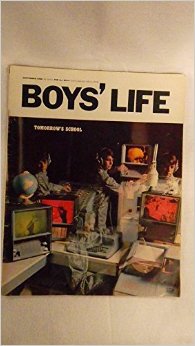
"The Faun" was published in Boy's Life and thus is one of Anderson's juvenile works (see also here). The title and the opening sentence:

"A wyvern flew up in a thunder of splendid wings."
-Poul Anderson, "The Faun" IN Anderson, The Queen Of Air And Darkness and other stories (London, 1977), pp. 86-90 AT p. 86 -

- suggest a fantasy but the following sentences clarify that the story is set on a colonized extra-solar planet.

"A python tree coiled its branches." (ibid.)

A tree so called because its branches move.

"A chiming rang among the tiny red blossoms that covered the ground." (ibid.)

As often before, Anderson tells us what a terrestroid planet has instead of grass.

"Alien in the forest, a grove of pines stirred only to a breeze." (ibid.)

So this planet has been colonized by human beings who have brought some of their own ecology with them. And that concludes the opening paragraph.