Thursday, 27 March 2014
The Man Who Came Early II
The protagonists of "Wildcat," "The Nest," "The Little Monster" and "The Man Who Came Early" travel to the Jurassic, the Oligocene, the Pliocene and the late tenth century AD respectively. Thus, they are true time travelers. The protagonist of "Welcome" psycho-physically exists for less than half an hour between 1997 and 2497 and the protagonist of "Time Heals" undergoes zero duration between 1952 and 2837 but neither can return so they are not time travelers.
The protagonists of "Flight To Forever" can travel into an indefinite future but would need infinite energy to travel more than about seventy years pastwards. But they can travel in that direction so they are time travelers. They can also reach the past by traveling forwards around the circle of time, which is a new angle. (Olaf Stapledon's Last Men discovered that time is a circle and that most of it is an unknown period between the end and the beginning of the universe.)
"The Man Who Came Early" perfectly complements these other stories of characters displaced in time. Its point, contra L Sprague de Camp's Lest Darkness Fall, is that a twentieth century engineer and soldier would lack the skills necessary to succeed or even to survive in tenth century Iceland. The time traveler is described entirely as perceived by the tenth century narrator. He wears what we recognize as a military uniform inscribed not with runes but with Roman letters, "...thus, MP." (p. 189) So we know that he is a military policeman.
By speaking with this stranger, the narrator has learned that the Christian priest is wrong to say that the world will end in two years but has also learned that Christ will conquer Thor - so he might as well be on the winning side. The stranger introduces himself as Gerald Robbins but, when asked, says that his father was named Sam, so he is known as Gerald Samsson. When he asks what year it is, he is told, "'...it's the second year after the great salmon catch...'" (p. 191), but he perseveres and learns the approximate date AD.
Thus, this is a time travel story recounted entirely from the perspective of the period that has been traveled to.
Friday, 11 July 2014
Multiverse: The Man Who Came Late
OK. There is an Old Phoenix story in this anthology but the tavern is seen only from the outside, and it provides the story's resolution.
"The Man Who Came Early" by Poul Anderson is a stand alone short story about a twentieth century man who travels to, and dies in, the Viking period. "The Man Who Came Late" by Harry Turtledove is a sequel to Poul Anderson's novel, Three Hearts And Three Lions. At the end of that novel, Holger Danske leaves the world in which he has met Alianora. In Anderson's A Midsummer Tempest, Danske is in the inter-universal Old Phoenix, trying to find his way back to that world. In "The Man Who Came Late," Danske returns after thirty years to find that Alianora is married with three grown up children.
How will this situation be resolved? Will Alianora leave with Holger? No. Will Holger instead leave with Alianora's daughter who resembles her as she was? No. The Old Phoenix appears and Holger enters it alone, although Morgan le Fay, unaged, has been glimpsed through its open door.
I have suggested before that a collection with the proposed title of The Old Phoenix And Other Universes could comprise a couple of alternative universe short stories followed by Anderson's two Old Phoenix stories. This sequel by Turtledove would make an appropriate conclusion to such a volume.
Wednesday, 26 March 2014
The Man Who Came Early
Anderson, Poul, "The Man Who Came Early" IN Knight, Damon, Ed. 100 Years of Science Fiction, Book One (London, 1972), pp. 185-212.
"The Man Who Came Early" reminds us of other historical fiction by Poul Anderson. Its second sentence refers to "...the king in Miklagard..." (p. 185) and to an "Eilif Eiriksson," who had served in the Varangian Guard.
Not only is the narration first person but it is addressed conversationally to a single auditor, a Christian priest. The speaker, having seen how the English and French prosper, concedes that "...the White Christ...must be a very powerful god, to ward so many realms..." (ibid.) and is attracted by the idea of receiving a white robe at baptism. Such a garment would mildew in Icelandic weather but he would sacrifice to the household elves...
Someone who thinks thus is prepared to change his deity within the Pagan world view but is not yet making the change to the Christian world view. How many of the first generation in Northern Europe did it that way? Christianity represented civilization, a higher culture and wider trade. There were pragmatic reasons for conversion. But subsequent generations grew up in a society that had collectively changed its world view from Pagan to Christian.
We now experience social change with, potentially, a more sympathetic understanding of earlier periods. I attended a handfast ceremony in which some people were surprised to hear a prayer to the Lord Jesus. However, the bride was Christian so it was appropriate that her deity was invoked. When a Pagan seasonal ritual was held in our kitchen, my daughter quietly informed the celebrant that she did not have any religious beliefs but was advised that belief or disbelief did not matter. (That is the Christian approach.) She found that she appreciated the ceremony.
I feel attuned to a world view in which it is acceptable to invoke local gods or not as we want and also to respect other people and their gods. Attending an anti-racist rally in Trafalgar Square, I again found my fellow demonstrators queuing to receive free vegetarian food from devotees of Krishna. And, if we learn meditation from Zen monks, then we offer incense to the Buddha who, in the mythology, was a "teacher of gods and men."
Thursday, 27 March 2014
The Little Monster And The Man Who Came Early
Similarities (i) In both of these stories, the title character is transported to the past by accident.
(ii) In both stories, the traveler is presented as seen by inhabitants of the period to which he has been sent.
(iii) Both stories address the question of how a modern person would be able to cope if transported to the past.
Differences
(i) The Little Monster is sent from and returns to a period where time travel technology is in regular use whereas The Man Who Came Early was struck by lightning.
(ii) "The Little Monster" alternates between the time traveler's point of view and that of an inhabitant of the Pliocene. (In fact, the title is ironic because each perceives the other as both little and monstrous.)
(iii) The Little Monster uses a knife and Scouting skills to survive whereas the Man Who Came Early, lacking necessary knowledge and skills, does not survive.
Thus, Poul Anderson not only addresses a question raised by earlier sf writers, Twain and de Camp, but also presents alternative answers to it.
Tuesday, 13 October 2020
Poul Anderson's Collections
"The Man Who Came Early" is not in Past Times but is in another Anderson collection. See above. Of the six stories in this other collection, The Horn Of Time, three are installments of different series:
Tuesday, 25 February 2014
Why I Am Posting About The Time Patrol
I have posted about the Time Patrol before but did not expect to do so again, certainly not in such detail. I had read or reread and posted about all of Poul Anderson's novels and series with the single exception of one volume of his detective trilogy so I looked at those of his collections that I have, first for stories not yet read, then for stories not read recently.
The collections include Past Times with its excellent time travel stories. I expected to reread and post about the entire contents of this collection. However, the time travel stories, "The Nest" and "The Little Monster," renewed an interest in Time Patrol which, after all, is another of Anderson's collections. "The Nest" describes an organization of time traveling brigands whereas the Patrol opposes such brigands. "The Little Monster" describes a technological future sending explorers into the past, as does the Patrol. "Nest" and "Monster" are good but short whereas Patrol is long and seemingly endless so it was natural to go there next.
I would like to see Past Times revised so as to include "The Man Who Came Early," another sort of pre-Patrol time travel story, and to exclude non-time travel stories and items which, of course, should be collected elsewhere. "The Light," a space travel story with good accounts of walking on the Moon, also belongs in an anthology of "First Man on the Moon" stories, e.g.:
"The Man Who Sold The Moon" by Robert Heinlein, not about the man who first landed on the Moon but about the man who financed the journey;
"Forms of Things Unknown" by CS Lewis connects a Moon landing to Greek mythology;
extracts from relevant novels by Wells, Burroughs, Heinlein etc.
I have not read any of Jules Verne's three interplanetary novels so I have ordered them through the Public Library. (His characters do not land on the Moon.)
Thursday, 27 March 2014
Icelandic Wisdom
The tenth century Icelandic narrator of "The Man Who Came Early" is "...a godi, a chief who holds sacrifices..." (p. 195). I was unfamiliar with this term. Googling reveals that some of the godis became Christian priests. Presumably, the similarity to the word "god" is accidental?
This godi says:
"Birth and life and death, these are the great mysteries, which none will ever fathom, and a woman is closer to them than a man." (p. 206)
Women are closer to birth and, in some societies, to preparing the dead for burial. We now fathom more than we did but not everything.
"I wonder if Gerald thought that the strangeness of his weapon would unnerve us. He may not have understood that every man dies when his time comes, neither sooner nor later, so that fear of death is useless." (p. 211)
That attitude helped them to face danger but I think we can say that a man who dies young potentially had decades in him if things had gone differently.
"...I look into the future, a thousand years hence...Maybe some of them, walking about on the heaths, will see that barrow and wonder what ancient warrior lies buried there, and they may well wish that they had lived long ago in his time when men were free." (p. 212)
We might.
Tuesday, 25 March 2014
Transoco
However, the first accident is an extremely rare natural occurrence whereas the second is a mishap involving regularly used time travel technology. Thus, the inventor of the Time Machine is conceptually intermediate between "The Man Who Came Early," with no time travel technology, and "The Little Monster" growing up in a civilization where the use of such technology has become routinized.
Such a civilization ought to generate organizations of time travelers. In previous posts, I have observed that Poul Anderson's time traveling characters include:
a gang of brigands;
a police force;
two sets of warring armies.
I should also have mentioned the Transtemporal Oil Company (Transoco) whose crude oil, extracted in the Jurassic, is sucked from the small temporal unit by the main projector in the twentieth century.
"Project Mastodon" by Clifford Simak is about trade between the sovereign nation of Mastodonia, established by time travelers in the Pleistocene, and the United States.
Wellsian premises; science fictional developments; Andersonian culminations.
Tuesday, 4 December 2012
Many Times II
"The Man Who Came Early," about the difficulties encountered by a man who is mysteriously transported to the Viking period, should definitely be included;
"Time Heals" would fit because its theme is difficulties encountered when transported into the future - although its character cannot return, thus experiences temporal stasis rather than time travel;
non-time travel items should be removed and collected elsewhere;
"Eutopia," about travel between alternative timelines, would fit better in a parallel universes collection ideally to be called The Old Phoenix And Other Universes, thus linking it to Anderson's four parallel universe novels;
"Wildcat," "The Little Monster," "The Nest" and "The Man Who Came Early" are set in different past periods;
"Welcome," "Time Heals" and "Flight To Forever" describe various problems encountered when traveling into the future.
Anderson wrote at least four non-time travel stories set in different past periods that are familiar from his novels: prehistoric, Roman and Viking. These stories -
"The Long Remembering,"
"The Forest,"
"The Peat Bog" and
"The Tale of Hauk"
- could form a Many Times collection. I will shortly reread these works and maybe comment here.
Thursday, 27 March 2014
Lightning
"'I was out in the storm, and somehow the lightning must have smitten me in just the right way, a way that happens only once in many thousands of times. It threw me back into the past.'" (p. 194)
A way that happens never, we believe! So this passage is ironic. Anderson is commenting in two ways on L Sprague de Camp's Lest Darkness Fall. De Camp's hero, thrown into the past by lightning, uses modern knowledge and expertise to succeed in the late Roman Empire and even averts the Dark Ages whereas Anderson's character, lacking the skills necessary to succeed in tenth century Iceland, comes to grief and is commemorated only by a burial mound.
The tenth century narrator of "The Man Who Came Early" had suggested:
"'Maybe Thor's hammer knocked you from your place to here.'" (p. 190)
- so he propounds essentially the same theory but in mythological language.
Being thrown into the past by lightning is so rare that it happens only in an occasional work of science fiction. However, Bob Shaw suggested in one of his "Serious Scientific Talks" at a Science Fiction Convention that it was quite common. His words, as far as I can remember them, were:
"Most people think that, if you are struck by lightning, it will kill you. But, if you read science fiction, you know that a much more likely result is that you will be flung into the past. Which period of the past you go to is a product of three factors:
"the voltage of electricity in the lightning;
"your body weight, measured in pounds;
"which period the author has been mugging up on!"
Authors "mug up" on periods, no doubt. We appreciate Shaw's honesty and humor. But we may add that Poul Anderson displayed a detailed knowledge and sound understanding of many historical periods in several works of both historical fiction and time travel fiction.
Monday, 12 October 2020
Yet Another Meeting On A Beach
The narrator, Ospak Ulfsson, knows that Iceland will soon be Christian because he has met a time traveler although we do not learn this immediately. An author like Poul Anderson finds every possible way to introduce an idea, in this case the idea of time travel. Martin Saunders steps into the time projector... Ospak reminisces... Manse Everard attends a job interview... These are all time travel stories.
The Time Patrol series presents three fateful meetings on beaches and "The Man Who Came Early" adds a fourth so first we read a description of the beach:
Tuesday, 4 February 2014
Poul Anderson's Time Travel
Novels of circular causality
The Dancer From Atlantis
The Corridors Of Time
There Will Be Time
Short stories and series
Past Times
Time Patrol
The Shield Of Time
I suggest that Past Times could be revised slightly and should certainly include "The Man Who Came Early." These half dozen or so stories are independent of each other and of the Time Patrol series which comprises the remaining two volumes. Nevertheless, Past Times makes a good conceptual introduction to Time Patrol, whereas the circular causality novels are a different category. The circular paradox is an ornamental garden obliging each completed work to stand alone unable to generate any sequels or series whereas "The Man Who Came Early" and "The Nest" present the kinds of situations and problems that are addressed in more detail by the Time Patrol.
Monday, 25 May 2015
THE THREE PHASES OF POUL ANDERSON'S CAREER, by Sean M. Brooks
Strictly speaking, it would be correct to date Anderson's career as beginning in September 1944, when AMAZING published his first short story, "A Matter of Relativity." However, dating the beginning of the early phase of his career to the publication of "Tomorrow's Children" (ASTOUNDING, March 1947) is more realistic. Because Anderson only began to write regularly from 1947 onwards.
I argue for dating Anderson's early phase from 1947 when "Tomorrow's Children" (which became the first part of TWILIGHT WORLD) was published. And I date the end of this early phase in Anderson's career to 1958, when THE ENEMY STARS was published. This early phase was when Anderson was still learning how to write, to find his natural voice as a writer, and when he began writing about many of the ideas and themes dearest to his mind. This early period is also when we can detect a few false starts, or perhaps merely a change of mind in how he thought about and wrote his stories. The clearest example of that being the Psychotechnic stories (found in collections such as THE PSYCHOTECHNIC LEAGUE, COLD VICTORY, STARSHIP, and novels like VIRGIN PLANET and THE PEREGRINE).
One of the false starts I believe can be found in Anderson's early phase is "Genius" (ASTOUNDING SCIENCE FICTION, December 1948). I base this on comments by a critic whose name I cannot convincingly recall (it may have been Sandra Miesel) who argued this very early story contradicted the moral values and beliefs of Poul Anderson. I wish I could cite the author by name and quote the exact text. I apologize for this vague and unsatisfactory paragraph and hope I can replace it if I find the text I am incompletely remembering.
Besides hard science fiction Poul Anderson also wrote a smaller but still impressive amount of fantasies, both novels and short stories. The most significant example of that, during his early phase, being THE BROKEN SWORD (Abelard: 1954). It's interesting to note how he became dissatisfied with the original form of that novel and published a revised version 1971. Which means THE BROKEN SWORD can be found in both his early and middle periods. The following bit from Anderson's "Foreword" to the 1971 Del Rey/Ballantine Books edition of THE BROKEN SWORD gives us some understanding of why he became dissatisfied with the first version: "I would not myself write anything so headlong, so prolix, and so unrelievedly savage. My vein is more that of THREE HEARTS AND THREE LIONS."
Going back to the Psychotechnic stories, in an "Author's Note" that Anderson placed at the end of THE PSYCHOTECHNIC LEAGUE (New York, Pinnacle Books, 1981) we are given some comments about his first "future history" and why he eventually became dissatisfied with it. On page 284 Anderson wrote:
A good reason for this abandonment was that the real world had, predictably, not been behaving as described. For example, World War Three remains ahead of us, rather than behind. No doubt I could have fudged my dates a bit. However, I could not explain away important scientific discoveries and technological advances which I had failed to foresee.I date Anderson's middle period as beginning with the publication of WE CLAIM THESE STARS! (Ace, 1959). This middle period is marked by the confidence and strength with which Anderson wrote. Two of his most prominent series of stories which began in his early phase, the stories featuring the Polesotechnic League/Terran Empire and the Time Patrol, reached their full maturity in this middle phase (although Anderson wrote one last Time Patrol story late, in 1995). I would date the end of this middle period to 1989, when THE BOAT OF A MILLION YEARS was published. BOAT shows both definite similarities with Anderson's earlier works and touches on the ideas and themes which would dominate the works he wrote during the last twelve years of his life.
People and institutions had also changed profoundly, as had my view of them. Once I was a flaming liberal, a fact which is probably most obvious in "Un-Man." Nowadays I consider the United Nations a dangerous farce on which we ought to ring down the curtain. (In justice to it and myself, though, please remember that when I wrote this novella the U.N. had quite a different character from that it has since acquired, and looked improvable.)
David G. Hartwell contributed a prefatory essay to the fourth volume of NESFA Press' reprinting of many of Anderson's shorter works in ADMIRALTY: THE COLLECTED SHORT WORKS OF POUL ANDERSON (2011). What he said on page 10 admirably describes qualities which can be found in the stories Anderson wrote during his middle period (in fact, in all three phases). Hartwell wrote: "Instead, again in the hard SF tradition, he most often wrote about strong men and women pitted against the challenge of survival in the face of the natural universe. Some of them die. But Anderson was optimist enough to see beyond the dark times into both a landscape, sometimes a starscape, and a future of wonders--for the survivors. Anderson's future is not for the lazy or the stay-at-homes. He was fairly gloomy about current social trends, big government, repression of the individual, so he catapulted his characters into a future of new frontiers, making them face love and death in vividly imagined and depicted environments far from home. I recall the power and beauty and pathos of his fine black hole story, "Kyrie," the wit of THE MAN WHO COUNTS (THE WAR OF THE WING MEN) the good humor of "A Bicycle Built for Brew," the enormous scope and amazing comprehension of "Memorial." His range was impressive."
(Hartwell's mentioning of "Memorial" puzzles me, I can't find it among Anderson's works. The item closest to it being "In Memoriam," which can most conveniently be found in ALL ONE UNIVERSE, published by Tor Books in 1996.)
And I would date the beginning of Anderson's middle period in his writing of fantasies to the publication of THREE HEARTS AND THREE LIONS in 1961. However, since this edition was only an expanded version of the original form of the novel first published by the MAGAZINE OF FANTASY AND SCIENCE FICTION in September/October 1953, this story belongs more to Anderson's early phase. A truer representative of Anderson's work in fantasies dating to his middle phase is A MIDSUMMER TEMPEST (Doubleday, 1974). An especially interesting thing to note about this book is how it was written almost entirely in blank verse, the form of poetry used by William Shakespeare for his plays. In other words, TEMPEST was written as an act of homage to the Bard.
I am convinced Poul Anderson was a master short story writer. In both fantasy and hard science fiction. By turns poetic and elegiac, and scrupulously faithful to known science or not too impossible extrapolations from what was known. He also excelled in describing his characters and the backgrounds of his stories.
What were some of the ideas and themes which Anderson took up with, in my opinion, magnificent success, in his later years? Immortality, artificial intelligence based on computer technology (AI, for short), the uploading of human personalities into computer networks (and their downloading into human bodies created for them via DNA engineering and cloning), nanotechnology, even raising animal species to human levels of intelligence, etc. Albeit, as of this writing, we are seeing results in the actual world only in cloning and nanotech. I am skeptical some of the themes Anderson speculated about in his later years will ever actually come to pass, such as immortality and AI.
One of the ideas which came most strongly to me as marking Anderson's late phase was how WELL he wrote during the period 1989-2001. It is my opinion that THE BOAT OF A MILLION YEARS marks both the end of his middle phase and the beginning of his late period. These years shows Anderson as not being content to rest on his laurels and rehash old ideas and themes from his earlier years. Instead, his late phase is marked by how boldly he tried out new ideas, some of them very strange to me! I refer, of course, to his four HARVEST OF STARS books, STARFARERS, GENESIS, and the posthumously published FOR LOVE AND GLORY. I ardently recommend readers to try out the HARVEST OF STARS books, despite the difficult ideas found in them (some of which, as noted above, I am skeptical will ever actually come to pass).
One of the themes which marked Anderson's later years was how he preferred to speculate about STL means of mankind reaching the stars. Mostly, of course, because that was, given our current knowledge of science, more likely than having a FTL drive. But he did use FTL for his last novel, FOR LOVE AND GLORY.
Compared to his early and middle phases, Anderson wrote fewer fantasies during his late period, 1989 to 2001. The first being "Faith" (co-authored with Karen Anderson) published in AFTER THE KING (1992). And the first of only two fantasy novels he wrote during his later years was WAR OF THE GODS (Tor: 1997). Truth to say, I consider WAR to be one of Anderson's very few weaker books. The second being OPERATION LUNA (1999), placed in the same "world" as OPERATION CHAOS.
I should also note that during his later years Anderson continue to write short stories, both hard SF and fantasy. Examples being "Death and the Knight," and the posthumously published "Pele" (set in Larry Niven's Man/Kzin wars series) and "The Lady of the Winds" (set in the Thieves World fantasy series).
Friday, 28 March 2014
The Light
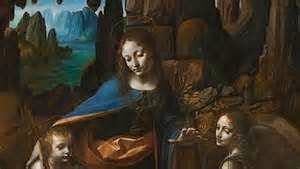
Anderson's "The Man Who Came Early" is a first person narration addressed to a single auditor, a priest. "The Light" is another first person narration addressed to a single auditor, this time a historian who is being told government secrets - and the surprise ending of the story reveals why. Someone reached the Moon before the Americans. (The background of da Vinci's The Virgin of the Rocks does look as if it might be a Lunar landscape, doesn't it?)
"The Light" is a first Moon landing story published in 1957, so how much did it get right? Americans, three of them, previous circum-Lunar missions, an embarrassing "first man on the Moon" speech written in advance by someone else. However:
they set off from a space station, not from the Earth's surface;
all three go down to the Lunar surface;
they have no radio or television link back to the Earth.
Thus, the first to step onto the surface can get away with:
"'May I suggest that the captain write in the log that the speech was delivered?'" (p. 170)
Description of the Lunar surface:
eerie;
bright;
dead;
huge, razor-cornered rocks;
horizon near;
deep, sharp shadows;
cracked, ocherous land;
indescribable light;
a lava plain like polished black metal;
oven in sunlight, freezing in shade;
a mysterious mist;
meteoric dust;
a familiar fog-glow;
prints of hob-nailed boots worn by a tall man...
The First Man on the Moon learns the identity of the real First Man on the Moon.
In a pre-Apollo cinema adaptation of The First Men In The Moon, a UN Moon expedition discovers that Cavor and Bedford were there before them. A post-Apollo TV adaptation asks us to accept that Wells' account of Cavor and Bedford and the TV transmissions from Armstrong and Aldrin both happened, then ingeniously fits both of these "first Moon landings" into a single narrative.
Tuesday, 6 September 2016
Holger's Personal Quest
"Alianora..." (p. 37)
Why do I quote only the opening word? Although the title of this story makes us think that it might be a sequel to Anderson's "The Man Who Came Early," the opening word reveals that it is instead a sequel to his Three Hearts And Three Lions. The opening paragraph gives us two colors, green and yellow, and five flavors, peas, onion, fennel, salt and pork.
Alianora wonders whether the war against Chaos thirty years previously was meant to bring about only uneventful villages scattered through plains and forests. However, she is able to imagine nothing better than:
"...ordinary lives free from anything worse than ordinary fears..." (p. 38)
Living later, we can imagine an alternative, progress.
I would have liked a story in which Holger found Alianora as he had left her in St Grimmin's Church. However, Turtledove follows his premise. It takes time for Holger to find his way back to the Carolingian universe. Therefore, time has passed also for Alianora.
This need not have been the case. The passage of time is not always uniform in different universes as we have seen in Operation Chaos, Three Hearts... and the Narnia Chronicles. Holger returned from the Carolingian universe without loss of time in our universe so could this not have worked the other way? Or does it mean that even more time passes in the Carolingian universe than in ours?
In any case, Turtledove has opted for the passage of time so we have to accept this premise of the story.
Wednesday, 28 March 2012
The Structure Of A Series: Poul Anderson
The Technic History series is elaborately constructed and “more than the sum of its parts.” (I did once read a series that was less than some of its parts.)
Beginnings:
“The Saturn Game” describes interplanetary exploration.
“Wings of Victory” and “The Problem of Pain” introduce Ythrians.
“Margin of Profit” and The Man Who Counts introduce Nicholas van Rijn.
“How To Be Ethnic In One Easy Lesson” introduces Adzel.
“The Three-Cornered Wheel” and “A Sun Invisible” introduce David Falkayn.
Thus, seven short stories and one novel introduce the series.
The Main Period:
Van Rijn features in “Hiding Place” and “Territory” and receives employees’ reports in “Esau” and “The Master Key."
Falkayn, Adzel and Chee Lan work for van Rijn in “The Trouble Twisters,” “Day of Burning,” Satan’s World, “Lodestar” and Mirkheim. “The Season of Forgiveness” and “A Little Knowledge” are two further League stories.
Thus, nine short stories and two novels continue and complete the series.
Sequels:
Ythrians and Falkayn-led human beings share the planet Avalon in “Wingless” and “Rescue on Avalon.”
The Terran Empire is founded in “The Star Plunderer,” is described further in “Sargasso of Lost Starships,” fails to annex Avalon in The People Of The Wind and is defended by Dominic Flandry in several works.
The post-Imperial Long Night is described in two short stories and one novel.
The later Commonalty is described in one short story.
Thus, after all that time, there is a new beginning. That is quite some mega-series. This summary emphasizes the Polesotechnic, rather than the Imperial, period because my appreciation of the former has increased since re-reading its opening stories in the new Baen edition.
I think that there could be an easier way to collect the complete Technic History:
five stories and one novel about van Rijn could be collected in one volume;
three stories and two novels about Falkayn working for van Rijn could be collected in one volume;
eight other stories set before Avalonian colonization could be collected in one volume to be read before or alongside van Rijn and Falkayn;
one volume of four stories and one novel would cover the Avalon and early Empire period;
three volumes for the later Empire (four novels and one story in the first volume; seven stories of different lengths in the second; three novels in the third);
one volume of three stories and one novel would cover the post-Imperial period.
Total: eight volumes with easily demarcated contents.
Of this suggested sequence:
the first volume introduces Ythrians, League, Adzel and Falkayn;
the second introduces van Rijn;
the third introduces Falkayn and Adzel working for van Rijn;
the fourth starts with Falkayn’s grandson and Ythrians on Avalon and ends with the Imperial war on Avalon;
the remaining volumes cover the Empire and after.
The King of Ys (historical fantasy)
(with Karen Anderson)
This series is four novels with the legendary city of Ys flooded at the end of the third novel. The tetralogy shows the simultaneous decline and conversion of the Roman Empire. In the first volume, the future King of Ys hopes that, if he serves Mithras, and another serves Christ, this will not matter if both serve Roma Mater: a sensible attitude unacceptable to the Christian regime.
Because the series is a fantasy, Christian saints work miracles but the gods of Ys, regarded by Christians not as non-existent but as demonic, also show their power until they abandon their city. In the fourth volume, the Dark Ages begin and the seeds of the Middle Ages are sown. Paganism becomes witchcraft. The former King of Ys, feeling abandoned by Mithras, accepts Christianity instead of philosophical paganism.
The series evokes its historical period, the beauty of the towered city of Ys and the diversity of its inhabitants.
The Last Viking (historical fiction)
This is a trilogy about King Harald Hardrada (1046-1066). Because, unlike other Norse-inspired works by Anderson, the trilogy is not a fantasy, Harald’s Arctic expedition finds ice bergs and a whale, not Jotunheim or the World Serpent.
The Time Patrol (historical sf)
The First Volume:
The original Time Patrol series was four short stories collected in one volume, Guardians Of Time, which was first published in Britain in 1961:
.
“Time Patrol” (May 55): Manson Everard’s recruitment, training, first case and promotion to Unattached status which he retains for the rest of the series.
“Delenda Est” (Dec 55): a culmination, in which history has been changed but Everard and the Patrol change it back.
The order of stories was changed to make “Delenda Est” the culmination. References to “earlier” stories were added to “later” stories to unify the series. Thus, the slightly revised “Delenda Est” refers to the central characters of the previous three stories and “The Only Game In Town” refers to the central character of “Brave To Be A King."
The Fifth Story:
“Gibraltar Falls” (1975) was added to later editions of Guardians of Time, now The Guardians of Time, but as Part III, not Part V, in order to preserve the status of “Delenda Est” as a culmination. “Gibraltar Falls” centrally features another Time Patrolman, Tom Nomura, who was recruited at a younger age and a later date than Everard, in 1972. This story gives Everard a sort of “elder statesman” role and reflects on the upheavals separating the 70s from the 50s while placing both in a longer historical perspective. Thus, I think that the story would have fitted better as an epilogue or a coda rather than as an arbitrary insertion into the middle of the collection.
The Second Volume:
From now on, all new Time Patrol stories appear first in books, not in magazines. The Guardians of Time remains the complete collection of all Time Patrol stories that were originally published in The Magazine of Fantasy and Science Fiction.
The second collection, but of original and longer stories, was Time Patrolman (1983).
“Ivory, and Apes, and Peacocks”: another case for Everard who has traveled to 950 BC, apparently from the 1980s.
“The Sorrow of Odin the Goth”: a second story featuring a different Time Patrolman and again giving Everard “elder statesman” status. Everard, from 1980, occasionally oversees Carl Farness, who, from his base in the 1930s, visits 300-372.
(“Gibraltar Falls” could have been collected here rather than in later editions of the first volume.)
Observations So Far:
Carl Farness’ story contains the single visit in the entire series to our future: 2319, too far ahead for us to disprove Anderson’s account simply by living long enough. Anderson while writing the series kept Everard’s present simultaneous with that of the author and the readers. Thus, to anticipate a later volume, The Shield Of Time, published in 1990, refers to Gorbachev whom Time Patrolmen would have known of but did not happen to mention back in the 50s.
Rooms in the Time Patrol Academy in the Oligocene period contain the sort of gadgets “…you would have expected by, say, AD 2000…” including “…screens which could draw on a huge library of recorded sight and sound for entertainment.” (1)
Everard, part of a group recruited from between 1850 and 1975, or from between 1850 and 2000 depending on which edition you read, wonders when a fellow recruit is from:
“…the girl with the iridescent, close-fitting culottes and the green lipstick and the fantastically waved yellow hair…” (2)
Shortly afterwards, there is a reference to “…the girl from 1972…” (3) So is that her?
In Guardians of Time (1961), Everard’s class was recruited from and studied the period 1850-1975. In The Guardians of Time (1981), they were recruited from 1850-2000 but studied 1850-1975. In Time Patrol (2006), they are recruited from and study 1850-2000. Thus, the text of the first story, “Time Patrol” (1955), is edited before our eyes. I thought that I remembered a discrepancy but did not find it until I had compared different editions.
The Third Volume:
The next Time Patrol episode was a juvenile novella, “The Year of the Ransom,” originally published as a single volume in 1988. Everard is present but as only one of the characters. The heroine, Wanda Tamberly, caught up in a time travel conflict in the 1980’s, helps to thwart one of the villains and is recruited to the Patrol. This story continues the convention, begun in “The Sorrow of Odin the Goth,” of a date heading for each new section of narrative. Because the main villain, Merau Varagan, had been apprehended by Everard at the end of “Ivory, and Apes, and Peacocks,” this new story fits between the two previous volumes.
The Fourth Volume:
The fourth volume was The Shield of Time (1990), a long novel written as a unit but comprising three long, consecutive stories. Wanda is a main view point character and starts a relationship with Everard at the end of the novel. For Everard, The Shield of Time begins immediately after the end of “Ivory, and Apes, and Peacocks” and we are now told that the events of “The Year of the Ransom” had occurred immediately before that. Two early Chapters of Shield… are flashbacks linking this novel to those stories.
Varagan belonged to a group of time criminals called “Exaltationists.” “Ivory…” includes a flashback to Everard’s first encounter with Varagan and Shield…begins with Everard’s pursuit of the remaining Exaltationists. Thus, Everard encounters Exaltationists four times but in three stories and eventually, when the series is complete, in two volumes.
Omnibus Volumes:
A volume called Annals Of The Time Patrol had collected the five stories from The Guardians of Time and the two from Time Patrolman. Now, a volume called The Time Patrol collected the seven stories from Annals Of The Time Patrol and the one from The Year of the Ransom with an original short novel, “Star of the Sea.” Regular readers who had missed the juvenile story when it was a separate volume had two new stories to read in this new collection.
In “Star of the Sea,” Everard returns as a leading character while retaining his “elder statesman” role towards the female colleague with whom he has an affair but this ends at the end of the story, thus clearing the way for Everard to meet Wanda for the first time later that same year, 1986. During “Star of the Sea,” Everard refers back to the events of “The Sorrow of Odin the Goth.” Thus, “Star of the Sea” has been carefully written to fit between two earlier stories and not to advance the increasingly consecutive narrative beyond the end of The Shield of Time.
The two stories in Time Patrolman should now be read in reverse order with two later written stories between them. These four stories form two pairs. “The Sorrow of Odin the Goth” and “Star of the Sea” both deal with Northern European mythology and could be collected under the title, The Gods of Time. “Year of the Ransom” and “Ivory, and Apes, and Peacocks” both deal with Exaltationists and could be collected as The Thieves of Time.The Last Story:
One further Time Patrol story, “Death and the Knight” (1995), was written for an original anthology on the Knights Templar and included in a later edition of The Time Patrol, now entitled simply Time Patrol. Until then, “Time Patrol” had been a short story, The Time Patrol had been an omnibus collection and the Time Patrol series had been that collection plus one long novel. Now, Time Patrol is the omnibus collection.
“Death and the Knight” interrupts the holiday that Everard and Wanda had started in early January 1990 at the end of The Shield of Time. Thus, despite its 1995 publication date, this last story does not advance Everard’s career beyond March 1990. He was born in 1924, entered the Patrol at age thirty and has had an apartment in New York since at least 1954 but, in 1990, is a lot older than sixty six because he has time traveled a lot. Patrol medical treatment prevents aging but Everard would soon have had to move to a different time and place in order not to appear unnaturally young to his New York contemporaries, from whom the fact of time travel must be concealed. Everard’s relocation would have been a major turning point in the series.
General Observations:
Time Patrolmen live for centuries unless they die by accident or violence. For the period 1850-1975 (or 2000), the Patrol has head offices in London, Moscow and Peiping in 1890-1910, with smaller offices in other decades. Thus, service in all three head offices for the entirety of their existences could be just one part of a Patroller’s career. At the Academy, Everard’s class numbers about fifty. His training is completed in three months by hypnotic conditioning. The Academy exists for half a million years before being carefully demolished so that no trace of it will remain. Does this mean that the Academy can have had one hundred million graduates with indefinite life spans? They guard a million years of history and claim to be chronically understaffed.
Living past 2000 would automatically take Everard out of the Patrol “milieu” administered from 1890-1910. Perhaps, to maintain his base in this milieu, he would, like Farness, have moved to an earlier decade of the twentieth century? With some Patrol disguise and a change of name, he might even have been the previous occupant of his own apartment.
As an Unattached agent, Everard is confined neither to his birth milieu nor to a Specialist period but it is obviously convenient for him to be based in familiar surroundings. From his base in 1954-1990, he operates in the past three millennia. The background of the series implies that other Unattacheds work in periods of similar lengths throughout a million years and that there are future periods when time travel is not a secret so that the existence of the Patrol need not be concealed. Citizens of such periods might apply for membership instead of being recruited by tests which are not explained until they pass them. However, Anderson used the Time Patrol premise to realize historical periods, not to speculate further about the future, which he does in other works.
The Correct Reading Order:
Since “Death and the Knight” occurs immediately after The Shield of Time, it should be collected as an epilogue to Shield…, not at the end of Time Patrol. If “Death and the Knight” were removed, then the last story in Time Patrol as it stands would be “The Year of the Ransom.” This story was placed at the end of The Time Patrol in the mistaken belief that, since it introduces Wanda, who features in Shield...,it was a direct prequel to Shield...
In fact, as we have seen, “Ivory, and Apes, and Peacocks” occurs between “The Year of the Ransom” and Shield... Time Patrol simply reproduces the order of the stories in Guardians…and Time Patrolman instead of revising that order in accordance with the contents of the stories. “Ivory, and Apes, and Peacocks” should be moved from before “The Sorrow of Odin the Goth” to the end of volume. Also, I think, as argued earlier, that “Gibraltar Falls” should be placed after “Delenda Est,” in which Everard’s home base date is 1960.
It would then finally be possible for a new reader to read the entire series in the right order, as experienced by Everard. That is the order in which the stories were written unless the stories themselves indicate otherwise. There are two factors here. First, the original quartet was revised and its order changed for book publication. Secondly, after Time Patrolman, Anderson consciously fitted new stories into a sequence relating them to earlier stories but not necessarily in a growing linear order. Thus, The Year Of The Ransom, published after Time Patrolman, is set before the first story in Time Patrolman but after the second and “Star of the Sea,” published later again, is set between the second story in Time Patrolman and The Year Of The Ransom.
For Everard, from the beginning of “Star of the Sea” to the end of “Death and the Knight” is almost an uninterrupted sequence of events. Between earlier stories, the gaps were longer and Everard dealt with cases some of which are referred to though not described.
The complete collection of Time Patrol stories has grown from four to five to seven to nine to ten stories and has changed its title from Guardians Of Time to The Guardians of Time to Annals Of The Time Patrol to The Time Patrol to Time Patrol. The entire series is now complete in two long volumes. I suggest that these volumes should be read after five others:
A Connecticut Yankee in King Arthur’s Court by Mark Twain;
The Time Machine by HG Wells;
Lest Darkness Fall by L Sprague de Camp;
Bring the Jubilee by Ward Moore;
Past Times by Poul Anderson.
Past Times should be revised to exclude non-time travel items and to include “The Man Who Came Early,” a short story that follows from and indirectly comments on Twain and de Camp.
These five volumes present a conceptual sequence of speculations on travel to historical periods and, to a lesser extent, on technological time travel. An initial discussion of the problems of traveling to historical periods does occur, briefly, in The Time Machine.
Anderson’s future humanity evolves into Danellians instead of devolving into Morlocks and Eloi. Anderson’s high tech mass-produced timecycles are conceptual successors to the Time Traveler’s elaborate nineteenth century contraption.
I exclude from this list Anderson’s three other time travel novels because, although these works are also historical, they are contributions to the ornamental garden of the circular causality paradox. As such, they belong to a secondary time travel tradition from “The Chronic Argonauts” by HG Wells to The Time Traveler's Wife by Audrey Niffeneger. In such works, causality violation is impossible whereas Time Patrollers do close causal circles but precisely in order to prevent causality violations which otherwise would and sometimes do occur. Thus, the Time Patrol series synthesizes fictional treatment of both causality paradoxes.
Development of Ideas:
“Delenda Est” was a culmination because it dramatized, instead of merely discussing, causality violation and because, to do this, it introduced a collective villain, the Neldorians, who, like Moriarty, had almost the status of a continuing villain despite appearing in only one story. The Patrol had had trouble with them “before.” The concluding section of Shield…is a similar culmination because it also presents a, much more elaborate, causality violation together with deeper reflection on the earlier case. However, the second temporal change is effected not by a time traveling villain but by a space-time-energy fluctuation: a new concept in time travel fiction. The fluctuation is embodied in a medieval knight who becomes a personal causal nexus, thus as dangerous an opponent as a Neldorian or an Exaltationist, though without realizing it. He thinks that a Patroller trying to dissuade him from a particular course of action by appearing as an angel is a demon or magician and fights to the death.
The idea of a continuing collective villain was developed further but separately and with Exaltationists instead of Neldorians. The campaign against the Exaltationists is a series within the series beginning with the flashback in “Ivory…,” then “The Year of the Ransom," then the main story in “Ivory…” and, finally, the first part of Shield…When “Ivory…” concluded with the observation that the escaped Exaltationists would be hunted, I suspect that Anderson meant to convey only that the task of the Patrol would continue, not that this observation would lead straight into a sequel, but then he did come to write a sequel and the Exaltationists provided perfect material for it. When imagining a female clone mate for Varagan, Anderson gave her the name of a spear carrying character in “The Year of the Ransom,” thus giving an earlier detail greater significance.
When the Patrol lays a trap for the Exaltationists, it does so by publishing, in a period that it was known some Exaltationists had visited, fake evidence for the pivotal significance of an ancient battle. If the Exaltationists took the bait, then they would try to affect the outcome of that battle and thus would enter a period when waiting Patrollers might be able to apprehend them. Thus, the Time Patrol, knowing what had occurred in earlier episodes, can use that knowledge to mislead its opponents at an earlier time. Anderson’s presentation of time travel becomes more elaborate. Although Everard and Wanda begin a relationship and a holiday in early January 1990, they had, earlier on their world lines, met and conversed in February 1990 and possibly in later months of that year. But, whatever the month, 1990 remains the last year in which we know anything about Everard. Unfortunately, this is simply because Anderson did not live long enough to write a concluding volume for the series.
Everard’s apartment becomes a familiar setting during the series. It acquires Bronze Age spears and helmet on the wall, then a tenth century polar bear rug on the floor, then loses the rug. (Twentieth century visitors reproached him for it and it became scruffy.) The apartment is visited by other characters, including Guion who guards the history of the Patrol as the Patrol guards the history of mankind.
Other settings that recur as the series continues are the Academy and the Pleistocene lodge. Shield…belatedly informs us in its final section that the Patrol emblem, an hourglass in a shield, is cast in brass on a lodge wall. The emblem is mentioned here because it will be used as a signal later in the story. Any visual adaptation of the series should display the emblem from the earliest scenes in the Academy. A faithful TV or graphic adaptation of the series could be extended almost indefinitely: “The Sorrow of Odin the Goth” alone follows four generations of one Gothic family. One setting that is not revisited is the office of Gordon, the agent who recruits Everard, because, when Everard becomes Unattached, he ceases to be accountable to the local office.
When the last Academy graduate retires, then the history of the Patrol is complete but that last graduate must not relate the organization’s history to his earlier colleagues. They must perform their tasks without knowing the outcomes in order to avoid the paradox of circular causality. (Causal circles may be completed in order to prevent causality violations but, otherwise, both paradoxes must be avoided.) The Danellians, living later, must know the full history but there is a perennial quantum uncertainty. Whenever a time traveler returns from visiting his past, it is always possible that he will arrive in an altered version of his present, will have to travel past-wards again to try to re-adjust the timeline and might fail. This can happen even when the timeline in which he initially set out to travel into the past had contained a record of his successful return to his unaltered present.
It seems to me that the Danellians can avoid this danger simply by ceasing to time travel. It makes sense to say that someone who visits his past may return to the wrong present but it makes no sense to say that the Danellian Era may exist until a particular moment but may then, at that moment, cease having existed until that moment. Of course, maybe the Danellians have good reason to continue time traveling. Another possible hazard for time travellers is unintended self-duplication. When Everard persuades Carl that he must return to the Gothic period in order to play the role of Odin betraying his followers, this is because, in their timeline, that betrayal has already occurred.
Thus, if Carl refuses to return, the first problem will be the arrival in the twentieth century of that Carl who did appear in the Gothic period and enact the betrayal. Carl’s current intransigence would have prevented his departure from the present but not his arrival in the past because that had happened earlier. I quote the rules of time travel taught in the Academy.
Everard tells Carl that an incipient causal loop can set up a resonance which can produce catastrophically multiplying historical changes. He does not tell us what a resonance is but could it mean this? - Carl’s refusal to conduct the mission of betrayal duplicates Carl; then, if either Carl travels further into the past than the Gothic period, there is the danger that, when he returns to the twentieth century, it will be to the twentieth century of a timeline in which Odin’s descendants were not betrayed, did defeat their enemy and did bring it about that an entirely different story was recorded in the Volsungasaga, thus preventing the history in which a Carl Farness sets out to track down the origin of the story of Odin’s betrayal.
Earlier, Carl had decided against jumping back through time to change a minor incident. It was just as well that he decided this because to make the change would have been to duplicate himself. The careful reader can find other cases where time traveler duplication could or even should have occurred.
Everard rescues the missing Keith Denison from ancient Iran and brings him home even though Records in 1890-1910, when asked, had said that he had never come home. Did Records lie, knowing that this would make Everard look for Keith and bring him home?
Guion, mentioned earlier, must seek for evidence that a causality violation may be imminent even when there is no evidence for it…There is some evidence of minor fluctuations not caused by time travelers. Even Temporal, the Patrol language with tenses for time travel, cannot express this attempt to anticipate causality violations. Guion seeks clues to “…the hypermatrix of the continuum…” but acknowledges that this is a misleading term. (3) He speaks of the coherence of chaos and interviews Patrollers whose world lines interact with many others. He uses their languages because they would not be able to express their experience fully in Temporal.
The personal causal nexus mentioned earlier seems to be the sort of thing that Guion was looking for but what else might happen? A renegade Danellian freeing the Nine, the Neldorians, the Exaltationists and other time criminals from the exile planet and dispatching them on multiple missions to disrupt evolution or even the formation of the universe? (Anderson’s imagination was more restrained and subtle than this. When asked to write about the Knights Templar, he did not make them anything dramatic like agents of the Patrol but did write a causal circle into their known history.)
Guion is introduced only as a unifying element in the long novel, The Shield of Time. He appears between the main sections speaking to Everard, to Wanda and again to Everard but is not present when Everard battles Exaltationists, when Wanda intervenes in prehistory or when Everard and Wanda together tackle the personal causal nexus. Thus, Anderson need not have revived Guion in any subsequent novel but, hopefully, would have revealed more about the Danellians. Guion refers to the Middle Command of the Patrol. He does not explain this phrase but obviously means that the Middle Command is human.
Like good historical fiction, each Time Patrol story evokes the spirit and atmosphere of the period in which it is set. The series contains many quotable passages that could be collected and published in an appropriately illustrated volume, e.g., from Guion:
“…think of the countless world lines intermeshed throughout the continuum as a spiderweb…There are occasions when we know only that the web is troubled, not where or when the source of the disturbance lies; for that source perhaps does not exist in our yet, in our reality. We can only try to trace it back up the threads-“ (4)
The Four Series
To list the series in a slightly different order, they comprise:
historical fantasy;
historical fiction;
historical science fiction;
futuristic science fiction, specifically a “future history”.
The future history describes fictitious historical events. The remaining three series set fictitious events in historical periods. “Historical science fiction” is a less familiar category but the Time Patrol does fit this category since it is equally historical fiction and science fiction.
Anderson, Poul. Time Patrol, 2006, Riverdale, NY, p. 8.
ibid, p. 6.
Anderson, Poul. The Shield of Time, 1991, New York, p. 8.
ibid, p. 135.
Saturday, 1 August 2015
Time Rovers
Miesel starts by observing that Anderson had roved past, future and alternative time for over three decades. We must now say for over five decades.
She uses the phrases, "Translation in time..." (p. 245) and "...time transit..." (p. 246), convenient labels for different treatments of time in fantasy and sf, e.g., she mentions, among other examples:
"The Man Who Came Early" (time travel);
Three Hearts And Three Lions (travel between timelines);
Tau Zero (space travel but with time dilation).
These three works are respectively historical sf, heroic fantasy and hard sf.
Miesel argues that:
temporal transitions challenge fictional characters;
"...response to challenge is Anderson's quintessential theme..." (p. 245);
both space travel and time travel "...offer the extension of mastery through knowledge and the enlargement of being through experience..." (ibid.);
also, Anderson saw "...the supreme knowledge [as] that gained through experience." (ibid.);
whereas archaic societies ignore or deny history, modern civilization searches for roots and speculates about growth;
Anderson's historically based fiction addresses this need.
I try to paraphrase but sometimes Miesel's succinct prose is already a summary. I merely summarize because I do not disagree. For discussion of James Blish on his quintessential theme of "knowledge," see here.
In one paragraph on p. 248, Miesel compares Anderson's Time Patrol series with five time travel works and with two parallel timeline novels. Of the five time travel works, I value only Ward Moore's Bring The Jubilee. For discussion of inconsistencies in some time travel fiction, see here. A better comparison for the "Two characters [who] escape to the more congenial nineteenth century..." would have been with Jack Finney's nostalgic time travel fiction.
The parallel timeline novels are mentioned in order to compare Anderson's Time Patrol with Piper's Para-Time Police and Norton's Crosstime Service. However, the Patrol polices pastwards and futurewards travel along a single mutable timeline whereas the other two organizations police present-moment sideways travel between many parallel timelines. Norton's title, The Crossroads Of Time, is unusually evocative and it would be good to read a novel worthy of such a title, e.g., a narrative about two intersecting timelines or an account of a real historical turning point like World War I but with insight into how events could have taken a different course.
Miesel lists four of Anderson's works that have "...Holmesian aspects..." (p. 250) but, of these, "Time Patrol" is surely the best both in its presentation of Holmes on a case mentioned but not recounted by Watson and as a new work in its own right. This single story must introduce the variable timeline, the Nine, the Danellians, the Patrol, its Academy, its Temporal language, Manse Everard, his first trips to the past, our first sight of a time criminal, Everard's promotion to Unattached status and his New York apartment that will become a familiar setting as the series progresses.
Miesel also writes:
"Besides composing interesting alternate history scenarios, [Anderson] achieves the subtler feat of historical transubstantiation: in 'Brave to Be a King' events remain the same but the reason they occur changes." (p. 249)
Well, recorded history remains the same although many unrecorded details differ: another man plays the role of Cyrus the Great. "Historical transubstantiation" might better describe some of the stunts pulled in There Will Be Time, with its invariable timeline. A time travel group recruits a handful of prospects, including Havig and Boris, in Jerusalem on the estimated day of the Crucifixion. Later on his world-line, Havig works against that group and sends Boris to Jerusalem to infiltrate it... Thus, we might say that, in Havig's experience, Boris' presence in Jerusalem is transubstantiated. No discernible detail can be or has been altered but the significance of Boris' trip to Jerusalem is inwardly transformed.
Reasons for traveling to the day of the Crucifixion:
to witness the Crucifixion;
to try to prevent it;
to meet other time travelers;
to recruit time travelers;
to infiltrate the group recruiting time travelers.
Boris turns out to have the fifth, not the first, reason.
Miesel rightly states that, although The Guardians Of Time "...is only one book...it reflects [Anderson's] essential principles..." (p. 251) - as also does There Will be Time, which she mentions but does not have space to discuss here:
the Patrol conserves whereas Havig's group liberates;
the Patrol prevents Neldorians, Exaltationists, individual time criminals and quantum fluctuations from changing the past whereas Havig's group prevents the Eyrie from dominating the future;
Patrol agents ride streamlined updates of Wells' Time Machine whereas Havig shares the Time Traveler's experience of external events flickering past;
Patrollers can change past events whereas Havig cannot but instead must ingeniously change their significance;
the Patrol leads to the Danellians whereas Havig's group leads to the Star Masters;
Everard learns that the Patrol, even though it too changes the past, is "The Only Game In Town" (story title) while Havig's recruits learn that "...Havig's was the only game in town." (There Will be Time, New York, 1973, p. 156)
Miesel characterizes Anderson's four time travel volumes to date:
the Time Patrol employs well-briefed agents;
The Corridors Of Time shows "...unprepared people hurled into strangeness..." (p. 246);
There Will Be Time shows time travel by "...psi talent" (p. 247);
The Dancer From Atlantis "...recreat[es] a real historical milieu..." (pp. 247-248).
The Dancer... is more directly about unprepared people hurled into a strange past and The Corridors... also shows well-briefed agents of time traveling organizations. Five time travel stories are mentioned among several other "time transit" works. Thus, "Of Time And The Rover" is a brief but comprehensive survey.
Friday, 24 February 2017
Time Travel Aspects And Contributions
pastward travel: Anon and Twain;
futureward travel: Wells;
circular causality: Wells and Heinlein;
causality violation: de Camp.
Uniquely, Poul Anderson addressed all four aspects in different works and also made five original contributions to the concept of time travel:
(i) corridors constructed in space, then rotated onto the temporal axis, so that it becomes possible to time travel by walking along a corridor;
(ii) mutants able to time travel by an act of will;
(iii) the Time Patrol with its milieu headquarters and branch offices in different periods linked by message shuttles and by Patrol members traveling on timecycles, its Specialists exploring undocumented periods and its Unattached agents acting at any point in history to prevent causality violations;
(iv) historical alterations caused not only by time travelers but also by random fluctuations in space-time-energy;
(v) a personal causal nexus, i.e., an individual whose world-line intersects with so many others that a small change in his life cause big changes in history.
In Anderson's Time Patrol series, mankind, instead of devolving into Morlocks or Eloi, evolves into the Danellians who found the Patrol whose members travel into the past in order to prevent causality violations sometimes by completing causal circles but, on one occasion, by responding to space-time fluctuations and neutralizing a personal causal nexus. This series incorporates the four aspects of time travel and also Anderson's contributions (iii)-(v). The Patrolmen use neither (i) time corridors nor (ii) a mutant ability but timecycles which resemble modernized, mass-produced, streamlined Time Machines. Thus, this series, while not fully comprehensive, is as comprehensive a synthesis of time travel fiction as we will probably get.
Pastward Travel
"Missing One's Coach" Anon
A Connecticut Yankee In King Arthur's Court by Mark Twain
"The Little Monster" by Poul Anderson
"The Man Who Came Early" by Poul Anderson
In each of these works, a man is transported to an earlier period with different consequences. The earliest literary time traveler merely visits the past, possibly just in a dream. The Yankee prospers. One Anderson character survives. The other does not.
Futureward Travel
The Time Machine by HG Wells
"Time Heals" by Poul Anderson
"Welcome" by Poul Anderson
"Flight to Forever" by Poul Anderson
In each of these works, a technological time traveler visits future periods, again with different results. Whereas Wells' Time Traveler sees the end of life on Earth and returns to the nineteenth century, one of Anderson's time travelers sees the end of the universe, then continues around the circle of time back to the twentieth century.
Circular Causality
"The Chronic Argonauts" by HG Wells
two stories and one novel by Robert Heinlein
The Technicolor Time Machine by Harry Harrison
three novels by Anderson
The Anubis Gates by Tim Powers
The Time Traveler's Wife by Audrey Niffeneger
Heinlein's time travelers experience the circular causality paradox in future periods and one of them emulates the Yankee by applying modern knowledge in a simpler period. Harrison's and Power's time travelers experience this paradox in historical periods whereas Niffeneger's characters experience it in their own lifetimes. Anderson's characters travel through past and future. Indeed, two future civilizations, using time corridors, wage war throughout history.
Causality Violation
Lest Darkness Fall by L Sprague de Camp
Bring The Jubilee by Ward Moore
De Camp's involuntary time traveler deliberately prevents the Dark Ages whereas Moore's time traveling historian accidentally alters the course and outcome of the Battle of Gettysburg.
Culmination
The Time Patrol series by Poul Anderson -
- a series of stories and novels about an organization of time travelers experiencing both causality paradoxes in various historical and prehistorical periods.