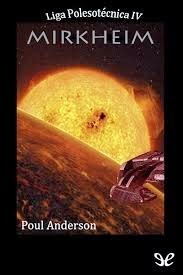
Poul Anderson's sf novel, Mirkheim, features or refers to the following planets:
Mirkheim
Babur
Hermes (see also here, here and here)
Ivanhoe
Diomedes (see also here)
Woden
Valya
Luna
Vanessa (see also here)
Merseia (see also here and here)
Cynthia (see also here)
Gorzun (see also here and here)
Ikrananka:
Tidal action has forced one hemisphere of the small, eccentrically orbiting, librating planet Ikrananka
to face its red dwarf sun but such slow rotation generates a weak
magnetic field so that the planet retains an atmosphere although most of
its water has frozen on the cold side making the warm side a slowly
deteriorating desert whose inhabitants, struggling for survival in
their season-less, rhythm-less environment, regard nature as hostile,
believing in demons but not in gods, whereas dwellers on the edge of the Twilight Zone, with rain, snow, day, night and constellations, more conventionally believe in an annually dying and rising god and a single devil whose power can be neutralized. The latter are easier to trade with.
Vixen:
In the Cerulian system,
resonance with the jovoid planet Ogre has multiplied perturbation and
brought the eccentricity of the terrestroid Vixen's orbit close
to one-half so that, with a 24 degree axial tilt and midsummer nearly
at periastron, once every eighteen month year the northern hemisphere
is scorched with four times the radiation that Terra receives from Sol
- snow melts, rivers overflow, lakes bake dry, storms rage, fires
break out, erosion prevents mountain formation, hot wind blows dust
and ash across dry plains.
- Ikrananka and Vixen copied from here.
Saturday, 20 December 2014
Friday, 19 December 2014
The Divided League
Planets
Hermes is a human colony planet.
Babur is a subjovian planet.
Mirkheim is a source of industrially valuable supermetals.
Organizations
The Polesotechnic League comprises the Home Companies, the Seven in Space and the independents.
The Supermetals Company is non-League.
Secrets
The Seven have armed Babur.
The Supermetals Company, helped by an independent, has not artificially generated the supermetals that it sells but mined them on Mirkheim.
Now that the second secret is out:
Babur claims Mirkheim;
the Home Companies say that the Solar Commonwealth should control Mirkheim;
the leading independents argues that Mirkheim, a stateless planet, should be protected by the League, which Supermetals would join;
Supermetals asks Hermes to take possession of Mirkheim;
the Seven say that the League should deal with whichever power gains Mirkheim.
How many sf novels present a four-sided conflict?
Van Rijn, the leading independent, meets Lennart of the Home Companies and Story of the Seven. They cannot agree but some things are learned from the meeting. Story knows that van Rijn helped Supermetals. Lennart lets slip that the Commonwealth has sent a task force to Mirkheim...
In Mirkheim, as in The People Of The Wind, Poul Anderson shows various groups of people gradually moving towards and preparing for war on an interstellar scale. Let us hope that this never happens in reality.
There is also humor. Van Rijn's waist is described as "...his Jovian equator." (Rise Of The Terran Empire, p. 66) His churchwarden pipe "...had seen years of service and grown fouler for each day of them." (p. 67) If only life could remain on that level.
See also here and here.
Hermes is a human colony planet.
Babur is a subjovian planet.
Mirkheim is a source of industrially valuable supermetals.
Organizations
The Polesotechnic League comprises the Home Companies, the Seven in Space and the independents.
The Supermetals Company is non-League.
Secrets
The Seven have armed Babur.
The Supermetals Company, helped by an independent, has not artificially generated the supermetals that it sells but mined them on Mirkheim.
Now that the second secret is out:
Babur claims Mirkheim;
the Home Companies say that the Solar Commonwealth should control Mirkheim;
the leading independents argues that Mirkheim, a stateless planet, should be protected by the League, which Supermetals would join;
Supermetals asks Hermes to take possession of Mirkheim;
the Seven say that the League should deal with whichever power gains Mirkheim.
How many sf novels present a four-sided conflict?
Van Rijn, the leading independent, meets Lennart of the Home Companies and Story of the Seven. They cannot agree but some things are learned from the meeting. Story knows that van Rijn helped Supermetals. Lennart lets slip that the Commonwealth has sent a task force to Mirkheim...
In Mirkheim, as in The People Of The Wind, Poul Anderson shows various groups of people gradually moving towards and preparing for war on an interstellar scale. Let us hope that this never happens in reality.
There is also humor. Van Rijn's waist is described as "...his Jovian equator." (Rise Of The Terran Empire, p. 66) His churchwarden pipe "...had seen years of service and grown fouler for each day of them." (p. 67) If only life could remain on that level.
See also here and here.
The Lunar Surface In Science Fiction
We are used to reading descriptions of the lunar surface in science fiction:
Verne's characters look down on it;
Wells' land on it;
Heinlein's live there.
However, from his suite in the Hotel Universe, Poul Anderson's Nicholas van Rijn sees an altered landscape. Forcefields hold air, an ozone layer, soaring trees and fountains, great blossoms and lamps on vine-like posts although beyond them are a crater floor, a ringwall, jewel-like stars, the silver Milky Way and the blue and white Earth, all making van Rijn's opulent suite look tawdry.
David Falkayn visits Elfland in Lunograd, a park with grass, arbors, flowers, tall trees and fountains, towers, colonnades, birds, elevated streets, small suns on bronze vines and an Avenue of the Sphinxes although again beyond them are a crater floor, a ringwall, stars in a black sky and Earth with the lights of megalopolises visible on its night side. Although technology makes the Moon inhabitable and even comfortable, the stellar universe remains beyond the works of men.
Going one stage further, Poul Anderson also wrote a short story about a project to terraform the Moon.
Verne's characters look down on it;
Wells' land on it;
Heinlein's live there.
However, from his suite in the Hotel Universe, Poul Anderson's Nicholas van Rijn sees an altered landscape. Forcefields hold air, an ozone layer, soaring trees and fountains, great blossoms and lamps on vine-like posts although beyond them are a crater floor, a ringwall, jewel-like stars, the silver Milky Way and the blue and white Earth, all making van Rijn's opulent suite look tawdry.
David Falkayn visits Elfland in Lunograd, a park with grass, arbors, flowers, tall trees and fountains, towers, colonnades, birds, elevated streets, small suns on bronze vines and an Avenue of the Sphinxes although again beyond them are a crater floor, a ringwall, stars in a black sky and Earth with the lights of megalopolises visible on its night side. Although technology makes the Moon inhabitable and even comfortable, the stellar universe remains beyond the works of men.
Going one stage further, Poul Anderson also wrote a short story about a project to terraform the Moon.
Supermetals
A Supermetals spokesman speaking in Starfall on Hermes says that technology:
eases labor;
preserves health;
prevents famine;
educates;
gives mastery of nature.
However, planets like Woden, Ikrananka, Ivanhoe and Vanessa, able to market only spice, fur, art, oils or minerals, cannot afford spaceships, power plants, automatons, laboratories or schools.
Although the technology to help them exists:
David Falkayn, discoverer of Mirkheim, must break his oath of fealty to van Rijn by giving this source of valuable supermetals to the poorer planets instead of to his own employer;
the poorer planets, organized as the Supermetals Company, must lie about the source of the supermetals that they sell to Technic society;
when the source is revealed, Supermetals' property rights in Mirkheim are denied and war is waged for possession of the planet.
This is all very unfortunate but also all too plausible.
eases labor;
preserves health;
prevents famine;
educates;
gives mastery of nature.
However, planets like Woden, Ikrananka, Ivanhoe and Vanessa, able to market only spice, fur, art, oils or minerals, cannot afford spaceships, power plants, automatons, laboratories or schools.
Although the technology to help them exists:
David Falkayn, discoverer of Mirkheim, must break his oath of fealty to van Rijn by giving this source of valuable supermetals to the poorer planets instead of to his own employer;
the poorer planets, organized as the Supermetals Company, must lie about the source of the supermetals that they sell to Technic society;
when the source is revealed, Supermetals' property rights in Mirkheim are denied and war is waged for possession of the planet.
This is all very unfortunate but also all too plausible.
Valya
The terrestroid planet Valya, close to its dwarf sun, Elena, has:
a forty plus hour day;
a calm ocean;
land covered by russet shrubs and turf;
tiny flyers, not insects;
long-limbed, spindly, blue-furred, mountain-dwelling, dancing, bronze-age natives with antennae on pointed heads and a strange grammar of personal pronouns;
a rich deposit of gold.
Gold attracts Stellar Metals. Bronze age natives cannot resist them. Like Tametha, another atrocity committed by a League company.
a forty plus hour day;
a calm ocean;
land covered by russet shrubs and turf;
tiny flyers, not insects;
long-limbed, spindly, blue-furred, mountain-dwelling, dancing, bronze-age natives with antennae on pointed heads and a strange grammar of personal pronouns;
a rich deposit of gold.
Gold attracts Stellar Metals. Bronze age natives cannot resist them. Like Tametha, another atrocity committed by a League company.
Blogging
Regular readers of this blog might notice my random movements back and forth within Poul Anderson's History of Technic Civilization. It is unpredictable which of the forty three installments will appeal next. However, it is possible to get into a frame of mind where known texts are reread with special attention to descriptive details and even to single words like "livewell" and "forever" in Chapter I of Mirkheim.
It is my opinion that Anderson's texts easily bear this amount of careful rereading and academic study. I know that there is repetition on the blog. However, each time I write something, it feels fresh, so I keep doing it. But we move on sometimes. I think that I have stopped unfavorably comparing Isaac Asimov with Poul Anderson - although just writing that gets me going again.
Whereas Asimov presents the abstract idea of an interstellar empire, Anderson shows us its concrete reality, always emphasizing that each planet is a world, with an ecology and a history, not just a platform for spaceships to land on. Whereas Asimov does not explain the convenient sf cliche of hyperspace, Anderson presents several alternative scientific rationales for FTL, including his unique quantum micro-jumps version of hyperspace in the Technic History.
In a book about sf, I once read a version of hyperspace that I have not seen in any fictional work. Matter cannot exceed light speed through space but a volume of space containing matter could be moved at above light speed? Or something? Maybe Anderson could have added this one to his list.
It is my opinion that Anderson's texts easily bear this amount of careful rereading and academic study. I know that there is repetition on the blog. However, each time I write something, it feels fresh, so I keep doing it. But we move on sometimes. I think that I have stopped unfavorably comparing Isaac Asimov with Poul Anderson - although just writing that gets me going again.
Whereas Asimov presents the abstract idea of an interstellar empire, Anderson shows us its concrete reality, always emphasizing that each planet is a world, with an ecology and a history, not just a platform for spaceships to land on. Whereas Asimov does not explain the convenient sf cliche of hyperspace, Anderson presents several alternative scientific rationales for FTL, including his unique quantum micro-jumps version of hyperspace in the Technic History.
In a book about sf, I once read a version of hyperspace that I have not seen in any fictional work. Matter cannot exceed light speed through space but a volume of space containing matter could be moved at above light speed? Or something? Maybe Anderson could have added this one to his list.
The Technic History: Generations
Nicholas van Rijn meets Sandra Tamarin in The Man Who Counts so there is an Eric Tamarin in Mirkheim.
David Falkayn marries van Rijn's granddaughter, Coya Conyon, between "Lodestar" and Mirkheim so Nicholas Falkayn is born in Mirkheim, Nicholas' son, Nathaniel, is in "Wingless" and their descendant, Tabitha, is in The People Of The Wind.
Tabitha marries Christopher Holm, son of Daniel Holm and, we hypothesize, descendant of Ivar Holm who had appeared in "Rescue on Avalon."
Emperor Manuel I is succeeded by his son, name unknown, who is succeeded by his son, Manuel II.
Dominic Flandry meets Persis d'Io in Ensign Flandry so there is a Dominic Hazeltine in A Knight Of Ghosts And Shadows.
The Starkadian Dragoika appears in Ensign Flandry and her son, Targovi, in The Game Of Empire.
Because Hugh McCormac flees the Empire, his second wife's brother becomes Firstman of Ilion and will be succeeded by his son, Ivar Frederiksen.
Emperor Hans is succeeded by his son, Dietrich, who is succeeded by his brother, Gerhart, who will be succeeded by his son, Karl. Hans also has a granddaughter, Megan.
Flandry meets Maria Crowfeather between novels so there is a Diana Crowfeather in The Game Of Empire.
We see three widely separated generations of Vixenite Kittredges.
As usual when I set out to summarize information from Poul Anderson's History of Technic Civilization, it turns out to be slightly more complicated than expected. (In fact, I have had to return to the post to add data.) The History covers periods of such length that we eventually lose sight of any particular lines of descent.
David Falkayn marries van Rijn's granddaughter, Coya Conyon, between "Lodestar" and Mirkheim so Nicholas Falkayn is born in Mirkheim, Nicholas' son, Nathaniel, is in "Wingless" and their descendant, Tabitha, is in The People Of The Wind.
Tabitha marries Christopher Holm, son of Daniel Holm and, we hypothesize, descendant of Ivar Holm who had appeared in "Rescue on Avalon."
Emperor Manuel I is succeeded by his son, name unknown, who is succeeded by his son, Manuel II.
Dominic Flandry meets Persis d'Io in Ensign Flandry so there is a Dominic Hazeltine in A Knight Of Ghosts And Shadows.
The Starkadian Dragoika appears in Ensign Flandry and her son, Targovi, in The Game Of Empire.
Because Hugh McCormac flees the Empire, his second wife's brother becomes Firstman of Ilion and will be succeeded by his son, Ivar Frederiksen.
Emperor Hans is succeeded by his son, Dietrich, who is succeeded by his brother, Gerhart, who will be succeeded by his son, Karl. Hans also has a granddaughter, Megan.
Flandry meets Maria Crowfeather between novels so there is a Diana Crowfeather in The Game Of Empire.
We see three widely separated generations of Vixenite Kittredges.
As usual when I set out to summarize information from Poul Anderson's History of Technic Civilization, it turns out to be slightly more complicated than expected. (In fact, I have had to return to the post to add data.) The History covers periods of such length that we eventually lose sight of any particular lines of descent.
Forever
In a roof garden on a floating city at night, David and Coya Falkayn hear music, smell Terrestrial and imported flowers and see ship lights like "...fireflies that had wandered far from land..." (Rise Of The Terran Empire, p. 31) and stars that "...seemed almost near enough to touch." (ibid.)
Coya wishes that this could go on forever and they discuss different hypothetical infinities. David reflects that even the best antisenescence will give them only a hundred years - although I heard recently that people now being born in developed countries are expected to reach a hundred and twenty, other things being equal, of course.
Although nothing is forever, the Falkayns' evening in that garden is more permanent for us than for them because we can reread it. At the outer rail, they are screened by "[v]ine-heavy trellises..." (p. 32), Luna lights the waves, water is "...like fluid obsidian..." (ibid.), leaves shine in the shadows, the deck pulses and the breeze is slightly chill. Rereading, I pause here rather than rushing on to the imminent interstellar war.
Coya wishes that this could go on forever and they discuss different hypothetical infinities. David reflects that even the best antisenescence will give them only a hundred years - although I heard recently that people now being born in developed countries are expected to reach a hundred and twenty, other things being equal, of course.
Although nothing is forever, the Falkayns' evening in that garden is more permanent for us than for them because we can reread it. At the outer rail, they are screened by "[v]ine-heavy trellises..." (p. 32), Luna lights the waves, water is "...like fluid obsidian..." (ibid.), leaves shine in the shadows, the deck pulses and the breeze is slightly chill. Rereading, I pause here rather than rushing on to the imminent interstellar war.
Thursday, 18 December 2014
Livewell On Delfinburg
There is livewell on Delfinburg. In other words, an Avalonian flower grows on a Terrestrial pontoon city. Anderson lists "...fragrances of rose, jasmine, aurelia, livewell..." (Rise Of The Terran Empire, p. 31) when David and Coya Falkayn talk in a roof garden on Delfinburg in Mirkheim.
But the Falkayns have not colonized or even named Avalon yet. The planet, provisionally called "Gray," was discovered during the Grand Survey and later explored - so were flowers brought from it then? Or is livewell an Ythrian plant that has been brought to Earth and will later, like windnest and hammerbranch, be taken to Avalon?
I have only just noticed this reference to "livewell" in Mirkheim. It caught my attention because I had previously posted about Livewell Street as a place on Avalon, then had realized that the street was named after a plant. Anderson, writing Mirkheim later than the works set on Avalon, included livewell among the plants growing on Delfinburg.
The proliferation of future historical details is endless.
Addendum: The People Of The Wind, Chapter One, confirms that "livewell" is native to Avalon. See here.
But the Falkayns have not colonized or even named Avalon yet. The planet, provisionally called "Gray," was discovered during the Grand Survey and later explored - so were flowers brought from it then? Or is livewell an Ythrian plant that has been brought to Earth and will later, like windnest and hammerbranch, be taken to Avalon?
I have only just noticed this reference to "livewell" in Mirkheim. It caught my attention because I had previously posted about Livewell Street as a place on Avalon, then had realized that the street was named after a plant. Anderson, writing Mirkheim later than the works set on Avalon, included livewell among the plants growing on Delfinburg.
The proliferation of future historical details is endless.
Addendum: The People Of The Wind, Chapter One, confirms that "livewell" is native to Avalon. See here.
What The Technic History Leaves Out
We see the trader team led by David Falkayn on only one typical mission and nothing of:
the five years when Coya was a member of the team;
Chee Lan's time as the xenobiologist of another trade pioneer crew;
Adzel's three years as a lay brother in a Buddhist monastery in the Andes;
van Rijn's years in Muddlin' Through, delaying the decline of the League;
his later expedition beyond known space, if it happens;
the Falkayns' life on First Island in the Hesperian Sea on Avalon;
the retired Adzel and Chee Lan conferring to protect their planets "...against the evil days" (Rise Of The Terran Empire, p. 290);
the careers of Diana Crowfeather and her companions;
the last days of the Terran Empire or of the Merseian Roidhunate;
the Second and how many other Empires?;
the later careers of Roan Tom or of Daven Laure;
the effects on human civilization of the wealth mined from the Cloud Universe...
We want the History to go on forever. However, it is remarkable first that it tells us as much as it does and secondly that this includes pointing towards all these further events that the author could not have incorporated into his texts unless he had written nothing else and, even then, we would still have wanted to know what happened after the Commonalty period and when was the period of the Galactic Archaeological Society?
the five years when Coya was a member of the team;
Chee Lan's time as the xenobiologist of another trade pioneer crew;
Adzel's three years as a lay brother in a Buddhist monastery in the Andes;
van Rijn's years in Muddlin' Through, delaying the decline of the League;
his later expedition beyond known space, if it happens;
the Falkayns' life on First Island in the Hesperian Sea on Avalon;
the retired Adzel and Chee Lan conferring to protect their planets "...against the evil days" (Rise Of The Terran Empire, p. 290);
the careers of Diana Crowfeather and her companions;
the last days of the Terran Empire or of the Merseian Roidhunate;
the Second and how many other Empires?;
the later careers of Roan Tom or of Daven Laure;
the effects on human civilization of the wealth mined from the Cloud Universe...
We want the History to go on forever. However, it is remarkable first that it tells us as much as it does and secondly that this includes pointing towards all these further events that the author could not have incorporated into his texts unless he had written nothing else and, even then, we would still have wanted to know what happened after the Commonalty period and when was the period of the Galactic Archaeological Society?
Subscribe to:
Posts (Atom)


