Monday, 10 February 2025

Immortality In Two Novels

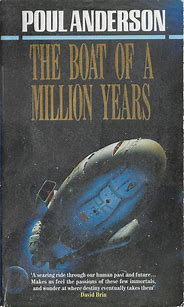
The Boat Of A Million Years, XVIII.

"The thought flitted through [Hanno] that if he did make known what he was and Gianotti's estimate of the rate of progress thereafter proved right, Natalia could become immortal herself. Probably rejuvenated, too; given such a command of biochemistry, that ought to be easy." (p. 386)

And there, almost, is the first premise of another sf novel by Poul Anderson, World Without Stars. However, that novel's second premise is diametrically opposed to the premises of Boat. Whereas Boat has slower than light interstellar travel, World... has instantaneous jumps to any point in space, even to remote galaxies or into intergalactic space. 


Anderson imagines every alternative slant on an idea.

I must eat, then go to meditation group. Tomorrow, a visit to Andrea above the Old Pier Bookshop.

Where would we be without Poul Anderson?

(That interior scene moves on YouTube but not here.)

Texts That Talk Back

The Boat Of A Million Years, XVIII.

First, read Ya-Kela And His Men.

In that post, I pointed out that a Poul Anderson text replied to its reader's thought. Then a letter from Ludwig Wittgenstein did likewise. Then a British TV comedian replied to a viewer. Then someone found that his response to a script written by Neil Gaiman was already incorporated into the script. Now Poul Anderson does it again.

Hanno says:

"'Now he's picking up extra votes - someday they may help him into the White House - by telling us that violence never settled anything. If only the city fathers of Carthage could talk to him.'" (p. 385)

Like no doubt many other sf readers, I remembered that a Robert Heinlein character had said that in Starship Troopers. The Carthaginian city fathers cannot talk to anyone because violence settled the question of whether they should continue to exist. "Delenda est Carthago." ("Delenda Est," Anderson's Time Patrol series.)

Next Hanno's companion replies:

"'Plagiarizing Heinlein, are you?'" (ibid.)

Andersonian self-parody. And Heinlein also wrote about an immortal man.

Religion In Nepal And The Future

The Boat Of A Million Years, XVIII, Judgment Day.

In Nepal, Wanderer, seeing some sneakers and jeans:

"...wondered how many people held by the mingled Buddhism, Hinduism and animism that was the faith of their fathers." (p. 364)

(I remember a hymn: "Faith of our fathers...")

Beliefs come, go and mingle but will remain in some form as long as people are as they are. Hinduism incorporates animisms and reabsorbs Buddhism by classifying the Buddha as an avatar of Vishnu. I can imagine practicing zazen and reading the Gita in that Tibetan village.

A Chinese postgraduate student, now attending our meditation group, mentioned that, in China about 1000 AD, there was a "Three Teachings In One" movement, uniting Confucianism, Taoism and Buddhism. Far out. I understand that Zen is a Taoist-Buddhist synthesis in any case. He also said that, in his town, there is a temple for the worship of Avalokitesvara but that it is obligatory to worship the Jade Emperor, the supreme Taoist deity, first! I would pay my respects to a local deity only as a preliminary to meditation practice.

Poul Anderson's immortals see so many gods come and go that they will wind up either as abstract monotheists or as atheists. Later, they are able to use virtual reality technology to simulate encounters with gods. The gods are our projections but the ultimate reality is not.

Time And Consciousness

My two philosophical preoccupations are the natures of time and consciousness. Time as the measure of motion is independent of consciousness but it is consciousness that defines the present and therefore divides time into past and future.

My two sf preoccupations are future histories and time travel. Both are related to time. All prose fiction involves narrative points of view and therefore raises the philosophical question of consciousness.

One of my blog refrains is that Poul Anderson alone among sf writers excels both in future histories and in time travel - both in quantity and in quality. Not just one future history but several, both series and single volumes. Not just one time travel classic - like maybe an equivalent of The Time Machine - but several short stories and novels and a series, all different. Time travellers either can or cannot "change the past" so, of course, Anderson presents both versions and in considerable detail.

Jack Havig, mutant time traveller, cannot alter the course of known events. Logically, this makes him no different from anyone else. If we now learn for the first time that a British agent had departed for Germany on a mission to assassinate Hitler in 1944, then we already know that any such mission failed even if we never learn how or why it failed. This remains true even if that agent turns out to have been a time traveller from our future. However, statistically, Havig is not like anyone else. He always falls and breaks a leg or suffers some other such mishap whenever he sets out to travel into the past in order to change it. Learning this, he soon stops trying and that alone is sufficient to explain why many past events are not changed.

Audrey Niffenegger does a good job with this issue in The Time Traveller's Wife. Events always remain consistent. At one point, Henry, trying to prevent a past event, is paralyzed by the knowledge that he is attempting the impossible. Also, he cannot control his departures or arrivals. Thus, unlike Havig, he is never able to set out in order to try to change the past. If you like Anderson, read Niffenegger.

More Historical References

The Boat Of A Million Years, XVIII.

Katya says that she is a Kazak. Pyotr responds, "'A Cossack?'" (p. 355)

Her people were armed against Tatar and Turk.

The war has thrown her together with Little Russians.

"'Mazeppa welcomed the Great Russians in...'" (p. 356)

Men who rode with Chmeilnicki hanged Catholic and Uniate priests.

There are more references, of course, but those were the eight that I thought worth googling. We know a word like "Cossack," of course, but what are the details? And do whatever vague impressions that we already have correspond to the reality? 

Now I really must do something about the here and now. I hope to visit Andrea above the Old Pier Bookshop tomorrow which will mean several hours away from the computer but maybe something interesting to report back.

Time Machines In Transit

Why are time machines invisible in transit? Are they always?

(i) HG Wells' Time Traveller tells his dinner guests that his Time Machine moves too fast to be seen but it doesn't move anywhere. It remains stationary on the Earth's surface in a state of time dilation so it should resemble a statue. The "Time Traveller" does not travel anywhere or when. In The Space Machine, his sequel to The Time Machine and The War Of The Worlds, Christopher Priest explains that the Time Machine in transit is attenuated.

(ii) Doctor Who's TARDIS disappears into and re-emerges from the "time vortex" where, according to the villainous Master, E = MCcubed.

(iii) Poul Anderson's Time Patrol timecycles do not exist between departure and arrival. They disappear from one set of spatiotemporal coordinates and (re)appear at another.

When a timecycle appears/arrives, it might have disappeared/departed from:

same place, earlier time;
same place, later time;
different place, earlier time;
different place, later time;
same place, prevented future;
different place, prevented future -

- but it cannot arrive from a prevented past.

Sunday, 9 February 2025

Katya

The Boat Of A Million Years, XVIII, Steel.

Katya/Svoboda seems to work for Zaitsev.

She is in a place which Stalin has renamed in his own honour and, at the end of the chapter, she refers to Stalingrad, the City of Steel.

The Four Horsemen on p. 361 are a Biblical reference.

Katya invokes:


There are other historical references but anyone can read the chapter and google!

See also Judgment Day.

Discovery And World-Taking

Poul Anderson, The Earth Book Of Stormgate (New York, 1978).

The Sky Book Of Stormgate, which we do not read, had covered:

the ancestors on Ythri;
the founders on Avalon;
the descendants until the time of the author, Rennhi.

The Earth Book, compiled by Rennhi's son, Hloch, comprises:

"...these annals, from the Discovery and on through the World-Taking." (p. 14)

- obviously these are major historical events:

the Discovery was the discovery of the planet Ythri by a human spaceship of the first Grand Survey;

the World-Taking was the two-stage joint colonization of the planet Avalon by human beings and Ythrians;

Hloch's annals include an account of the exploration of Avalon by Ythrians employing Aenean human beings;

they also cover the entire period of the Polesotechnic League.

The two pages of Hloch's introduction make clear that this volume covers an entire historical period and process.

His afterword concludes:

"Fair winds forever." (p. 390)

Our attention is drawn back from the history of the immortals in Poul Anderson's The Boat Of A Million Years to his History of Technic Civilization. Two evocative titles. 

Appreciating The Earth Book

We will shortly go out for the evening. I am appreciating the hardback The Earth Book Of Stormgate as a physical artifact. Of course the text is identical but reading the collection in this edition is a very different experience from carefully handling and struggling with my disintegrating paperback edition. Hloch's introduction is superb. For anyone who has just read The People Of The Wind, as ideally they should have done, the references to Stormgate Choth, the Weathermother, a Wyvan and the towns of Gray and Centauri are instantly comprehensible.

Of course, the Earth Book does not include the final version of Sandra Miesel's Chronology of Technic Civilization. Thus, "The Saturn Game" is absent. Also, A Knight Of Ghosts And Shadows is followed not by The Game Of Empire but by "/story on Flandry's old age planned/" (p. 12) The collection represents a stage in the development of the Technic History and therefore is of inestimable historical value.

The Roman

The Boat Of A Million Years, XVI, Niche.

Their names change. We recognize McCready as Hanno but what do we make of Oktai Saygun, making his first appearance to us here? 

Yet another cat and mouse conversation. When pressed by McCready, Saygun very guardedly tells a story in the style of H.G. Wells. Indeed, after McCready has at last openly declared his immortality, it remains conceivable, although improbable I suppose, that Saygun merely humours him by inventing a fiction about a record-keeper, originally of the late Roman Republic, who has found his niche and, other things being equal, would quietly and contentedly remain in that niche, lower to middle level government bureaucracy, not literally forever of course but certainly for an even longer time than he has already done. At the end, they exchange business cards, nothing more. Hanno has found one more, it seems, but has failed to recruit him. The plot moves very slowly indeed. As at the end of his conversation with the Cardinal, Hanno is more or less back where he had started. In Chapter XIV, he found Wanderer but lost Rufus. 

The Eight will all get together later in the twentieth century but, before that, Chapter XVII, will be about Svoboda defending Stalingrad. At least that is how I remember it.

Having judged that Flora is the best immortal, I now have to add that this Roman is the most boring. But the main point is that they are all different. And here is an appropriate quotation.