Friday, 5 December 2014

Underground On Terra

I am always alert to any details of life on Terra during the League or Empire periods of Poul Anderson's History of Technic Civilization. See here for the League period.

And here are two from a single day during the Empire period. First, Dominic Flandry's superior, Admiral Fenross, says:

"'If I didn't oblige the peerage,...I'd be begging my bread in Underground and someone would be in this office who'd never tell them no.'" (Sir Dominic Flandry, p. 192)

And:

"...rhododendrons bloomed like cool fire in Terra's parks, and the laughing youth of Terra's aristocracy flew past on their way to some newly opened pleasure house." (p. 197)

Other Anderson sf novels, e.g., The Long Way Home and The Corridors Of Time, present high tech futures in which a large percentage of the population is permanently unemployed and either impoverished or minimally subsidized. This single reference to "...Underground..." implies a similar lowest social stratum in the Terran Empire although it does not tell us how many Undergrounders there are. Are they literally underground or does "Underground" just mean "the under-class"?

We are used to societies in which wealth is unequally distributed but this does seem to be an extreme case. An able individual like Fenross could be impoverished at the whim of a "peer" while at the same time youths who have done nothing to generate any wealth fly to a pleasure house even though Terra is now at war on two fronts.

Flandry reflects:

"...when the bombs finally roared out of space, when the barbarians howled among smashed buildings and the smoke of burning books hid dead men in tattered bright uniforms - when the Long Night came, as it would, a century or a millennium hence, what difference? - something of beauty and gallantry would have departed the universe." (p. 190)

Maybe, but the Long Day will last much longer if more people have a stake in defending it. How many Undergrounders will join with extraterrestrial barbarians in smashing buildings, burning books and killing anyone wearing a uniform?

Thursday, 4 December 2014

WWII Fantasy And Completion

On this blog, I have mentioned three British writers of graphic fantasy: Alan Moore, Neil Gaiman and Mike Carey. A comparable American author is Roy Thomas, whose monthly comic book, The Young All-Stars, combined mythical, literary and historical characters with newly invented superheroes during World War II, each twelve months of publication corresponding to about two months of WWII time.

I mention Thomas for two reasons. First, comparison with Poul Anderson, who also combined fantasy with history while his fantasy novel, Three Hearts And Three Lions, begins with an important incident during World War II.

The second reason is more fanciful and whimsical. I quoted Anderson's character, Aycharaych, calling death a completion. Completeness is a virtue in art. When The Young All-Stars was being published, I was unsure whether to continue collecting it. I was strangely relieved when it was announced that the title would soon be cancelled. This meant that I would shortly have the entire series complete. I may be alone in seeing the parallel - Aycharaych sees death as a completion and I saw the cancellation of an imaginative series as also its completion.

A Vast, Multi-Faceted Fictitious Universe

I think that it will be worthwhile to analyze what went on in the previous post. I began by listing kinds of ice because this was an interesting technical detail in the short Dominic Flandry novel, "Hunters Of The Sky Cave." I was not sure how far this would take us but was prepared to find out.

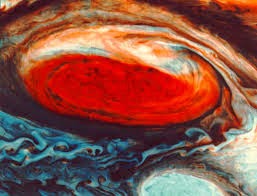
Sure enough, there were two interesting outcomes. First, a routine google search for the Great Red Spot on Jupiter disclosed that current understanding of this phenomenon differs from Flandry's, published in 1959. The Red Spot is not after all a red kind of ice. Secondly, something said by Flandry while on the Red Spot initiated a discussion of attitudes to death and even to me quoting Dylan Thomas.

The moral of this story is that Poul Anderson's History of Technic Civilization is a vast multi-faceted fictitious universe and that, as with the real universe, it is possible to reflect on reality and life as they are focused through historical events and through the biographies of historical figures.

Two further points about death:

I prefer Dylan Thomas' "And Death Shall Have No Dominion."

"And death shall have no dominion.
"Dead men naked they shall be one
"With the man in the wind and the west moon;
"When their bones are picked clean and the clean bones gone,
"They shall have stars at elbow and foot..."

This is relevant here because that last quoted line gives us the title of Volume I of James Blish's future history.

Secondly, I recently referred here to a conversation between Flandry and Aycharaych. I could have added that this conversation discloses Aycharaych's attitude to death: it is "'A completion.'" (Sir Dominic Flandry, p. 164)

"Call no man happy until he is dead" (see here) I think means that a life must be complete before it can be evaluated although, in Volume I of James Blish's theological trilogy, a medieval monk presents the safer Scholastic interpretation: the dead man is happy in Heaven.

Aycharaych's philosophical cynicism is displayed yet again when later he sets out to "complete" Flandry's life.

Wednesday, 3 December 2014

Kinds Of Ice

Familiar white or transparent ice;
a black allotrope on the Jovian surface;
super-dense ice in the mantle around the Jovian core;
red crystalline ice floating in the Jovian atmosphere.

The Red Spot is a storm according to Wikipedia (see here) but "'...a mass of aerial pack ice...'" (Sir Dominic Flandry, p. 185) according to Dominic Flandry. Hence, the fourth kind of ice listed here.

In the Technic History:

"'...always, Chives, the Red Spot is a pack of flying glaciers, stretching broader than all Terra. And we've been crashed on one of them!'" (ibid.)

- crashed in a vehicle protected by a force-field although the field may fail in the dense, violent atmosphere and, in any case, food and air will run out unless Flandry and Chives can attract help which, of course, they do.

It was interesting to find a link to the Red Spot only to discover that it gives a different account of this phenomenon but that is the relationship between science and science fiction. The science moves on. The fiction moves with it but, if earlier fictions were worthwhile, then they are still appreciated, with their earlier versions and visions of the Solar planets.

It is on this occasion that Flandry says:

"'I don't want to die so fast I can't feel it. I want to see death coming, and make the stupid thing fight for every centimeter of me.'" (p. 184)

For those of us who disbelieve in a hereafter, this is an intriguing thought. We can die in our sleep or can be killed instantaneously by an explosion. In these cases, we do not realize that our last moment of consciousness is our last. Like Flandry, I would prefer to see death coming but would not, at the very end, want to fight it. Life's limits, its beginning and its end, are not "stupid."

Dylan Thomas wrote, "Rage, rage against the dying of the light." I do not want to die enraged.

Art And Horror

Poul Anderson's History of Technic Civilization includes two revealing dialogues between Dominic Flandry and his adversary, Aycharaych of Chereion. In the first, at the Crystal Moon, Aycharaych admires a (to him) black orchid against a quicksilver zero grav globe of water with "'...the universe black and cold beyond both...'" and comments:

"'A beautiful arrangement, and with that touch of horror necessary to the highest art.'"
-Poul Anderson, Sir Dominic Flandry: The Last Knight Of Terra (New York, 2012), p. 162.

Tragedy is a higher art form than comedy but horror necessary for high art? I disagree, although Aycharaych's association of beauty with horror probably tells us something about his ruthlessness. Later, Flandry speculates that Aycharaych himself is an artist and Chunderban Desai completes the thought:

"'An artist of espionage and sabotage, whose materials are living beings?'" (p. 391)

If Aycharaych's idea of high art incorporating horror includes what he does to living beings, then we must certainly assert that morality overrides art. Desai goes on to make another interesting remark:

"'We have not had the good fortune to be born in an era when our society offers us something transcendental to live and die for.'" (ibid.)

Do we need our society to offer us this? Since the invention and free use of the printing press, we have become the heirs of all the traditions. Meditating in the Quiet Room of a Youth Hostel, I was joined by a Japanese man reading his Bible! Desai, from the planet Ramanujan, says:

"'I hope to do more than read sutras in my retirement...'" (p. 390)

Buddhist and Yoga Sutras point towards practices for the realization of transcendence. It is not necessary to die for them - unless, maybe, a future dictatorship persecutes unorthodox religious practices.

I cannot resist one concluding reference to horror in futuristic sf. In Alan Moore's Halo Jones, horror fiction and philosophy have been synthesized in works with titles like Frankenstein Meets Wittgenstein...

Meanwhile, On Another Blog, Like This One...

See here.

Sean M Brooks has listed uncollected works of Poul Anderson.

Inspired by Sean's article, Peter has created an e-book of some of the uncollected stories and has also posted information about where Poul Anderson items might be found on the web.

I thought that this correspondence ought to be drawn to the attention of readers of this blog and I welcome any further information about uncollected works.

Tuesday, 2 December 2014

Endings

Every novel has an ending - because its text is not infinite. Usually, it also has a resolution. The plot can be resolved by an ending that is either happy or sad. Poul Anderson's A Knight Of Ghosts And Shadows has a happy ending insofar as Dominic Flandry has defeated his enemies but a sad ending insofar as his fiancee has been killed in the action.

They would have settled down on her home planet, Dennitza, but, at the end, planning to return to Terra, he says:

"'I have my own people.'"
-Poul Anderson, Sir Dominic Flandry: The Last Knight Of Terra (New York, 2012), p. 605.

The following novel, A Stone In Heaven, has a happy ending both because Flandry defeats his enemies and because he starts a new relationship:

"They walked on into the autumn."
-Poul Anderson, Flandry's Legacy (New York, 2012), p. 188.

The advantage of a series is that it can tell us what happened after a happy ending. In The Game Of Empire, Miriam Abrams Flandry starts home, across an interstellar distance, as soon as news of civil war is received. At debarkation on Terra, her husband's uniform gets them waved through and they go straight to their apartment in Archopolis for champagne, caviar and serious conversation about the war. It is good to know something of what happened after the autumnal walk. However, the series cannot continue indefinitely. Further, The Game Of Empire ends not with another ending for Flandry but with a new beginning for his daughter - and the next work in the series is set centuries later. This is (fictitious) history.

More Details On Nyanza

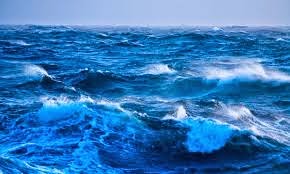
Poul Anderson's ocean-covered planet, Nyanza, is the diametric opposite of Frank Herbert's desert planet, Dune. I prefer Nyanza. Whereas Dune appears in six novels by Herbert, many more novels by his successors, one feature film and one TV series, Nyanza is the setting of only a single short story, "The Game of Glory."

This story presents a wealth of information about the fictional Nyanzan environment. Several of the details are presented only once and very briefly but they nevertheless demonstrate that a series of novels could have been set on this single planet.

Tessa Hoorn, Lightmistress of Little Skua in Jairnovaunt, tells Dominic Flandry that:

Jairnovaunters harpoon the kraken, a beast with more bulk than the harpooner's boat;
"'...T'Chaka Kruger farms a great patch of beanweed in the Lesser Sargasso...'" (Captain Flandry, p. 314);
commons and sometimes captains scrape low-tide reefs for shells or dive for sporyx;
there are many professions common to society on any planet;
"'...wandering boats of actors...'" (ibid.) come and go as they please.

A focus of the action of the story is the permanently submerged area of Uhunhu but only one part of one sentence tells us the nature of this place:

"...the weed-grown steeps of Uhunhu rose beneath him, monstrous grey dolmens and menhirs raised by no human hands, sunken a million years ago..." (p. 336)

Monday, 1 December 2014

The Marines

"Everybody knows the Empire was won and is maintained by naked power, the central government is corrupt and the frontier is brutal and the last organization with high morale, the Navy, lives for war and oppression and anti-intellectualism."
-Poul Anderson, Young Flandry (New York, 2010), p. 6.

I wouldn't have said it was that bad. The Terran Imperial Navy includes Max Abrams, Ilya Kheraskov, Dominic Flandry and presumably some others like them.

But let's see some marines in action. It is their invariable rule to obliterate when one of their own is shot dead in an ambush. This happens while they are brutally annexing Brae. Buildings have been smashed, anti-Imperialists are being exiled and a collaborationist government is being installed. When a single marine is fatally wounded by a shot from a house:

another squad member instantly flips a tracer dart from his belt;
the dart follows a trace of ions to the front of the house;
a rover bomb is launched from a shoulder-borne rack;
the front wall of the house is destroyed;
the squad attacks with debris striking their helmets;
Flandry's marine escort, joining him around the dying man, look wistfully towards the sound of blasters and bombs.

So, yes, they do sound like guys who live for war, oppression and maybe also anti-intellectualism.

When someone in a crowd throws a missile at the police, it is the police's job to identify their assailant and to make their way through the crowd to arrest him, not to attack the crowd. We might say the same to these marines: attack your attacker; do not destroy an entire building with anyone else in or near it.

"He In Uhunhu"

"'...shall freedom come from slave-masters, asked he in Uhunhu.'"
-Poul Anderson, Captain Flandry: Defender Of The Terran Empire (New York, 2010), p. 305.

In the abstract, that is a valid question. In practice, there are two problems with it:

(i) it is asked on Nyanza, where there are no slaves;
(ii) it is asked by A'u, an agent of Merseia.

(i) The question can be reformulated to apply to situations other than slavery:

Can conquerors liberate?
Can a military dictator establish peace and freedom?
Can perpetrators of injustice end injustice?

The question is more relevant on planets forcibly annexed by Terra or Merseia. Brae is an obvious example in the same story. Nyanza was forcibly annexed but that was a century ago and it suffers no current injustices.

(ii) This fact makes the question entirely cynical since A'u intends only to spearhead a Merseian invasion. Is it too much to ask that another spacefarer, shipwrecked for example on Brae, might ask exactly the same question but in complete sincerity? Anderson shows us both Avalonians and Freeholders successfully resisting the Terran Empire to preserve their distinctive ways of life and a National Liberation Army was one of the forces that emerged when Dominic Flandry sabotaged the Scothani Empire. A'u is a fake but not everyone who asks his question is.