Showing posts sorted by date for query Alice In Sunderland. Sort by relevance Show all posts

Friday, 12 July 2024

Other Literary Associations

For more about Poul Anderson and Rudyard Kipling, see the combox here.

Other literary associations are more complicated. CS Lewis replied to the secularist sf of HG Wells and Olaf Stapledon whereas Poul Anderson and James Blish wrote Wellsian and Stapledonian sf while respecting Lewisian theological issues.

Lewis:

hinted at time travelling in the concluding sentence of his first Ransom novel, Out Of The Silent Planet;

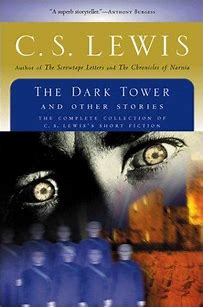
discussed time travel in the opening passage of his unfinished Ransom novel, "The Dark Tower," and in the Preface to his The Great Divorce.

However, it was Anderson who most fully developed Wellsian time travel.

Alice In Wonderland pervades our culture and impinges on Poul Anderson's works at least in one Dominic Flandry story. While recuperating from a cold, I have reread in full Alice In Sunderland by Bryan Talbot and The Great Divorce by CS Lewis. Like a reward near the end of the Lewis work, comes:

"'And she couldn't make herself smaller? - like Alice, you know.'"
-CS Lewis, The Great Divorce (London, 1946), p. 113.

Yes, we all know.

This and other important works by Lewis are set in England during World War II. Manse Everard of the Time Patrol visits London during the Blitz. All fiction is one.

Thursday, 11 July 2024

More About Alice And Kipling

See "Alice," combox, here. 

"The story that Queen Victoria, delighted by Alice, requests another book from Carroll and receives an impenetrable mathematical treatise is unfortunately not true.
"It's just one of the many myths that surround him."
-Bryan Talbot, Alice In Sunderland (London, 2007), p. 227, captions 1-2.

I thought that if I added this quote in the combox to the first "Alice" post, it might be missed.

As was pointed out in that combox, one literary influence on Poul Anderson that I missed was Kipling. See Anderson's The Enemy Stars and The Game Of Empire. 

See also "Harvest Of Stars II" (here) where I respond to Anson Guthrie's remark about Kipling.

Tuesday, 9 July 2024

Alice

Literary influences on Poul Anderson:

the Bible
the sagas
Shakespeare
Sherlock Holmes
Lewis Carroll

Carroll is a lesser influence but nevertheless present in the Dominic Flandry story, "The White King's War."

Alice In Wonderland has been with us all our lives. I remember posters advertising a dramatization of Alice at my primary school in about 1955. In the centre of Lancaster right now, prominent posters advertise a promenade performance in Williamson Park, which overlooks the city. There have been many stage and screen adaptations between 1955 and 2024.

I want to plug a graphic work about Alice but find that I have already done so here (scroll down) and here.

I might spend this evening rereading Alice In Sunderland but with some excursions back into Anderson.

Saturday, 14 July 2018

Common Ancestry

Manse Everard has been in fifth century Britain and now visits a house in London in 1944:

"Mary perched on the edge of the sofa, watching him with large eyes. He wondered if Wulfnoth and Eadgar were among her ancestors. Yes...undoubtedly they were, after all these centuries. Maybe Schtein was too."
-Poul Anderson, "Time Patrol" IN Anderson, Time Patrol (Riverdale, NY, 2010), 6, p. 47.

(Schtein had traveled to the fifth century from 2987.)

"If you go back to the Visigoths...or even just medieval times...everyone is descended from everyone, including Charlemagne and Genghis Khan, she thought but did not say. You can prove that with some simple mathematics."
-SM Stirling, Black Chamber (New York, 2018), FIVE, p. 102.

Each of us has:

two parents;
four grandparents;
eight grandparents;
sixteen great-grandparents;
thirty two great-great-grandparents;
sixty four great-great-great-grandparents.

That is six generations. From 500 to 1940 A.D. is seventy two generations and the world population shrinks as we travel pastward. It seems to me that I have always been more interested in the fact of our common ancestry than in tracing my particular line of descent but it might have been Poul Anderson's "Time Patrol" that made me aware of common ancestry.

Bryan Talbot ends his Alice In Sunderland by celebrating descent from Picts, Celts, Romans, Africans, Middle Easterners, Gauls, English, Vikings, Danes, Normans, Irish, Europeans, Belgians, Lithuanians and Jewish Poles. A man to whom I handed an anti-racist leaflet in Lancaster was outraged when I claimed that everyone is related and tried to insult me by saying that I looked Chinese!

Tuesday, 19 June 2018

This Evening And Tomorrow

(From Alice In Sunderland.)

Blogging till midnight and beyond was disrupting my sleep pattern so I now stop about 09:00 pm, which means a longer gap till the breakfast posts, if any.

After about 09:00 pm, I sometimes want a visual break from reading prose and prefer graphic works to TV. Alan Moore's graphic fiction, Miracleman, led to a comparison of Poul Anderson's obscure flying men with several more famous ones here whereas Bryan Talbot's graphic documentary, Alice In Sunderland, led to a comparison of Anderson's Dominic Flandry with the historical Jack Crawford.

I expect to continue rereading Talbot this evening. Either this or other inputs will probably lead to more posts here tomorrow.

Five Naval Heroes Or A Man And His Rep III

See:

A Man And His Rep
A Man And His Rep II
Brands

Five naval heroes are:

Horatio Nelson
Horatio Hornblower
Jack Crawford
John Paul Jones (and here)
Dominic Flandry

Other sf naval series characters have been mentioned in the combox.

We mix historical and fictional figures because history, legend and fiction mix. While reading about fictional heroes, we should never forget that they have real life counterparts.

We mix sea and space because of a literary tradition that sees the latter as an extension of the former, e.g., see A Later Period, although it is arguable that this is implausible.

Dominic Flandry is a space naval hero whose exploits change future history, e.g., even his opening adventure on Starkad saves the Terran fleet and thus also Terra itself. For this reason, I compare Flandry with a real historical hero:

"Crawford's actions shape future history and give the expression 'to nail your colours to the mast' to the English language."
-Bryan Talbot, Alice In Sunderland (London, 2007), p. 42.

Crawford's life has some superb interactions between the living legend and the real man:

because he refused to play the hero, a stand-in replaced him at his official parade of honour;

he refused a lucrative offer to play himself in re-enactments of the Battle of Camperdown;

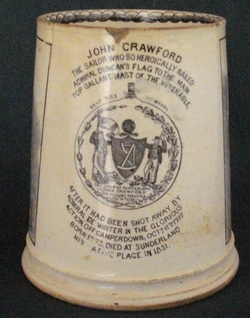
he criticized the pottery bearing images of his heroic deed;
 
but, like Hornblower, he did attend Nelson's funeral - and walked in the procession.

Invoking Virgil, we might imagine that the soul destined to be born as Flandry was also present. (Aeneas, ancestor of Romulus, met Caesar in Hades just as the Fourth Gospel projected Christ as the Word back to the Beginning.)

Whitehaven, the town where I lived for my first two or three years, is proud of its association with John Paul Jones because he attacked it! Time changes perspectives:

"'If an Englishman of around 1600 had found out about the American Revolution, he probably would have thought it a tragedy; an Englishman of 1950 would have had a very different view of it. We're in the same spot. The messages we get from the really far future have no contexts yet.'"
-James Blish, The Quincunx Of Time (New York, 1983), AN EPILOGUE, pp. 109-110.

We are indeed in the same spot. In Poul Anderson's History of Technic Civilization, Americans must accept that the Terran Empire will have its Admiralty Center in the Rockies and Englishmen must accept that Britain will have become a mere Mayoralty.

Pardon by the town and port of Whitehaven in 1999

John Paul Jones was given an honorary pardon in 1999 by the Port of Whitehaven for his raid on the town, in the presence of Lt. Steve Lyons representing the US Naval Attaché to the UK, and Yuri Fokine the Russian Ambassador to the UK. The US Navy were also awarded the Freedom of the Port of Whitehaven, the only time the honour has been granted in its 400-year history.[34]
The Pardon and Freedom were arranged by Gerard Richardson MBE as part of the launch of the series of Maritime Festival. Richardson's of Whitehaven is now the honorary Consulate to the US Navy for the Town and Port of Whitehaven. The Consul is Rear Admiral (retired) US Navy, Steve Morgan and the Deputy Consul is Rob Romano.[35]
-copied from here.

Friday, 3 October 2014

Some English History

Rereading Poul Anderson's works has slowed down because I have:

worked my way through most of the Technic History;

been reading Peter O'Donnell's Modesty Blaise for the first time;

begun rereading Bryan Talbot's Alice In Sunderland.

Since I have met Bryan Talbot a few times and saw Poul Anderson at a couple of World SF Cons, that leaves Peter O'Donnell as the only one of these three writers with whom I have had no personal or visual contact.

Talbot's Alice... summarizes a lot of English history and thus covers some familiar Andersonian territory. Talbot mentions Romans, Vikings and Normans but, so far, has skipped over Harald Hardrada. He reminds us that it was the Venerable Bede, the father of English history, who invented the BC/AD calendar. 

Does anyone out there know which Poul Anderson book this cover illustration is for?