Showing posts sorted by date for query "The Nest". Sort by relevance Show all posts

Thursday, 3 September 2026

Forgotten Details

Orbit Unlimited, part four.

How many details do we remember out of all the books that we have read? For example, how did Danny Coffin wind up in a spearfowl's nest? Did the spearfowl grab him and carry him up there?

No. When a tusked animal chased Danny, he ran to a crag and climbed up it, causing a landslide that frightened away the animal but made it impossible for Danny to climb back down again. Fortunately, the spearfowl was away from home when Danny fell asleep in its nest. When the bird did return, Danny's would-be rescuers, his father and Jan Svoboda, were close enough so that it had to check on them before landing.

Svoboda gets close, although not close enough, with climbing equipment and an exploding piton wakens Danny. How the two men do rescue him is described in Rescue On Rustum. All the details fit together. It is just a matter of rereading them. 

Sunday, 30 August 2026

The Daily Life Of The Future II

Orbit Unlimited, part four

What details have we already noted? See Some Details On Rustum. (I was bound to have noticed Joshua Coffin's reference to Lazarus.)

Although Jan Svoboda thinks of the airbus that he flies as "...this old rattletrap...," (p. 97) it and others like it are:

"...still so scarce and expensive as to be publicly owned..." (p. 100)

Svoboda, an engineer on Earth, is an iron miner on Rustum and has built his house beside the line that carries ore from his pit to the steel mill. In his garden, a phoenix nest lit by luminous fungi is "...like a goblin lantern." (p. 114). I am picking out colourful or notable details but there is much more where this came from.

"The wind, slow and heavy, rustled withering leaves with a sound which was not like October in New England, nor like anything Earth had ever heard." (ibid.)

Poul Anderson always tells us what the wind is doing: "...slow and heavy..." matches the mental states of his characters at this stage of the narrative. Although this wind is not October in New England, merely mentioning this does evoke October in New England! (Ray Bradbury, very unlike Anderson, has an evocative title, The October Country.)

There is more pathetic fallacy with the wind:

"The wind ruffled a loose lock of Mother's hair and made the trees sigh around her voice. She talked low and carefully..." (p. 103)

Appropriately, this wind, not heavy, makes the trees sigh around Mrs Coffin's low voice. Even casual readers must be subliminally affected by Anderson's fully integrated texts.

Tuesday, 28 July 2026

Senses And Silence

The Game Of Empire, CHAPTER THREE.

Silence falls often. (Scroll down.)

Diana and Targovi converse privately in a crow's nest:

"Wind swirled in shrouds, bore iodine odors. The ship creaked and whooshed. A low sun threw a bridge over the waters. Forsaking this quest for another world would not be quite easy." (p. 242)

Four senses but I have said that before. (See also here.) That last sentence above reflects the fact that these characters can leave this planet and travel to another.

When there is a dramatic pause in the dialogue:

"Silence fell, save for wind, sea, and ship." (p. 245)

This is silence of speech but not of the sea setting and we have become used to the perennial wind. Completing our appreciation of the setting, Diana:

"...stared out beyond the sunset." (p. 247)

She looks beyond her immediately sensed scene of sun, sea and sky but we can meanwhile pause to appreciate it.

Monday, 26 January 2026

Centauri

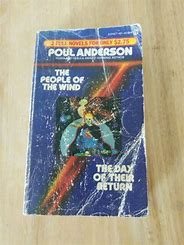
The opening paragraph of The People Of The Wind, VI, might be my favourite passage in Poul Anderson's Technic History. We have quoted from it in whole or in part nine times.

"Where the mighty Sagittarius flows into the Gulf of Centaurs..." (p. 55)

Now ten times.

Centauri, human town and spaceport, is like a gateway to the Empire. Arinnian must be Christopher Holm while there and the West Coronan home guard and the Seamen's Brotherhood confer there. Afterwards, Arinnian and Hrill eat in the Phoenix House (not to be confused with the Old Phoenix) and drink in the Nest. (Unfortunately, for blog searching purposes, there are two "Nests" in Anderson's multiverse.) I hope to find previously unnoticed details but will shortly depart to the gym with the first Inspector Morse novel to read in the cafe.

Tomorrow evening, a proposed family meal has had to be postponed because it would have clashed with Holocaust Memorial at the Cenotaph. We still live real history and read future history.

Saturday, 27 December 2025

Oceanest

The Man Who Counts, V.

Some Diomedeans call their planet "Oceanest." We have mentioned this name twice before. See here. (Scroll down.)

Does "Oceanest" mean "Most Oceanic" or "Ocean-Nest"? I suppose not the latter. If Poul Anderson had intended such a meaning, then he would have expressed it more clearly.

The sound that the Diomedean utters is "'...Ikt'hanis...'" (p. 160) Unlike some other planetary names, it does not mean "earth" but instead refers to the water covering the earth.

We want to know much more about Anderson's extraterrestrial languages and apparently some Trekkies have expanded on Vulcan and Klingon but Tolkien was unique. No one can do everything and Tolkien's project of creating languages, then imagining people who spoke them, then writing stories about those people was unprecedented and unparalleled.

Monday, 28 April 2025

Lisbeth And Coya

Beside me on this settee are two thick volumes:

the 390 pages of Poul Anderson's The Earth Book Of Stormgate;

the 746 pages of Stieg Larsson's The Girl Who Kicked The Hornets' Nest.

Each is part of a larger work.

Larsson's technology is up to date for the early twenty-first century. Anderson's is futuristic but reads like a plausible extrapolation. His characters take their tech for granted as we take ours.

Lisbeth Salander hacks computers. Coya Conyon uses Luna Astrocenter computers to track a supernova.

Coya defies her grandfather. Lisbeth has defied her father. But, apart from that, the two relationships are entirely different. Read them and see what I mean.

By implication, any contemporary novel has some kind of future ahead of it but to refer to any particular future events would be to go outside the parameters of contemporary fiction writing. Anderson's Technic History has the Chaos in the early twenty-first century. Larsson's Millennium Trilogy has only the world events that had happened at the time of writing.

Saturday, 19 April 2025

Real Places

Poul Anderson's The People Of The Wind makes Livewell Street in Centauri on Avalon seem like a real place. The Bishop's Arms pub on Bellmansgatan in Stockholm is a real place. Googling reveals that Stieg Larsson regularly visited this pub which explains why he mentioned it in his The Girl Who Kicked The Hornet's Nest.

It is that time of the evening when I do non-blog-related reading but find connections anyway. Novelists must make places seem real whether the places are fictional or real. Sometimes we don't know which but googling helps.

I did not expect to publish a picture of the Bishop's Arms or to advertise the pub here but any friend of Stieg Larsson deserves our support. I have become a big fan of Sweden.

Tuesday, 15 April 2025

Character Interactions

Part of the pleasure of reading or rereading a long novel with a large cast of characters is that the narrative moves back and forth between characters or sets of characters and also presents them in different combinations. While reading a dialogue between Daniel Holm and Matthew Vickery in Poul Anderson's The People Of The Wind, we glance ahead to the following page and notice with pleasurable anticipation that the next narrative passage features Tabitha Falkayn and Philippe Rochefort. While reading about the fatal confrontation between Gullberg and Zalachenko in Stieg Larsson's The Girl Who Kicked The Hornet's Nest, we glance ahead to the following page and notice with pleasurable anticipation that the next narrative passage recounts how Lisbeth Salander and Annika Gianni respond to the sound of gunshots from Zalachenko's room just two doors down the hospital corridor. Each new passage returns us to characters that we like or at least are interested in and there are endless ways that they can interact. Rereading, we know in general what happens in the novel but usually do not remember the precise sequence of narrative passages or which interesting character we are going to encounter next when we turn a page or begin a new chapter. There is extra enjoyment in noticing as if for the first time the details of how each character responds to what to them are new and challenging situations. And not all of them will survive to the end of the novel.

Tuesday, 8 April 2025

The Two Avalonian Cities

The People Of The Wind.

The two Avalonian cities, Gray on Falkayn Bay and Centauri on the Gulf of Centaurs, are very different from each other and are described in detail. Arinnian flies above then inland from Gray and spends time with Tabitha in Centauri where it is usually safer for him to be Christopher. We find that we have previously posted about both cities:

Gray

In Centauri

Livewell Street

In The Phoenix House

In The Phoenix House And The Nest

In The Nest

Gray and Centauri are more concretely realized than Stellamont on Nerthus in Poul Anderson's earlier Psychotechnic History. It is good to be able to compare them.

Monday, 28 October 2024

Seasons

An author can tell us in a single word that a year has elapsed or alternatively can evoke the passage of time by recounting the passage of the seasons:

"That summer blazed up into fall, winter came, spring, and summer again, while we made ready. Our last year on Harbor."
-"Gypsy," p. 269.

"The days turned to weeks and spring turned to summer...
"Autumn came suddenly and still he had not made a move. When it got colder he bought an electric heater..."
-Stieg Larsson, The Girl Who Kicked The Hornets' Nest (London, 2010), p. 730.

We appreciate the passage of time more with a longer description. We realize how much preparation is necessary before leaving Harbor and it is restful to read about Larsson's fugitive character in hiding:

"...staring out of the window, day after day, week after week."
-Larsson, op. cit., p. 731 -

- while only seconds elapse for us as readers.

Wednesday, 16 October 2024

Clinton And Nystrom

Regular blog readers know that:

I give a lot of attention to narrative points of view (povs);

Poul Anderson usually has good control of his povs;

I do other reading, often of Stieg Larsson, later in the evening;

we sometimes link that later reading to Anderson.

With all that for context, I have found an interesting pov point in Larsson. Clinton, Nystrom and Sandberg are in conversation. When Sandberg speaks:

"Clinton and Nystrom exchanged glances."
-Stieg Larsson, The Girl Who Kicked The Hornets' Nest (London, 2009), p. 588.

But whose pov is it? Reading on:

"...Clinton and Nystrom felt a surge of anxiety." (ibid.)

A double pov! That is unusual. And my impression, for what it is worth, is that this was unreflecting on Larsson's part.

Sunday, 5 May 2024

In Arvanneth

The Winter Of The World, V

The impoverished Lairs, dominated by the criminal Brotherhoods, end abruptly at the Avenue of Dragons connecting the Old Bastion to the Council House and kept safe by militia patrols. However, also nearby is the abandoned, ruined Hollow Houses area:

roofless walls
wall-less chimneys
porticos
colonnades
ivy on all the above
trees, brambles and flowers overrunning rubble heaps
grass parting pavement blocks
lichen devouring a monument
mellow stone
jasmine
a mockingbird
mossy slabs
a hanging oriole's nest
Dream Abbey (?), still inhabited

The Jugular River has withdrawn, leaving the moat-like Lagoon to which it is connected by canals. The nearby Swamp of Unvar makes itself known. Not as fabulous as Ys but a large, ancient city nevertheless.

Monday, 29 April 2024

Fictional Comments

The Byworlder.

Futuristic sf comments on the period in which it is written. Discussing art, Skip says:

"'You know what absolute garbage-pit bottom we hit in the middle twentieth-century, don't you?'" (IX, p. 78)

See also The Relevance Of SF and Old Days And Silence.

Fiction set in any period also comments on people fairly timelessly. Skip tells Yvonne that, despite her recent celebrity, she will not be recognized in public because:

"'The sensation's died of old age. Your picture hasn't been on a screen for two or three weeks. Ninety-nine percent of the population has lousy memory...'" (X, p. 96)

Similarly, despite having been "Wanted for Murder" for an extended period, Lisbeth Salander:

"...was surprised that nobody at the ticket desk or at the check-in counter seemed to recognize her or react to her name."
-Stieg Larsson, The Girl Who Kicked The Hornet's Nest (London, 2010), CHAPTER 29. p. 688.

We can pass from being well-known to back again. "This too will pass" etc.

Friday, 19 April 2024

Communication

"Epilogue."

Zero transmits an alarm:

"Forty miles thence, the person who may as well be called Two answered, 'Is that you, Zero? I noticed something peculiar in the direction of your establishment. What is the matter?'
"Zero did not reply at once. Others were coming in, a surge of voices in his head..." (p. 180)

Lisbeth Salander logs on to Hacker Republic:

"<Hi, gang.> Wasp wrote.
"<Wasp. That really U?> SixOfOne wrote. <Look who's back.>
"<Where you been keeping yourself?> Trinity wrote.
"<Plague said you were in some trouble.> Dakota wrote."
-Stieg Larsson, The Girl Who Kicked The Hornet's Nest (London, 2009), CHAPTER 13, p. 320.

This is when Zero reminded me of Wasp. Hackers like Plague live mainly on line but they are exceptions where humanity is concerned. However, by contrast with the mass of humanity, Zero and his kind communicate entirely by radio and hardly ever physically. Zero has observed very few persons optically. By radio, they communicate ritual, friendship and art. Zero and Seven criticise each other's poetry. Ninety-six shares his abstract tone constructions, Eighty shares narratives and Fifty-nine shares speculations about space and time. Fourteen has shared with Zero his sensory impressions of the seashore, including the salt in the air. In this way, Zero has also experienced catching and eating an aquamotile.

Sunday, 17 March 2024

Three Years

After Doomsday.

The text is very condensed. Three years pass between two chapters. In that time, human beings have led their allies to victory in the war against Kandemir. Grateful freed beings have let Donnan make his base on their planet. There has been time for the "The Battle of Brandobar" ballad to be composed and to be sung in another civilization-cluster where it is heard by the women of Terran Traders. 

Several TV series could be set in those three years (a "three year mission"):

the War against Kamdemir
Terran Traders
Songs sung and tales told in Yotl's Nest
What happened to the Russian ship
What happened to the Chinese ship with its sexually mixed crew
the British Commonwealth ship
Other human ships

Very like the way Star Trek developed.

Saturday, 16 March 2024

Loud In The Trees

After Doomsday.

A song sung by a spaceman in Yotl's Nest tells the women of Terran Traders that other human beings are alive. Sigrid says that there can only be two such days in her life. Of course Donnan asks what is the other one:

"'V'en my first-born is laid in my arms.'
"For a while only the wind blew, loud in the trees." (14, p. 112)

This time the wind underlines what is important, loudly for emphasis. That wind gets everywhere. We can think of it as:

"...the wind at the edge of the world forever calling."
-see here.

It certainly blows between worlds. If enough works by Poul Anderson were to be filmed, then there could certainly be a compilation of scenes with wind punctuating dialogue and commenting on action in Ys, in Gothland and on other planets.

Monday, 29 January 2024

In The Nest

The People Of The Wind, VI.

One of my favourite scenes in Poul Anderson's Technic History is Christopher and Tabitha in the Nest.

Centauri is the second and only other city on Avalon after Gray. The Nest is the tallest building in Centauri. We are not told what is inside the building. A transparent canopy covers the unwalled rooftop tavern. Winged Ythrians and gravbelt-wearing human beings frequent the tavern and there is also a gravshaft. Stars, invisible from the street, are seen through the canopy. There is also a view of the River Sagittarius and the Gulf of Centaurs.

Dim fluoroglobes light tables and are circled by insectoids. Patrons drink from glasses or inhale from narcobraziers. Christopher and Tabitha hear a recorded steel harp. Sometimes bards perform. The human pair meet Eyath's fiance, Vodan, who is spending time with Quenna, a permanently on heat Ythrian female, before going to war in which he will be killed by the friendly fire of the Avalonian defence system - devised by the two Marchwardens who include Christopher's father - although, of course, no one can yet know whether or how Vodan is destined to die. He is just out in the Nest for some leave time like everyone else. A trundling service robot dispenses:

"...thick, strong New African beer." (p. 506)

We vicariously experience some everyday life on Avalon.

Tuesday, 11 July 2023

Wind In Aquilo

Gallicenae, XV, 3.

When Gratillonius and Apuleius walk to the latter's farm:

"Wind boomed.... A buzzard rode watchful upon its torrent.
"Apuleius must raise his voice against the noise." (p. 334)

And he must inform Gratillonius of Imperial forces ranged against him. Gratillonius is regarded as "'...the King of that nest of pagans...'" When Apuleius says this:

"The wind slipped fingers under Gratillonius' cloak." (p. 335)

The main problem is that Stilicho:

"'...intends that his will, and none other, shall prevail everywhere in the West.'" (ibid.)

However, the wind blows both ways. Apuleius gives Gratillonius a horse called Favonius, meaning:

"'...the west wind that brings the springtime.'" (p. 343)

- and hopes that the horse will bear the King to his own springtime.

Friday, 31 March 2023

Future Everyday Life

My favourite moments of future everyday life in Poul Anderson's Technic History are:

Jim Ching visiting Betty Riefenstahl in "How To Be Ethnic In One Easy Lesson" (even more than Jim and Betty visiting Adzel):

Coya Conyon with Nicholas van Rijn in the chartered Ythrian ranger, Gaiian (=Dewfall) in "Lodestar";

Christopher Holm/Arinnian and Tabitha Falkayn/Hrill spending an evening in Centauri in The People of the Wind;

Dominic Flandry's souffle breakfast in his Archopolis apartment with the window open to the roof garden in A Stone in Heaven.

Arinnian and Hrill:

walk by the canal in Livewell Street;

eat piscoid-and-tomato chowder, beef-and-shua pie, clustergrain salad and pears and drink coffee spiced with witchroot and vintage dago in the Phoenix House;

meet Vodan and Quenna in the Nest where they drink New African beer.

As Larry Niven commented, Anderson immerses us in the future and puts us into a whole new world.

Wednesday, 29 March 2023

The Southern Continents On Avalon

The People of the Wind.

New Gaiila has scorching savannahs.

New Africa is the source of thick strong beer sold in the Nest in Centauri.

Equatoria has tool-using centaurs and therefore has not been colonized. It is also a death trap as the Terrans learn when they are misled into establishing a beachhead there.

There is probably more information scattered among Poul Anderson's texts. If found, it will be added here or in a later post. Anderson would definitely have created more environmental information than he was able to incorporate into the texts. "New Africa" is Anglic whereas "New Gaiila" is an Anglic adjective and a Planha noun. "Equatoria," like "Oronesia," is an appropriate coinage for a land mass on an extra-solar planet.

Fair winds forever.