
See also: Who Knows Of Avalon?
Showing posts sorted by relevance for query Falkayn Bay. Sort by date Show all posts
Showing posts sorted by relevance for query Falkayn Bay. Sort by date Show all posts
Wednesday, 9 December 2020

Tuesday, 13 August 2019
San Francisco And Falkayn Bays

-Poul Anderson, Perish By The Sword (New York, 1959), 1, p. 1.
These are the opening sentences of the novel.
For previous blog references to San Francisco Bay, see here.
"Nob Hill was more than a good address; it was seeing the great two-footed stride of the Bay Bridge, or the lovely curve men had thrown across the Golden Gate, or ships standing in past blue islands, whenever you wished."
-ibid.
For previous blog references to the Golden Gate, see here.
For comparable descriptions of Falkayn Bay on the colonized planet, Avalon, see here. (Scroll down.)
There is no direct connection between a contemporary detective novel and a futuristic sf novel. However, a real Bay on Earth and a fictional Bay on a terrestroid planet are comparable. Further, fictionally speaking, Avalon will be colonized in our future just as, fictitiously again, the events of the detective novel occurred in the 1950s. Thus, these two narratives could fit into a single timeline. In any case, we appreciate the descriptive passages set in such diverse periods and worlds of Poul Anderson's imagination.
Sunday, 6 April 2025
Details On Avalon

Falkayn Bay (blog search result)
The city of Gray on the planet Avalon is named after the captain of the Grand Survey ship, Olga, which made first contact with Ythri and discovered Avalon. The city is on Falkayn Bay which, of course, is named after the Founder of the Avalonian colony, David Falkayn.
Three ecologies coexist: native Avalonian; imported Terran and Ythrian. Many plant and animal species are named and described as if by someone who is acquainted with them. Native flowers include:
"...sweet small janie, pungent livewell, graceful trefoil and Buddha's cup..."
-Poul Anderson, The People Of The Wind IN Anderson, Rise Of The Terran Empire (Riverdale, NY, March 2011), pp. 437-662 AT I, p. 444.
Names must have been bestowed by colonists because there are no native Avalonians. The last flower listed here must have been named by Terrans!
Poul Anderson's characters live in this history and we feel as though we do too.
Saturday, 31 January 2026
Tabitha Falkayn On Falkayn Bay

I am revisiting one of my favourite scenes in Poul Anderson's Technic History and finding that I have already quoted it three times:
We know Gray and Falkayn Bay and the mixed vegetation of Avalon. Poul Anderson conveys a sense of place as some mainstream writers have been able to do for London, Paris, Dublin etc and as Poul and Karen Anderson did for Ys.
The time for walking across town to the Chinese New Year concert approaches.
Laterz.
Tuesday, 4 June 2019
On Falkayn Bay

The view of Gray and Falkayn Bay:
A View On Avalon
In Gray
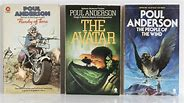
The image on "A View Of Avalon" is of a book called Terra gegen Avalon, which looks as if it might mean "A Planet Called Avalon."
The Hesperian Sea is mentioned. We know from "Wingless" that the colonists of both species settled on the Hesperian Islands before moving to the Coronan continent.
We have just seen Ansa defeated by the Empire which now threatens the Lauran System.
Fortunately, having read an account of Arinnian's aerial view of Gray, we go on to read a later account of Tabitha's ground-based view and, unfortunately, the novel ends soon after that.
The second Avalonian city, Centauri, is described in More On Livewell Street.
Tuesday, 23 January 2024
Arinnian Over Gray And Falkayn Bay

My favourite prose passage in this novel is the conclusion:
"Snowpeaks flamed. The sun stood up in a shout of joy.
"High is heaven and holy." (XIX, p. 662)
These two short paragraphs are comparable to the conclusions of A Knight Of Ghosts And Shadows and "Star of the Sea," which I have also quoted.
My favourite scene in The People Of The Wind is in Chapter I when Arinnian, ascending from Gray on antigrav, enjoys the view. We have described this scene before and need not repeat every detail but they include:
the town of Gray sprawling among green trees and susin and colourful gardens on hills surrounding Falkayn Bay;
the Hesperian Sea, sun-flared silver, horizonward sapphire;
a cargo vessel from Brendan's Islands;
above, patrolling space warcraft (war is imminent);
on the inland horizon, the Andromedas/the Weathermother;
outside Gray, Ythrian ranches, human farms and native ecology.
We can see why the colonists settled the Hesperian Islands before tackling this Coronan continent. Beyond Hesperia and over the horizon is Oronesia. We will learn more about that archipelago and also about Brendan's and other islands later in this novel.
It is human beings that build cities, only two on Avalon: Gray and Centauri. But some Ythrians live in highrises in Gray. Thus have the two species come to intermingle. Christopher Holm/Arinnian has joined Highsky Choth which is based in the Weathermother but has agreed with his parents that he will remain in Gray to complete his mathematical studies. Choths have been accepting human members for the past century. Thus, Avalonian history has progressed a long way from "Rescue on Avalon."
Thursday, 25 January 2024
Two Conversations On Avalon

Twice while confiding with Ferune about his problems with his son, Christopher, Holm looks out the window of Ferune's office. We know from what we have already read that he is seeing, although maybe not noticing, the view of Gray and Falkayn Bay. On that Bay, a cargo vessel had been coming in from Brendan's Islands. Now Holm mentions the Shielding Islands where Christopher had hidden for a year. Where are these islands?
Chapter III describes the single large northern continent, three much smaller southern continents and the Oronesia archipelago and adds:
"All else consists of far smaller islands." (p. 464)
Chapter XI informs us that the Brendan's, Fiery and Shielding Islands are to the south and east of Oronesia. Western Coronan and Northern Oronesian defence cooperation has extended to the whole archipelago and it is hoped that it will next extend further to integrate these islands.
Chapter III: Christopher Holm And Tabitha Falkayn On St. Li
"'Hello, Christopher Holm,' she said in Anglic.
"'I come as Arinnian,' he answered in Planha. 'Luck fare beside you, Hrill.'" (p. 465)
Ythrians do not entreat deities but do wish for luck.
This dialogue should be filmed with Tabitha speaking English and Christopher speaking Planha with subtitles. Or maybe Tabitha should speak Anglic with subtitles?
She says that the Terran Empire has grown since Manuel the First. Thus, Manuel Argos from two instalments previously has become a historical figure like David Falkayn. The latter can also be referred to without being named. Later in Chapter III, Imperial Governor Ekrem Saracoglu summarizes Avalonian history, including the detail that the planet was colonised by:
"'...humans, a mixed lot under the leadership of an old trade pioneer...'" (p. 476)
Tabitha also mentions that the Cynthians voluntarily joined the Empire, thus increasing our already existing knowledge of that inhabited planet. History permeates everything that is said.
Wednesday, 24 January 2024
Holm And Avalon
"Avalon rotates in 11 hours, 22 minutes, 12 seconds, on an axis tilted 21 degrees from the normal to the orbital plane. Gray, at about 43 degrees N., knows short nights always; in summer the darkness seems scarcely a blink." (p. 452)
The first sentence reads like the omniscient narrator imparting physical information directly to the reader. In the second sentence, the phrase, "...the darkness seems...," maybe reflects the collective experience of the Avalonians rather than just another fact about their environment. However, the third sentence, which completes the opening paragraph, reads:
"Daniel Holm wondered if that was a root of his weariness." (p. 452)
Thus, we learn that the entire paragraph, and indeed the entire ensuing chapter, are narrated from the point of view of Daniel Holm who had conversed with his son, Christopher, at the beginning of Chapter I. It is Holm that knows and reflects on Avalon's rotation period. The omniscient narrator, who is always present however marginally, has been pushed further into the background.
Holm goes on to reflect that his ancestors have lived on Avalon for centuries and indeed had:
"...arrived with Falkayn." (ibid.)
David Falkayn, whom we first saw as a Polesotechnic League apprentice, has become a historical figure. That is what happens in future histories. When James Blish's John Amalfi, preserved for centuries by antiagathics, revisits the planet, He, he learns to his embarrassment that the highest mountain on the planet has been named Mount Amalfi.
On Avalon, the city of Gray is on Falkayn Bay:
the Grand Survey ship, Olga, under Captain Gray discovered Avalon;
David Falkayn founded the colony on Avalon;
Falkayn's granddaughter named the planet.
Friday, 20 April 2012
Who Knows of Avalon?

"...intermediate in size between Earth and Ythri, surface gravity 0.8 terrestrial;
"slightly more irradiation, from a somewhat yellower sun, than Earth gets, which simply makes it a little warmer;
"axial tilt, therefore seasonal variations, a bit less than terrestrial;
"length of year about three quarters of ours, length of day a bit under half;
"one small, close in, bright moon;
"biochemistry similar to ours - we could eat most native things, though we'd require imported crops and livestock to supplement the diet.
"All in all, seemingly well-nigh perfect." (1)
"slightly more irradiation, from a somewhat yellower sun, than Earth gets, which simply makes it a little warmer;
"axial tilt, therefore seasonal variations, a bit less than terrestrial;
"length of year about three quarters of ours, length of day a bit under half;
"one small, close in, bright moon;
"biochemistry similar to ours - we could eat most native things, though we'd require imported crops and livestock to supplement the diet.
"All in all, seemingly well-nigh perfect." (1)
South of the largest continent, a great gulf swarms with life. A strong eastward current is deflected north by an archipelago. Monstrous marine creatures graze on floating islands of densely interwoven "atlantis weed" probably also supporting lesser plants and animals. Higher solar energy input and rapid rotation make storms more violent than would be possible on Earth.
On an island in the gulf:
"A mat of mossy, intensely green plants squeezed out any possibility of forest." (2)
Surgeon trees' thin leaf-fringed bows, sharp enough to cut a wing from a swooping Ythrian, whip insanely in the wind which blows gorgeous blossoms torn from vines. Widespread low, russet-leaved, rankly odorous hell shrubs clutch at feet with raking twigs and emit vapours scarcely harming Ythrians but slowly poisoning human beings. Waterfowl fly through a rose, gold and silver-blue sunrise.
In "Wingless"
Ythrians and human beings settle different territories in the Hesperian Islands before jointly colonising the Coronan continent. Nat Falkayn, seventeen Avalonian (twelve Terran) years of age when visiting the Ythrian extended household of Weathermaker Choth:
"...stood on a balcony of that tall stone tower which housed the core families. Below were a paved courtyard and rambling wooden buildings. Meadows where meat animals grazed sloped downhill in Terrestrial grass and clover, Ythrian starbell and rye, Terrestrial oak and pine, Ythrian braidbark and copperwood, until cultivation gave way to the reddish mat of native susin, the scattered intense green of native chasuble bush and delicate blue of janie. The sun Laura stood big and golden-colored at morning, above a distantly glimpsed mercury line of ocean. Elsewhere wandered a few cottony clouds and the pale, sinking ghost of Morgana. A flock of Avalonian draculas passed across view, their leathery wings awkward beside the plumed splendor of Keshchyi's." (3)
Morgana is the moon, brighter and faster than Luna. Keshchyi is a young Ythrian.
Whirlpools around the dark coraloid reefs at a lagoon entrance hold "...thick brown nets of atlantis weed torn loose from a greater mass far out to sea..." (4)
In "Rescue on Avalon"
The highest Avalonian mountains are called the Andromeda Range by human beings and the Weathermother by Ythrians. (Hloch of the Stormgate Choth wrote The Earthbook of Stormgate on the peak of Mount Anrovil in the Weathermother.) Ironleaf trees draw metal from the soil and concentrate pure particles in shining purple leaves which attract pollinating bugs and also absorb radio waves. A hospital window opens on Avalonian king's-crown, Ythrian windnest and Earthly oak.
The Parliament of Man and the Great Khruath of the Ythrians divided continental territory between the species. Human beings need prairies for crops whereas Ythrian hunters occupy the Weathermother.
In The People of the Wind, Chapter One
The city of Gray on Falkayn Bay is surrounded by human-owned grain-fields, Ythrian-owned pastures for maukh and mayaw, forests of oak, pine, windnest or hammerbranch and treeless areas of native susin where some barysauroids survive. Even in Gray, humans, with ample room on Avalon, build low. Highrises are for ornithoids (Ythrians).
"Laura, a G5 star, has only 72 per cent the luminosity of Sol and less ultraviolet light in proportion; but Avalon, orbiting at a mean distance of 0.81 astronomical unit in a period of 0.724 Terran, gets 10 percent more total irradiation than man evolved under." (5)
Christopher Holm, thirty years Avalonian old, has joined Stormgate Choth as Arinninan. The Stormgate compound:
"...stood on a plateau of Mount Fairview. At the middle lifted the old stone tower which housed the senior members of the family and their children. Lower wooden structures, on whose sod roofs bloomed amberdragon and starbells, were for the unwed and retainers and their kin. Further down a slope lay sheds, barns, and mews. The whole could not be seen at once from the ground, because Ythrian trees grew among the buildings: braidbark, copperwood, gaunt lightningrod, jewelleaf which sheened beneath the moon and by day would shimmer iridescent. The flowerbeds held natives, more highly evolved than anything from offplanet - sweet small janie, pungent livewell, graceful trefoil and Buddha's cup, a harp vine which the breeze brought ever so faintly to singing. Otherwise the night was quiet and, at this, altitude, cold." (6)
Avalonian constellations include Wheel, Swords, Zirraukh, Ship and Maukh.
Chapter Two
"Avalon rotates in 11 hours, 22 minutes, 12 seconds, on an axis tilted 21 degrees from the normal to the orbital plane. Thus Gray, at about 43 degrees N., knows short nights always; in summer the darkness seems scarcely a blink." (7)
Human fluid balance and kinesthesia have had to readjust to a gravity field only 80 percent Terran. Ythrians shifting their breeding cycle to Avalonian conditions had low fertility in early generations.
Humans who join choths "go bird." Ythrians who leave choths to become atomic individuals within the global community become "Walkers." Mistwood Choth, like the home world Ythri, has successfully adapted Terran technology.
Chapter Three
Equatorial diameter: 11,308 kilometers. Highest Andromedan peak: 4500 meters. Corona, the north polar continent extending past the Tropic of Swords: eight million square kilometers, comparable to Australia. In the Southern hemisphere, Equatoria, New Africa and New Gaiila are small continents or large islands.
2000 kilometres west of Gray, the Oronesian archipelago crosses the Tropic of Spears, separating the Middle Ocean to the West from the Hesperian Sea in the northern hemisphere and the South Ocean beyond the equator. Oronesia supports a distinct ecology. Eccentrics flee there to settle islands and found choths of only a single household. However, the more numerous Highsky Choth occupies much of the archipelago and controls the fisheries around latitude 30 degrees North. Tabitha Falkayn, Hrill of Highsky, is a third generation human member of her choth and was brought up by Ythrians. Western Corona and northern Oronesia must defend the Hesperian Sea against Terrans.
Upper slopes have susin and a few shrubs. Lower, cultivated ground has red Ythrian clustergrain to feed shuas and Terrestrial fruit trees to feed Highsky humans. A herder and his uhoth control flapping shuas while an Ythrian sailor scouts for piscoids and native pteropleuron lumber around.
Chapter Four is about Terrans preparing to attack Avalon from Esperance.
Chapter Five
The main Ythrian language is Planha, the equivalent of Terran Anglic. Khruaths, gatherings open to all free adults in a given territory, have judicial and limited legislative authority. Wyvans, the presiding officers, explain the law and try suits but cannot compel. If non-compliance is deemed sufficiently serious, then the Wyvans cry Oherran, calling on everyone in the territory to attack the offenders. Rejection of the call would be a deathpride matter, with suicide the Wyvans' only option.
Addendum, Sun 23 Nov 2015: I was too brief about the Khruaths -
an ancient Khruath was a periodic gathering open to all free adults in a territory;
later, regional Khruaths elected delegates to Year-Khruaths covering larger territories;
Year-Khruaths send delegates to the High Khruath of the planet, meeting every six years or on extraordinary occasions;
Wyvans are chosen at each level;
however, any free adult can attend a Khruath at any level.
Chapter Six
Addendum, Sun 23 Nov 2015: I was too brief about the Khruaths -
an ancient Khruath was a periodic gathering open to all free adults in a territory;
later, regional Khruaths elected delegates to Year-Khruaths covering larger territories;
Year-Khruaths send delegates to the High Khruath of the planet, meeting every six years or on extraordinary occasions;
Wyvans are chosen at each level;
however, any free adult can attend a Khruath at any level.
Chapter Six
The only other Avalonian city is Centauri at the mouth of the Sagittarius in the Gulf of Centaurs. In the Phoenix House, Tabitha/Hrill orders a catflower cocktail. She and Chris/Arinnian eat piscoid-and-tomato chowder, beef-and-shua pie, salad of clustergrain leaf and pears and drink coffee spiced with witchroot and a bottle of vintage dago. The Nest, a tavern for ornithoids, is the tallest building in Centauri with a gravshaft to its rooftop for humans who have not brought flying gear. It is unwalled, protected from rain by a vitryl canopy. Insectoids circle fluoroglobes and a service robot serves New African beer.
Most of Highsky keeps to the Old Faith, using drugs in sacred revels. Other planets in the Lauran System are Elysium, Camelot, Phaeacia and Utgard.
Chapters Seven and Eight describe a battle in space.
Chapter Nine
Morgana is smaller than Luna but, being close, raises twice the tides. The Avalonian vertebrate design is hexapodal. Winged creatures have four legs. The dense mat of low-growing vegetation prevents native forests and helps to explain why animals remain reptiloid, unable to compete with mammals or birds. Trees are low and thick or slim and supple to survive high winds caused by rapid rotation. Imported domestic animals had to be revamped genetically because local food lacks some vitamins.
In Chapter Ten, the Terran Admiral parleys with Avalonian leaders and a fallen Avalonian, the First Marchwarden, is laid to rest.
Chapter Eleven
High Wyvan Liaw of the Tarns addresses the Great Khruath of Avalon from outside David Falkayn's house on First Island in the Hesperian Sea. On a North Coronan prairie, a flapping youth leads a herd of quadrupedal burden-bearing zirraukhs. South-East from Oronesia are the Brendan's, Fiery and Shielding Islands. Atlantis weed patches are entire ecologies grazed by peaceful but huge kraken. David Falkayn's granddaughter named Avalon. Equatorian centaurs use tools of stone and bone.
Chapters Twelve and Thirteen are mainly about the consequences of the war in space.
Chapter Thirteen
In winter, snow falls in North Corona and in the mountains but not in Gray where "...the susin stayed green on its hills the year around." (8)
Chapter Fourteen
Zirraukhs are warm-blooded quadrupeds smaller than horses and unlike them but used for the same purpose.
Chapter Fifteen
An Ythrian swoops on a pteropleuron that had been hunting piscoids near the surface of the sea.
Chapter Sixteen
Grief causes premature ovulation in a bereaved Ythrian female. A male seeks her out. This is not against choth law and the female's human chothmate, Arinnian, has no cause to challenge so he insults the Ythrian male until the latter challenges him.
Chapter Seventeen
On the Scorpelunan plateau in Equatoria, hexapods graze under their parasol membranes. Packs of dog-sized hexapodal lycosauroids and throngs of twenty centimeter long cockroach-like kakkelaks attack Terran invaders who are being slowly poisoned by hell shrubs. Furious tropical storms caused by high irradiation and fast spin delay evacuation.
Chapter Eighteen
Chapter Nineteen
Trefoil and sword-of-sorrow grow in the grass. Harp vines ring. Jewelleafs twinkle. Morgana is less bright because scarred by Terran bombardment.
Why Am I Doing This?
I have summarized an alternative reading. We read an Anderson novel to follow the story. We appreciate that there are rich background details but do not usually pause to savor the details. I have noted as many details as I can of the planet Avalon.
(1) Poul Anderson, "The Problem of Pain" IN Anderson, The Earth Book of Stormgate, New York, 1978, pp. 26-48, AT p. 33.
(2) ibid., p. 40.
(3) Poul Anderson, "Wingless" IN The Earth Book of Stormgate, pp. 411-420, AT pp. 413-414.
(4) ibid., p. 417.
(5) Poul Anderson, The People of the Wind, London, 1977, p. 7.
(6) ibid., p. 10.
(7) ibid., p. 18.
(8) ibid., p. 127.
(2) ibid., p. 40.
(3) Poul Anderson, "Wingless" IN The Earth Book of Stormgate, pp. 411-420, AT pp. 413-414.
(4) ibid., p. 417.
(5) Poul Anderson, The People of the Wind, London, 1977, p. 7.
(6) ibid., p. 10.
(7) ibid., p. 18.
(8) ibid., p. 127.
Tuesday, 15 November 2016
In Gray

When the Founder's descendant, Tabitha Falkayn, visits Philippe Rochefort in hospital, the color of her hair and skin tell Rochefort that she has been under "...a stronger sun than shone over Gray." (Rise Of The Terran Empire, p. 644)
Why is the comparison made with Gray? Because the hospital "...building had been hastily erected on the outskirts of Gray." (p. 646)
When Tabitha leaves the building, a double space between paragraphs marks the change of point of view from Rochefort to Tabitha. As ever, Poul Anderson makes the Avalonian setting seem real with many concrete details and with appeals to at least three of the senses:
"Where she stood, a hillside sloped downward, decked with smaragdine susin, starred with chasuble bush and Buddha's cup, to the strewn and begardened city, the huge curve of uprising shoreline, the glitter on Falkayn Bay. Small cottony clouds sauntered before the wind, which murmured and smelled of livewell.
"She inhaled that coolness. After Equatoria, it was intoxicating." (p. 647)
So she has been on Equatoria, where the Terrans were defeated. What better name for an equatorial continent? And imagine looking at scenery where a major feature bears your own surname. The mention of the wind is appropriate because Tabitha, as a member of a choth, is one of this novel's title characters, the "People of the Wind." In fact, she stops to don her gravbelt as she leaves the hospital. We have learned many details of Avalonian life and want to know more but unfortunately this novel is about to end.
Monday, 27 March 2023
On Avalon

When Arinnian has reached his destination, Lythran'a aerie on Mount Fairview in the Andromedas/the Weathermother, the description becomes more detailed:
Ythrian trees
broadbark
copperwood
lightningrod
jewelleaf
native flowers
janie
livewell
trefoil
Buddha's cup
harp vine singing in the breeze
Constellations, Wheel, Sword, Zirraukh and Ship, are visible and Arinnian reflects on other regions of Avalon:
Plains of Long Reach
arctic marshes
scorching New Gaiilan savannah
the many islands that are most of the land
A well conceived almost real place.
Wednesday, 23 April 2025
Closing Scenes

We have appreciated this scene before. Emerging from the improvised hospital outside Gray, Tabitha Falkayn stands, in a murmuring, livewell-scented wind, atop a hill of emerald susin and Avalonian flowers above the gardened city and glittering Bay. We have seen Falkayn Bay, named after Tabitha's ancestor, the Founder of Avalon, often enough that it has become a familiar background setting and we particularly appreciate these concluding scenes set on both Avalon and Esperance.
Arinnian's closing speech to Tabitha celebrates Poul Anderson's twin values of freedom and diversity.
"Snowpeaks flamed. The sun stood up in a shout of light.
"High is heaven and holy." (XIX, p. 662)
Eyath flies home to Stormgate which is where we find Hloch perched on the peak of Mount Anrovil in the Weathermother when he introduces the following volume of Anderson's Technic History, The Earth Book Of Stormgate.
Fair winds forever.
Sunday, 20 April 2025
Familiarity

David Falkayn's mother, Athena, and brother, John, each appear only once, in different scenes, in Mirkheim. But we know the Falkayn family.
(Tolkien has Mirkwood. Anderson has Mirkheim and Mistwood.)
The city of Gray on Avalon seems very real and familiar when Daniel Holm glances out his window:
a clear winter's day although, at this latitude and altitude, there is no snow so that the hills remain green with susin;
whooping wind, cold but exultant;
dancing whitecaps on Falkayn Bay;
cloak-clad men and women;
swooping Ythrians.
We are there.
Saturday, 28 March 2026
Port Kestrel

Similarly, in Anderson's The Fleet Of Stars, we read about the small town of Port Kestrel at the mouth of the Lily River on an island shore of the Azurian Ocean on the colonized planet, Amaterasu. Port Kestrel has boats, bridges, bright buildings, trees and a communications mast. Amaterasu is being terraformed and grass grows on several islets. Above and around the port are plantations, industries and parks with dandelions and harebells. Dark native thalassophyte still grows in patches while imported seagulls fly above it. Elsewhere on Amaterasu, terraforming continues among glaciers and deserts.
Although The Fleet Of Stars is Volume IV of a later and very different future history series, its sceneries are described in comparably minute detail.
Monday, 23 November 2015
Livewell On The Wind

-Poul Anderson, Rise Of The Terran Empire (New York, 2011), p. 647.
Three senses: colorful flowers and glittering bay; murmuring wind smelling of livewell.
These might be the only sauntering clouds anywhere in literature?
The extraterrestrial plants named in this passage are:
susin;
chasuble bush (see "In 'Wingless'" here);
Buddha's cup (see "In The People Of The Wind, Chapter One" here);
livewell.
In particular, Avalonian livewell weaves in and out of the narrative and I have tried to chart the references to this flower in earlier posts. "Buddha's cup" is obviously an evocative and colorful name bestowed on another native flower by human colonists of Avalon.
Tuesday, 4 June 2019
Five Senses Above Falkayn Bay

Arinnian hovers above Gray and the Bay:
the Hesperian Sea is silvered by sunlight, purpled on the horizons, otherwise sapphire;
the low sun, Laura, is aureate;
the sky is darkening blue;
Ythrian-influenced as ever, he thinks of cirrus clouds as breastfeathers;
he hears, feels and smells the salt breeze.
A cargo ship comes from Brendan's Islands and another stands out to the Hesperian Sea. The rest of the scene is summarized here.
It is to be hoped that there are planets like this out there. So many exoplanets have been detected that the probability must have increased significantly.
Saturday, 8 June 2019
Another View Of Falkayn Bay

Daniel Holm, Second Marchwarden, looks out:
beautiful day;
autumn breeze;
salt odors;
glittering bay;
Laura (the sun) and heaven;
brilliant gardens;
garden scents;
blue haze;
distant hills;
wings overhead;
lost on Holm -
- who must stay as backup while First Marchwarden Ferune leads the space defense against the Terran attack.
Ferune will die and Holm will become First Marchwarden.
Friday, 19 February 2021
Some Sights In Technic Civilization

the view from the Zamok, here
the Obala
Mount Anrovil in the Weathermother, here
the city of Centauri
the High Sierra
the Flone Valley
I was struck by Kossara's reference to the blue of a summer sky over the Kazan but, of course, I have posted about that before as also about various other scenes in Poul Anderson's Technic History.
Monday, 23 November 2015
Reflections On Avalon

-Poul Anderson, Rise Of The Terran Empire (New York, 2011), p. 630.
Hold that thought. It is a plausible hypothesis that "...no spaceship was really good in atmosphere...," but Anderson seems to write with the confidence of experience - and makes us feel that we also know it from experience. A small torpedo boat with a live crew of three has just the right combination of maneuverability and firepower for atmospheric combat. Of course it does. Larger craft, like "...the lumbering guns...," are obviously unsuitable. We knew that before we read this passage, didn't we?
"...the glitter on Falkayn Bay." (p. 647)
Remember that young Polesotechnic League apprentice from Hermes that we met on Ivanhoe? Centuries later, there is a Bay named after him on the planet that calls him Founder. Details like that firmly establish that we are reading a History. Still later, there is an Adzel Square on Aeneas.
Tuesday, 8 April 2025
The Two Avalonian Cities

The two Avalonian cities, Gray on Falkayn Bay and Centauri on the Gulf of Centaurs, are very different from each other and are described in detail. Arinnian flies above then inland from Gray and spends time with Tabitha in Centauri where it is usually safer for him to be Christopher. We find that we have previously posted about both cities:
In The Phoenix House And The Nest
Gray and Centauri are more concretely realized than Stellamont on Nerthus in Poul Anderson's earlier Psychotechnic History. It is good to be able to compare them.
Subscribe to:
Posts (Atom)