Showing posts sorted by relevance for query Roger Elwood. Sort by date Show all posts

Tuesday, 4 September 2018

Poul Anderson's Juveniles

"How To Be Ethnic In One Easy Lesson" (as "How To Be Ethnic"), Future Quest, ed. Roger Elwood, Avon Books, 1974. Copyright Roger Elwood.

"The Season of Forgiveness," Boy's Life, December 1973. Copyright The Boy Scouts of America.

"Wingless" (as "Wingless on Avalon"), Boy's Life, July 1973.

"Rescue on Avalon," Children Of Infinity, ed. Roger Elwood, 1973.

"The Little Monster," Way Out, ed. Roger Elwood, 1974. Copyright Roger Elwood.

"Escape the Morning," Boy's Life, November 1966. Copyright The Boy Scouts of America.

"The Year of the Ransom." Copyright Byron Preiss Publications and Poul Anderson, 1988.

Vault Of The Ages, New York, 1952. Copyright Poul Anderson.

Friday, 22 January 2021

"As Far As We Know..."

Poul Anderson, "Wingless" IN Anderson, The Earth Book Of Stormgate (New York, 1979), pp. 409-420.

The text of this story begins:

"As far as we know..." (p. 411)

Thus, the narrative viewpoint is that of an author addressing her contemporaries in Technic civilization. Hloch's introduction to the story (pp. 409-410) identifies the author as a daughter of Emil Dalmady ("Esau").  Writing in "...her high old age...," (p. 411) Judith Dalmady/Lundgren recounts an experience of David and Coya Falkayn's young grandson, Nat. Never has a future history series been so strongly bound together across its fictional timeline.

Astounding Science Fiction was renamed Analog Science Fiction/Science Fact. In both versions, it is abbreviates as ASF. Thus, of the twelve works collected in the Earth Book:

six were originally published in ASF;
one in an Astounding Memorial Anthology;
one in The Magazine of Fantasy and Science Fiction -
 
- and four are juvenile short stories originally published elsewhere:

"How To Be Ethnic In One Easy Lesson" in Future Quest, ed. Roger Elwood;
"Wingless" in Children of Infinity, ed. Roger Elwood;
"The Season of Forgiveness" and "Rescue on Avalon" in Boys' Life.

We are grateful to Roger Elwood and to Boys' Life for giving Poul Anderson these opportunities to extend his Technic History in unexpected directions:

"How To Be Ethnic..." features Adzel, David Falkayn's future team member;
"Wingless" features Falkayn's grandson;
"The Season of Forgiveness" is set on a planet previously visited by Falkayn;
"Rescue on Avalon" cameos an ancestor of Daniel and Christopher Holm.

Monday, 17 November 2014

Numbers

The 24 works collected in Baen Books' The Technic Civilization Saga, Volumes I-III, comprise:

12 from The Earth Book Of Stormgate;
3 each from Trader To The Stars and The Trouble Twisters;
3 other novels;
3 other short stories -

- extremely comprehensive and also systematic, although the systematic numerical sequence, 12 + (4x3) = 24, is entirely fortuitous. Volumes I-III are just under half of the seven volumes of the series but collect more than half of the 43 installments of the Technic History because there are more full length novels in Volumes IV-VII.

I suggest that Volumes I-III are an Extended Earth Book Of Stormgate because, although the Earth Book ends at the mid-point of Vol III, the concluding work in Vol III, The People Of The Wind, provides the background for the Earth Book.

Most installments of the Technic History were originally published in science fiction magazines, 16 in Analog Science Fiction. Publication in anthologies or in a different kind of magazine generated other kinds of stories, presenting alternative perspectives on the History:

"How To Be Ethnic In One Easy Lesson" (Future Quest, ed. Roger Elwood, Avon, 1974);
"The Season of Forgiveness" (Boy's Life, December, 1973);
"Wingless" (Boy's Life, July, 1973);
"Rescue on Avalon" (Children Of Infinity, ed. Roger Elwood, Franklin Watts, 1973).

Thank you, Roger Elwood and Boy's Life. David Falkayn led a trader team consisting of himself, Adzel and Chee Lan and later led the colonization of Avalon. However, these four stories do not present any further adventures of Fakayn or his team. Instead, we get:

Adzel's student days;
a later incident on a planet where Falkayn had been as an apprentice;
Falkayn's grandson on Avalon;
a later incident on Avalon.

The first trader team story had mentioned some of Adzel's activities as a student on Earth. "How To Be Ethnic..." describes these activities but introduces a one-off character, James Ching, to narrate them. Although Ching, who also goes into space, is a potential series character, we do not see him again, although Hloch's introduction in the Earth Book does summarize his later career. The History becomes richer at each stage of its development.

Monday, 17 October 2016

Technic History Stories Not Published In SF Magazines

"How To Be Ethnic In One Easy Lesson" was published in an original anthology called Future Quest, edited by Roger Elwood.

"The Season of Forgiveness" and "Wingless" were published in Boy's Life.

"Rescue on Avalon" was published in an original anthology called Children Of Infinity, edited by Roger Elwood.

"Lodestar" was published in an original anthology called Astounding: The John W. Campbell Memorial Anthology, edited by Harry Harrison.

Everything else was in an sf mag: Analog, Fantasy and Science Fiction, Planet Stories, Amazing, Galaxy, Future Combined With Science Fiction Stories, Venture or Fantastic. The Campbell Memorial anthology was like a continuation of Analog.

Thanks to Elwood and Boy's Life, there are four more short stories that do fit into the Technic History but do not belong to any of its sub-series: van Rijn, trader team or Flandry. The History is enriched by these additional stories.

Thursday, 3 March 2022

Roger Elwood

We owe Roger Elwood some good Poul Anderson stories that were first published in original anthologies edited by Elwood. 

The Technic History
"How To Be Ethnic In One Easy Lesson," Future Quest (1974)
"Rescue in Avalon," Children of Infinity (1973)

The Maurai History
"Windmill," Saving Worlds (1973)

The Rustum History
"My Own, My Native Land," Continuum I (1974)
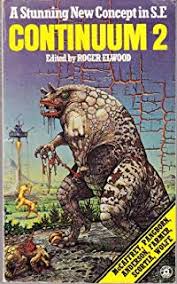
"Passing the Love of Women," Continuum II (1974)
"A Fair Exchange," Continuum III (1974)
"To Promote the General Welfare," Continuum IV (1975)

Friday, 31 May 2019

Sources

In In The Hesperian Islands, I referred to the original publications of the two juvenile Avalon stories, "Wingless" and "Rescue on Avalon." Then I corrected what I had written. Then I noticed a discrepancy.

I refer to:

Poul Anderson, The Earth Book Of Stormgate (Berkley Books, New York, 1979);

Poul Anderson, Rise Of The Terran Empire (Riverdale, NY, 2011).

In the Earth Book, p. v is "ACKNOWLEDGMENTS"; pp. ix-xii are "A CHRONOLOGY OF TECHNIC CIVILIZATION."

According to the Acknowledgments:

"Wingless" (as "Wingless on Avalon"), Children of Infinity, Roger Elwood, ed., Franklin Watts, 1973. Copyright 1973 by Franklin Watts, Inc.

"Rescue on Avalon," Boy's Life, July 1973. Copyright 1973 by The Boy Scouts of America.

According to the Chronology:

"Wingless on Avalon," Boy's Life, July, 1973.

"Rescue on Avalon," in Children of Infinity, ed. Roger Elwood, Franklin Watts, 1973.

Rise Of The Terran Empire:

includes both these stories;

presents "Acknowledgements" on p. V and "CHRONOLOGY OF TECHNIC CIVILIZATION COMPILED BY SANDRA MIESEL" on pp. 663-672;

reproduces the discrepancy.

Saturday, 29 August 2026

Three Achievements And One Disappointment

When an editor asks an author to contribute to an anthology of original stories, he does not know what he is going to get. Does he?

Poul Anderson's Technic History
"How To Be Ethnic In One Easy Lesson" IN Future Quest, ed. Roger Elwood, 1974.

"Lodestar" IN Astounding: The John W. Campbell Memorial Anthology, ed. Harry Harrison, 1973.

"Rescue on Avalon" IN Children of Infinity, ed. Roger Elwood, 1973.

Clifford Simak's City future history
"Epilog" IN Astounding... (see above)

(We are talking about only two editors and two authors here.)

We already know what outstanding additions to his Technic History those three stories by Anderson are.

"Epilog" (this should be my last reference to City): the Ants, who have covered most of the Earth with a single Building, and the robots who had helped them have died. The deathless robot Jenkins learns this when the Building begins to crumble and he is able to enter it for the first time. All that it contains is a lot of now dead ant hills. Coincidentally, when the Building begins to crumble, some wild robots who had left Earth in interstellar spaceships visit and take Jenkins away with them. End. Point?

Addendum: There is a serious omission in this post which will be addressed. The title should have been "Four Achievements..."

Later: Now see here. 

Friday, 4 March 2022

The Rustum History

While rereading Poul Anderson's Maurai series, we noticed that the third story, "Windmill," was originally published in an anthology edited by Roger Elwood. Remembering that two Technic History stories were also originally published in different anthologies edited by Elwood, we checked and found that four Rustum stories were originally published in the anthologies, Continuum I-IV, edited by Elwood.

The Rustum History comprises:

four stories collected as Orbit Unlimited and culminating in the colonization of the extra-solar planet, Rustum;

the four stories originally published in Continuum I-IV and later collected in New America;

"The Queen of Air and Darkness," set on another planet, Roland, in the same timeline and also collected in New America;

thus, nine stories that could be collected in a single volume as The Rustum History.

Thursday, 10 September 2026

Elwood's Continuum

Yes. I checked. See Sequel. Continuum, 1-4, edited by Roger Elwood, was a series of anthologies of new additions to already existing series written by their respective authors. See here. Poul Anderson's four additions to his already existing Rustum History were later collected in New America and the new instalments by the other authors were likewise collected so that the original Continuums have become redundant.

This explains some odd features of the Anderson stories. Written to order, they are uncharacteristically didactic. In these four successive instalments, Danny/Dan/Daniel Coffin systematically ages, solves problems of qualitatively different kinds - technical, scientific, personal, economic and political - and steadily grows in social stature, out of the shadow of his imposing father into the most important single individual in the Rustumite lowlands.

Elwood has been accused of editing mediocre anthologies but we are glad that he facilitated the writing of two excellent short stories that fitted into the chronology of Anderson's Technic History.

Thursday, 26 April 2012

Sandra Miesel's Technic Civilization Chronology by Sean M Brooks

Several editions of the Technic Civilization stories of Poul Anderson (Gregg Press, Ace Books, Baen Books) have attached to them a chronology compiled by Sandra Miesel, an excellent commentator on the works of Anderson. This chronology lists in internal chronological order all the stories and novels of the Technic Civilization series through periods like that of the Polesotechnic League and the Terran Empire. Miesel also added many annalistic notes to her chronology.

For those who wish to read the Technic Civilization stories in chronological order, or merely to have a list of the stories in a correct temporal sequence, Sandra Miesel has done readers of Anderson's works a real favor. However, commentators like Dr. Paul Shackley have discovered inconsistencies in some of Miesel's proposed dates which contradicts what the texts says.

For example, Miesel dates the birth of Nicholas van Rijn to AD 2376 and the crucial Polesotechnic League's Council of Hiawatha to 2400. However, as discussed by Dr. Shackley in his note "Inconsistencies II," Nicholas van Rijn was born too late to have attended that council. The section of Chapter IX of MIRKHEIM which discussed the Council of Hiawatha ended with "But when a century had passed--". Nicholas van Rijn could not have attended that council because he was 80 years old at the time of the Mirkheim/Baburite crisis. He would need to have been, implausibly, well over a century in age.

I have no objection to keeping Miesel's dating of the Council of Hiawatha to 2400, but I believe dating van Rijn's birth to 2424 is more accurate. And since the Mirkheim/Baburite war came when van Rijn was 80 years old, that means it should be dated 2504 (not in 2456, Miesel's date). This has the advantage of not contradicting what Chapter IX of MIRKHEIM said about "But when a century had passed."

Another error in Miesel's chronology contradicting what the texts say are her dates for "Lodestar" and MIRKHEIM. She dates the events in "Lodestar" and MIRKHEIM to 2446 and 2456. However, the Prologue to MIRKHEIM emphatically dates the events in that book to EIGHTEEN, not 10, years after "Lodestar." My revision of her chronology dates those stories to 2486 and 2504.

The next major inconsistency in Miesel's chronology contradicting what the texts say came from her dating the foundation of the Terran Empire to the 28th century and the birth of Dominic Flandry to AD 3000. These dates clash with what Chapter 10 of ENSIGN FLANDRY says, as the Merseian prime minister Brechdan Ironrede was going to the Imperial embassy for an official reception: "His destination was another offense, a compound of residences and offices in the garish bubble style of the Imperium four hundred years ago." This indicates the Empire had existed for over four centuries by the time of ENSIGN FLANDRY (because it is reasonable to think schools of architecture needed some time after the Empire arose to become popular).

However, one problem with this dating is that we don't know how long the year of the planet Merseia was when compared to our Earth's year. We don't know whether it was longer or shorter than the Terran year. Nonetheless it does indicates the Empire was older than the three centuries or so her chronology gives it by the time of ENSIGN FLANDRY.

Moreover, Miesel herself contradicts her chronology when she wrote in her "Introduction" for THE PEOPLE OF THE WIND (Gregg Press: 1977): "The Empire is its third century when it moves against the Domain in its first aggressive campaign against a civilized foe." Another chronological indication can be found in Chapter 8 of Anderson's THE DAY OF THEIR RETURN, as Ivar Frederiksen briefly summarized the history of relations between the Empire and the Domain of Ythri: "Still, it [the Domain] grew. So did Empire, Terra's, that is, till they met and clashed. Couple centuries ago, they fought." Now, if the Empire had existed a little over two centuries by the time of the Ythrian War and then that conflict was at least two centuries in the past by the time of THE DAY OF THEIR RETURN, that can only mean it had lasted more than four centuries by then.

Therefore, I would argue for dating the birth of Dominic Flandry to AD 3100, not 3000 (the year Miesel chose). The later date better fits the chronological evidence I collected from the texts. I am still puzzled how Miesel could have missed, for example, such crucial indications as the Prologue of MIRKHEIM saying the Baburite war occurred 18 years after "Lodestar."

In addition, I suggested below that Josip died in 3142 rather than in 3141 (Miesel's date was 3041) because a slightly longer reign for that Emperor fitted better the background of the stories. That is, it gives more time for the events recorded in those stories to take place without being crowded together too tightly.

If the argument I gave above is correct, then that means many, not all, of the dates given by Miesel in her chronology needs to be changed. Mostly by proposing dates later than the ones she chose. In the chronology given by me below, the dates I advocate are given first while Miesel's dates are given in square brackets. For the most part I used the "Chronology of Technic Civilization" to be found in the Gregg Press edition of ENSIGN FLANDRY. I also thought it best, for simplicity's sake, to omit many of the annalistic notes added by Sandra Miesel. I omitted many bibliographical details for similar reasons.

The Breakup and the Polesotechnic League

2055 "The Saturn Game," ANALOG SCIENCE FICTION (cited as ASF), February, 1981

2150 "Wings of Victory," ASF, April, 1972

24th century "The Problem of Pain," FANTASY AND SCIENCE FICTION, February, 1973

2400 The Council of Hiawatha

2424 [2376] Birth of Nicholas van Rijn

2454 [2406] Birth of David Falkayn

2464 [2416] "Margin of Profit," ASF, September, 1956

2470 [2416] "How to be Ethnic in One Easy Lesson," FUTURE QUEST, ed. Roger Elwood, Avon Books, 1974

2470 [2416] "The Three Cornered Wheel," ASF, October, 1963

2474 [2426] WAR OF THE WING MEN, Ace Books, 1958

2474 [2426] "Esau," ASF, February, 1970

2475 [2427] "Hiding Place," ASF, March, 1961

2475 [2427] "Territory," ASF, June, 1963

2480 [2426] "A Sun Invisible," ASF, April, 1966

2481 [2427] "The Trouble Twisters," as "Trader Team," ASF, July-August, 1965

2481 [2433] "Day of Burning," as "Supernova," ASF, January, 1967

3481 [2433] "The Master Key," ASF, July, 1964

2485 [2437] SATAN'S WORLD, Doubleday, 1969

2485 [2437] "A Little Knowledge," ASF, August 1971

2485 [2437] "The Season of Forgiveness," BOY'S LIFE, December, 1973

2486 [2446] "Lodestar," ASTOUNDING: THE JOHN W. CAMBPBELL MEMORIAL ANTHOLOGY, ed. by Harry Harrison, Random House, 1973

2504 [2456] MIRKHEIM, G.P. Putnam's Sons, 1977

Early 26th century [late 25th century], settlement of Avalon

26th century, "Wingless on Avalon," BOY'S LIFE, July, 1973

26th century, "Rescue on Avalon," in CHILDREN OF INFINITY, ed. Roger Elwood, Franklin Watts, 1973

26th century, dissolution of the Polesotechnic League

The Time of Troubles and the Terran Empire

2600-2700 [27th century] The Time of Troubles

Late 27th century, "The Star Plunderer," PLANET STORIES (cited as PS), September, 1952

2700 Manuel Argos founds the Terran Empire, Principate phase begins

28th century, "Sargasso of Lost Starships," PS, January, 1952

29th century, THE PEOPLE OF THE WIND, New American Library, 1973

29th century [30th C], Covenant of Alfzar

3100 [3000] Birth of Dominic Flandry

3119 [3019] ENSIGN FLANDRY, Chilton, 1966

3121 [3021] A CIRCUS OF HELLS, New American Library, 1971

3122 [3022] Josip succeeds Georgios as Emperor

3125 [3025] THE REBEL WORLDS, New American Library,1969

3127 [3027] "Outpost of Empire," GALAXY, December, 1967

3128 [3028] THE DAY OF THEIR RETURN, Doubleday, 1973

3132 [3032] "Tiger by the Tail," PS, January, 1951

3133 [3033] "Honorable Enemies," FUTURE COMBINED WITH SCIENCE FICTION STORIES, May, 1951

3135 [3035] "The Game of Glory," VENTURE, March, 1958

3137 [3037] "A Message in Secret," as MAYDAY ORBIT, Ace Books, 1961

3138 [3038] "A Plague of Masters," as EARTHMAN, GO HOME, Ace Books, 1961

3140 [3040] WE CLAIM THESE STARS! (also HUNTERS OF THE SKY CAVE), Ace Books, 1959

3042 [3041] Hans Molitor succeeds Josip as Emperor after brief civil war, supplants short lived Imperial relative as Emperor.

3143 [3042] "Warriors from Nowhere," as "Ambassadors of Flesh," PS, Summer, 1954

3148 [3047] A KNIGHT OF GHOSTS AND SHADOWS, New American Library, 1975

3155 Dietrich succeeds Hans as Emperor

3157 Gerhart succeeds Dietrich as Emperor

3162 [3061] A STONE IN HEAVEN, Ace Books, 1979

3167 [3064] THE GAME OF EMPIRE, Baen Books, 1985

Early fourth millennium, the Empire enters its Dominate phase

Circa AD 3500, Fall of the Terran Empire, the Long Night begins. War, piracy, anarchy, economic collapse, and isolation devastate countless worlds.

The Long Night

3600 "A Tragedy of Errors," GALAXY, February, 1968

3900 THE NIGHT FACE, Ace Books, 1978

4000 "The Sharing of Flesh," GALAXY, December, 1968

7100 "Starfog," ASF, August, 1967

Monday, 2 February 2026

Publication Histories

Short stories published, and novels serialized, in sf mags can be or become instalments of future history series. John W. Campbell's Astounding/Analog was the starting point for Robert Heinlein's Future History and Poul Anderson's Polesotechnic League series among others. 

Future histories can also incorporate instalments with surprisingly dissimilar publication histories.

Heinlein's Future History
four stories from the Saturday Evening Post
+ one each from:
Argosy
Town and Country
Boy's Life
the American Legion Magazine
Scientific American

(10 out of 24 or so instalments.)

Anderson's Technic History (incorporating the Polesotechnic League)
two from original juvenile sf anthologies edited by Roger Elwood

two from Boy's Life

one from Astounding: The John W. Campbell Memorial Anthology, edited by Harry Harrison

one written for Four For The Future, a themed anthology edited by Harrison, although first published in Galaxy

(6 out of 43 instalments.)

Thus, Elwood, Boy's Life and Harrison between them give us six Technic History instalments. 

Wednesday, 23 April 2014

"Sandra Miesel's Technic Civilization Chronology," by Sean M. Brooks

Prefatory Note.  Dr. Shackley kindly published on his blog (April 26, 2012) an earlier version of this essay written by me.  Since then, I decided it needed to be revised, mostly from dating the birth of Nicholas van Rijn to 2421 instead of my earlier suggestion he was born in 2424.  And that made it necessary to revise my suggested dates for the birth of David Falkayn and many of the stories set during the Polesotechnic League. I also found it necessary to change some of the dates for the stories set in the Imperial era.

Several editions of the Technic Civilization stories of Poul Anderson (Gregg Press, Ace Books, Baen Books) have attached to them a chronology compiled by Sandra Miesel, an excellent commentator on the works of Anderson.  This chronology lists in internal chronological order all the stories and novels of the Technic Civilization series through periods like that of the Polesotechnic League and the Terran Empire.  Miesel also added many annalistic notes to her chronology.

For those who wish to read the Technic Civilization stories in chronological order, or merely to have a list of the stories in a correct temporal sequence, Sandra Miesel has done readers of Anderson's works a real favor.  However, commentators like Dr. Paul Shackley have discovered inconsistencies in some of Miesel's proposed dates which contradicts what the texts says.

For example, Miesel dates the birth of Nicholas van Rijn to AD 2376 and the crucial Polesotechnic League's Council of Hiawatha to 2400.  However, as discussed by Dr. Shackley in his note "Inconsistencies II," Nicholas van Rijn was born too late to have attended that council.  The section of Chapter IX of MIRKHEIM which discussed the Council of Hiawatha ended with "But when a century had passed--".  Nicholas van Rijn could not have attended that council because he was 80 years old at the time of the Mirkheim/Baburite crisis.  He would need to have been, implausibly, well over a century in age.

I have no objection to keeping Miesel's dating of the Council of Hiawatha to 2400, but I believe dating van Rijn's birth to 2421 is more accurate.  And since the Mirkheim/Baburite war came when van Rijn was 80 years old, that means it should be dated 2501 (not in 2456, Miesel's date).  This has the advantage of not contradicting what Chapter IX of MIRKHEIM said about "But when a century had passed."

Another error in Miesel's chronology contradicting what the texts say are her dates for "Lodestar" and MIRKHEIM.  She dates the events in "Lodestar" and MIRKHEIM to 2446 and 2456.  However, the Prologue to MIRKHIEIM clearly dates the events in that book to EIGHTEEN, not 10, years after "Lodestar."  My revision of her chronology dates those stories to 2483 and 2501.

The next major inconsistency in Miesel's chronology contradicting what the texts say came from her dating the foundation of the Terran Empire to the 28th century and the birth of Dominic Flandry to AD 3000.  These dates clash with what Chapter 10 of ENSIGN FLANDRY says, as the Merseian prime minister Brechdan Ironrede was going to the Imperial embassy for an official reception: "His destination was another offense, a compound of residences and offices in the garish bubble style of the Imperium four hundred years ago."  This indicates the Empire had existed for over four centuries by the time of ENSIGN FLANDRY (because it is reasonable to think schools of architecture needed some time after the Empire arose to become popular).

However, one problem with this dating is that we don't know how long the year of the planet Merseia was when compared to our Earth's year.  We don't know whether it was longer or shorter than the Terran year. Nonetheless it does indicate the Empire was older than the three centuries or so her chronology gives it by the time of ENSIGN FLANDRY.

Moreover, Miesel herself contradicts her chronology when she wrote in her "Introduction" for THE PEOPLE OF THE WIND (Gregg Press: 1977): "The Empire is its third century when it moves against the Domain in its first aggressive campaign against a civilized foe."  Another chronological indication can be found in Chapter 8 of Anderson's THE DAY OF THEIR RETURN, as Ivar Frederiksen briefly summarized the history of relations between the Empire and the Domain of Ythri: "Still, it [the Domain] grew.  So did Empire, Terra's, that is, till they met and clashed.  Couple centuries ago, they fought."  Now, if the Empire had existed a little over two centuries by the time of the Ythrian War and then that conflict was at least two centuries in the past by the time of THE DAY OF THEIR RETURN, that can only mean it had lasted more than four centuries by then.

Therefore, I would argue for dating the birth of Dominic Flandry to AD 3100, not 3000 (the year Miesel chose).  The later date better fits the chronological evidence I collected from the texts.  I am still puzzled how Miesel could have missed, for example, such crucial indications as the Prologue of MIRKHEIM saying the Baburite war occurred 18 years after "Lodestar."

Because of Dr. Paul Shackley's zeal and devotion to accuracy, I became aware of mistakes I made in my proposed ordering of the Dominic Flandry stories beginning with "Tiger By The Tail" and ending with WE CLAIM THESE STARS.  While working on a revision of Sandra Miesel's Chronology of Technic Civilization, I erred in too quickly accepting Miesel's listing of these stories when I should have paid attention to certain texts in THE PLAGUE OF MASTERS and WE CLAIM THESE STARS.  This time I made what I believe is a more accurate listing and "dating" of these six stories.

"Tiger By The Tail" is at the head of this listing because Dominic Flandry  was not yet a knight in that story.  That honor was conferred on him by the Emperor because of how he had nullified the Scothanian threat.  And also because we see Aline Chang-Lei saying in "Honorable Enemies," while trying to cheer up an anxious Flandry: "Dominic Flandry, the singled-handed conqueror of Scothania, brought down by that overgrown buzzard?" So I placed "Honorable Enemies second after "Tiger By The Tail."

"The Game of Glory" begins with mention of how an agent  serving Merseia escaped the Terrans from a planet named Conjumar in a spaceship so badly damaged that this agent, Aa'u, was forced to hide on another frontier world of the Empire. Then we read: "Two years went by. He was sent to Betelgeuse and discovered how to lie to a telepath," referring to "Honorable Enemies," which happened before the "Game of Glory" proper.  So we arrive at this partial listing: "Tiger By The Tail," "Honorable Enemies," and "The Game of Glory."

Next comes the problem of where to most accurately list, chronologically, "A Message in Secret" and THE PLAGUE OF MASTERS.  In Chapter II of PLAGUE we read: "The Betelgeuseans were ubiquitous throughout this sector of space.  Flandry had engaged passage on one of their tramp ships, as the quickest way to get from his completed assignment  on Altai to the big Imperial port at Spica VI." Which means "A Message in Secret " came immediately before THE PLAGUE OF MASTERS.  Last, in Chapter I of WE CLAIM THESE STARS, we see Flandry saying to Lady Diana Vinogradoff: "The Nyanza business was a trifle wearing, y' know,"  to remind her  of yet another exploit of his on yet another exotic planet.  "I came home for a rest. And the Merseians are such damnably strenuous creatures.  It makes me tired, just to look at one, let alone spar with him." And that places "The Game of Glory " not long before WE CLAIM THESE STARS.  Summing up, we get this listing: "Tiger By The Tail," "Honorable Enemies," "A Message in Secret," THE PLAGUE OF MASTERS, "The Game of Glory," and WE CLAIM THESE STARS.

 In addition, I suggested below that Josip died in 3142 rather than in 3141 (Miesel's date was 3041) because a slightly longer reign for that Emperor fitted better the background of the stories.  That is, it gives more time for the events recorded in those stories to take place without being crowded together too tightly.

If the argument I gave above is correct, then that means many, not all, of the dates given by Miesel in her chronology needs to be changed.  Mostly by proposing dates later than the ones she chose.  In the chronology given by me below, the dates I advocate are given first while Miesel's dates are given in square brackets.  For the most part I used the "Chronology of Technic Civilization" to be found in the Gregg Press edition of ENSIGN FLANDRY.  I also thought it best, for simplicity's sake, to omit many of the annalistic notes added by Sandra Miesel.  I omitted many bibliographical details for similar reasons.

In my proposed revision of Sandra Miesel's Chronology I preferred to list the stories by their first magazine or book publication dates.  To be strictly accurate I should say that Poul Anderson revised a few of these stories: "Margin of Profit," "The White King's War," "Tiger by the Tail," "Honorable Enemies," and "Warriors from Nowhere." These later versions should be considered canonical and first appeared in THE EARTHBOOK OF STORMGATE ("Margin of Profit") and in the Ace Books and Gregg Press editions of the Dominic Flandry stories ("The White King's War," GALAXY, October 1969, was incorporated in A CIRCUS OF HELLS.)

The Breakup and the Polesotechnic League

2055  "The Saturn Game," ANALOG SCIENCE FICTION (cited as ASF), February, 1981
2150  "Wings of Victory," ASF, April, 1972
24th century  "The Problem of Pain," FANTASY AND SCIENCE FICTION, February, 1973
2400  The Council of Hiawatha
2421 [2376]  Birth of Nicholas van Rijn
2451 [2406]  Birth of David Falkayn
2461 [2416]  "Margin of Profit," ASF, September, 1956
2461 [2416]  "How to be Ethnic in One Easy Lesson," FUTURE QUEST, ed. Roger Elwood, Avon Books, 1974
2468 [2416]  "The Three Cornered Wheel," ASF, October, 1963
2471 [2426]  WAR OF THE WING MEN, Ace Books, 1958
2471 [2426]  "Esau," ASF, February, 1970
2472 [2427]  "Hiding Place," ASF, March, 1961
2472 [2427]  "Territory," ASF, June, 1963
2473              "A Sun Invisible," ASF, April, 1966
2476 [2427]  "The Trouble Twisters," as "Trader Team," ASF, July-August, 1965
2478 [2433]  "Day of Burning," as "Supernova," ASF, January, 1967
3478 [2433]  "The Master Key," ASF, July, 1964
2482 [2437]  SATAN'S WORLD, Doubleday, 1969
2482 [2437]  "A Little Knowledge," ASF, August 1971
2482 [2437]  "The Season of Forgiveness," BOY'S LIFE, December, 1973
2483 [2446]  "Lodestar," ASTOUNDING: THE JOHN W. CAMBPBELL MEMORIAL ANTHOLOGY, ed. by Harry Harrison, Random House, 1973
2501 [2456]  MIRKHEIM, G.P. Putnam's Sons, 1977
Early 26th century [late 25th century], settlement of Avalon
26th century, "Wingless on Avalon," BOY'S LIFE, July, 1973
26th century, "Rescue on Avalon," in CHILDREN OF INFINITY, ed. Roger Elwood, Franklin Watts, 1973
26th  centruy, dissolution of the Polesotechnic League

The Time of Troubles and the Terran Empire

2600-2700 [27th century]  The Time of Troubles
Late 27th century, "The Star Plunderer," PLANET STORIES (cited as PS), September, 1952
2700  Manuel Argos founds the Terran Empire, Principate phase begins
28th century, "Sargasso of Lost Starships," PS, January, 1952
29th century [30th C], Covenant of Alfzar
2925 [29th century], THE PEOPLE OF THE WIND, New American Library, 1973
3100 [3000]  Birth of Dominic Flandry
3112 Battle of Mirzan, Alarri invasion crushed by the Navy.
3119 [3019]  ENSIGN FLANDRY, Chilton, 1966
3121 [3021]  A CIRCUS OF HELLS, New American Library, 1971
3122 [3022]  Josip succeeds Georgios as Emperor
3125 [3025]  THE REBEL WORLDS, New American Library,1969
3127 [3027]  "Outpost of Empire," GALAXY, December, 1967
3128 [3028]  THE DAY OF THEIR RETURN, Doubleday, 1973
3132 [3032]  "Tiger by the Tail," PS, January, 1951
3135 [3033]  "Honorable Enemies," FUTURE COMBINED WITH SCIENCE FICTION STORIES, May, 1951
3137 [3037]  "A Message in Secret," as MAYDAY ORBIT, Ace Books, 1961
3137 [3038]  "A  Plague of Masters," as EARTHMAN, GO HOME, Ace Books, 1961
3139 [3040] "The Game of Glory," VENTURE, March, 1958
3140 [3040]  WE CLAIM THESE STARS! (also HUNTERS OF THE SKY CAVE), Ace Books, 1959
3042 [3041]  Hans Molitor succeeds Josip as Emperor after brief civil war, supplants short lived Imperial relative as Emperor.
3143 [3042]  "Warriors from Nowhere," as "Ambassadors of Flesh," PS, Summer, 1954
3148 [3047]  A KNIGHT OF GHOSTS AND SHADOWS, New American Library, 1975
3155  Dietrich succeeds Hans as Emperor
3157  Gerhart succeeds Dietrich as Emperor
3162 [3061]  A STONE IN HEAVEN, Ace Books, 1979
3167 [3064]  THE GAME OF EMPIRE, Baen Books, 1985
Early fourth millennium, the Empire enters its Dominate phase
Circa AD 3500, Fall of the Terran Empire, the Long Night begins.  War, piracy, anarchy, economic collapse, and isolation devastate countless worlds.

The Long Night

3600  "A Tragedy of Errors," GALAXY, February, 1968
3900  THE NIGHT FACE, Ace Books, 1978
4000  "The Sharing of Flesh," GALAXY, December, 1968
7100  "Starfog," ASF, August, 1967

Tuesday, 25 October 2022

Four Short Stories In One Future History Series


When an sf writer has created a future history timeline, he is then free to add new instalments of any length and type and at any point along that timeline. The history can be enhanced by the addition of stories written for different markets. Asked for a story on the theme of redemption, Poul Anderson wrote "The Sharing of Flesh"/"The Dipteroid Phenomenon," set during the Long Night/Allied Planets period of his Technic History.

"How To Be Ethnic in One Easy Lesson," about Adzel's student days on Earth, and "Rescue on Avalon," set during the colonization of the Coronan continent on Avalon, were each first published in a different anthology of juvenile short stories edited by Roger Elwood. "Wingless (on Avalon)," set during the colonization of the Hesperian Islands on Avalon, was first published in Boy's Life. Adzel will become a member of Nicholas van Rijn's first trade pioneer crew led by David Falkayn and "Wingless" features Falkayn's grandson.

The three juvenile stories enhanced the Technic History further when they were incorporated into The Earth Book Of Stormgate and therefore acquired informative introductions fictitiously written by the Earth Book editor, Hloch of Stormgate Choth on Avalon.

We are glad that Anderson took these opportunities to enlarge his Technic History rather than to write unrelated stories. 

Thursday, 26 July 2012

Three Paperbacks II

New America by Poul Anderson collects seven items:

four stories set on the planet Rustum which had been introduced in Orbit Unlimited;

two other stories, "The Queen Of Air And Darkness" and "Home," which are also the first two stories collected in The Queen Of Air And Darkness and other stories;

an article on interstellar travel.

The four Rustum stories were first published in issues I-IV of Continuum, edited by Roger Elwood, 1973-'74. All are about the, now older, Dan Coffin who had been the child rescued from the Rustumite lowland in the concluding story of Orbit Unlimited. Thus, these four stories form a continuous sequence that is a sequel to the four that had been collected in Orbit Unlimited.

At the end of Orbit Unlimited, it had been discovered that Dan was a rare individual who could survive comfortably without needing a helmet in the high air pressure at Rustumite sea level and it had then seemed to be a foregone conclusion that he and his descendants would colonize all the surface of the planet that could not be reached by the majority of colonists who were confined to the plateau of High America.

However, Dan had for many years afterwards suffered from nightmares of his ordeal when lost in the lowland and threatened by a spearfowl. The new stories chronicle four further stages of his life:

first, he must be persuaded to join a mission to the lowland before he realizes that it is a place that he will return to again;

secondly, he realizes that, having settled in the lowland, he must marry a woman who shares his tolerance for the high air pressure, not Highland Mary but Eva;

thirdly, Eva and he have children and live well but need economic help, which Dan negotiates, from the more industrially developed High America;

fourthly, Dan, widowed but now a great grandfather, proposes that Rustum welcome five thousand new immigrants approaching from Earth and that their arrival be preceded by a joint research effort to find a way to enable anyone to live in the lowlands so that the new immigrants will not have to crowd the plateau.

We now know of five generations of Coffins. We first encountered Dan's father Joshua as a spaceship captain on Earth in the opening story of Orbit Unlimited where he conversed with the man who later became the first mayor of Rustum. Dan, not born until that concluding story of Orbit Unlimited, ends the first volume as a lost boy and the second as an elder statesman.

In an earlier post on Anderson's future histories, I wrote that all but one of the six stories in The Queen Of Air And Darkness and other stories were not incompatible with the Rustum History but will now reread that collection to confirm or disconfirm that statement.

Friday, 4 September 2026

Computer And Continuum

Hi. My current computer problem is that I cannot publish comments in the combox but can publish posts like this one (I hope). This is a quick post before going out again in half an hour.

Poul Anderson stories first published in anthologies of original stories edited by Roger Elwood:

Technic History
"Wingless" (1973)
"How To Be Ethnic In One Easy Lesson" (1974)

time travel, non-series
"the Little Monster" (1974)

Rustum History
"My Own, My Native Land" (1974)
"Passing the Love of Women" (1974)
"A Fair Exchange" (1974)
"To Promote the General Welfare" (1975)

The four Rustum stories were first published in Continuum I-IV, respectively, and are collected in Poul Anderson, New America.

Ad astra.

Tuesday, 29 April 2025

Youth And Age

Each of us experiences youth and age successively but at every moment they coexist. Poul Anderson shows us the passage of generations.

Time Patrolman Carl Farness interacts with four generations of a single Goth family from 300 to 372.

Emil Dalmady is a young man on his first job for Solar Spice & Liquors when he confronts Nicholas van Rijn in "Esau" but Emil's daughter, Judith, is in her high old age when she writes a fictionalized account of a teenage adventure of Nat Falkayn, son of Nicholas Falkayn who is a son of David and Coya Falkayn and thus a great-great-grandson of Nicholas van Rijn. Tabitha Falkayn is their descendant although we do not know by how many generations.

We ought to be grateful to Roger Elwood for editing original anthologies that resulted in Poul Anderson enhancing his Technic History with the juvenile adventures, "How To Be Ethnic In One Easy Lesson" and "Wingless," the latter about Nat Falkayn.

Monday, 7 March 2022

Time As A Burning Bridge

Orbit Unlimited.

Time is a hunter, a burning bridge, an ever-rolling stream, an old gypsy man, money, the great healer and what else? 

An extraordinary consequence of the mid-flight crisis is that Joshua Coffin judges himself to be no longer worthy as a spaceship captain so instead intends to join the Rustum colony. Thus, he will recur as a character later in this volume. Some characters remain on Earth and are never seen again. Others weave in and out of Poul Anderson's narrative of events off Earth.

The difficulty of even arriving on the surface of an extra-solar planet is emphasized by the fact that we are not shown the surface of Rustum until the concluding story of Orbit Unlimited. Fortunately, however, four further stories were added in Roger Elwood's Continuum anthologies. Meanwhile, remember:

"You aren't alone, Joshua, she wanted to call. Time is the bridge that always burns behind us." (p. 70)

Wednesday, 5 January 2022

The Holms

"Rescue on Avalon."

"'I'm Ivar Holm.'" (p. 313)

There have been three ways to read this. story:

(i) in its original appearance;
(ii) in The Earth Book Of Stormgate;
(iii) in The Technic Civilization Saga, Volume III, Rise Of The Terran Empire.
 
(i) The Acknowledgements in the Earth Book and in Rise... state that "Wingless on Avalon" was first published in the original anthology, Children Of Infinity, edited by Roger Elwood, 1973, and that "Rescue on Avalon" was first published in Boy's Life, July 1973, whereas Sandra Miesel's Chronology of Technic Civilization places "Wingless..." in Boy's Life and "Rescue..." in Children Of Infinity.
 
Either way, in its original publication, the surname "Holm" is of no significance.

Interruption. Continued later.

Thursday, 3 March 2022

From Anthologies To Collections

I do not go for original anthologies, themed or otherwise. I might get a copy of such an anthology for one story by one author and not read the rest. So it is good when a story written for such an anthology is republished in a collection by its author. Look how good Poul Anderson's seven Roger-Elwood-edited stories are:

the two Technic History stories are in The Earth Book Of Stormgate;

the one Maurai story is in Maurai And Kith;

the four Rustum stories are in New America.

Three collections are more convenient than seven anthologies.

The Technic History is enhanced by the inclusion of two juvenile short stories, one in the Polesotechnic League sub-series, the other in the Ythrians sub-series. The four Continuum contributions double the length of the history of Rustum. The Maurai story, the third in the series, again set generations later, presents further progress because the Maurai now have some jet aircraft whereas such aircraft had been legendary at the time of the second story, "Progress."

Sunday, 24 February 2019

New America

I should have said that SM Stirling's Theater Of Spies includes oblique allusions to at least two other Stirling alternative histories.

The contents of Poul Anderson's Orbit Unlimited originally appeared in Astounding and Fantastic whereas the four Rustum stories in the sequel volume appeared in Continuum I-IV, edited by Roger Elwood, a name we have met before. In the first story, Dan Coffin, now a teenager, must come to terms with his fear of the Rustumite lowlands and thus joins the ranks of Andersonian juvenile heroes on another colonized planet, Avalon.