Showing posts sorted by relevance for query Middle Earth. Sort by date Show all posts

Monday, 6 March 2017

None Better? II

Having compared JRR Tolkien's Middle Earth History with Poul Anderson's Technic History and Time Patrol series here, we should also mention Poul and Karen Anderson's The King Of Ys.

First, The Lord Of The Rings and The King Of Ys have in common that each is a single long narrative usually published in more than one volume only for reasons of length. Thus, they are not really a trilogy and a tetralogy, respectively.

Secondly, both involve fantasy although to different extents. In Ys, the Gods remain off-stage although their effects are palpable.

Thirdly, each is an "end of an era" narrative:

the Elves withdraw from Middle Earth;
the Gods withdraw from Ys.

In fact, many periods begin and end in Ys:

Christianity grows;
Mithras, the Olympians and the Ysan Three withdraw from the world of men;
trans-Atlantic colonization is contemplated though not yet implemented;
the Roman Empire withdraws from Britannia and Gaul;
the fabulous city of Ys is destroyed;
the modern city of Quimper is built;
feudalism begins.

The Lord Of The Rings leads to the Fourth Age of Middle Earth, the Age of Men, whereas The King Of Ys leads to the Dark Ages, the Middle Ages and the modern age - as if everything leads to us. However, Poul Anderson also looks into the future where some timelines culminate in post-human intelligences indistinguishable from gods.

Monday, 12 August 2019

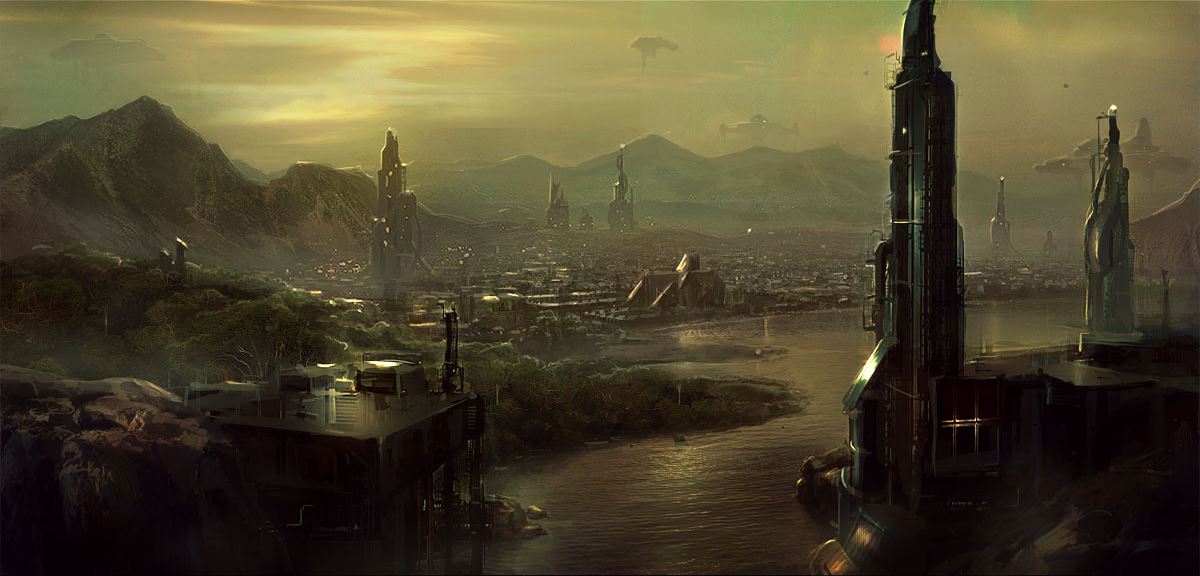
Middle Earth And The Technic History

I have acquired a copy of Isaac's Universe, Volume Two: Phases In Chaos, edited by Martin H. Greenberg, because it contains "Woodcraft" by Poul Anderson which Anderson adapted as one section of his novel, For Love And Glory.

Asimov famously created a humans-only galaxy in his Foundation series, then created the multi-species "Isaac's Universe" for other authors to set original stories in. In his Introduction to Volume Two, Asimov cites Tolkien as an unconscious inspiration because the latter's Middle Earth is a multi-species environment with:

human beings
elves
dwarfs
ents
wizards
hobbits
orcs/goblins
trolls
Tom Bombadil
Shelob
superwolves
supereagles
a superbear
Gollum

However, since Tolkien's Middle Earth history is a fantasy set on a single planet, a much more relevant possible source is Poul Anderson's History of Technic Civilization which is multi-planet sf with:

human beings
winged Ythrians
green Merseians
large Wodenites
small Cynthians
goblin-like Gorzuni
no-longer-human Kirkasanters -

- and many more.

Anderson, of course, also adapted Norse mythology, including elves, independently of Tolkien.

Tuesday, 16 August 2016

Anderson And Tolkien

Although I have visited Birmingham twice recently, I have only just heard of the Middle Earth Festival, which prompts me to make a comparison:

whereas Tolkien's Lord of the Rings Trilogy is part of his Middle Earth series which recounts a fantastic past history of Earth, Poul and Karen Anderson's The King of Ys Tetralogy is one part of Poul Anderson's complete works which recount past and future histories in multiple timelines;

both The Lord of the Rings and The King of Ys explain how our prosaic present has followed from a fantastic past - Earth became round and the elves withdrew, Ys was inundated and its memory suppressed;

I have read ...Rings twice and ...Ys three or four times;

I prefer Anderson to Tolkien.

Sunday, 15 March 2020

Three Fictional Histories

JRR Tolkien devoted much of his life to the History of Middle Earth with what results we know. By contrast, Robert Heinlein's Future History is only a small part of his total output. Poul Anderson's Technic History, although much longer than the Future History, is also of necessity much shorter than Tolkien's Middle Earth canon.

Heinlein and Anderson achieve future historical continuity with very few cross-references, e.g.:

Pinero appears in "Lifeline" and is mentioned in Methuselah's Children;

Rhysling appears in "The Green Hills of Earth" and is mentioned in perhaps three other works (and also makes it into Anderson's Old Phoenix);

Anderson deploys a few surnames - Runeberg, Holm and Davisson in just two works each. (See Families In Future Histories.)

Nevertheless, both Heinlein and Anderson achieve the desired effect: credible fictional (future) histories.

Sunday, 2 April 2017

Apocrypha

Science fiction future histories are one kind of fictional history, other examples being JRR Tolkien's Middle Earth History and CS Lewis' Chronicles of Narnia. The Bible contains myths, legends, historical fictions and theologically interpreted histories. Thus, while it is not itself a fictional history, it does cover some of the same territory.

And fictional histories have apocrypha:

(i) earlier versions of stories that have had to be revised to fit into the history;
(ii) stories that share background details but that remain inconsistent with the course of events in the history.

Larry Niven's Known Space History has two examples of (ii) and Anderson's Psychotechnic History has one, which I have discussed somewhere. It is about a guy who gets duplicated. Does anyone remember the title?

On (i), I have been told that, at one point in the Middle Earth History, a character narrating a story apologizes to some people who have read a different version of it. In Poul Anderson's The Earth Book Of Stormgate, the Avalonian editor, Hloch, notes that The Man Who Counts had been published in different places. It had indeed. And the author disliked the title, War Of The Wing Men.

Monday, 16 March 2020

Human Population Throughout The Technic History by Johan Ortiz

What this is

The Technic civilization future history takes off in our near future, in the year 2055 (THE SATURN GAME), and the Great Survey begins in 2150. Thus, the earliest part of the Technic history falls within a period for which we now have plausible world population projections. Armed with these projections and some guesstimates regarding mean population growth rates per annum, it is possible to extrapolate - roughly - the Human population in the Polesotechnic and Imperial Eras.
I will in this endeavour make use of Sean Brooks revision of Sandra Miesels chronology of the Technic civilization, because it just makes sense. Thus I take the Empire to have been founded in the early 27th century rather than the 28th and Flandry’s time to be the 32nd century, him being born around 3100 AD, not in 3000 AD.
We also know the rough number of inhabited planets at the height of the Empire - 100.000 worlds acknowledged the supremacy of the Terran Emperors, although even in the late Empire there were occasional human colonies who did not, and some worlds were primarily inhabited by non-human sophonts. Even so, we can calculate a rough average population for a human world during the height of the Empire. But we also see that average might well not be typical. There is reason to believe that only the earliest human colonies ever became worlds with populations counted in the billions.
Since the Technic stories give some data regarding the population and time of founding for certain colonies like Nyanza, we can use our growth estimates to count backwards and determine the likely size of the initial colonising population. Armed with this information, we can speculate somewhat informedly about the difference between old, populated worlds and the typical colonial Imperial world. For example, we will find that even in the late Empire, Terra herself would have been exceptional for its massive population, outstripping any other human world by a large margin.

Where to begin?

The UN at present estimates (World Population prospects, 2019) that the world population will reach around 10,9 billion in 2100, although warning that it might grow as much as to around 13 billion or more worst case. If we interpret the “Time of Chaos” as a serious disturbance of civilization – famines, plagues, ecological disasters, wars – perhaps even nuclear - then those numbers would have to be knocked back a bit – but on the other hand increased wealth after the end of those upheavals and consequent raised standards of living compared to those the UN predicts might, ironically, knock them back more!

The Time of Chaos

The Technic History begins with a “Time of Chaos” taking place in the decades before THE SATURN GAME – although the nature of those troubles is left unclear. It might have been no more than our present sorry times being looked back at with horror from a better future, a time when indeed we are risking ruining both Earth and civilization. But we can make an educated guess.
In 2009, prof. John Beddington, chief scientific adviser to the British government predicted what he called “a perfect storm of shortages” – energy, food and water by 2030, which would usher in an era of international conflict and upheaval. This is around the same time we’d expect the coming climate disaster to really start to bite, which of course only reinforces the good professors projections.
This indeed sounds a lot like a “Time of chaos”.
It is not necessary to speculate on the actual sequence of events, but by 2055 the world was unified under one government, there was ample energy thanks to the introduction of efficient fusion power, and other environmental issues had been solved or were in the process of being solved by means of moving production and mining into space. Fusion power alone could well have solved the energy and climate crisis – but it is almost unimaginable that we would peacefully arrive at a World Government, the core of the future Solar Commonwealth. It is more likely that a period of savage wars over dwindling resources begun in the 2030s and/or 2040s.  This might have caused a powerful coalition of nations to confederate to restore global order, in effect creating the embryo of the future Solar Commonwealth. In any case, the World Government, whether already known as the Commonwealth or not and whether by military means or not, won a complete victory. The only hint PA gives as to the identity of the winning faction is that the Technic civilization was a heir to the Western one – so reasonably, we could guess that the coalition was at least lead by western powers. It is also notable that Anglic is the dominant Technic language.

Assumptions regarding world population and growth rates in early Technic Era

Given the probability of large scale casualties from the climate crisis and wars, possibly even limited nuclear war, plus the expected lower birth rates at higher standards of living during the 2nd half of the 21st century, I’m going to assume a world population of 10 billion in 2100, somewhat down from UN estimates.

As for the rate of growth until then, the most developed countries (Europe and North America) are expected to have virtually zero population growth during the coming 80 years, growing very slightly until 2050, and then contracting in the following 50 years back to 2020 levels. But assuming essentially zero growth is incompatible with what we know of the Technic era. World population will peak because the resources of Earth are not inexhaustible, leading to the cost of raising children gradually raising until  a balance is struck. But Technic civilization, eventually expanding to a hundred thousand worlds, knows not such limitations. Also, Technic civilization is not quite the same as Western. Standards of living are higher, the society richer. The number of children each couple decides to have will be dictated only to a very small extent by economic opportunities, most people will afford to have about as many or as few children as they want.
And this, in fact, comes very close to the current situation in Sweden, a country whose rates of births to deaths is notably higher than most other western countries. While taxes are admittedly high, child care is all but free, schooling is free, even higher education is free. “Free” is of course deceptive, since taxation still has to be payed – but this is regardless of having children or not, and children are in fact also directly subsidized by the state.  Of course, children still need to be clothed, feed, housed and brought up, but for the vast majority of Swedes, the number of children they choose to have is limited far more by their life style preferences than by financial considerations. Thus I am going to assume that the proportion of net births (births minus deaths) to population in Sweden is close to the natural growth rate of a human race living in affluence, security and with mostly western values. There will of course be groups retaining religious and/or cultural mores dictating much larger families – but so are there in Sweden, where roughly 20% of current population is either born abroad or born of two parents born abroad. Much if not most of this group originates outside of Europe.
So Swedish growth rates it is. And this annual rate of net births to total population was for the period 2013-2019 on average  0,25% per annum, varying between 0,23% and 0,27%. This gives a reasonable growth rate to be applied to the human population as a whole in the Technic Era.

The first colonies
Another thing we can perhaps infer is that in the World-State that followed the time of Chaos, it eventually became possible to allow open borders and global freedom om movement. The reason for this supposition is that it is stated that the first wave of colonization was driven by a desire to preserve national identity in a world that was gradually moving towards a monoculture. Thus were founded ethnic-based colonies such as Germania, Nuevo Mexico, Dayan, Denitza and many others. This freedom of movement is only imaginable if the less developed areas of Earth were able to catch up with the more developed ones, which is also part of the underlying assumptions influencing the overall human growth rates. Compare with the European Union, where freedom of movement before the inclusion of the former eastern bloc countries caused no resentment whatsoever, while afterwards, it contributed substantially to Brexit. Migration that moves small numbers both ways is much less threatening, indeed is seen as much more as personal opportunity than threat. But over a span of centuries, even such limited migration would undoubtedly meld the nations of the world ever closer together, a process reinforcing the effects of a global mass culture. This was a likely a very drawn out process, still very much uncompleted by the times of van Rijn and Falkayn (see HOW TO BE ETHNIC IN ONE LESSON) but more so in Flandry’s days.
This desire to preserve national cultures explains the otherwise puzzling appearance of League Latin as a trader lingua franca. To the newly formed ethnic worlds, using the Anglic of the Solar Common-wealth as a common language was probably unthinkable, at least early on. A resurrected, dead language like League Latin was much more palatable.
Using these assumptions defined earlier, we’ll find that by 2150 when the Great Survey was launched, human population would have reached roughly 11,3 billion, making conditions on Earth rather cramped. In the following 50 years, humans colonised a number of worlds in a first wave of expansion. These worlds must later have become the most important and populous worlds of the Empire, as we will now show.
If we follow our extrapolated growth curve, human population would rise from 11,3 to 12,8 billion by the end of the 23rd century.  Given that Earth would have been rather crowded at the time, we can assume that most of this increase went off-world, indeed it is likely that Earth population dwindled somewhat. But with many planets colonised already, and especially if the initial wave of colonisation was driven by “ethnic” motives as is implied, then there would have been much less incentives to start new colonies in the following centuries – there are not that many nations on Earth! Rather than founding a new colony, most people would emigrate from the “old country” on Earth to the new “national” planet where there would still be ample space. There are currently around 6.000 ethnic groups on Earth, if we go by language as a definition, but most of these are very small and already on the verge of assimilation into larger groups at present in 2020 AD. A century on, most of these would have disappeared. On the other hand, the largest ethnic groups would have had little reason to fear assimilation into a Globish culture already in the 23rd century. Thus, it would be mainly small to middle size ethnicities that would feel the need to set down roots in a new world. This might explain why we never hear of a Han Chinese planet, but we do hear about Germania, Sassania (Persian), Dayan (Jewish/Israeli), Nuevo Mexico, Hermes (Scandinavian), Unan Besar (Malayan) and so on. Even adding a few planets colonised not on ethnical but ideological basis (like pacifist Esperance), these colonies numbered at most a couple of hundred. Some of the first colonies would not necessarily have been ethnic but merely a cross-section of the polyglot populations of Earth – Alpha Centauri springs to mind, being likely among the first worlds colonised.
I will refer to these first colonies as the “Great Worlds” because of their later prominence among others in terms of population and importance.

By the end of the first wave of colonization, we would have nearly 3 billion humans living on perhaps 200 major colonies at most, and any number of much smaller colonies set up not for ethnical/ideological reasons but for commercial, like mining or trade, or simply pure pioneering drive. Their population would remain largely insignificant although growing in the coming two-three centuries, unless for some reason attracting a large number of colonists from Earth. The average Great World would have perhaps 15 million inhabitants, mostly emigres arriving over the course of the last half century. The largest would have more. Consider for example the planet of Germania, one of the most important of the early “ethnic” colonies. If we start with the current estimate of 150 million Germans of all subgroups in 2020, and always assuming that there will be no real population growth in the developed nations from here to 2100, then we could assume that by 2200, Germans as a whole would number a little over 190 million. If, again, we assume most of the growth to go off-world, then Germania could have as much as 40 million inhabitants by that date, maybe slightly more. Other worlds would have correspondingly less.

The Polesotechnic league era

Total human population would approach 24 billion by the mid-25th century, the start of the era of Nicholas van Rijn and David Falkayn. If we assume more or less constant Earth population – maybe growing to 12 billion to allow for increased wealth and technology making room for more, then we have another 12 billion people distributed across roughly 200 Great Worlds and any number of smaller ones.
Given that even these “Great Worlds” were still virtually empty compared to Earth, and that inevitably they would have grabbed the best, most human-inhabitable worlds available after the Great Survey, it is reasonable to assume there was very little colonisation of new worlds going on - most of those wanting to emigrate from Earth choosing one of the existing colonial worlds. And any emigration from the larger colonies would be mainly by those fed up with their rustic monoethnic surroundings, instead longing for the cosmopolitan sophistication of old Earth, since untouched land would still have been plentiful on their existing worlds. This would not change throughout the era of the Polesotechnic League – even by its very end around 2600 AD, with around 35 billion human beings in total, the average Great World had no more than 120 million people – the same as Earth around 1000-500 BC. Smaller colonies remained minuscule for the most part, unless one for some reason caught the fancy of would-be emigres from Earth. Even so, their inhabitants were likely counted in the thousands, rather than millions.

Break-up of the Commonwealth and The Times of Troubles

The collapse of the Commonwealth would cause not only the birth of the Terran Empire, but a second wave of human colonisation. The first of these new colonists were driven by a will to escape the ever more overbearing and corrupt Commonwealth – among these would be Avalon, founded by David Falkayn among others. While not driven by ethnological motifs, like the first wave, they would in many cases have originated from monocultural Great Worlds and thus at least start also monocultural. Soon though, the violent collapse of the Commonwealth would drive a number of people to escape from the wrecked Earth and Great Worlds of the fallen Commonwealth. In the case of the Great Worlds, they were still so sparsely inhabited that even after having been devastated by invasion and plunder, the colonists could revert to farming to feed the population. This means that, unless several Great Worlds were depopulated by war, on the whole the growth of Human population would not have been greatly affected. In the case of Earth however, the devastation would have caused severe scarcity, even famine. While there would have been refugees from every Great World, those from Earth would logically have been the most numerous.
Probably in many cases, those small colonies founded earlier for commercial purposes would now receive waves of refugees – others would settle on entirely new worlds, hoping to escape attention from raiders. Among these would be less than ideal planets, like Ocean-covered Nyanza (THE GAME OF GLORY), which after five centuries and a second wave of colonization had 10 million inhabitants in Flandry’s time. The original ones had South African roots, but did most likely not escape directly from Earth, but rather probably some unmentioned Bantu Culture Great World. There is mention of a second German colony from which the land-bound Lubbers hail – Deutschwelt. This might be a parallel case of a colony set up by refugees from Germania.
This second wave of colonies were probably numerous, because the need to escape and hide would have been ongoing during the Times of Troubles. These extended for long enough that some planets, like Denitza, Hermes, Aeneas or Ansa became culturally militarised. If we assume that humanity suffered no great genocide during this era, and that emigration to the Great Worlds from Earth more or less stopped during this time, then at the close of the Times of Troubles around 2700 AD there would be around 44 billion humans, with about 10 billion still living on Earth, 28 billion inhabiting the two hundred or so Great Worlds and another 6 billion descended from refugees spread out over much of the remining 100.000 worlds of the future Empire – with on average around 60.000 inhabitants each. Of course, some would be substantially larger, like Avalon or Nyanza.

The Imperial Era

During the rule of the Terran Empire, the Imposition of the Pax and resumption of Trade would have allowed Terra herself to prosper again. Being the centre of Empire, we could expect her population to swell – emigration would largely stop, or even be reversed, especially early in the history of the Empire when Terra and her immediate neighbourhood were safe, but many human worlds were not. Also, as the Empire expanded, the administrative needs for manpower would have grown enormous so that at it’s peak, Terra held an population far above over what it could sustain with its own resources. Similar to Italy in the Roman Empire, the capital became parasitic, dependent on the provinces even for its basic needs.
By 2900 AD, towards the end of the era of Imperial expansion, the human race would amount to about 73 billion people, whereof perhaps as many as 18 billion lived on Terra herself, 45 billion on the Great Worlds (average population above 200 million) and the final 10 billion spread out over the 100.000 worlds mostly settled during the Times of Trouble (average population ca 100.000).
By Flandry’s time in the 32nd century, total numbers of the human race surpassed 120 billion. Because even the Great Worlds were still sparsely populated by this time, there was little colonisation going on, there still being plenty of space on each. The population of Terra stagnated around 20 billion and remained at zero growth. Around 75 billion lived in the Great Worlds of the Empire, still with on average below 400 million inhabitants, similar to Earth in the High Middle Ages. But on the on the 100.000 worlds of the Empire, now 25 billion people made their lives. On average, there were still no more than a quarter of a million people on each. Given that a few, like Nyanza, had populations counting in the millions though, the typical colonial world would have been even less densely populated. Even at this late stage, Terra outstripped the population of almost any other human world by 20 to one.

The Long night

Before the fall of the Empire around 3500 AD, human population surpassed 325 billion. Of these more than 200 billion were on the Great Worlds, by now with an on average population of a billion each. Terra herself, remained at 20 billion and the small worlds made up the remainder with now, on average, a million people each. But this time, the greater the world, the larger the fall. With much larger populations, and dependent on the produce from a myriad smaller colonies, the Great Worlds suffered a collapse similar of that of Terra during the Time of Troubles. Terra herself was completely unable to sustain her swollen population after the fall of the Empire, and having been thoroughly plundered, there were few star ships to allow the surplus to escape, nor industries left to build new ones. In the decades following the ravage of Terra billions died of famine and epidemics. The resulting turmoil rendered the planet essentially ungovernable – it become a post-apocalyptic nightmare. Most likely, 70-80% of the peak Imperial population perished. What was left was an agricultural world not much more populous than some of the former Great Worlds, its natural resources depleted to the point of hampering any resurrection of civilization. The Great worlds suffered less, but were still plundered to the bone and left with little more than agriculture to barely be able to sustain their populations. And the myriad small colonies, too small to fend for themselves could do little more than subsist – if they were lucky - as imports of everything from energy cells to star ships ceased. Those who depended on imported nutrient supplements were doomed. It would be a thousand years before some of the former Great Worlds had rebuilt enough to relaunch civilisation, but we can be certain that it was on those planets that it happened, given the disparity in human resources and potential for self-reliance between Great Worlds and second wave colonies.
After the fall of the Terran Empire, our population growth projections no longer hold. Probably total population plummeted, even if Terra made up only a small part of humanity by then. Many colonies would have died out entirely, although the vast majority did not. The Human race eventually recovered and took to the stars once more. But that is a different story.  

Tuesday, 30 August 2016

Percheron Etc

Poul Anderson, Three Hearts And Three Lions (London, 1977), Chapter One.

"The animal was gigantic, a stallion the size of a Percheron but with more graceful build, sleek and black as polished midnight. It was not tethered, though an elaborate fringed pair of reins hung from a headstall chased with silver and arabesques. On its back was a saddle, high in pommel and cantle..." (p. 14)

Having googled "Percheron," I now understand the significance of a stallion the size of one.

Holger dons the armor and rides the horse. He seeks hospitality from an old woman called Gerd who sounds like a fairy tale witch. They speak in a language that he does not recognize but nevertheless understands. She claims to live "...by the edge of the world." (p. 18) That might be literally true.

If this is a flat Earth, then how did it come into existence? Cosmos-forming processes would have to be entirely different. The flat earth of Narnia was directly created, sung into existence, by Aslan. There are some parallels between Three Hearts And Three Lions and The Lion, the Witch And The Wardrobe - apart from a leonine element in both titles, which I have only just noticed. Tolkien elaborately explains how the directly created flat Middle Earth became our round Earth. I suppose that a flat Earth has a place in our collective imagination. In Anderson's The Broken Sword, a ship leaves Midgard and enters Jotunheim by sailing North.

Sunday, 29 October 2017

Tolkien, Stirling And Anderson

I have just seen the conclusion of the film adaptation of J.R.R. Tolkien's Lord Of The Rings, Vol III, The Return Of The King, for the first time because it was re-shown on British television. This prompts three observations:

Tolkien knew how to create a myth of endings and farewells;

SM Stirling's Emberverse History is a sequel to Tolkien's Middle Earth History to the extent that some of Stirling's characters regard Tolkien's fictions as Histories and they also call their post-Change period the Fifth Age of Middle Earth;

Poul Anderson adapted Norse mythology as fiction contemporaneously with and independently of Tolkien -

like his contemporary, J.R.R. Tolkien, he is a significant successor to the Eddas, sagas and William Morris;
-copied from here.

Anderson was also a successor to several other very different authors as can be seen by reading the linked post.

See also None Better? II and Anderson And Tolkien.

Saturday, 8 June 2019

Middle Earth And The Technic History

(I hope to sort an image tomoz.) (Just did.)

See previous discussions here.

Two fictional histories about human beings interacting with other intelligent species: past fantasy and futuristic sf.

Tolkien's Middle Earth is undeniably longer and more complex than Poul Anderson's Technic History. However, this blog demonstrates that the Technic History is longer and more complex than many might think. Although I am not about to write it, one very long Wells-Stapledon model future historical volume could be created to record the entire History of Technic Civilization and its long aftermath and it should also become a very long screen series.

Tuesday, 25 July 2017

Powers

"'Sir,' said Merlin, 'what will come of this? If they put forth their power, they will unmake all Middle Earth.'
"'Their naked power, yes,' said Ransom. 'That is why they will work only through a man.'"
-CS Lewis, That Hideous Strength IN Lewis, The Cosmic Trilogy (London, 1990), pp. 349-753 AT Chapter 13, 5, p. 653.

"'...we have made the Sword for you, to sever their power and show humankind the truth of things. That much we can do in this turn of the Wheel, without breaking reality asunder with our contentions. All the rest is your burden.'"
-SM Stirling, The Sword Of The Lady (New York, 2010), Chapter Twenty-One, p. 653.

Merlin and Artos are human instruments of the Powers which must work through such an instrument if they are not to unmake Middle Earth or break reality.

Cosmic!

Tuesday, 29 July 2025

Gods And Men

Conan The Rebel, XV.

"'Two gods are in struggle. We mortals are not mere instruments - no, it is we who must win or lose by our own efforts, lest the universe be torn asunder as they wrestle...'" (p. 147)

"'Sir,' said Merlin, 'what will come of this? If they put forth their power, they will unmake all Middle Earth.'
"'Their naked power, yes,' said Ransom. 'That is why they will work only through a man.'"
-CS Lewis, That Hideous Strength IN Lewis, The Cosmic Trilogy (London, 1990), pp. 349-753 AT CHAPTER 13, 5, p. 653.

Tear the universe asunder or unmake Middle Earth?

Conan the Cimmerian and Merlinus Ambrosius learn what their mortal roles are to be. And my present role is to seek the realm of Morpheus.

Monday, 22 June 2020

Is Pan Dead?

Three Hearts And Three Lions, CHAPTER THREE.

Law and Chaos, which are in perpetual struggle, are:

primeval forces;

modes of existence;

or a terrestrial reflection of the spiritual conflict between heaven and hell? (p. 28)

Holger's guide, Hugi, identifies four sides, Heaven, Hell, Earth and the Middle World, adding that his people, the woods dwarfs, remain neutral. Human beings are the chief agents of Law on Earth although most do not realize this and some, witches, warlocks and other evildoers, have sold out to Chaos. A few nonhuman beings support Law although on the other side is the entire Middle World comprising realms like:

Faerie;
Trollheim;
the Giants, which are a creation of Chaos.

Human wars, as between the Holy Empire and the Saracens, help Chaos. Law means peace, order and liberty but the Middle Worlders work against this and try to extend their realm. The lands of men, comprising the Empire, the southern Saracen countries and lesser kingdoms, are to the west whereas the Middle World is to the east, its closest part being Faerie. Holger has arrived in a disputed borderland.

History:

there was a literal Fall;
then nearly everything was Chaos;
Chaos has been driven back;
when the Saviour lived, the darkness could not stand;
at that time, Pan died;
however, Chaos has rallied;
it prepares to strike back.

Pan imagery has revived on our Earth. CS Lewis cited the "Piper at the Gates of Dawn" chapter of The Wind In The Willows as a literary example of awe.

"Pan has taken their souls, and they stampede."
-Poul Anderson, A Midsummer Tempest (London, 1975), xxiv, p. 221.

Wednesday, 31 August 2016

Woods Dwarfs

Poul Anderson, Three Hearts And Three Lions (London, 1977), Chapter Three.

This cover shows the scene that I am rereading at present.

In the Carolingian universe, woods dwarfs:

live in the enormous forest;
eat mushrooms, nuts, rabbits and squirrels;
have no magical powers;
do not fear iron, silver or holy symbols;
unlike Narnian or Middle Earth dwarfs, do not take sides in wars between other beings -

"'We'll ha' naught to do wi' the wars in this uneasy land,' said Hugi. 'We'll bide our ain lives and let Heaven, Hell, Earth, and the Middle World fight it oot as they will. And when yon proud lairds ha' laid each the other oot, stiff and stark, we'll still be here. A pox on 'em all.'" (p. 26)

In one of Aesop's Fables, a donkey carrying military supplies is advised to flee in order to avoid capture by the advancing enemy. However, when he is told that the enemy will probably not try to make him carry any more than he is now because he is already at his limit, he replies, "I'll stay where I am!" In an sf novel by Fred and Geoffrey Hoyle, factory workers asked how they feel about the prospect of aliens conquering Earth, reply that they will still have to work in the factories. (That shocked me when I read it. Then I saw their point.)

Saturday, 16 May 2026

Strange Dimensions

The Broken Sword, XXII.

En route to Jotunheim, Skafolc and Mananaan sail further than any mortal ship ever can over chill, dead water under stars, moon and aurora. I think that, like some lost sailors in Tolkien's Middle Earth History, they sail not around the curve of the earth but straight out from the earth. 

"Skafloc thought this realm could not lie on earth at all, but in strange dimensions near the edge of everything, where creation plunged back into the Gap whence it had arisen. He had the notion that this was the Sea of Death on which he sailed, outward bound from the world of the living." (p. 156)

Maybe so but I am quite certain that Skafloc did not think of "dimensions"! This is sf terminology intruding into heroic fantasy. 

CS Lewis, not as author but as fictional first person narrator, quotes an entirely fictitious seventeenth century writer, Natvilcius, who hypothesizes that an angelic or demonic body:

"...exists after a manner beyond our conception in the celestial frame of spatial references."
-CS Lewis, Perelandra IN Lewis, The Cosmic Trilogy (London, 1990), pp. 145-348 AT 1, p. 158.

Fictional Lewis comments:

"By the 'celestial frame of spatial references' I take him to mean what we should now call 'multi-dimensional space'. Not, of course, that Natvilcius knew anything about multi-dimensional geometry, but that he had reached empirically what mathematics has since reached on theoretical grounds." (ibid.)

Skafloc also reaches out empirically, not theoretically. 

While we are outside our normal dimensions, let's take another look inside the Old Phoenix:

"...I suspect that besides being at a nexus of universes, the hostel exists on several different space-time levels of its own."
-Poul Anderson, "House Rule" IN Anderson, Fantasy (New York, September 1981), pp. 9-20 AT p. 10.

If each universe comprises a four dimensional space-time continuum, then the nexus is in a fifth dimension, neither spatial nor temporal but something else? Maybe. But what is a space-time level? The narrator retreats from this suggestion:

"Well, let's not speculate about the unanswerable." (ibid.)

See:

Sunday, 5 March 2017

None Better?

Eilir Mackenzie thinks of Tolkien:

"...it's a great story, none better..."
-SM Stirling, The Protector's War (New York, 2006), Chapter Four, p. 117.

I do not share this "none better" evaluation of Tolkien. How good a book is is closely related to how often I want to reread it. I read The Lord Of The Rings once when at University and once again when the films came out. I do not know how often I have reread two major series by Poul Anderson.

Tolkien's major body of work is the History of Middle Earth;

Anderson's Time Patrol series is the history of mankind as seen by time travelers;

Anderson's History of Technic Civilization is a "future history."

I recommend Anderson's The Earth Book Of Stormgate, a single volume collecting twelve works including one novel with additional introductory passages and covering three periods of the Technic History:

the Grand Survey;
the Polesotechnic League;
the early Terran Empire.

The introductory passages are based on The People Of The Wind and the Earth Book includes stories about Nicholas van Rijn, David Falkayn and Adzel, all of whom appear in other volumes of the History. Thus, the Earth Book is a massive single volume that is also fully integrated into a much longer fictional history. It deserves both wider recognition and screen adaptation.

Wednesday, 23 November 2016

Fictional Histories And Poul Anderson

We all know that Robert Heinlein wrote the Future History and that some other American sf writers have followed this model. Thus, there are "future histories," including "the Future History," which was collected as The Past Through Tomorrow.

Future histories are one kind of fictional history. Others include:

JRR Tolkien's History of Middle Earth;
CS Lewis' Chronicles of Narnia;
Geoffrey of Monmouth's History of the Kings of Britain.

Not unrelated to the works of Tolkien, a Catholic, and Lewis, an Anglican, is the Bible, a multi-generational narrative comprising every kind of literature including:

myths;
genealogies;
theologically interpreted histories;
historical fictions (Ruth, Job and Jonah).

Also relevant is John Milton's theological trilogy:

Paradise Lost;
Paradise Regained;
Samson Agonistes.

With the passage of time, a future history becomes an alternative history. Also, an alternative historical series can become a fictional history. Thus, SM Stirling presents:

three novels about the gradual conquest of Earth by the Draka;
one novel about interstellar and inter-cosmic conflicts involving the Draka -

and:

a trilogy about Nantucket translated to an alternative timeline;
a series about the Earth that Nantucket left behind.

Of the future history series that I have read, I think that Poul Anderson's History of Technic Civilization is the most substantial and comprehensive. We should always remember the original model:

Heinlein's Future History
I A collection about technological advances, eventually including interplanetary travel.
II A collection about the colonization and exploitation of the Solar System.
III A novel about the revolutionary overthrow of an American theocracy and two stories about different aspects of the post-revolutionary society, including the resumption of space travel.
IV A novel about a crisis in the post-revolutionary society.
V Two stories about a lost interstellar ship mentioned in Vol IV.

Some other future histories can be summarized briefly:

Anderson's Psychotechnic History
UN
Solar Union
Stellar Union
Galactic civilization (query)

Anderson's Technic History
interplanetary and interstellar exploration
Solar Commonwealth and Polesotechnic League
Time of Troubles
Terran Empire
Long Night
civilizations in several spiral arms
a Galactic civilization

Jerry Pournelle's CoDominium Future History
the CoDominuim
the First and Second Empire of Man

James Blish's Cities In Flight
a novel about the discoveries necessary for interstellar travel
two volumes about Okie civilization
a novel about the post-Okie universe

Larry Niven's Known Space Future History
Too complicated to summarize briefly?

Thursday, 25 May 2017

Contact Re-Established (Out Of The Silent City)

I have been in Birmingham for three nights without my laptop. When I try to sign in from a strange PC, Google sends a verification code to my old mobile number so we do not communicate. Any attempt to give them my new number fails. I have much to catch up on so please bear with me.

Poul Anderson and JRR Tolkien based fantasies on Norse mythology but Anderson also wrote in several other genres, mainly hard sf. Birmingham parks have been renamed the Shire Country Park after the Shire in Tolkien's Middle Earth. (Also, a town in Sicily has renamed itself after a fictional one. See here.)

Dwellers In Space
(i) Olaf Stapledon's pre-galactic nebulae.
(ii) Fred Hoyle's intelligent gas clouds.
(iii) CS Lewis' eldila.
(iv) James Blish's Angels.
(v) Poul Anderson's Aurigeans.
(vi) Larry Niven's Outsiders.

(i) and (ii) are gas.
(iii) are "hypersomatic."
(iv) and (v) are energy.
(vi) are solid.

Often, Anderson alone covers every option but sometimes, as here, he does it in cahoots with his illustrious colleagues. What authors' names to conjure with!

In Anderson's First Dominic Flandry Novel And Blish's Second Jack Loftus Novel
(i) Flandry visits Merseia while the Rhoidhunate plots to disarm Terra.
Jack visits Malis just as the Hegemony decides to annex Earth.

(ii) Flandry and his superior meet the Protector of the Roidhun's Council.
Jack and his superior meet the Hegemon of Malis.

(iii) Abrams and Flandry spy on Merseia.
An Angel concealed in the Earth ship spies on the Hegemony.

(iv) Merseians are less rule-bound than human beings.
Malans, even the Hegemon, are entirely ruled by their machine-interpreted laws.

(v) Flandry and one companion flee through hyperspace.
Jack and his two companions flee on the Haertel overdrive.

(vi) Land- and sea-dwelling Starkadians are natural enemies like men and wolves.
Land- and sea-dwelling Terrestrials (men and dolphins) decide to live in amity with each other and thus become able to live in amity with extraterrestrials.

(vii) Blish, like Anderson in other works, discusses the issue of freedom in future high-energy civilizations.

Dig it. Anderson fans, read Blish!

Jack Loftus heard not, as I had thought, the music of the spheres but a "dismal universal hiss," not quite the same thing! This will lead to reflections on:

chaos in Milton, Heinlein, Anderson and Alan Moore;
Milton as quoted by Lewis, Pullman and Blish.

Laters.

Saturday, 27 November 2021

Future Historiography

The Earth Book Of Stormgate collects twelve works by Poul Anderson with new introductions based on the background of his novel, The People Of The Wind. Leaving the new introductions in place, make four changes to the Earth Book:

(i) remove the last five works from this volume;

(ii) add the previously uncollected "The Saturn Game" at the very beginning;

(iii) add the first two of the three David Falkayn stories from The Trouble Twisters in the middle;

(iv) add the first of the three Nicholas van Rijn stories from Trader To The Stars at the end.

You have now transformed the Earth Book into The Technic Civilization Saga, Volume I (of VII), The Van Rijn Method. The Earth Book, which need not be republished as such, was like a first draft of the first section of the Technic History.

Of the five remaining Earth Book installments, three are among the seven works collected in Volume II, David Falkayn: Star Trader, and two are among the six collected in Volume III, Rise Of The Terran Empire.

The mid-point of Volume III is a peak of future historiography because that is the moment when Hloch, compiler of the Earth Book, hands the baton to Donvar Ayeghen, President of the Galactic Archaeological Society. Ayeghen introduces "The Star Plunderer," (1952) another of the very early stories that was not originally part of a future history series.

All of this is a far cry from Jim Ching struggling with tensor calculus in the fifth story in Volume I. A future history presents individual perspectives as well as millennial narratives.

Tuesday, 30 August 2016

A Few More Details

Poul Anderson, Three Hearts And Three Lions (London, 1977), Chapter Two.

Mother Gerd has a hook nose, an iron pot and a black cat called "Grimalkin" and even claims to be a witch. She refers to:

"'...wonder-working relics of some saint, that do their miracles alike for Christians or paynim...'" (p. 19)

we have met "paynim" before, e.g., in The Shield Of Time, but perhaps it was time to google it. I had not realized that it was derived, via Anglo-Norman and Old French, from Latin paganus.

She says that dwellers in the marchland need magical "'...protection against the Middle World powers...'" (ibid.)

Thus, this "Middle World" seems to be different from Midgard or Middle Earth.

"This house, and the carline who took his knightly accoutrements as a matter of course..." (p. 20)

An old woman? Oh, so it refers to Mother Gerd.

Holger considers time travel but cannot make sense of Gerd's references to Fairies. The marches are disputed between the Middle World/Faerie and the Holy Empire. And there is another human group: the Saracens. The Christians claim that Mahound is an evil spirit and maybe he is here.

Wednesday, 14 January 2015

Fictional Cosmologies II

See here.

I argued that Olaf Stapledon and JRR Tolkien are polar opposites whereas Poul Anderson is bipolar - although I did not phrase it like that. I could have added that he is also tropical and equatorial. His works stretch along a line of longitude between the poles of heroic fantasy and cosmological sf:

heroic fantasy
historical fantasy
historical fiction
historical fiction with elements of fantasy
historical science fiction
one long historical/contemporary/futuristic novel
alternative history fiction
a contemporary fantasy novel
a contemporary detective trilogy
near future sf
future histories
cosmological sf

A novel with gods as characters is fantasy whereas a historical novel in which gods are invoked and magic sometimes works involves "elements of fantasy." Tolkien's Lord Of The Rings Trilogy is one narrative in three volumes. Poul and Karen Anderson's King Of Ys Tetralogy is one narrative in four volumes. These works are comparable. Tolkien describes the end of the Third Age of Middle-earth leading to the Age of Men and eventually to the Anglo-Saxon period and the present day. The Andersons describe the end of the city of Ys, then of the Roman Empire, and the beginning of the Dark Ages which lead, as we know, to the Middle Ages, then to the modern period and hopefully to a future on and off Earth.

On top of all that, alternative histories literally broaden the temporal perspective.