Showing posts sorted by relevance for query John W. Campbell. Sort by date Show all posts

Sunday, 18 August 2013

John W Campbell

Poul Anderson reminisced about Astounding/Analog editor, John W Campbell, in "John Campbell" (All One Universe, New York, 1997). Anderson differentiates three generations of writers influenced by Campbell:

"...Jack Williamson...began working well before him but then came under his influence..." (p. 49);

the Golden Age (1938-1943) writers who developed under Campbell - Asimov, de Camp, Heinlein, Sturgeon and van Vogt;

the next generation, including Anderson whose first publication was in 1947.

My purely personal perspectives on these writers are:

I have not read much Williamson, although his The Legion Of Time is incoherent as a work on time travel;

I have argued several times that Asimov should have confined his attention to Robots;

I know de Camp almost entirely through one good time travel novel, Lest Darkness Fall;

I have read almost no Sturgeon and have not read what I have been told is a major telepathy novel, More Than Human;

van Vogt wrote space opera, including even something called More Than Superhuman;

I classify Heinlein, Asimov and Blish as "the Campbell future historians" because Campbell edited and strongly influenced Heinlein's Future History, Asimov's Robots stories and Foundation series and Blish's Okie series (this last would have remained a single story, not a series, without Campbell's input);

I further classify Anderson both as Heinlein's main successor and as a later Campbell future historian (apparently, Campbell gave Anderson the idea that became the Ythrians);

the Golden Age of sf included the Golden Age of superheroes because Superman, an sf character, first published in 1938, was immediately successful and widely imitated, generating a new genre.

I showed in some earlier posts that Anderson's A Midsummer Tempest contains much blank verse, one Shakespearian sonnet and several rhyming couplets, all disguised as prose. In conversation with Anderson, Campbell:

"...observed that all good prose has metrical structure and that more than half of Heinlein's Methuselah's Children [part of the Future history] is in blank verse." (p. 54)

Really? Methuselah's Children? I am not about to reread the novel to find out but it would be interesting to check on this sometime.

Tuesday, 16 May 2023

Introductions And Beginnings

What is the best way to introduce and begin a future history series? Right now, I am considering only four such series that I consider important:

The Future History by Robert Heinlein
Cities In Flight by James Blish
The Psychotechnic History by Poul Anderson
The Technic History by Poul Anderson

Heinlein's Future History, Volume I, The Man Who Sold The Moon, has both a Preface by its author and an Introduction by the magazine editor of the stories, John W. Campbell, Jr. Although Heinlein in his Preface states that the Future History is not prophecy, Campbell ends his Introduction as follows:

"The important thing is that these, sirs, are high adventure. The high adventure of the years to come - the years we, unfortunately, may not live to see. These are a window on tomorrow; a television set tuned to the future. But we lack the key to the door that would let us walk through into that future; we must only watch and listen to the highest of all adventures - the conquest of the stars!"
-John W. Campbell, INTRODUCTION in Robert Heinlein, The Man Who Sold The Moon (London, 1963), pp. 11-14 AT p. 14.

This collection was first published in 1953, seventy years ago. 

Campbell seems:

to assume that his audience is entirely male;

to regard the future as a place where we cannot go rather than as the time that we are always living into;

to forget that this volume at least does not feature interstellar travel.

In fact, in the Future History, the first Moon landing occurs off-stage in the fifth instalment and regular faster than light interstellar travel is about to begin only at the end of Volume IV, the effective end of the history.

Blish's Cities In Flight, Volume I, They Shall Have Stars, set within the Solar System, is about the discoveries that will lead to interstellar travel.

The opening instalment of Anderson's Psychotechnic History is set among the ruins of World War III although, from the second instalment onward, there is a rebuilt high tech Earth and interplanetary travel.

Anderson's Technic History originally began with Trader To The Stars and interstellar travel already under way as proclaimed in the fictional Introduction signed "Le Matelot." The later written earliest story, "The Saturn Game," describes interplanetary exploration during the rebuilding of Earth in the twenty first century.

We have come a long way both in real history and in fictional future histories since The Man Who Sold The Moon but this is all a single literary tradition.

Wednesday, 2 March 2022

A Window On Tomorrow


John W. Campbell edited:

Robert Heinlein's Future History;
Isaac Asimov's Robots and Foundation;
James Blish's Okie series;
Poul Anderson's Polesotechnic League.
 
When Campbell speaks, we listen, even if we then disagree.
 
"These are a window on tomorrow; a television set tuned to the future. But we lack the key to the door that would let us walk through into that future; we must only watch and listen to the highest of all adventures - the conquest of the stars!"
John W. Campbell, Jr., INTRODUCTION IN Robert Heinlein, The Man Who Sold the Moon (London, 1963), pp. 11-14 AT p. 14.
 
The first story in the Future History, "Life-Line," was published in 1939 and set in 1951. The Man Who Sold The Moon was first published in 1950. Did Campbell believe that he and his readers were permanently confined to the 1950s as if those years were a place, not a decade? The mid-point of Heinlein's Future History Chart is:
 
2025 (The Stone Pillow)

(Brackets indicate a "story-to-be-told.")

Thus, some of us who were alive in the 1950s have "walked" through nearly the first half of the Future History Chart simply by living long enough. And The Man Who Sold The Moon does not show "the conquest of the stars!" The first four of its six stories are Earthbound. The first Moon landing happens in the fourth story in 1978 although Heinlein's PREFACE says that it could be sooner. The first interstellar round trip does not happen until the fourth of five volumes.
 
Sure, interstellar travel is a major factor in American future histories although some, like Heinlein's Future History and Anderson's Maurai History, take a while to get there.

Thursday, 5 February 2026

The Highest Adventure

Focus on the differences between The First Men In The Moon and the Apollo landings. Wells got it right that human beings would be able to land on the Moon but the speculative fiction was bound to differ in every conceivable detail from the eventual reality.

Robert Heinlein wrote three alternative first men on the Moon stories. In his Future History, the first rocket to the Moon is in 1978. Poul Anderson's equivalent story is "The Saturn Game," about exploration further into the Solar System. James Blish's is Welcome To Mars. Larry Niven's Known Space future history series opens with the exploration of Mercury, Venus, Pluto and Mars. 

If the human race survives, then our descendants will do great things on and off Earth and will make unpredictable and unimaginable discoveries about the universe by either close or remote observation.

John W. Campbell, introducing Volume I of Heinlein's Future History, wrote:

"These are a window on tomorrow; a television set tuned to the future. But we lack the key to the door that would let us walk through into that future; we must only watch and listen to the highest of all adventures - the conquest of the stars!"
-John W. Campbell, Jr., INTRODUCTION IN Robert Heinlein, The Man Who Sold The Moon (London, 1963), pp. 11-14 AT p. 14. 

Some of us who read the Future History have walked some distance into the future. The highest adventure will be whatever human beings do accomplish in the further future. The conquest of the stars? I doubt conquest in any sense. Interstellar travel is a symbol of freedom in American sf, maybe only a symbol. Our descendants will either be interested that we imagined them as DD Harriman, Nicholas van Rijn, Dominic Flandry etc or will have forgotten such imaginings.

We refer to:

Wells
Heinlein
Blish
Niven
Campbell
Anderson

Wells is a Homer and Anderson is a culmination.

Wednesday, 11 July 2012

A Non-Linear Sub-Series

The "Trader Team" sub-series in Poul Anderson's History of Technic Civilization comprises just five works. In the first, "Trader Team"/"The Trouble Twisters," Nicholas van Rijn explains his trade pioneer crew idea to David Falkayn:

robot probes will investigate as yet unexplored planetary systems that have been bypassed by the frontier of known space;
a crew comprising a Master Merchant, a planetologist and a xenobiologist of different species will visit any that seem promising.

In this story, Falkayn leads his team on their first mission and coins a term for their new profession, "trouble twister." (1)

It might be expected that the remaining four works would describe four more missions but they don't. On the one hand, we are to understand that Falkayn's and other teams enrich van Rijn by continuing to pioneer for several decades. On the other hand, the remaining works present different kinds of events that are turning points for the team, for their civilization or for both.

In the second work, "Day Of Burning," the team is not pioneering but is on a rescue mission simply because theirs was the nearest League ship to the planet Merseia when a threat to all life on that planet was detected. Falkayn claims to have seen planets devastated by all-out nuclear strikes. That must have happened between stories and would not have been on a pioneer crew mission. This story is a turning point for Technic civilization because the Merseians later become the main adversaries of the Polesotechnic League's successor, the Terran Empire.

 In the third work, Satan's World, the team is on yet another kind of mission, investigating a data processing company based in the Solar System where, because of exploits that we have not read about, Falkayn is known to be:

"Right-hand man and roving troubletwister for Old Nick." (2)

(Falkayn's coinage has become a single word.)

This novel is a turning point for Technic civilization because it shows that the Polesotechnic League could be vulnerable to external threats which, in turn, is a prelude to recognition of internal threats to the League's continued prosperity and stability. The novel is a potential ending for the series: the team has to be split up and might not survive, as indeed Technic civilization might not. When, at the very end, they have defeated their enemies and are embarking on a new pioneering mission, things have changed. They have passed a turning point. Their share in Satan's World has made them rich for life. They now pioneer because they want to, not because they have to. In that sense, the first phase of their troubletwisting career has ended.

And this sub-series could have ended there. However, Anderson next wrote "Lodestar," based on an idea suggested by his editor John W Campbell, for a John W Campbell Memorial Anthology. The team visits an established League base. Thereafter, the story follows van Rijn and his granddaughter, Coya, who finally discover that Falkayn and his team have secretly worked against van Rijn's business interests in order to help the poorer rational species whose needs are ignored by the League. This is a turning point for the League, for the relationship between van Rijn and Falkayn and, we later learn, for the relationship between Coya and Falkayn who have married and started a family by the time of the fifth and last work in this sub-series, Mirkheim.

Arguably, the sub-series proper ends with "Lodestar." That is the last time we see Falkayn's team during that period of their employment by van Rijn. Mirkheim, set many years later, is a sequel in which, during many other epochal events, van Rijn reassembles the long dispersed original team but for a different kind of mission and in very different circumstances. We learn that Coya had married Falkayn and joined the team for five years but stopped pioneering when they started a family and that that had ended the team, with its members going their separate ways. Thus, there is another entire period, of Coya on the team, which is not covered by any of the stories.

As part of a longer history, the sub-series is also rich in both prequels and sequels that tell us what van Rijn and some of the team members did both before and after this period. But my point here is that Anderson, having defined the role of a trade pioneer crew, does not present merely a linear series about successive exploits of such a team. Taking it as given that they had such exploits, he instead paints a broader picture by spacing his stories out through time to show us what happened to the League throughout an entire historical period.

For what it is worth, I now think that the entire Technic History could best be collected as:

The Polesotechnic League (9 works);
Star Traders (9);
League And Empire (6);
Young Flandry (3);
Flandry And Empire (9);
Children Of Empire (3);
Long Night And Dawn (4).

It is possible to rethink this issue endlessly and to keep arriving at different conclusions. The problems are where to divide the omnibus volumes and what to call them. Van Rijn dominates his period, appearing not only in six works of his own but also in four of the five "Trader Team" works. Thus, the proposed Star Traders volume would, with the exception of "Day Of Burning," be an extended van Rijn series but with a pluralized title, Star Traders, not Star Trader, in order to acknowledge that this volume covers Falkayn and the team as well as Old Nick.

Again, Mirkheim's status as really a sequel to the Trader Team sequence could be acknowledged by placing it at the beginning of the following volume which would therefore be called League And Empire, not Avalon And Empire. Near the end of Mirkheim, Coya bears Nicholas Falkayn who addresses his son in the very next story set in the Falkayns' colony on the planet Avalon and this omnibus volume ends with Avalon resisting the Empire. Thus, League And Empire would be an appropriate title as showing not interaction (they do not coexist) but transition between the Polesotechnic League, beginning its decline in "Lodestar" and Mirkheim, and the Terran Empire, becoming territorially aggressive in The People Of The Wind.

(1) Anderson, Poul, David Falkayn: Star Trader (compiled by Hank Davis), New York, 2010, p. 206.
(2) ibid., p. 332.

Thursday, 20 June 2024

2001

In twentieth century sf, the years 2000 and 2001 represented the future. Volume I of Robert Heinlein's Future History covered the period from the author's present to the end of the century. The stories in Volume II are all set around 2000. They are overlapping stories like some in Poul Anderson's Technic History.

In his Introduction to Volume I, The Man Who Sold The Moon, John W. Campbell describes Heinlein's stories as a window or a TV set showing the future but adds that we lack the key to the door into the future. However, we are walking through that door at every moment. We now look back at the periods covered by the Future History, Volumes I and II, and Poul Anderson's ultimate sf novel, Genesis, was, appropriately, published in 2000, at the very end of the twentieth century. Its first mass market edition, which I have, was published in 2001 at the very beginning of the twenty-first century. We have come a long way from Heinlein's opening story and, so far, are still going. From 2024, we salute John W. Campbell, Robert Heinlein and Poul Anderson.

Tuesday, 20 September 2016

Generations

"Lodestar."

Nicholas van Rijn:

"shrugged like a mountain sending off an avalanche." (p. 654)

- thus validating his granddaughter Coya's nickname for him, "Gunung Tuan." (p. 647)

Coya thinks:

"...Nick van Rijn! You keep complaining about how moralistic my generation is." (p. 654)

Van Rijn says:

"'...as youngsters like you, Coya, get more prudish, the companies and governments get more brutish.' She answered: 'The second is part of the reason for the first.'" (p. 659)

Here are two differences that we recognize:

"'...you don't smoke neither,' he said. 'Ah, they don't put the kind of stuff in youngsters like when I was your age.'
"'A few of us try to exercise some forethought as well as our consciences,' Coya snapped." (p. 648)

Van Rijn says:

"'You better hope, you heathen, and I better pray...'" (p. 655)

Thus, we get indications of social changes on Earth and wish that we could see more of them.

Coya, an astrophysicist, tells Captain Hirharouk the purpose of their expedition. If a supernova had a sufficiently large planet, then the core of the planet will have survived, coated with valuable supermetals. She comments:

"'It took a genius to think this might be!'
"She grew aware of van Rijn's eyes upon her.'" (pp. 667-668)

Whom is she complimenting? Van Rijn organized this expedition. But he had the clue of the existence of the Supermetals Company. Coya knows that David Falkayn thought that "...this might be..." ten years earlier and thus that Falkayn might be behind Supermetals. And how much does van Rijn suspect?

Is Poul Anderson claiming to be a genius for writing about the Lodestar? No, because he tells us that John W Campbell gave him the idea. "Lodestar" was first published in a John W Campbell Memorial Anthology.

Generationally, Falkayn is intermediate between van Rijn and Coya but, despite their age difference, he will marry Coya.

Monday, 2 February 2026

Publication Histories

Short stories published, and novels serialized, in sf mags can be or become instalments of future history series. John W. Campbell's Astounding/Analog was the starting point for Robert Heinlein's Future History and Poul Anderson's Polesotechnic League series among others. 

Future histories can also incorporate instalments with surprisingly dissimilar publication histories.

Heinlein's Future History
four stories from the Saturday Evening Post
+ one each from:
Argosy
Town and Country
Boy's Life
the American Legion Magazine
Scientific American

(10 out of 24 or so instalments.)

Anderson's Technic History (incorporating the Polesotechnic League)
two from original juvenile sf anthologies edited by Roger Elwood
two from Boy's Life
one from Astounding: The John W. Campbell Memorial Anthology, edited by Harry Harrison
one written for Four For The Future, a themed anthology edited by Harrison, although first published in Galaxy

(6 out of 43 instalments.)

Thus, Elwood, Boy's Life and Harrison between them give us six Technic History instalments. 

Tuesday, 7 November 2017

The End Of A Saga

(John W. Campbell.)

Hank Davis wrote in his Introduction to Poul Anderson, David Falkayn: Star Trader (Riverdale, NY, 2010) that Anderson had indicated that he:

"...was considering writing no more Polesotechnic League stories after 'Lodestar'..." (p. XII)

Davis was referring to these words by Anderson:

"...I dedicate to him this ending of a saga on which so long we worked together." (p. 682)

- "him" being John W. Campbell.

However, "Lodestar" is indeed the end of the saga of the trade pioneer crew and also an appropriate culmination of Volume II of The Technic Civilization Saga. The first work to be collected in Vol III is Mirkheim which is neither a continuation nor a culmination but a sequel to the trader team series. At the beginning of Mirkheim, Chapter I:

eighteen years have passed since "Lodestar";
Coya had joined the team;
however, for three years, David and she have been retired, starting a family;
Chee Lan has joined another team;
Adzel has entered a Buddhist monastery in the Andes;
van Rijn reconvenes the team not for its original purpose but in response to a political crisis.

And that is indeed the end of the Polesotechnic League series, appropriately republished in a volume entitled Rise Of The Terran Empire.

Monday, 1 February 2021

Two Tributes

The Game Of Empire, CHAPTER ONE.

The Jerusalem Catholic Galilean Order maintains a university in Port Campbell on Woden. Although I have mentioned Port Campbell before (see Woden), I did not allude to the fact that its name is an obvious tribute. See John W. Campbell.

Thus, in Poul Anderson's Technic History, one Wodenite, Adzel, studies at the Clement Institute whereas another, Axor, studies in Port Campbell.

And I have a feeling that there is a third such tribute somewhere about.

Sunday, 11 January 2015

The Campbell Future Historians

John W Campbell, Editor of Astounding, later Analog, Science Fiction, published:

Robert Heinlein's Future History;
Isaac Asimov's Robot stories;
Asimov's Foundation series;
James Blish's Okie series;
Poul Anderson's Polesotechnic League series.

Therefore, I call Heinlein, Asimov, Blish and Anderson the four Campbell future historians. Heinlein's direct successors as American future historians are Poul Anderson, Larry Niven and Jerry Pournelle. There are other future historians but these six form a literary sequence.

Campbell:

published Heinlein's Time Chart, thus encouraging him to continue writing the Future History;

because the Foundation was guided by Seldon's psychohistorical predictions, advised Asimov to imagine an event that confounds the predictions;

because the Okies traded with the germanium-based Oc dollar, advised Blish to envisage the collapse of the germanium standard;

when asked by Anderson what might succeed mammals as they succeeded amphibians and reptiles, suggested the biological supercharger that enables Anderson's Ythrians to combine intelligence with flight in terrestroid conditions;

suggested the supermetals-covered remnant of a planet blasted by a supernova that became Anderson's Mirkheim.

Need I say more?

Saturday, 13 July 2024

Campbell's Influence

Expecting "Lodestar" to be his last Polesotechnic League story, Poul Anderson dedicated to Analog Editor, John W. Campbell:

"...this ending of a saga on which so long we worked together."
-Poul Anderson, David Falkayn: Star Trader (Riverdale, NY, March 010), p. 682.

Campbell edited:

Robert Heinlein's Future History;
Isaac Asimov's Robot stories and Foundation series;
James Blish's Okie series;
Poul Anderson's Nicholas van Rijn series.

He advised:

Asimov to see what would happen if Seldon's predictions failed;

Blish that the Okies should be a series, not a one-off story, and also that the germanium basis of the Oc dollar should fail.

He gave Anderson the ideas that became to Ythrians' biological supercharger and the supermetals planet, Mirkheim.

Five series and five influences. There were more influences. These are just the ones that I know about.

Monday, 19 August 2013

Kipling & Co


Poul Anderson's collection, All One Universe (New York, 1997), includes articles on three individuals:

Johannes V Jensen;
Rudyard Kipling;
John W Campbell.

Unexpectedly, they "cross over." First, Anderson quotes Jensen's description of Kipling after interviewing him, although I am not sure what Jensen meant by describing Kipling's head as "...not large but singularly full..." (p. 156).

Secondly, the article on Campbell mentions the Campbell school of science fiction writers, including Robert Heinlein. Heinlein wrote detailed descriptions of fictitious futures. Anderson tells us that Kipling did this in his sf story, "As Easy as ABC," "...with the same eye for detail as would later distinguish the work of Robert Heinlein." (p. 157) I have read very little Kipling but have liked what I read although my reading has not included "As Easy as ABC."

Anderson also replies to George Orwell's criticisms of Kipling. Thus, we have now referred to three writers of technological dystopias:

in 1984, television is used to spy on the population;
in "If This Goes On -," television is used to fake miracles for a religious dictatorship;
in "As Easy as ABC," I gather, "...technology driv[es] the evolution of the managerial society..." (ibid.)

Pretty smart stuff.

Thursday, 25 February 2016

More On American Future Histories

I listed four Campbell-edited future historians (Heinlein, Asimov, Blish and Anderson) but maybe should have included a fifth:

"H. Beam Piper was first and last a John W. Campbell writer, his first SF story, "Time and Time Again," appeared in Astounding in April 1946, and his last, "Down Styphon!," in Analog in November 1965."
-John F. Carr, "The Terrohuman Future History of H. Beam Piper" IN Bulletin of the Science Fiction Writers of America, Fall 1979.

However, returning to the authors that I do know something about, Poul Anderson not only wrote hard science fiction in the tradition of Robert Heinlein  but also, and completely independently of JRR Tolkien, wrote heroic fantasies derived from Norse mythology. These two literary traditions converged when Heinleinian sf writer Jerry Pournelle included "Sauron supermen" in his CoDominium future history.

In The Mote In God's Eye (London, 1979), Niven's and Pournelle's characters speculate as to whether isolated extrasolar colonists might not only regress sociologically but also evolve biologically. The concluding installments of Poul Anderson's Technic History address this question.

Mote presents its own distinctive version of hyperspace: instantaneous transit along "tramlines" (p. 32) between certain stars, with the usual restriction that this kind of travel is impossible from too deep within a gravity well. Travel time is necessary to and from tramline end points. By contrast, I think that the version of hyperspace in Anderson's Technic History is unique because it involves many instantaneous quantum jumps through normal, familiar, 3D space, not through any other kind of space.

We recognize Anderson-type world-building in the description of the New Caledonia star system on pp. 32-34 of Mote. I do not think that Heinlein did this? Direct Imperial rule of New Chicago after the defeat of its rebellion recalls the comparable situation on Aeneas in Anderson's The Day Of Their Return.

For the nationality of a space warship's Chief Engineer, Niven and Pournelle follow neither Heinlein nor Anderson but Star Trek:

"Like many engineering officers, Sinclair was from New Scotland. His heavy accent was common among Scots throughout space." (p.15)

How can a handful of writers create such fascinating texts? It continues to be a blast.

Thursday, 23 January 2025

A Few Details

I have just had that familiar and annoying experience of not finding a book, in this case Genesis by Poul Anderson, where it should have been on a bookshelf. However, I have also just ordered a cheap replacement copy online. It is expected by 12 Feb. I want to quote and compare certain passages in Genesis (I think) and in the same author's The Boat Of A Million Years and There Will Be Time. I might start on this before Genesis arrives although I will then, of course, have to locate the passage that I am thinking of in that book. 

While looking for Genesis, I found Isaac's Universe, Volume Two, which contains Anderson's "Woodcraft." Is this one of the two Andersonian Isaac's Universe stories that Anderson adapted and incorporated into his For Love And Glory? I will read or reread this story at least until I have confirmed that it is familiar.

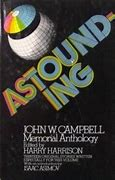
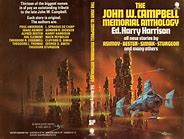
When farmer John gave me a lift home after the sf group, I found on his dashboard something that I had never previously seen or held, a paperback copy of The John W. Campbell Memorial Anthology. See the attached image. This anthology presented Anderson's "Lodestar." As I explained to John, this is a pivotal story of Anderson's main future history series and I have read it in that context, not in its original anthologization. 

Wednesday, 3 June 2015

Quetzas And Ythrians

SM Stirling, The Sky People (New York, 2007).

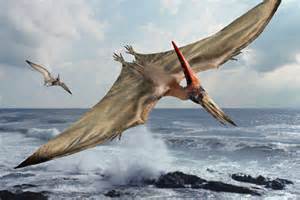
A pterodactyl with an eighty foot wingspan would not be able to fly on Earth but is able to fly on (this alternative version of) Venus because:

gravity is less;
air is thicker;
there is more oxygen.

At this point, sf readers remember:

many other fictional encounters with dinosaurs (see here);
Poul Anderson's question to John W Campbell - what comes next after fish, amphibians, reptiles and mammals?

Campbell suggested an animal that can energize its body by pumping atmospheric oxygen directly into its bloodstream. Anderson utilized this suggestion to imagine Ythrians, able both to fly under terrestroid conditions and to carry a body and brain heavy enough for intelligence.

Reading about Stirling's Quetzas and remembering Anderson's Ythrians, we next ask: do the conditions on Stirling's Venus allow for intelligent fliers?

Monday, 5 November 2018

Superiority

Will humanity be superior or inferior to other intelligent species?

John W. Campbell favored human superiority. Isaac Asimov avoided conflict with Campbell by leaving aliens out of the Foundation series.

Poul Anderson, of course, covered both options in different works. Somewhere on the blog, we list ways in which human beings are superior in After Doomsday.

In Julian May's Galactic Milieu Trilogy, human beings, just being inducted into the Milieu, already show that they will be metapsychically superior to the other member races. We recognize this as a familiar theme in sf.

In CS Lewis' Ransom Trilogy, humanity is the one Fallen race.

Monday, 17 October 2016

Technic History Stories Not Published In SF Magazines

"How To Be Ethnic In One Easy Lesson" was published in an original anthology called Future Quest, edited by Roger Elwood.

"The Season of Forgiveness" and "Wingless" were published in Boy's Life.

"Rescue on Avalon" was published in an original anthology called Children Of Infinity, edited by Roger Elwood.

"Lodestar" was published in an original anthology called Astounding: The John W. Campbell Memorial Anthology, edited by Harry Harrison.

Everything else was in an sf mag: Analog, Fantasy and Science Fiction, Planet Stories, Amazing, Galaxy, Future Combined With Science Fiction Stories, Venture or Fantastic. The Campbell Memorial anthology was like a continuation of Analog.

Thanks to Elwood and Boy's Life, there are four more short stories that do fit into the Technic History but do not belong to any of its sub-series: van Rijn, trader team or Flandry. The History is enriched by these additional stories.

Saturday, 12 November 2016

Ythrians And The Weather

Poul Anderson asked what might succeed mammals, John W Campbell answered the question and Anderson adapted Campbell's answer as the flying, intelligent Ythrians. More generally, could there be intelligent beings whose bodies were completely at home in wind, rain, storm and sea without needing clothes or buildings? They would need to have some level of technology and limbs for manipulation as well as locomotion. They might have bypassed or superseded urban civilization? Such beings might synthesize the best features of animality and rationality.
-copied from here.

Ythrians are definitely more at home in the elements than human beings:

"Eyath left the crag whereon she had perched the last few hours, after she could breast the weather no more. She was cold, wet, stiff at first. But the air blew keen into nostrils and antlibranchs, blood awoke, soon muscles were athrob." (Rise Of The Terran Empire, p. 606)

Eyath mourns alone. Before that, Rochefort and Tabitha had looked for her:

"'Where is she?' His voice was raw.
"'Alone,' she answered.
"'In this weather? When it's likely to worsen?'" (p. 602)

When Eyath left the crag:

"The sea laughed but the island dreamed..." (p. 606)

We have previously discussed this use of the word "dreamed."

Sunday, 24 August 2014

Common Features

A fictitious version of Mars.
A fictitious version of Venus.
A future history.
Being edited by John W Campbell.

Each of these four features links several of the twelve authors listed in the previous post. In fact, some of the features link more than you might expect:

ERB's Moon Maid trilogy is a future history;
CSL's That Hideous Strength is a reply to Wells' and Stapledon's future histories;
Ray Bradbury's The Martian Chronicles just misses being a future history because it covers only a single generation.

Greg Bear, whom I am just starting to read, has a Martian novel. Poul Anderson, whom this blog is mainly about, was, like Heinlein, Asimov and Blish, influentially edited by Campbell and created more versions of Mars and Venus and more future histories than any of the others.