Wednesday, 22 March 2017
Fiction And Reality
On Saturday, 30,000 people marched through London to Parliament Square where we were addressed by several Members of Parliament. Afterwards, some of us crossed Westminster Bridge to our parked coach. We saw armed police at an entrance to Parliament. Today we hear news reports of an attack on Parliament in which several people, including one policeman, were killed. Fortunately, this real attack was not on the scale of the fictional one.
We did not expect to blog about either slavery or terrorism but cannot always choose our agenda.
Friday, 18 August 2017
In The Dennitzan Parliament
"On gilt mural panels were painted the saints and heroes of Dennitza."
-Poul Anderson, A Knight Of Ghosts And Shadows IN Anderson, Sir Dominic Flandry: The Last Knight Of Terra (Riverdale, NY, 2012), pp. 339-606 AT Chapter XVII, p. 559.
Lords wear rainbow robes, Folk tunics or gowns, Zmayi leather and metal. A majority of Zmayi vote to hear the demonstrators' leaders who can be trusted to be good mannered and to speak briefly. Surely impossible in a human gathering.
The Chief Justice greets the demonstrators in Serbic, "Zdravo," and Eriau, "Hydhref." (ibid.) Flandry, concealed among the demonstrators, realizes that the only member of Parliament whom he knows is the ychan/zmay/Merseian, Kyrwedhin. History plays strange tricks on its main protagonists. Since the session is televized, Ywodh addresses his audience, "'Worthies and world...'" (p. 560) When Kossara emerges from between the demonstrators, human beings moan and zmayi rumble. We must continually remember that two rational species are represented here.
Then, at last, the shooting starts, not from the demonstrators, and Kossara takes her first step towards canonization - martyrdom.
Thursday, 1 September 2022
Wind In Zorkagrad
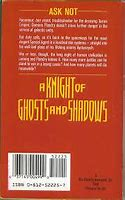
A Knight Of Ghosts And Shadows.
I have probably quoted all of these examples before. They show the wind accompanying Poul Anderson's characters through the narrative as if commenting on the action.
When the ychani march to the Dennitzan Parliament:
"A west wind skirled against the sun, whose blaze seemed paled in a paled heaven." (XVII, p. 551)
Heaven pales as the crisis deepens.
When Flandry speculates about a Merseian agent meddling in Dennitzan affairs:
"The wind boomed between walls." (p. 555)
When Kossara Vymezal arrives unexpectedly to address the Shkoptsina (Parliament):
"A moan lifted out of the benched humans, as if the fall wind had made entry..." (p. 560)
This time, the wind outside is not heard but is present as a metaphor.
Finally, for now, when, after the attempted coup:
"Zorkagrad lay silent under bitter blue, as if killed..." (XVIII, p. 569)
- we are told that:
"Day broke windless and freezing cold." (ibid.)
What could be more appropriate than windlessness to accompany apparent death?
Wednesday, 21 January 2026
Anti-Racist Statements
First, although he had originally introduced the Merseians as standard sf pulp villains, he later presented the integration of beings of Merseian descent into the political and economic life of the human colony planet, Dennitiza. See:
A Powerful Anti-Racist Statement By Poul Anderson
When Dominic Flandry and Kossara Vymezal enter the Dennitzan Parliament as part of an ychani (Merseian) demonstration and delegation, Flandry knows that his only certain ally in the Parliament is Merseian by descent.
Secondly, Anderson introduced the Ythrians as primarily alien and different: flying carnivores, therefore territorial, therefore possibly waging a war for territory. Surprisingly, Avalonian Ythrians welcome large numbers of human beings, flying with antigravity belts, into full membership of choths. If there was ever any opposition to such recruitment, then it has been left far behind between instalments.
Saturday, 13 September 2014
Kossara Vymezal
Poul Anderson, Sir Dominic Flandry: The Last Knight Of Terra (New York, 2012).
Kossara learned Serbic from her parents, Anglic from a governess and Eriau from gamekeeper Trohdwyr's family. She calls Trohdwyr's people "ychani," in Eriau, not "zmayi," in Serbic. She learned to walk by clinging to his tail. Her mother sang her the Eriau lullaby, "'Dwynafor, dwynafor, odhal tiv'" (p. 401), although Kossara has no tail. Later, Kossara accepted that, although she was an Orthochristian, Trohdwyr "...remained an old-fashioned pagan ychan." (p. 366)
She served in the Narodna Voyska which had been basic to Dennitzan life since the Troubles: squadrons, regiments, honors, rights, chapels, ceremonies, parade grounds, bugles, pipes, drums, volleys, the flag coming down at sunset, the litany of the dead. An adult, she gave Trohdwyr "...confessions which she did not give her priest." (p. 368) I must not tell a future saint how to practice her religion but, of course, any actions that are classified as sinful should be mentioned to a priest.
Dennitzan Orthochristians canonize St Kossara. Virginity is not necessary for sainthood although unrepented premarital sex would disqualify, if it were known about. However, Kossara did in fact remain a virgin. She did not have sex with her first fiance, Mihail Svetich, before he was killed in action during the war of Imperial succession. Her second fiance, Dominic Flandry, and she were interrupted by a nearby nuclear explosion and, soon afterwards, she was killed in an attack on the Dennitzan Parliament. You have to be dead to be canonized.
Tuesday, 27 May 2014
Dennitzan Democracy
Each of the two species has brought organizational forms from its home planet: human Parliament; Merseian Vachs. The Merseians, although more recent immigrants and a planetary minority, are represented in a third House of the Parliament but sometimes also a large demonstration of zmayi (citizens of Merseian descent) has marched into the Chamber, demanding to be heard.
"...no clash came. Despite what they told [Flandry] when the move was being planned, he'd more or less awaited behavior like that when a gaggle of demonstrators wanted to invade a legislative session on any human planet he knew - prohibition, resistance, then either a riot or one of the sides yielding. If officialdom conceded in order to avoid the riot, it would be grudgingly, after prolonged haggling; and whatever protesters were admitted would enter under strict conditions, well guarded, to meet indignant stares."
- Poul Anderson, Sir Dominic Flandry: The Last Knight Of Terra (New York, 2012), p. 558.
I have never been in Tahrir Square but I have participated in enough sieges of local City Council or management-union meetings to know that what Anderson gives us is (as good as) an eye-witness account.
Dennitzans have also institutionalized, without fully legalizing, the ispravka, direct citizen action, without riots or lynching. Since every able adult is a reservist, they are able to move under discipline either to expel offenders or to detain them while spokesmen demand action from the authorities. Such actions can bring down governments. When Imperials arrest the Gospodar, Terrans and other servants of the Empire are rounded up into certain buildings as hostages. Although the civil authority denounces the action and sends in police, the people guard the buildings and no shots are fired (yet) while hundreds march to intervene in a joint session of Parliament.
Thus, individual Dennitzans participate in an action affecting planetary policies.
Tuesday, 22 May 2012
Dennitza
Terrestrial human beings colonized Dennitza about 2450. About 200 years later, Merseian immigrants arrived and in 3047 comprise 10% of the population. Their self-designation is "ychani," seekers. The human Dennitzan term, possibly contemptuous in origin, is "zmayi." Displaced by political conflicts at home, ychani provided labor for new Dennitzan industries. Able to endure cold better than humans, they mainly live on the Obala, the east coast of Rodna, the main continent in the northern hemisphere, where they specialize in fishing and pelagiculture. The legendary ychan hero Gwyth dared the storms and sea beasts of the Black Ocean.
In Dubina Dolyina province, Danilo Vymezal is both the voivode (hereditary aristocrat) and the nachalnik (governor chosen both by the Gospodar {planetary head of state} and by the popular assembly).
Cultural influences: Vymezal's bugle call is an immemorial Merseian war song; his wife sings an Eriau lullaby to their daughter, Kossara: Dwynafor, dwynafor, odhal tiv.
Religions: human Dennitzans, Orthochristians worshiping in St Clement's Cathedral, later canonize Kossara Vymezal, who has a large tomb on Founders' Hill. Some ychani of the Black Ocean remain pagans referring not to "the God" of Merseian religion but to Afherdi of the Deeps, Blyn of the Winds and Haawan who lairs on the reefs.
Yovan Matavuly led the human pioneers who, like other emigrant groups at the time, wanted to preserve traditions, customs, language, race etc. They speak Serbic and Imperial Anglic while the ychani/zmayi speak archaic mutated Eriau.
Dennitza, still in its ice age, has limited habitable areas. Mahovina turf and woodland duff are soft and springy. Evergreen equivalents are low and gnarled with blue-black plumes. Firebush burns spontaneously to ripen and scatter its seeds. There are no ornithoids but orliks are winged theroids. Flocks of yegyupka fly south; guslars trill; a horned bull leads a herd of yelen; riba caught from the Lyubisha River can be fried to eat.
The original colonists, having to survive without sophisticated technology, developed a baronial clan system which persisted under industrialization. The Shkola, university and research center, preserved learning almost from the beginning of the colony. Lake Stoyan and the capital Zorkagrad are in the center of the Kazan, an astrobleme containing woods, farms and rivers, on Rodna. In Zorkagrad, the fountain before the Capitol in Constitution Square contains bronze statues of the hero Toman Obilich in combat with wild Vladimir. On a rock hill beyond the Square are the battlements of the Zamok or Castle, the executive center.
The Gospodar, elected out of the Miyatovich family by the plemichi, clan heads and barons, has supreme executive authority subject to Grand Court rulings on constitutionality. Court verdicts are reversible by the Shkoptsina, a Parliament with chambers for plemichi, commons and zmayi, although more than once in history a demonstration of zmayi has marched into the House of the Zmayi and been heard. One demonstration in 3047 carries the white star on blue standard of Yovan Matavuly and the red axe on gold of Gwyth. A militia, the Noradna Voyska, has been basic to Dennitzan society since the Troubles.
The nachalniki, i.e., heads of okruzhi (baronies or prefectures), are hereditary or elected by resident clans or appointed by the Gospodar depending on ancient usage. Towns and rural districts have elected councils. Ychani have preserved the Merseian organizational form, Vachs. For example, Ywod is Hand of the Vach Anochrin as well as steadcaptain of the fishing village of Nanteiwon on the Obala. Kyrwhedin is Hand of the Vach Mannoch, a member of the House of the Zmayi and moot-lord of the Obala steadcaptains. In this third capacity, he presides when the steadcaptains meet around a table made from timbers of Gwyth's ship in Council Hall at Novi Aferoch at the Elena River mouth.
Gospodar Bodin Miyatovich, having supported the Imperial usurper Hans Molitor, was rewarded with governorship of the Taurian Sector which faces the Merseian Rhoidunate. Ychani, not wanting Merseian rule, are loyal to Gospodar and Emperor. The Dennitzan poet Andrei Simich celebrated the deeds of the Founder and other ancestors but, in the absence of Simich, we must make do with a prose account of Bodin's raid into Merseian space.
Source: Anderson, Poul, A Knight Of Ghosts And Shadows, London, 1978.
(For convenience, dates are as given in Sandra Miesel's Chronology of Technic Civilization but see here.)
Wednesday, 17 September 2014
Explicit Pathetic Fallacy
In Poul Anderson's A Knight Of Ghosts And Shadows, a disciplined, armed procession of four hundred ychan fishers marches towards the Dennitzan Parliament where they will respectfully but firmly request that their leaders be invited to address the Lords, the Folk and the Zmayi, who are meeting in a single chamber. The procession conceals the cloaked and hooded Dominic Flandry and Kossara Vymezal.
The ychani and their two human companions might encounter resistance either from the authorities, Dennitzan or Imperial, or from pro-Merseian assassins. In fact, Anderson, through Flandry, has reminded us of Djana's curse: that Flandry will never get the woman that he really wants. He did not get Kathryn McCormac and now is engaged to Kossara who resembles Kathryn. But they were interrupted before having sex, right after Flandry had reminded us of Djana... We have every reason to fear the worst for Kossara.
Nature obliges with a skirling west wind, a pale sky, sweeping cloud shadows, cold, crying winged animals, branches casting about, leaves blown noisily along the pavement and rain puddles. To clinch everything, the paragraph ends:
"All nature was saying farewell."
-Poul Anderson, Sir Dominic Flandry: The Last Knight Of Terra (New York, 2012), p. 552.
Wednesday, 13 December 2023
The Tale Of Bodin's Raid
A Knight of Ghosts and Shadows, XVII.
As the march approaches the Dennitzan Parliament, Kossara tells Flandry:
"'Here we go, my brave beloved. They'll sing of you for a thousand years.'" (p. 558)
Maybe they will but what we see happening later is Dennitzans celebrating Bodin Miyatovitch and Kossara herself:
"How shall we tell it, brothers, the tale of Bodin's raid?" (p. 341)
"...while [Bodin] lived, no foeman troubled the peace [St. Kossara] brought us through his valor." (pp. 605-606)
The saint inspires. The Gospodar acts.
Flandry planned the raid on Chereion but Bodin led it. Afterwards, Flandry returned home:
"'...he answered Miyatovich: 'I have my own people.'" (XX, p. 605)
- and maybe his role was played down on Dennitza.
The fictional author of the italicized passages is a colleague across the centuries of Hloch who edited The Earth Book of Stormgate. We would like to know the name and rank of this Dennitzan who records and praises Bodin Miyatovitch and Kossara Vymezal.
Monday, 3 August 2020
The Brotherhood Of Beings
After the First Man-Kzin War, impoverished veterans of both sides drink together, then work together. Economic necessity is a powerful force. Suddenly, a man and two kzinti have common interests: good pay; safe working conditions etc. Unfortunately, not everyone sees it that way. Rough-sleeping kzinti are vulnerable to attack by exterminationist fanatics.
Poul Anderson's Technic History presents examples of inter-species integration:
human and Ythrian Avalonians resist the human-dominated Terran Empire to remain within the Domain of Ythri;
green hunters welcome Kossara;
Flandry and Kossara march with Merseians to the Dennitzan Parliament.
Friday, 11 August 2017
Deaths In Fiction
Kossara Vymezal in Poul Anderson's Dominic Flandry series;
Tracy Bond in Ian Fleming's James Bond series;
Mike Havel and Astrid Loring in SM Stirling's Emberverse series.
Such a death, when it does occur, usually happens at or near the end of a volume and is a significant event for the series as a whole. Astrid's death, occurring off stage between chapters, seems to be an exception to this.
Kossara's death should have been expected. We had been told that Flandry would not get the woman that he really wanted and events so far had borne that out. Nevertheless, Kossara's death by violence while addressing the Dennitzan Parliament was devastating.
Sunday, 28 January 2024
Other Anticipations
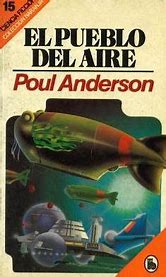
The People Of The Wind.
On reflection, that list of people anticipating the Terran-Ythrian war is not really very comprehensive. Sean suggested that there could have been a scene with the interstellar diplomats trying to head off the conflict. I can think of at least two other possible extra scenes. First, the causes of the war include:
"'That there have been bloody clashes over disputed territories and conflicting interests.'" (III, p. 473)
Tales from the wild frontier?
By contrast, on Esperance, formerly a pacifist colony, Eve Davisson tells Philippe Rochefort:
"'I shan't join the demonstrators...'" (IV, p. 488)
One part of a single sentence is the only indication that there were anti-war demos on the planet called Esperance in the system of the star called Pax! I would want a film adaptation to show such a demonstration - and to do it right. The film makers could get real demonstrators to stage it for them. There was a Roger Moore film where a crowd of what looked like otherwise isolated individuals stood still chanting the single word, "Peace!," in dirge-like tones, then one of them tried to fake evidence of police violence! (Thankfully, I do not remember the title of the film.)
I was pleased when Dominic Flandry and Kossara Vymezal marched on the Dennitzan Parliament with Dennitzans of Merseian descent in A Knight Of Ghosts And Shadows. There have got to be some street politics in Technic civilization. In fact, Flandry refers to other such occasions.
Sunday, 4 August 2024
Police
Mirkheim, XIII.
At an open-air public meeting, there are:
"...police at the corners of the park. Evidently a disturbance was considered possible." (p. 187)
In my experience, police can either prevent disturbances or cause them. But, whatever they do, they act in unison and obviously under orders. There is always some policy. We learn about the police by interacting with them and can be surprised. Preconceptions can be wrong.
Today, in Lancaster, the police were helpful. They were neither too many nor too few. Their liaison officer informed our organizers, for example, when those on other other side who had come from elsewhere had departed so that only a few locals were left around the statue of Queen Victoria. ("Local reference," as it says in Pantomime stage directions.) There were no disturbances. Two city centre windows were found to have been smashed but that might have happened during the night.
One of the many things that I do with Poul Anderson novels is to compare them with life. I have never been in space or on another planet but I have been in parks surrounded by police. I can imagine marching for peace on Esperance or to the Dennitzan Parliament with Dominic Flandry, Kossara Vymezal and hundreds of Merseians.
Onward.
Thursday, 17 August 2017
On Avalon And Dennitza
On Avalon, there is a Parliament of Man and a High Khruath of all the choths. Many human beings join choths and live under Ythrian law and custom. Some Ythrians adopt the human lifestyle of atomic individuals in a global community and, I imagine, are represented in Parliament. A Khruath, i.e., a periodic meeting of all free adults in a given territory, has judicial and limited legislative but no administrative authority. The planetary High Khruath meets every six years or on extraordinary occasions.
On Dennitza, there is a tricameral Parliament, the Shkoptsina, with Houses of the Lords, the Folk and the Zmayi (Merseians) although Mersians also retain their traditional Vachs. A Vach is not ruled by a Head but served by a Hand.
"'The Shkoptsina's no controlled inner-Empire congress. It's about five hundred proud individuals, speaking for as many different proud sections of land or walks of life. It's often turbulent - fights have happened, yes, a few killings - and tomorrow it'll be wild.'"
-Poul Anderson, A Knight Of Ghosts And Shadows IN Anderson, Sir Dominc Flandry: The Last Knight Of Terra (Riverdale, NY, 2012), pp. 339-606 AT Chapter XVI, pp. 548-549.
"'Ychani" is the Eriau name for Dennitzan Merseians:
"'Ychani have always been the Peculiar People of Dennitza. The House of the Zmayi has never entirely spoken for them; it's a human invention.'" (p. 550)
Occasionally, hundreds of Merseians have marched into the Chamber and demanded that their leaders be heard. More like a Khruath?
Saturday, 8 February 2020
Some Very Good Questions
For once, the cover image is directly relevant because this post is about Diana Crowfeather talking with the disguised Targovi in his cage on the Waterblossom. She asks several penetrating questions:
"'But what is our cause? If you're on the side of Gerhart - why? To head off a civil war? But you can't; it's already begun. Mightn't Olaf Magnusson be the better man anyway? And what can we possibly do, stuck here on Daedalus, that'd make the slightest difference?'" (p. 304)
That last question applies to all of us here and now. What can I in Lancaster do to affect events in London or the Middle East? But, if a lot of us gather in one place, then we might do something. Dominic Flandry and Kossara Vymezal are escorted into the tricameral Dennitzan Parliament by a demonstration of zmayi. Campaigners hope to mobilize a million people for an event in Britain later this year. I will be there and will report back here. Major events are, like science fiction, about our future. This is one of those posts that has taken us a bit further than I had expected it to.
Saturday, 20 February 2016
Civil Strife
Such strife is an unfortunate aspect of contemporary society. Science fiction can show us utopias free from civil strife or dystopias where conflicts have intensified but how much sf presents street conflicts in future cities?
In Jerry Pournelle's CoDominium future history, John Christian Falkenberg's troops face street demonstrators and, in Poul Anderson's A Knight Of Ghosts And Shadows, a group of beings Merseian by species but not by loyalty marches on the Dennitzan Parliament, with Dominic Flandry and his fiancee hidden among their ranks. For me, that latter scene rings true.
However, maybe most fiction shows us the leaders and decision-makers at the top of a society rather than conflicts arising from below?
Monday, 25 September 2023
Dominic Flandry Highlights
(i) Flandry and Kossara are concealed among the Merseians who march on the Dennitzan Parliament - the idea of Flandry on a political march, let alone one composed of Merseians!
(ii) In the Cathedral of St Clement, a priest chants behind a screen while the future St. Kossara lies in state and her bereaved fiance, Flandry, effectively prays to the future saint, requesting a sign...
(iii) The italicized concluding passage that becomes a prayer:
Wednesday, 23 September 2020
Resonances And Future Posts
The scene where I most closely identify with Poul Anderson's Dominic Flandry is the one where he uncharacteristically marches with Merseians to the Dennitzan Parliament. Different era, different issues. (And how far the Merseians have come since their first appearance as space opera villains. It is like reading about the Japanese first in a war comic, then in a serious novel.)
Tomorrow, this blog will return to Anderson's The Shield Of Time and, after that, I think, his time travel short stories. We have worlds to win.
Friday, 31 January 2020
A Powerful Anti-Racist Statement By Poul Anderson
Some sf characters are not black, white, red or yellow but green:
Dan Dare's Treens from Venus;
ERB's Tharks, Warhoons and lesser hordes on Barsoom;
Anderson's Merseians.
Thus, sometimes sf addresses current issues obliquely through a sort of "knight's move," two squares forward into a fictional future and one square sideways into an alternative reality. We know that Mars is not like Barsoom but still read ERB. An Alan Moore-style deconstruction of Rupert Bear might show teenage Rupert working in an office in a city beset by species riots between Elephants and Rabbits - ("I'm a Bear!") - simultaneously bizarre- and familiar-sounding.
Anderson introduced the Merseians as space opera villains and would-be galaxy-conquerors in a pulp magazine. (See image.) After such an introduction, these greenskins could have retained that uni-dimensional role throughout an interminable Captain Flandry adventure series. Instead, as the series progresses, we see:
Merseians protecting Flandry on Talwin;
later friendships between Terran and Merseian scientists on Talwin;
cultural integration on Dennitza;
Kossara's life-long friendship with Trohdwyr;
ychani definitely not wanting Roidhunate rule on Dennitza;
Flandry and Kossara marching with ychani to the Dennitzan Parliament;
and -
"...moonlit gravbelt flight over woods, summer air streaming past her cheeks, a campfire glimpsed, a landing among great green hunters, their gruff welcome..."
-A Knight Of Ghosts And Shadows, IV, p. 401.
Perfect: the green aliens have been effortlessly transformed from stereotypical villains into great green hunters giving a gruff welcome. The most powerful anti-racist message is a narrative showing the complete absence of any conflict between members of the two groups.