Saturday, 8 December 2012
Rogue Sword II
In Cathay, he had learned some meditation techniques or martial arts from a Ch'an Buddhist monk and in Constantinople has befriended a Christian military monk of the Knights of St John. Unfortunately, on page 36 (which is as far as I have reread) Lucas and the Knight have got into a sword fight with the wronged merchant from whom Lucas had escaped in Venice. It is to be hoped that the novel will soon move beyond action fiction and sword fights but I might find out tomorrow.
Fourteen years in Cathay occur off-stage between the Prologue and Chapter I. Lucas remembers:
"...graceful red roofs, willows and arched bridges above garden ponds, a philosopher who had been his friend and many gentle beauties who had been his loves...music in violet nights when the cherry trees bloomed, and a certain mountain seen through clouds, and temple bells that rang in his dreams just at sunrise...what had driven him back to the filthy West?" (p. 30)
- but he realizes that he had returned because "...he could not change himself into an Oriental." (p. 30)
Later in the novel, we realize that his time in China had broadened his perspective.
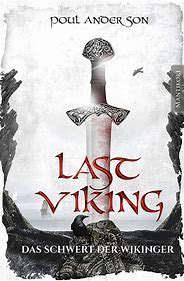
On page 36, the sword fight is interrupted by the unwelcome approach of the Varangian Guard. I have only just googled and learned that, despite serving in Constantinople, the Varangians were what we call "Vikings." This connects with Anderson's The Last Viking Trilogy, Volumes I and II of which I will be able to reread after Rogue Sword.
Wednesday, 6 November 2019
Rogue Sword, PROLOGUE, Continued II
"When the fleet neared the Lido, [Lucas] discerned other craft..." (p. 16)
Merchant ships sail to Venice from:
Dalmatia;
the eastern Mediterranean;
the Black Sea;
Iceland;
Cathay;
Saracen lands;
Genoa.
For some of us, perhaps, a reference to "...the hated Genoese..." (ibid.) recalls:
| Who knows how oft with squat and noisy gun, | |
| Questing brown slaves or Syrian oranges, | |
| The pirate Genoese | |
| Hell-raked them till they rolled | 10 |
| Blood, water, fruit and corpses up the hold. |
- but the Genoese in Lucas' time would not have been able to "rake" anyone.
The knight who challenges Lucas speaks the Venetian patois with a Catalonian accent. (p. 17) He inquires about his missing servant but Lucas responds that he would not trust the latter:
"'...to say a truthful Credo.'" (p. 17)
Lucas' Venetian father was stationed at the mercantile center at Canea on Crete.
Lucas' Venetian master had caught Lucas with his wife on returning from "'...an entertainment at the Rialto.'" (p. 19)
Now, what news on the Rialto?
-copied from here.
The Catalan knight, being one of those "...haughty nobles of Iberia...," (ibid.) is merely amused to hear of a Venetian merchant's discomfiture.
This is a dense PROLOGUE but that is what we have come to expect from Andersonian texts.
Wednesday, 12 December 2012
Changing Times
Lucas, the hero of Rogue Sword, is a transitional figure and a modern man:
the illegitimate son of a Venetian father and a Cretan mother;
learned the handling of boats from his stepfather;
learned Greek and Latin from mother's uncle, a monk;
at eleven, thanks to his natural father's family, was apprenticed to a Venetian counting house;
learned half a dozen languages in the cosmopolitan Republic but left urgently because of an affair with his employer's wife;
became a knight's attendant;
travelled with a Venetian merchant to the Crimea, Bokhara and Samarkand;
was captured and imprisoned by the Genoese but escaped;
travelled with a Tartar merchant and spent time in Cathay;
homesick, returned to the West but no longer felt at home there;
familiar from childhood with Catholic-Orthodox conflict, was influenced by the Cathayan belief in many (or no) roads to God;
found no reasonable answer to the question of what God wanted of men;
valued Oriental hygiene and Cathayan police procedures that prevented the planting of evidence after an accusation had been made;
gains an ambiguous social standing -
" 'If you were clearly of gentle rank...you're no simple commoner who must be punished for assaulting a cavalier. Confound it, Lucas, you aren't anything! Neither in birth nor nation nor way of thinking. Does anyone alive understand you? Do you understand yourself?' " (p. 146)
Maybe he is an American?
Friday, 1 August 2025
Lucas And God
"On [Lucas Greco], whose childhood had been marred by the clash between the Catholicism of his father's people and the Orthodoxy of his mother's, the Cathayan belief that there were many ways to God, or else none at all, had fastened powerfully. Only in the last few years, as he approached an age where the meaning of things overshadowed the things themselves, had he wondered - more and more often - what God truly wanted of men. Nowhere had he found a reasonable answer." (p. 49)
"...ways to God..." could mean just ways to oneness with the transcendent or eternal, whatever that is, whereas "what God wants of men" implies a transcendent person in the Biblical/Koranic sense.
Do "things" have a meaning? They are not nouns referring to entities other than themselves. In this context, I prefer "value" to "meaning." Life is its own value.
People live by many ways. Some ways lead to greater understanding. I like the Hindu approach which recognizes that many people personify reality whereas others do not.
How can reality in its primary state be a self-conscious being, a person? Reality has developed and evolved and thus has become conscious of itself through many psychophysical organisms. We are it.
Wanting to understand why people believe differently, I will reread Surprised By Joy, CS Lewis' account of his conversion first to Theism, then to Christianity. I already know first that his approach to Theism involved philosophical reasoning that I disagree with and secondly that his account of his acceptance of Christianity is anything but complete. I have read the Gospels and Gospel commentaries and do not share Lewis' view of them. However, we seek mutual understanding.
(I met an Evangelical who, having read Surprised By Joy, remembered only the account of the moment when Lewis first believed that Jesus Christ is the Son of God and had forgotten everything else. Let us contemplate the whole story.)
Lucas clearly benefited from his time in Cathay.
Thursday, 7 November 2019
In Constantinople II
We continue to learn the geography of Constantinople as Lucas and Hugh walk through the city. Wind blows from the hills above Galata. As they approach the Venetian district, a fellow Catholic asks directions to the forum of Amastrianon. Then he recognizes Lucas and a fight ensues. Lucas remembers chivalric romances with "...a single knight against a thousand paynim." (p.35) He was taught moves useful in fights by a Ch'an Buddhist monk in Cathay. (Ch'an moved to Japan and became Zen.)
After the fight, Lucas and Hugh agree to meet the following day "'...after the hour of nones.'" (p. 37) Lucas asks the rescued slave girl, "'Rhomaizeis?'" (p. 38) I googled this word and found it only here. Conversing in Genoese and humming a chanson, Lucas takes the girl to his lodging in the Phanar slums where he has presented himself as a sailor from the Morea because Venetians are still hated. For example, the fleet of Giustiniani had harried only four years previously.
The historical facts and details are like currants in a very rich fruit cake.
Saturday, 30 January 2016
China
China is a big country that maybe does not get a lot of attention in Poul Anderson's works?
In "How To Be Ethnic In One Easy Lesson," the large quadrupedal alien, Adzel, performs the Chinese dragon in street parades while he is a student on Earth.
In The Broken Sword, the supernatural beings of different national traditions coexist and (I think that) Chinese beings are mentioned.
In Rogue Sword, Lucas has returned from Cathay.
China is more civilized than Europe here.In The Boat Of A Million Years, one of the immortals is Chinese. See here. Thus, his introductory chapter is set in China.
In "SOS," Pitar Cheng leads a Great Asian space fleet.
Finally, not to ignore our ever-growing food thread, in exchange for his dragon performances, Adzel:"...has an unlimited meal ticket at the Silver Dragon Chinese Food and Chop Suey Palace."
-Poul Anderson, "How To Be Ethnic In One Easy Lesson" IN Anderson, The Technic Civilization Saga: The Van Rijn Method, compiled by Hank Davis (Riverdale, NY, 2009), pp. 175-197 AT p. 195.
What have I missed? (See comments.)
Wednesday, 12 October 2022
Years
Monday, 24 December 2012
Hyperborea
In the concluding Chapter of Volume II, that claimant, who has by now been King of Norway for many years, leads an Arctic expedition in search of Hyperborea, Jotunheim or whatever else is to be found to the North. A learned Saracen had told him that the world was round. He might:
sail over the top to Vinland or Cathay;
find Hyperborea, believed by the Greeks to be " '...a land of ageless springtime, beyond the north wind...' " (Anderson, The Road Of The Sea Horse, New York, 1980, p. 247);
find the Norse Giant Land, the World Serpent, Ydhun's apples, the well of youth or unicorns in fields where flowers are stars.
What they do find is cold, darkness, fog, icebergs and a whale until they turn back to be well rewarded by their King but with a story that will be recorded only in "...some monkish chronicle..." - and in a Poul Anderson novel (p. 253).
Tuesday, 28 June 2016
Supernatural Beings
Fleeing elves scatter booty to delay trollish pursuit as Hrolf Kraki did when pursued by King Adhils.
Goblins are:
"...a race half-way between elf and troll, green-skinned and squat but of not unpleasing aspect." (p. 78)
Did we know that or has Poul Anderson just made it up? Valgard the Changeling is the son of the elf Imric and his troll prisoner so is Valgard a goblin?
"...a yellow demon-shape..." (p. 78) is explained as:
"'One of the Cathayan Shen (see also here), whom [the elves] took captive in a raid. He is strong and makes a good slave.'" (p. 79)
The Shen, like a beam of light, can move only in straight lines so a dwarf runs ahead to hold a shield across corners for the Shen to rebound from. Thus, elves fight trolls and enslave Shen, goblins and dwarves.
Friday, 8 November 2019
A Solid World And A Waste Of Years
I think that I am proving a point here, whether or not anyone else agrees with it, that the actions and adventures of Poul Anderson's historical novels occur in a solid world that remains invisible to the readers if they just read past all the place names and other local details as I used to do. All of the background information in these fictional narratives imparts a strong sense of place and time, including both physical and political geography.
To continue:
"'The quarrel took place beyond the Bailo's jurisdiction...'" (p. 45)
"'I suppose you know that Holy Church has forbidden Christians to sell their fellow...'" (p. 46)
- human beings? -
"'...believers. Therefore slavers are at pains to withhold the Word of God from their poor pagan victims.'" (ibid.)
That makes sense, doesn't it?
Lucas has traveled:
by sea "...to the Crimean port, Soldaia, which Venice maintained." (p. 47);
by caravan to Bokhara and Samarkand.
Soldaia has fought the Genoese colony, Kaffa.
Lucas has served a Tartar merchant and visited:
Sarai;
Karakorum;
Khan Baligh;
Cathay;
Sinope;
Anatolian emirates;
Trebizond. (Scroll down.)
He has been with many women including a Kazakh and Mei-Mei in "...the Heavenly City." (p. 48)
However, most of the women that he has known are:
"...nearly forgotten, lost in a waste of years and miles." (ibid.)
The phrase, "...a waste of years...," could be applied to Anderson's time travel saga, "Flight to Forever," but also fits as a description of a man's life.
Wednesday, 29 June 2016
Faerie Alliances
This "Faerie" is not a single realm ruled by Auberon but several realms, including Alfheim and Trollheim. In their coming war against the elves, the trolls' allies will be:
most goblin tribes;
demons of Baikal;
Shen of Cathay;
Oni of Cipangu;
Moorish imps;
werewolves;
vampires;
ghouls;
dwarf thralls -
- whereas the elves might be helped only by some goblins and dwarves and the Sidhe. However, trollish spies have ascertained that the Sidhe will fight only if they are attacked, which the trolls will not do this time.
As with the Merseians of the Roidhunate, accurate military intelligence would disclose that the trolls use each truce only to prepare for the next war "'...while the elves loafed and intrigued among themselves and took their pleasure.'" (p. 91) It would be necessary to act on such intelligence, with a preemptive strike, permanently depriving the trolls of the ability to wage war. I do not like to talk about extermination. In the Technic History, the Merseians on Dennitza are proof that not all of their race serve the Roidhun.
Tuesday, 25 February 2014
1280 AD
Poul Anderson, Time Patrol (New York, 2006).
In 1280 AD:
Kublai Khan was the Great Khan of the Mongol Empire;
Manson Everard and John Sandoval of the Patrol watched a Mongol expedition advancing through North America.
Poul Anderson presents all of this background information, which I have checked on google (I am not sure that Philip the Bold's titles included "King"?), before describing how Everard and Sandoval interact with the expedition, which they must prevent from returning to China.
Tuesday, 6 March 2018
Marco Polo And Time Travelers
In 1280 A.D.:
Kublai Khan welcomes any guests who bring new knowledge or philosophy;
these include the Venetian merchant, Marco Polo;
there are revolutionary secret societies in Cathay;
Japan has repelled one Mongol invasion;
other important events occur, too numerous to recount here. My source for this information is:
Poul Anderson, "The Only Game in Town" IN Anderson, Time Patrol (Riverdale, NY, 2010), pp. 129-171 AT p. 133.
After "August," (see also here) Neil Gaiman's Fables And Reflections collects "Soft Places," Gaiman's account of Marco Polo's passage through the Desert of Lop where Marco meets people from his future. In Doctor Who, Marco met the Doctor but did not mention time travel in his memoirs because he thought that it would not be believed.
In "Soft Places," it is suggested that it was the explorers like Marco that froze the world into rigid patterns. See Anti-Magic.