Friday, 15 March 2019
"The Faun" III
8 Arcadian years = 17 Terrestrial. (See A Scene On Mithras, here.)
We learn that:
Tom is a "Faun," able to open all his senses to his total environment;
the Arcadian population is 10,000;
whereas frozen animal sperm and eggs were sent to Rustum, frozen embryos were sent to Arcadia;
Edmund Wylie is the Arcadian president;
in a passage narrated from Wylie's pov, Wylie sees the Faun who is referred to as "Tom," thus indicating that the president knows the Faun's name;
in fact, the surprise ending is that Wylie and Tom are father and son;
a Faun, like the planetary consciousnesses in the Harvest of Stars Tetralogy, directly experiences the ecology.
Thursday, 14 March 2019
"The Faun" II
Tom, tall, thin, wearing a scaly leather tunic and carrying knife, rifle and backpack, is accompanied by a six-legged "cynopard" with fur of the same bluish green as the local leaves. Peering, listening and smelling, Tom senses something wrong and leads the cynopard in a particular direction.
Having following a peacock moth off the trail, Edmund Wylie has become lost and separated from his party. He is a settler on Arcadia, a planet of Epsilon Eridani, eleven light years from Earth. The journey from Earth had involved decades in suspended animation, as in both the Rustum and the Directorate future histories. However, in its history, Rustum, twenty light years from Earth, is the nearest habitable extra-solar planet whereas, in the Directorate history, Mithras, thirty three light years away, is so far the only habitable planet to be found within a radius of under fifty light years. On the other hand, at the time when the base on Mithras is being terminated, less than half the stars within that radius have been visited. Thus, Arcadia, although nearer, might have been found later.
Settlers on Arcadia have introduced squirrels and other animals and talk of somehow cooperating with nature which is where the Faun will come into the picture. Cooperation with nature sounds like an improvement on the losing war against a hostile environment that human beings were obliged to wage on Sibylla.
Saturday, 28 July 2012
A Future History Or Not?
These stories are the last two in Anderson's collection New America and the first two in his The Queen Of Air and Darkness and other stories. Anderson collections include redundancies that would have to be edited out of any Complete Works editions.
In New America, these two stories are preceded by four about the colonisation of Rustum. Those four in turn are sequels to the four Rustum History stories collected as Orbit Unlimited. In The Queen..., the two stories are followed by four others, all but one also featuring slower than light interstellar travel and extrasolar colonies.
Do these thirteen stories form a continuous sequence? Nine are definitely connected by common references to Rustum. Further, slower than light travel, extrasolar colonies and their related economic, political and ecological issues are strong common themes. However, the author's Foreword to The Queen... states that the stories in the book do not project a single future history. An italicised "Publisher's Note" in New America implies that both "The Queen Of Air And Darkness" (agree) and "Home" (disagree) fit into the Rustum History timeline. However:
in the Rustum series:
there have been Atomic Wars;
Earth is ruled by a Federation;
there are enduring extrasolar colonies.
In "Home":
there has been a Solar War;
Earth is ruled by a Directorate;
there are terminated extrasolar bases.
These are different timelines. "Home" could have been called "Earthman, Come Home," which is the title of a James Blish collection. Anderson's characters reflect on history and argue about whether the terminated Mithran base should be turned into a colony. Would human beings expanding across the planet displace the pacific native Mithrans? In one chilling passage showing a Mithran point of view, we, though not the human characters, learn that if the human beings were to exceed certain limits, then a Mithran:
"...would be forced to kill. But he would continue to love as he did." (1)
Although "Home" is not consistent with Rustum, it might just form a very loose tetralogy with the three other interstellar stories in the collection. In "The Alien Enemy," the Directorate has a failed colony on Sibylla but surviving colonies on Zion, Atlas, Asgard and Lucifer. Did the Directors, after terminating bases, reverse their policy and initiate colonies?
"The Alien Enemy" has a remarkable surprise ending in which Anderson characters succeed against all the odds. Unable, with their limited resources, to survive on the inhospitable Sibylla, the colony's leaders had faked an alien attack in order to be recalled home. On Earth, they are given the challenge of developing the Sahara where, hardened by Sibylla, they succeed and, decades later, when a spaceman has returned from his next voyage, they are making a difference to Earth itself.
"The Faun" is set on Arcadia which could be another of the Directorate's colonies. "Time Lag" involves relativistic travel between Chertkoi and Vaynamo which could also have been colonized by the Directorate. I suggest that the nine Rustum History stories be collected in one volume and the "Home" four in another.
(1) Anderson, Poul, New America, New York, 1982, p. 253.
Tuesday, 22 March 2022
Epsilon Eridani In Two Timelines
Wednesday, 13 March 2019
Revisions
Three Paperbacks I
Three Paperbacks II
Three Paperbacks III
Poul Anderson's Ninth Future History
A Future History Or Not?
Orbit Unlimited
"Robin Hood's Barn"
"The Burning Bridge"
"And Yet So Far"
"The Mills Of The Gods"
New America
"My Own, My Native Land"
"Passing The Love Of Women"
"A Fair Exchange"
"To Promote The General Welfare"
"The Queen Of Air And Darkness"
"Home"
"Our Many Roads To The Stars"
The Queen Of Air And Darkness And Other Stories
"The Queen Of Air And Darkness"
"Home"
"The Alien Enemy"
"The Faun"
"In The Shadow"
"Time Lag"
Revisions
(i) Remove "Home" from New America.
(ii) Put "Our Many Roads To The Stars" in a collection of non-fiction articles by Poul Anderson.
(iii) Remove "The Queen Of Air And Darkness" from The Queen Of Air
And Darkness And Other Stories which would therefore have to change its title.
(iv) Put "In The Shadow" in a multi-volume collection of non-series short stories by Anderson.
(v) Combine Orbit Unlimited and what is left of New America in one volume to be called The Rustum History.
(vi) Republish what is left of The Queen Of Air And Darkness And Other Stories as The Directorate History.
That would give us:
one volume of articles;
many volumes of non-series short stories;
two one-volume future histories -
- although whether we would have linked "The Faun" and "Time Lag" to "Home" and "The Alien Enemy" if they had not been collected in the same volume is another question.
Although the Directorate sequence is not prolonged, we recognize within it those elements of future historical writing that could have generated a framework for a longer series.
Wednesday, 1 February 2017
"The Faun": Opening Paragraph
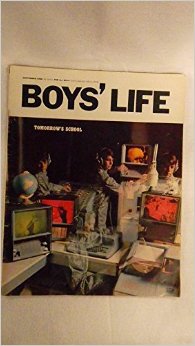
"The Faun" was published in Boy's Life and thus is one of Anderson's juvenile works (see also here). The title and the opening sentence:
"A wyvern flew up in a thunder of splendid wings."
-Poul Anderson, "The Faun" IN Anderson, The Queen Of Air And Darkness and other stories (London, 1977), pp. 86-90 AT p. 86 -
- suggest a fantasy but the following sentences clarify that the story is set on a colonized extra-solar planet.
"A python tree coiled its branches." (ibid.)
A tree so called because its branches move.
"A chiming rang among the tiny red blossoms that covered the ground." (ibid.)
As often before, Anderson tells us what a terrestroid planet has instead of grass.
"Alien in the forest, a grove of pines stirred only to a breeze." (ibid.)
So this planet has been colonized by human beings who have brought some of their own ecology with them. And that concludes the opening paragraph.
Monday, 27 June 2016
Out In The Weather
"Presences moved in the night, but they were not men -" (The Broken Sword, p. 20)
We expect other supernatural beings but the presences turn out to be a wolf, a wildcat and small animals which:
"...were aware of the elf-earl's passage and shrank deeper into the gloom." (ibid.)
Animals would sense what most human beings would not.
In the elven castle, which looks like a tor, flutes have "...voices like mountain brooks..." (p. 21) and a troll-woman's voice is "...like a thunder..." (p. 22) Again, supernatural beings merge with natural phenomena. The troll is a prisoner and there are dwarf thralls. We can safely deduce that in this narrative every kind of mythological being exists.
"Mountainous in the east, with runes of lighting scribbled across, a storm stood on the horizon." (p. 23)
"...lighting..." should be "lightning"?
We have become very familiar with wild winds in Anderson's works and, sure enough, in the next sentence:
"Wind hooted and howled." (ibid.)
Shortly after that, thunder is:
"...boom and bang of great wheels across the sky." (ibid.)
No sooner have we thought of Thor than:
"Imric urged his horse to yet wilder speed. He had no wish to meet Thor out here in the night." (ibid.)
Gods also exist and an elf fears a god as the animals feared the elf. After stealing a human child, Imric sees Odin leading the Wild Hunt. A bad sign...
Finally, at the beginning of Chapter IV, the stolen child, Skafloc, begins to grow up in Alfheim where elven lays are:
"...like sea and wind and soughing branches." (p. 26)
Other Beings
Skirnir, messenger of the Aesir, attends Skafloc's naming-feast.
Sprites, dimly seen, inhabit waterfalls.
Gnomes live under trees.
Goblins live in caves.
Skafloc meets an exiled faun.
In the south:
Pan is dead;
the priests of the new god cut down the sacred groves;
exorcisms have killed dryads;
temples are empty and crumbling;
nymphs and Olympians are no more.
One world culture is being imposed.
Meanwhile, Skafloc, bridging the realms of men and elves, also learns from foxes and otters which might be kin to elves.
Thursday, 14 March 2019
"The Faun"
"A wyvern flew up in a thunder of splendid wings." (p. 86)
We think that we are reading a fantasy. However, the text continues:
"A python tree coiled its branches. A chiming rang among the tiny red blossoms that covered the ground." (ibid.)
The python tree sounds alien. The ground blossoms sound like another of Poul Anderson's extraterrestrial alternatives to grass. The last sentence of the opening paragraph clinches it:
"Alien in the forest, a grove of pines stirred only to a breeze." (ibid.)
Pines are alien here. This is another planet settled and modified by human beings. The second paragraph begins:
"The boy, Tom, stepped out from among them." (ibid.)
Saturday, 26 March 2022
Two Endings
"'All right, Dad.'" (p. 90)
-which reads like a prologue. However, this story of only five pages was originally published as a one-off in Boys' Life and has sufficiently conveyed its central notion of an individual trained to tune in to his total environment.
"In The Shadow" ends when a spaceship crew has agreed not to return to Earth, currently ruled by a dictatorial Gearch, but instead to remain in the outer Solar System, there to spend years communicating with the inhabitants of a newly detected shadow planet. We might expect to learn some of what they learn from this interplanetary, even inter-universal, communication. Instead, the story ends when its viewpoint character articulates his reason for staying where he is:
"'Freedom. I'm my own man now.'" (p. 111)
Saturday, 15 September 2012
Mixing Mythologies
Lau Tzu was supposedly a contemporary of Confucius and a teacher of the Buddha;
Mani claimed to fulfill the teachings of the Buddha, Zarathustra and Jesus;
the Romans identified Zeus and Thor with Jupiter.
Modern fantasy writers, notably Neil Gaiman in The Sandman, can imagine all mythological realms as coexisting and interacting. In Poul Anderson's The Broken Sword (London, 1977):
Odin masquerades as Satan and lists "Brahm" as one of the names of Time;
a faun flees north after the Olympians have died;
the elves enslave one of the Cathayan Shen.
I am still rereading The Broken Sword so expect to find other examples.
Anderson knows that "...As..." (a god) is the singular of "Aesir" (the gods) and does not use the Marvel Comics monstrosity, "Asgardian." (p. 84)
Tuesday, 22 March 2022
Cooperation With Nature
"But he felt now, in his bones, that he belonged to city and machine. He did not quite understand the new generations, scattering themselves thinly across the world, speaking of cooperation with nature rather than war against it." (p. 87)
For cities as opposed to nature, see Cities. For war against nature, see The Enemy. However, we cannot be merely at war with nature. If we were, then it would not have produced us. Some environments we are adapted to. Most environments are hostile to us. To survive in them, we must apply, thus cooperate with, the laws of physics. As Hegel said, conscious beings are both at one with and in conflict with the rest of nature. The conflict is incorporated into a higher synthesis not fully comprehended yet.
The Faun, like the Life Mothers in the Harvest of Stars future history, personifies nature-consciousness synthesis.
Wednesday, 1 February 2017
"The Faun": Continued
A boy, stepping out from among the pines, dressed and equipped for the outdoors life, is accompanied by a six-legged animal, its fur the same bluish green as the leaves on the native plants. They peer, listen and smell: three senses.
The boy, Tom, opens his entire nervous system to the forest. He combines the sensitivity of the Sensitive Man in Anderson's Psychotechnic History with the ecological oneness of the Freeholders in Anderson's Technic History. He has been trained for this purpose so that the colonists will not repeat the environmental mistakes and disasters of their ancestors on Earth.
Just a five page story originally published in Boys' Life but a whole new approach to extra-solar colonization.
Monday, 28 March 2022
Poul Anderson's Past Fantasies
Conan The Rebel is set in a remote and entirely fictional past. In The King Of Ys (with Karen Anderson), The Broken Sword and The Merman's Children, pagan gods and other beings retreat as Christianity advances.
The King Of Ys: the Three end their Covenant with Ys and the last King of Ys converts from Mithraism to Christianity;
The Broken Sword: a Greek faun flees to Northern Europe;
The Merman's Children: Christian priests exile "...with bell, book and candle, all beings of heathendom..." (p. 24) from an island named after Aegir, the sea giant.
However, on a nearby uninhabited islet:
"Enough of the sea god's older power lingered that merfolk could approach from the south and go ashore." (ibid.)
Thus, all of these works read like a single long series. The Three of Ys include Lir, god of the sea, and Mananaan Mac Lir (son of Lir) is in The Broken Sword.
Sunday, 29 July 2012
Poul Anderson's Ninth Future History
Earlier, I listed seven series and one individual work by Poul Anderson that I classified as "future histories":
Psychotechnic;
Technic;
Maurai;
Flying Mountains;
Rustum;
Kith;
the Harvest Of Stars tetralogy;
Genesis.
It is appropriate to end with a Genesis, a new beginning, long after human extinction. With Anderson, there is always more to be said:
"Flight To Forever" and "In Memoriam" are miniature future histories;
the Time Patrol series and The Boat Of A Million Years are "past and future histories";
several works present past and alternative histories, as also does the Time Patrol;
four stories that I thought fitted into the Rustum History timeline instead form a loose "Directorate" future history.
"Home": population has grown so large and resources so low that the Terrestrial Directorate terminates all its extrasolar scientific bases, forcibly if necessary. Generations have grown on Mithras and do not leave willingly.
"The Alien Enemy": Policy has changed. The Directorate establishes extrasolar colonies. Sibylla fails but Zion, Atlas, Asgard and Lucifer survive. Returned Sibyllans, given the Sahara to develop, succeed and make a difference on Earth decades later.
"The Faun": colonists on Arcadia preserve ecological balance. A boy is trained to open his senses and comprehend his total environment.
"Time Lag" is a mini-history. The planet Chertkoi attacks the planet Vaynamo three times at sub-light speeds so that three generations of Vaynamoans grow up to resist. A woman taken captive to Chertkoi returns to meet her great-grandson.
Vaynamo is rural and peaceful, Chertkoi the opposite but both represent humanity spreading and diversifying on an interstellar scale with Old Sol's exact location forgotten a thousand parsecs away. This is an Anderson future.
Sunday, 3 May 2026
Aesir And Others
The Broken Sword.
The Aesir are the Norse pantheon. As As is a god. "Aesir" is the plural: "gods." Asgard is the enclosure of the gods. Thus, a dweller in Asgard is an As, not an "Asgardian," as in Marvel Comics.
Imric the elf-earl:
hears Thor ("Thunder...great wheels across the sky...," III, p. 23);
sees Odin ("...long gray beard...shadowing hat...spear...single eye...," p. 24);
receives Skirnir ("...messenger of the Aesir...," IV, p. 25).
Although I did not remember Skirnir's name, Wikipedia reminds us that he is in both Eddas.
Odin will reappear in this novel.
The omniscient narrator informs us that gods, giants and trolls are "...others..." (ibid.) of the same sort as elves, whatever sort that is. This sort has in common that they do not age and have:
"...few children, centuries apart..." (ibid.)
The text proceeds to mention dwarves, sprites, gnomes, goblins, a faun, Pan, the new god, dryads, nymphs and Olympians. For some of these beings, see:
Friday, 15 March 2019
"Time Lag"
"The Faun" does not refer to the Terrestrial Directorate but does not contradict it either. It and the two stories that do refer to the Directorate are set in periods when people from Earth make round trips to nearby extra-solar planets whereas "Time Lag" is set in a period when planets much farther away have been colonized for centuries.
The opening section is set on the planet Vaynamo in the year 522 Anno Coloniae Conditae.
Comments
Googling "Vaynamo," I find references only to this text.
The ACC calendar is named after AUC.
We do not (yet) know how long a Vaynamoan year is but we may infer that 522 years is a long time.
The viewpoint character has married into a family that has held a Freehold for nearly two hundred years.
Whereas Rustum has a Swift and a Smoky River, Vaynamo has a Swiftsmoke River.
Old Sol is said to be a thousand parsecs away.
The Directorate will not still exist even if we are still in that timeline.
Tuesday, 4 September 2018
Poul Anderson's Juveniles II
"The Faun," Boys' Life, September, 1968. Copyright The Boy Scouts of America.
The above item should have been on the list.
Is "The Year of the Ransom" a juvenile? This is partly a matter of how it was marketed (I am not sure) and of how it struck us (it struck me as juvenile or at least Young Adult).
Four installments of the Technic History are juveniles and Anderson was more imaginative than just to present, e.g., a teenage Dominic Flandry. We should be grateful to the editor, Roger Elwood, and to the magazine, Boy's Life, for making possible these different aspects of the Technic History. A future history series needs to be as diverse and as many-angled as possible.