Showing posts sorted by relevance for query "Symmetry". Sort by date Show all posts

Wednesday, 13 November 2024

"Symmetry"

I am not about to reread anything else this evening but here are some reflections on "Symmetry." (Scroll down.)

I had thought that this story, although it has a fully consistent Psychotechnic History background, was incompatible with the rest of the series because it ends with its protagonist, Dunham, returning to civilization with a matter duplicator which would completely revolutionize society yet is not mentioned anywhere else in the series. 

However, according to the Chronology, "Symmetry," the second last title in the list, is set in the 3100s and the Third Dark Ages, when a lot of technology could well have been lost, began in 3200. The only remaining instalment, "The Chapter Ends," is set tens of thousands of years later and there is an argument to the effect that it does not belong in the series in any case.

Thus, maybe Dunham died in an accident before returning to civilization or maybe his discovery did revolutionize part of the Galaxy for a while before the current civilization came to an end in any case.

I think that "Symmetry" can stay where it is in the Chronology.

Sunday, 10 November 2024

Current And Imminent Rereading

"Virgin Planet."

So far, while rereading the FTL period of Poul Anderson's Psychotechnic History - this period begins with "Gypsy" - we have found no explicit reference back to any of the events of the pre-FTL period that had concluded with "Brake."

When we read:

"The man felt sick. His whole culture was conditioned against war, it remembered its past too well." (p. 103)

- we reflect that this accords with the anti-war ethos of "Un-Man" but, again, there is no explicit reference either to the UN world government or to any of the individual protagonists or particular events of that period. 

Our rereading has brought us to the point where Davis' rebels besiege Ship city. Only ten pages of text remain. After "Virgin Planet" in the Chronology, we find:

"Teucan"
"The Pirate"
"The Peregrine" [novel not collected here]
"Entity"
"Symmetry"
The Third Dark Ages
"The Chapter Ends"

"Teucan" is minor but we will reread it for its future historical references.
"The Pirate" is important as introducing Trevelyan Micah.
My copy of The Peregrine is packed for moving.
(The Peregrine, my personal favourite of this series, has been reread a lot.)
I do not see that "Entity" belongs in this series.
"Symmetry" has a fully relevant background, even mentioning Nerthus.
(I had thought that "Symmetry" could not fit but maybe it can. More later.)
It is argued that "The Chapter Ends" does not fit.

We will reread all this stuff anyway.

Of my copies of The Technic Civilization Saga, Volumes IV and V are larger format and therefore have not been packed yet so I will keep them out for rereading. They collect:

IV, the Young Flandry Trilogy;
V, the two non-Flandry instalments in the Flandry period;
the first four of the eight Captain Flandry instalments.

We can probably find something there to discuss while other volumes are inaccessible. There will also probably be a gap in Internet access.

(The Imperial Stars has the same contents as Young Flandry but a much better cover.)

Thursday, 2 February 2023

Nomads, Nerthus, Cordies, Cosmos

What else are we told about Nerthus?

"(Ship Harpsong of Nerthus, out of Highsky for David's Landing, is long overdue...)"
-Poul Anderson, "The Pirate" IN Anderson, The Complete Psychotechnic League, Volume 3 (Riverdale, NY, July 2018), pp. 137-165 AT p. 137.

- is presented as a typical request for the services of the Stellar Union Coordination Service.

"Nothing awaited [Dunham] on Nerthus but the loss of his ship to his debts."
-Poul Anderson, "Symmetry" IN op. cit., pp. 183-193 AT p. 186.

A reminder that there is a spaceport on Nerthus. 

We are also assured that the Co-ordination Service would never have licensed Dunham as an interstellar explorer if he had been half-educated or reckless. Thus, the Cordies (Coordinators) become another common reference point:

"...there is little which the Coordination Service can do about it..."
-Poul Anderson, "Teucan" IN op. cut., pp. 115-134 AT p. 125.

Finally, stories are linked when their characters swear by Cosmos:

"'...good Cosmos, Alanna!'"
-Poul Anderson, "Gypsy" IN op. cit., pp. 255-270 AT p. 263.

"'I can't help him, oh Cosmos, I can't help him!'"
-Poul Anderson, "The Acolytes" IN op. cit., p. 18.

"'I know a little of your god,' said Joe. 'Your all-pervading primordial Cosmos...'"
-Poul Anderson, "The Green Thumb IN op. cit., pp. 21-41 AT p. 28.

"'Good Cosmos, what're you doing?' he exclaimed."
-"The Pirate," p. 145.

"Before Cosmos - they were egging him on!"
-"Teucan," p. 118.

"'Oh - oh, Cosmos, no!" Her eyes were filled with sudden horror."
-Poul Anderson, "Star Ship" IN op. cit., pp. 273-306 AT p. 300.

"Cosmos, but he was thirsty!"
-Poul Anderson, "Virgin Planet" IN op. cit., pp. 43-112 AT p. 53.

"'AAllmmiigghhttyy CCoossmmooss,, wwhhaatt iiss tthhiiss??'"
-Poul Anderson, "Symmetry" IN op. cit., pp. 183-193 AT p. 183.

(Two Dunhams have spoken simultaneously.)

"'In the name of Cosmos, rendezvous,' he began formally."
-Poul Anderson, The Peregrine (New York, 1978), CHAPTER II, p. 7.

Nine instalments are linked by Nomads, Nerthus, Cordies and/or Cosmos:

"Gypsy" (Cosmos, Nomads)
"Star Ship" (Cosmos)
"The Acolytes" (Nerthus, Cosmos)
"The Green Thumb" (Nerthus, Cosmos)
Virgin Planet (Cordies, Cosmos, Nerthus)
"Teucan" (Cordies, Cosmos)
"The Pirate" (Cordies, Nerthus, Cosmos)
The Peregrine (Nomads, Cosmos, Cordies, Nerthus)
Symmetry (Cosmos, Nerthus, Cordies)

Thursday, 14 November 2024

"Symmetry" II

"Symmetry" was not included in the earlier three-volume Psychotechnic History collection but was collected elsewhere and did not seem to fit in the series for the reason given in the previous post but, now that it is included and placed late in the Chronology, that seems to make sense.

Dunham swears by Cosmos, has a base on Nerthus and knows of the Coordination Service so he definitely belongs in this future history series.

Cordies, Nomads and Nerthus are the three unifying factors in the second half of the History.

The two Wilson Pete stories are set on Nerthus. "Virgin Planet" and The Peregrine have scenes on Nerthus. "The Pirate" and "Symmetry" refer to Nerthus. "The Pirate" even refers to the Nerthusian natives who were discovered in the second Wilson Pete story.

Dunham is a problem-solver. His duplication generates a problem. After the frustration of each duplicate getting in the other's way, there is a moment of realization followed by the solution. Then the series jumps a long way into the further future with "The Chapter Ends."

Sunday, 1 September 2013

Deathwomb

Immediately after "Hunter's Moon" in Poul Anderson's collection, Space Folk (New York, 1989), is his paradoxically entitled short story, "Deathwomb," which turns out to be his contribution to Fred Saberhagen's Berserker series. Yet again, I have had this story on a shelf for years without, as far as I can remember, ever having read it.

Thus, to reiterate some points made earlier, of the twelve items in Space Folk:

"Pride" is a prequel to Anderson's novel, Tau Zero;
"Quest" is a sequel to his The High Crusade;
"Hunter's Moon" is part of Harlan Ellison's Medea series;
"Deathwomb" is part of Saberhagen's Berserker series;
"Symmetry" has the background of Anderson's Psychotechnic future history although it is not part of that series;
"Commentary" is non-fiction.

I think that the remaining six stories are independent although at least two of them are what I call "proto-series":

"Horse Traders" could easily be the first installment of a "horse traders" series;

the very Heinleinian story, "Escape The Morning," written for the Boy Scouts of America, is about young people living, and effecting a rescue, on the Moon and could very easily initiate a series of such stories, similar to the Moon period of Heinlein's Future History.

Anderson contributed to so many other authors' series or shared universes that an entire volume of his Complete Works would be able to hold his Medea story, his Berserker story, his Robots story, his Man-Kzin Wars stories, his Isaac's Universe stories etc;
"Pride" and "Quest" should be published with their respective novels;
"Commentary" belongs in a non-fiction collection;
"Symmetry" could fit in an Appendix of the collected Psychotechnic History;
thus, Space Folk would be halved to six stories which, in turn, could be incorporated into a longer volume about space exploration.

Having said all that, I ought to get on with reading "Deathwomb."

Friday, 3 February 2023

The Diogenes And Dunham

"Entity" has to be set early in the second main section of Poul Anderson's Psychotechnic History because its events take place only a few decades after the invention of the faster than light interstellar drive but it also has to be set late in the History because it involves the discovery of an energy source that should have affected the technology in all subsequent instalments. "Symmetry" is set late in the History presumably because Dunham's discovery of a matter duplicator would have affected everyone and everything else thereafter. In Robert Heinlein's Future History, "'-We Also Walk Dogs'" involves the discovery of antigravity which however does not affect subsequent instalments, where spacecraft have to be rotated to generate centrifugal force.

Larry Niven described such problems in his Known Space future history:

"There were too many unlikely miracles left over from individual stories. For example, from World of Ptavvs came a stasis field so useful that every story set later in time must be examined for reasons why a stasis field would not solve the problem. From Neutron Star, where it was introduced to create an airtight problem in logic, comes an invulnerable spacecraft hull - same remarks. For the Ringworld floor material I had to come up with still another unreasonably strong material."
-Larry Niven, Afterthoughts IN Niven, Tales of Known Space (New York, 1975), pp. 221-223 AT p. 22.

In the case of the two Psychotechnic History instalments, we can imagine that the Diogenes, in "Entity," and Dunham, in "Symmetry," perished in accidents on their return journeys.

The Diogenes is described as:

"...a metal bubble floating through darkness and void for years on end..." (p. 171)

But it is not really that, is it? The spaceship is surrounded not by darkness but by the universe and the interstellar medium which the crew would observe and study throughout their voyage. The concluding sentence is optimistic:

"He went out of the building toward the Diogenes, shining under the stars." (p. 181)

Saturday, 21 July 2018

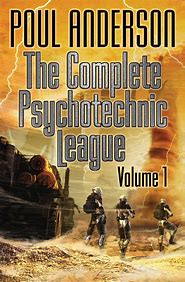
The Complete Psychotechnic League, Volume 3

That looks like a Starfleet uniform on the cover.

I argued here that "Symmetry" does not fit in the Psychotechnic History. However, since it has been included in this volume, it made sense to include it near the end where it can do less damage to continuity!

The volume includes one story, "Entity," that has not previously been listed as belonging to this future history. Is it included by the inclusive or by the exclusive criterion? (See the section, "Constructing an American Future History," in American Future Histories.)

This volume should have included both "Virgin Planet" and Virgin Planet. It is incomplete without the latter.

"Empires rose and fell among the stars." (p. 194)

With this single additional sentence in one of her italicized interstitial passages, Sandra Miesel acknowledges how much happens between "Symmetry" and the concluding "The Chapter Ends."

I have yet to read "The Acolytes," "The Green Thumb" and "Entity."

Friday, 15 November 2024

Causes Of Stellar Union Failure

In Poul Anderson's Psychotechnic History, why does the Stellar Union fail and the Third Dark Ages begin?

Because of conflicts between Coordinators and settlers as shown in "The Pirate"? (See the combox here.)

Or because of a failure to incorporate the matter duplication technology discovered in "Symmetry"? (See the combox here.)

Or because of several factors?

I doubt whether Anderson had envisaged such far-reaching consequences of the discovery made in "Symmetry." However, this combox suggestion is an example of how the series could have been developed. Even if matter duplication remains impossible, any sufficiently advanced technology will require social adjustments and failure to make such adjustments could lead to destructive misuse of the technology. 

Saturday, 9 May 2020

Dunham's Moment Of Realization

"Symmetry."

To grasp and turn the door knob, it is necessary to insert an arm into a transparent cylinder enclosing the knob. Each duplicate Dunham tries to insert his arm at the same time. The box in which they are enclosed grows hot.

"This is the way the world ends, not in chaos but in symmetry, frozen yet blazing hot.
"Hot!
"The double whoop rang off the walls." (p. 193)

Each pulls and drops a hair.

"The one whose hair lands first will open the door." (ibid.)

Problem solved. But there is no mention of matter duplication technology in the remaining installment of the Psychotechnic History.

Tuesday, 24 July 2018

The Incomplete Psychotechnic History And The Iffy Department

A The Complete Psychotechnic League that excludes two entire novels is not complete!

The last three items in Volume 3, "Entity," "Symmetry" and "The Chapter Ends," are all iffy vis a vis Psychotechnic History continuity so maybe it is appropriate that they are gathered together like this at the end of the series: in an "Iffy Department," so to say. It can be argued that the History properly so called culminates, satisfactorily, with The Peregrine.

However -

Two chief threads in the History are psychotechnics and the Nomads. There are psychotechnicians in the Galactic era of "The Chapter Ends." Sandra Miesel's interstitial passage immediately preceding "The Chapter Ends" reads in part:

"...as Trevelyan had foreseen decades earlier, the self-sufficient, enterprising Nomads bore seeds of knowledge safely through the Third Dark Ages. The antecedents of our own civilization were among those who reaped what the wandering Nomad ships had sown." (p. 194)

I think that this passage plausibly bridges the gap between Trevelyan's period
of the Stellar Union with its Coordination Service and the later Galactic period especially since Trevelyan, when leaving the Service and joining a Nomad ship, would have brought with him knowledge of psychotechnics. The technological discoveries made in "Entity" and "Symmetry" might have affected only parts of the galaxy, then been lost during the Third Dark Ages.

Thus, the single irresolvable contradiction remains one line in "Entity" stating that interstellar travel is, at that time, only a few decades old. If Anderson had not dropped "Entity" from the time chart, then he could have edited it to iron out this chronological anomaly.

Friday, 8 May 2020

Knowledge

Poul Anderson, "Symmetry" IN Anderson, The Complete Psychotechnic League, Volume 3 (Riverdale, NY, 2018), pp. 183-193.

Whereas Weber Franz in "Teucan" is a Trader, Dunham in "Symmetry" is a voortrekker, exploring beyond the known for something to sell to civilization:

"Groundlings are apt to forget that material goods are hardly ever worth seeking among the stars: the real treasure is knowledge." (p. 187)

Here, Dunham agrees with James Blish:

Blish on Knowledge

Although Blish addressed the question whether the desire for secular knowledge is evil, there is no doubt about his answer to it, as expressed through other characters.
In another work, an alien says:

“This organism dies now. It dies in confidence of knowledge, as an intelligent creature dies. Man has taught us this. There is nothing. That knowledge. Cannot do. With it…men…have crossed…have crossed space…” 35

Blish’s major character, Amalfi, says:

“That’s the priceless coin, gentlemen, the universal coin: human knowledge.” 36

When the universe ends, a scientist pronounces the:

“…epitaph for Man: We did not have time to learn everything that we wanted to know.” 37

And that is a fitting epitaph for James Blish.
-copied from here.

Saturday, 9 May 2020

Stories' Ends

Recently Discussed Psychotechnic History Stories

Each story fits, to a greater or lesser extent, into the Psychotechnic History framework while also reaching its own particular narrative conclusion:

in "Star Ship," Janazik covers for Anse;
in "Teucan," Weber dies, deservedly;
in "Symmetry," the Dunhams escape.

(Regarding Weber, he is not a hero whose death we regret. In some British comic strips, the central character was not a hero but a villain whose plans never quite succeeded. Weber is definitely in this latter category.)

After a first reading of Poul Anderson's "The Chapter Ends," we might remember its unhappy ending and therefore not want to reread it. However, I think that the story as a whole is positive. It can be read and discussed whether or not it is accepted as the culmination of the Psychotechnic History.

I do accept this story as part of the Psychotechnic future history series because its characters include psychotechnicians whose physiological self-control and psychokinesis are like ultimate culminations of the aims of the Psychotechnic Institute of long ago. We know that the science of psychotechnics survived the outlawing of the Institute. Either the Nomads preserved knowledge of psychotechnics through the Third Dark Ages or the principles of this science have been rediscovered during the long ages of interstellar empires between the Stellar Union and the Galactic civilization.

If "The Chapter Ends" is regarded as independent of the Psychotechnic History, then, following "Symmetry," we can instead imagine a future civilization packed with the immense wealth to be derived from the matter duplication technology discovered by the voortrekker, Dunham.

Saturday, 21 September 2013

Terrestrial And Sigman Metazoans

Stages of Terrestrial Evolution
protozoa, some swimming with cilia;

a clump of aggregated cells;

a hollow sphere;

two concentric spheres;

spheres with specialized inner and outer walls and an opening at either end for intake and excretion;

colonies like sponges and corals;

cells joined end to end as segmented worms;

complex organisms retaining bilateral symmetry and an oral-digestive-anal tract;

branched-off organs like heart and lungs adopting the canal principle.

Stages of Sigman Evolution
spheroidal, not flat, protozoans with universally spaced cilia for swimming and whipping food towards the animalcule which is permeable, without orifices;

cells joined by linking cilia which became tubes for support and fluid conveyance;

complex organisms comprising spheroids connected by rods with axial or radial, not bilateral, symmetry and permeable skin;

possibly sensing and thinking with the whole body, not needing a brain, thinking more slowly but also more deeply.

Conclusion
Human beings have a lot to learn from the disgusting looking alien.

Monday, 23 July 2018

"Entity" III

In "Entity," the spaceship captain is an Andersonian problem-solver experiencing a moment of realization like many other Anderson characters.

A new source of energy being found a few decades after the beginning of interstellar travel makes it hard to fit this story into the Psychotechnic History. Maybe "Entity," like "Symmetry," should be included in the collection not on a "Here is a consistent history" basis but on a "These are the stories that the author thought of fitting into his first future history" basis. Some textual changes could have been made to enhance the consistency of the series but any such changes would have had to have been made by the author.

My next self-appointed task as a blogger is to reread and reassess "Symmetry." Then it will be time to return to Anderson's novel, The Avatar.

Friday, 18 August 2017

Apocrypha

(This issue arose from other reading but is relevant here.)

The Apocrypha are not esoteric documents but books that were included in the Septuagint, the Greek translation of the Hebrew Canon, and therefore also in the Catholic Canon but that were later excluded from the Hebrew Canon and therefore also from the Protestant Canon. I think that I have read about a further distinction between passages included in the Septuagint but not in the Catholic Canon but googling did not shed any light on this. Excluded books automatically gain a reputation for  hidden knowledge and/or heresy. In one useage, "apocryphal" means "false."

This concept can be transferred to future history series where there could be at least two kinds of "Apocrypha."

(i) Non-canonical works: a story might share background details with a future history series but in other ways diverge from the fictional history of that series. See Poul Anderson's "Symmetry."

(ii) Some installments are revised for later publication. Thus, the earlier versions could be collected as "Apocrypha." Poul Anderson's History of Technic Civilization has a few of these.

Tuesday, 21 April 2020

Questionable Canonicities

(i) "Star Ship"
(ii) "The Acolytes"
(iii) "The Green Thumb"
(iv) "Entity"
(v) "Symmetry"
(vi) "The Chapter Ends"

Do these stories fit in Poul Anderson's Psychotechnic History?

For (i)-(iii), see A Galactic Civilization.

For (iv)-(v), see "Entity" III and its links.

(vi) "The Chapter Ends"
This story, set millennia later, makes no reference to the Psychotechnic History - except that it does include psychotechnicians. If anything, its reference to an earlier First Empire based in Sol City contradicts the earlier History which did not have interstellar imperialism.

It has been asked whether Sandra Miesel added this story to the Chronology. I don't know although I assume that she would not have done. Given that it does include psychotechnicians, I think that the story makes sense as happening a long time after the Third Dark Ages. Its title also fits as the end of a series.

Saturday, 16 November 2024

Assessing The Second Part Of The Psychotechnic History

Poul Anderson's Psychotechnic History is unusual in splitting so neatly into two almost completely disconnected parts. In his later Technic History, Dominic Flandry's period incorporates multiple references back to Nicholas van Rijn's period.

In the second half of the Psychotechnic History:

"The Pirate" and The Peregrine make a good Trevelyan Micah two-parter;

they and "Gypsy" make a good Nomads-Coordinators trilogy;

Nerthus is a good unifying factor in six instalments;

"Symmetry" maybe leads in to the Third Dark Ages;

"The Chapter Ends" is a good conclusion;

other instalments add body to the future history.

It is all more than it seems.

A lunch break post.

Wednesday, 26 May 2021

Three Culminations

In Starship (New York, 1982), the Chronology of the Psychotechnic History ends with:

"The Pirate"
The Peregrine
The Third Dark Ages (a period, not a title)
"The Chapter Ends"
 
In The Complete Psychotechnic League, Volume 3 (Riverdale, NY, 2018):
 
"Entity"
"Symmetry"
 
- have been inappropriately inserted between the Third Dark Ages and "The Chapter Ends."
 
"The Chapter Ends" is a culmination of the Psychotechnic History because it describes a Galactic civilization guided by psychtechnicians. However, it has been argued that this story does not fit in the series. If that were the case, then The Peregrine, about a Coordinator joining a Nomad crew, would become the culmination. But, in another sense, "The Pirate," about the custodial role of the Coordination Service, is a culmination because it was written much later and was Anderson's final addition to the series. 

Monday, 23 July 2018

"Entity" II

See "Entity."

A feature common to Robert Heinlein's Future History and Poul Anderson's Psychotechnic History, the latter modeled on the former, is stories included in the earliest version of the time chart but excluded later. There is a period when the history is taking shape.

The Wiki article on Anderson's "Entity" (see here) suggests that Anderson had placed this story late in the time chart because the technology discovered in the story does not affect the history. This is the same reason why I suggested here that it makes sense to place "Symmetry" late in the time chart. However, "Entity" still contains that discordant statement that interstellar travel is only a few decades old.

"He felt again the weariness of his years on the long hunt. Civilization could not expand blindly into the stars. Someone had to go ahead of even the explorers and give a vague idea of what to expect. Only Earth's finest, the most ultimately sane of all mankind, could endure being cooped in a metal bubble floating through darkness and void for years on end, and even they sometimes broke."
-Poul Anderson, "Entity" IN Anderson, The Complete Psychotechnic League, Volume 3, pp. 167-181 AT p. 171.

(Merseians and kzinti conceptualize their galactic endeavor as a hunt.)

Here again is the contrast between infinite space and constricting metal, expressed as a very sharp dichotomy. Sometimes space is seen merely as a dark void to be traversed in order to reach other worlds but it can alternatively be seen as a vast environment full of stars and other sources of energy.

Sunday, 12 February 2023

Publishing The Complete Psychotechnic History

Two ways. 

First: two omnibus collections, STL and FTL. 
TLA's (Three Letter Abbreviations): 
STL = slower than light space travel; 
FTL = faster.

Second:

Vol I UN-Men
"Marius"
"Un-Man"
"The Sensitive Man"
"The Big Rain"

Vol II Cold Victory
"Quixote and the Windmill"
"Holmgang"
"Cold Victory"
"What Shall It Profit?"
"The Troublemakers"
"The Snows of Ganymede"
"Brake"

Vol III Gypsy
"Gypsy"
"Entity"
"Star Ship"
"Teucan"
"The Acolytes"
"The Green Thumb"
"Symmetry"
"Virgin Planet" (shorter version)

Vol IV Virgin Planet

Vol V Star Ways
"The Pirate"
The Peregrine
"The Chapter Ends" 

Un-Men covers the UN period. 
The title, Cold Victory, signifies the overthrow of the Psychotechnic Institute. 
Gypsy indicates the beginning of the interstellar period. 
From "The Acolytes" to The Peregrine is the Nerthus period.