Showing posts sorted by relevance for query "Holmgang". Sort by date Show all posts

Tuesday, 25 September 2012

Holmgang

In Poul Anderson's Hrolf Karki's Saga (New York, 1973):

"In the morning the holmgang took place." (p. 117)

So far, a straightforward narration although we need to know what a "holmgang" is but we might guess this from the context. A man called Svipdag has just challenged the king's berserkers to single combat one at a time.

The text continues:

"This is a usage among the heathen, when men wish to fight out a challenge." (p. 117)

This confirms that the holmgang, like a duel, is the formula for fighting a challenge. It also reminds us, after just over a hundred pages, that the reader is not being addressed by an omniscient narrator. Instead, a Danish woman is addressing an English Christian court several centuries after the events described. That is why she pauses to explain to her audience that the holmgang is a "...usage among the heathen...," where Anderson or his readers might have said "a Norse custom."

The holmgang practice is then described in detail to an audience unfamiliar with it:

a holm is a small island where the antagonists are isolated;
four willow wands mark a field;
an antagonist loses if he is driven beyond them;
the blows go by turns till first blood, yielding or death.

As noted of Saxo and Starkad in the previous post, readers of Anderson's sf have already encountered this term. In a story called "Holmgang," two space suited men agree to fight on an asteroid. Anderson has a unique ability to project the past into the future for story purposes as well as to speculate about possible futures differing qualitatively from previous history.

Sunday, 12 April 2020

The Holmgang

"Holmgang."

A holmgang was a single combat on a small island. This one is between Bo and Lundgard on a small asteroid. For once, I do not care for Poul Anderson's narrative sequence. He begins with the two men stalking each other on the asteroid, then repeatedly flashes back to the preceding circumstances, which makes for disjointed reading. As in the earlier stories of this future history series, I am more interested in the philosophical disagreements than in the physical conflict by which one of the disputants overcomes the other. However, as always, there are many interesting details in the narration.

Thursday, 10 October 2024

Boomtown

"Holmgang."

What interests me most in this story is the:

"...permanent boomtown atmosphere..." (I, p. 21)

- created by the miners on Achilles, the main asteroid at one of the Jovian Trojan points. Unfortunately, the Last Chance bar on Achilles is introduced only so that it can be setting for the murder of Johnny Malone. We learn that:

Venus has changed since "The Big Rain" because it is now the home of violent kilted clans;

a conspiratorial Humanist movement now opposes the Solar Union and the Psychotechnic Institute and has, for its own purposes, murdered Johnny.

So we have returned to the earlier theme of the protean enemy committing atrocities for supposedly noble reasons.

The action moves abruptly back and forth between Bo Jonsson stalking and being stalked on an asteroid and the earlier events that had led up to this "holmgang" duel. Bo and his antagonist argue about Humanism, then fight physically. There is a happy resolution to this story but there is also a successful Humanist Revolt between "Holmgang" and "Cold Victory." History marches on.

Wednesday, 6 January 2016

A Later Period

Another comparison is drawn between space warfare and sea warfare:

"'...it became a battle of standard weapons. Which Dushanovitch-Alvarez knew how to use! A more brilliant naval mind hasn't existed since Lord Nelson.'" (Cold Victory, p. 191)

But Dushanovich-Alvarez commands a space fleet! Are his skills really comparable to those of Nelson?

However, to move on to the post-Humanist period - according to the Chronology of the Psychotechnic Series, the installments set during the Solar Union era are dated as follows:

2120 "Quixote and the Windmill"
2140 "Holmgang"
2180 "Cold Victory"
2200 "What Shall It Profit?"
2205 "The Troublemakers"
2220 The Snows Of Ganymede
2270 "Brake"

In the collection, Cold Victory, "The Troublemakers" is placed between "Quixote..." and "Holmgang." However, since "The Troublemakers" is set inside a large, slower than light spaceship leaving the Solar System, its events are not connected with anything that happens inside the System.

Although the Humanist regime has come and gone, "What Shall It Profit?" begins very like "Quixote..." Two men drinking, but only one of them drunk this time, discuss technological unemployment. The Martian Professor in "Cold Victory" was right to say that the problems addressed by the Humanists have not been resolved. The drunk man complains about the Institute. But the Psychotechnic Institute was suppressed. But this is the Institute of Human Biology.

The drunk, Barwell, makes an interesting point. Modern medicine has not increased the human lifespan. Why not? Radiation levels have gone up and radiation shortens life. So cures for radiation sickness ought to lengthen life? Drunkenly, Barwell summarizes the main idea of Robert Heinlein's Methuselah's Children:

"'...kept it secret. Easy t'do. Change y'r name and face ever' ten, twen'y years - keep to y'rself, don't make friends among the short-lived, you might see 'em grow old and die, might start feelin' sorry for 'em an' that would never do, would it -?'" (p. 200)

Barwell is on the right lines with his discussion of radiation but Anderson has set out to present an idea of longevity differing from Heinlein's. Barwell, claiming to have been sacked from the Institute because he learned too much, also refers to many large rooms deep underground. Human food goes down to them but no one ever comes up...

Anderson is harking back to an earlier era of science fiction when (mad?) scientists experimented in secret.

Sunday, 3 January 2016

Holmgang

"Holmgang" is like the "Green Hills of Earth" period of Poul Anderson's Psychotechnic History:

asteroid prospectors and miners are the last private enterprisers;

there are bases on the Trojan asteroids in Jupiter orbit;

ships leave the trailing group for the outer planets and the leading group for the inner System;

Achilles and Patroclus "...have a permanent boom town atmosphere..." (Cold Victory, p. 115);

Guardsmen visit the Last Chance bar on Achilles in threes;

some bars centrifuge for artificial gravity;

Johnny Malone from Luna City says that the whole System is getting too civilized except Venus;

spaceships have upgraded to the ion drive;

the Sirius, crewed by Malone and Bo Jonsson, carries cargo and passengers.

We recognize this as an old-fashioned story about the future. Unfamiliar word: "tommicker." (p. 118)

Thursday, 10 October 2024

Solar Power

"'The sun pours out about a horse-power and a half, or one and one-eighth kilowatts on every square yard of surface on the earth that is faced directly towards the sun.'"
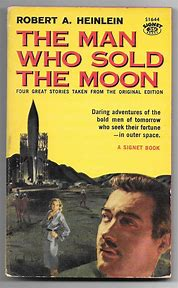
-Robert Heinlein, "Let There Be Light" IN Heinlein, The Man Who Sold The Moon (London, 1963), pp. 33-48 AT p. 41.

"'The sun is pouring out more than we'll ever need...'"
-"Holmgang," III, p. 32.

"'Free power! Riches for everybody! It's the greatest thing since the steam engine.'"
-Heinlein, op. cit., p. 43. 

"'There'll be factories springing up right away all over the Southwest - every place where there's a lot of sunshine. Free power!'"
-ibid., p. 47.

"'Power!... No more fuel worries, no more Martians freezing to death because a converter fails, no more clan feuds on Venus starting over uranium beds -'"
-"Holmgang," ibid.

The next step is a Dyson sphere and there is also sf about that.

Thursday, 12 January 2023

Trojan Asteroids

Poul Anderson, "Holmgang" IN Anderson, The Complete Psychotechnic League, Volume 2 (Riverdale, NY, February 2018), pp. 19-50.

"Un-Man" showed us Mars. "The Big Rain" shows us Venus being terraformed. No story shows us Venus terraformed. "Holmgang" shows us asteroids. The Jovian orbit has two dense clusters of extensively mined Trojan asteroids. Spaceships depart from the trailing group for trans-Jovian space and from the leading group for the inner Solar System. Leading Achilles and trailing Patroclus are permanent boomtowns.

"The Last Chance on Achilles...is a rowdy bar where Guardsmen come in trios." (I, p. 21)

Johnny Malone from Luna City likes the Last Chance because everywhere else, except Venus which he does not like, is becoming too civilized. This is the moment when Poul Anderson's Psychotechnic History most resembles Robert Heinlein's Future History. Space was changing as Rhysling aged and wanted to return to the Green Hills of Earth...

Tuesday, 5 January 2016

The Solar Union: Physics And Politics

The climax of Poul Anderson's "Holmgang" is a neat solution to a technical problem: how to fight an armed man on a small asteroid? Solution: use one of your air tanks to propel yourself right around the asteroid so that you can smash into his back. Similarly, "Brake" also builds towards the solution to a technical problem: how to decelerate a spaceship on a hyperbolic orbit and with insufficient reaction mass? Solution: jettison non-essentials and brake by skimming the Jovian atmosphere until the ship can float in the atmosphere and await rescue.

However, I am currently rereading these Psychotechnic History installments not for their hard sf but for their information on the political opposition to the Solar Union. "Holmgang" tells us that the Humanists have an asteroid base and plan a military uprising. Why?

A Humanist argues that:

three ideologically motivated World Wars ruined Earth;
therefore, populations emotionally reacted against ideology in favor of reason;
by applying reason, scientists produced goods, machines, space travel, new food sources, new cures for old diseases and a workable plan for socioeconomic unity;
however, this New Enlightenment has created new practical problems that it cannot solve;
these are mass unemployment on Earth and cultural resistance both from Asia and from the extra-planetary colonies;
the psychotechs are making enemies by responding oligarchically and unconstitutionally to these insoluble problems created by themselves.

Before we continue to discuss Solar Union politics, let me quote a speculative passage from The Snows Of Ganymede (New York, 1958), Chapter 4:

"Seen from space, Ganymede was bleaker than Luna herself - seamed with mountains, pocked with craters, mottled light and dark over her sterile face." (p. 21)

This story was originally published in 1954. Now we have close up photos of Ganymede (see image). Anderson described it before we saw it.

Monday, 13 April 2020

Impressionism

This cover depicts the asteroidal "holmgang" in "Holmgang."

Current posts are "impressionistic." Knowing that the computer can revert to unusability at any moment, I hastily reread the next few passages of "Cold Victory" to find some point to post about while posting remains possible. However, given that, in any case, these posts are often brief and to-the-point, blog readers might not notice much difference.

Between times, I will try to read ahead and to take some notes for future posting although there is always the pull of other reading and also the need for exercise. Following government guidelines, we can go for a walk provided that we keep our distance from other pedestrians and there are many good walking routes around here.

Wednesday, 24 August 2016

Dwarfs

Poul Anderson, Operation Luna (New York), Chapter 27.

Tolkien, Lewis and Anderson all describe dwarfs. Lewis and Anderson also describe Martians. Dwarfs and Martians have big places in our collective imagination. They are fantasy and sf, respectively. When an author describes Martians, he is free to write whatever he wants. Lewis respects Wells well enough to inform us that the latter's Martians are very different from the "real Martians."

By contrast, when an author describes dwarfs, he has to be authentic to the myths and legends. It is as if the dwarfs were real beings. Lewis informs us that they like digging in the way we enjoy what we regard as leisure activities. Anderson describes the dwarf Fjalar exactly as we expect:

four feet tall;
wide and thick;
musceled and massively boned;
hairy;
large red nose;
bearded;
leather aproned;
sooty and scorched;
unwashed;
wearing wooden shoes.

Fjalar refers to "'...holmgang.'" (p. 246)

"Holmgang" was a story in Anderson's early Psychotechnic Future History. Thus, this is a third allusion to an earlier period of sf. See here.

Tuesday, 12 February 2019

Night Thoughts And Relevant Other Reading

We have had holmgang before, both in Poul Anderson's Hrolf Kraki's Saga and in his Psychotechnic History. Now I discover that the giant Rungnir challenges Thor to Holmgang in Chapter 8 of Roger Lancelyn Green's The Saga of Asgard and I have also found two appropriate images.

This makes for a short post which I dedicate to Morpheus whose realm I will shortly enter.

Sunday, 12 April 2020

Iron Womb And Mercury

"Holmgang."

The heroine, called Valeria, has red hair.

Bo is "...spewed out of an iron womb..." (III, p. 30) I thought that this phrase sounded familiar. The publication details tell us that "Holmgang" was originally published as "Out of the Iron Womb."

Valeria tells Bo and Lundgard that power will be beamed from "'...the hot side of Mercury.'" (III, p. 32) It follows that this story and therefore the entire Psychotechnic History, like Larry Niven's Known Space History, is set in a universe with an old-style Mercury.

Lundgard, a Humanist, is opposed to the Solar Union. More on that, maybe.

Sunday, 3 January 2016

Judgment Day And Valkyries

Religious ideas remain in language long after they have passed from belief. In Poul Anderson's "Holmgang," a spaceman, buried at Helmet Hill on the asteroid Achilles, is said to be waiting unchanged till Judgment Day. When two spacemen agree to "holmgang" combat on a small asteroid, one of them imagines "'Valkyries in spacesuits...'" (Cold Victory, p. 153)

Spiritualists say that each human being is an immortal soul that will survive his/her body. Some Biblical sects say that immortality can only be in a resurrected body. Orthodox Christianity combines these ideas so that there is both an immaterial hereafter immediately after physical death and a future resurrection of the body at Judgment Day. Valhalla was a cycle of fighting, dying, rising and feasting that would end at the Ragnarok.

References to these ideas remain in language even though many of us no longer entertain such notions.

Sunday, 12 April 2020

Gigantic Against The Milky Way

"Holmgang," IV.

Barely surviving after being shot on the"holmgang" asteroid, Bo either dreams or remembers the sights and sounds above the Sound. Next:

"Then he made out the bulky black-painted edge of it, gigantic against the Milky Way, and it was Lundgard, moving unhurriedly up to kill him." (p. 35)

Our old friend, the Milky Way, is getting good coverage, in fact here appears for the third time, in this story. Also present is Orion, described as "marching past," while also reminding us of Anderson's Orion Shall Rise. Familiar constellations should be all the more discernible in interplanetary space and therefore should be mentioned in this kind of fiction. In addition, I expect that new patterns of stars would be seen and named.

Monday, 16 January 2023

Men Fight On Asteroid

"Holmgang."

Perhaps the simplest kind of narrative is: Guys fight. More specifically, in this case, a guy armed only with a wrench fights a guy armed with a rifle on a small asteroid. Solution: Flee; fly right round the asteroid and hit the other guy from behind. Fight won. Problem solved. Neat solution. Andersonian heroes are problem-solvers who usually have a moment of realization before implementing their solutions.

However, this story exists as part of a series. Lundgard's role is not only to fight on an asteroid but also to expound anti-psychotechnic Humanism. This Humanist is defeated but his samideanoj (Esperanto: "members of a group having the same idea") seize power between episodes and are overthrown in the next episode. (Or, at least, one character recounts his role during the anti-Humanist counterrevolution after the event.) As in Anderson's model, Heinlein's Future History, much occurs between episodes. In fact, Anderson's revolutionary Humanists exactly parallel Heinlein's revolutionary Angels of the Lord while also being completely different from them.

This holmgang is on an asteroid instead of on an island. Earlier, on a boomtown asteroid, Boot Hill had become Helmet Hill. Viking and Western narratives project their echoes into space opera.

Saturday, 9 January 2016

Two Moments Of Realization

For discussion of Andersonian moments of realization, see here.

In "Holmgang"
"Orbital velocity equals escape velocity divided by the square root of two.
"For a moment he lay there, rigid..."
-Poul Anderson, Cold Victory (New York, 1982), p. 160.

I did not know that about orbital velocity and that is the sort of technical detail that I usually read past without noticing it. This is the moment when the hero of this story realizes that he can fight his armed enemy on a small asteroid by flying right around the asteroid and attacking him from behind. Orbital velocity...

The view point character going rigid immediately after thinking about his situation is a sure sign to regular Anderson readers that the solution to the current problem has just been recognized but also that we will not be told what that solution is until we are shown its implementation.

In "Brake"
"Banning groaned. Per Jovem, it was too much to ask of a man!
"And then he stiffened.
"'What is it, sir?' Nielsen looked alarmed.
"'By Jupiter,' said Banning. 'Well, by Jupiter!'
"'What?'
"'Never mind. Come on.'" (p. 263)

This is quite explicit. They have a problem while they are approaching Jupiter. Banning will somehow use Jupiter to solve the problem but he will not tell his crewman, and therefore will not tell the reader either, how he is going to do it. And I do not remember, despite having read this story more than once before. Maybe posting a summary of the story's conclusion will help to fix it in memory.

Saturday, 14 January 2023

Science And Religion In Two Future Histories


The comparison between Robert Heinlein's Future History and Poul Anderson's Psychotechnic History continues.

In the Future History, science progresses but society regresses until a US theocracy misuses technology to fake the annual miraculous return of the First Prophet from Heaven. In the Psychotechnic History, science progresses until it satisfies physical but not psychological needs. I think that there is a contradiction here because those sciences included predictive psychodynamics which should have addressed mass psychological needs or at least should not simply have ignored them. However, we must accept Anderson's premises for the sake of his narrative.

The Future Historical Angels of the Lord oppose secularism with religion whereas the Psychotechnic Historical Humanists oppose reason alone with "humanism." The Humanist, Lundgren, says that:

"'...the scientific method doesn't have all the answers.'" (III, p. 33)

- although he specifically rejects a religious solution. However, he also mentions Asian resistance to scientific Enlightenment and, in "Brake," we learn that there are American Kali-worshippers.

I remember my Northern Irish aunt-in-law's response to spiritualism:

"Thon's going against the Bible and religion! I don't think much of the Brethren but give me the Brethren before thon!"

Friday, 11 October 2024

Two Aspects Of SF

In "Holmgang" and in "Brake," the central character triumphs not by winning the philosophical argument but by a neat physical trick. Propelled by one of his air tanks, Bo Jonsson flies right around a small asteroid and hits his rifle-wielding protagonist in the back. In the later story, a disabled spaceship that has shed all unnecessary weight floats in the Jovian atmosphere until its surviving crew and passengers can be rescued. Thus, Poul Anderson combines two aspects of sf: issue-raising and problem-solving. The problems are specific to their particular stories whereas the issues, less easily resolved, continue throughout the series.

The eventual Galactic civilization seems to have transcended social conflicts.

Sunday, 15 January 2023

War And Progress

"Holmgang," III.

Lundgard the Humanist:

"'If a period of interplanetary wars is necessary, let's get it over with... Enough men will survive to build something better. This age has gotten stale. It's petrifying. There have been plenty of shake-ups in history - the fall of Rome, the Reformation, the Napoleonic Wars, the World Wars. It's been man's way of progressing.'" (p. 34)

So World War IV or Solar War I would be a good thing? Enough men will survive a nuclear exchange? To build something better or just to survive - or to build something worse? Wars are inherently destructive and are surely regressive as much as or more than progressive? History is progress or regression, not just progress. Real progress in 1914 would have been international refusal to fight: Social Democratic rhetoric but not reality.

The Psychotechnic History faces a series of enemies of peace and progress. In this story, the protean enemy takes the form of the Humanists.

Thursday, 19 January 2023

Again Two Future Histories

In Robert Heinlein's Future History:

pre-space flight: the first four stories
interplanetary period: The Green Hills of Earth
colonization of Venus: "Logic of Empire"
revolution on Earth: Revolt in 2100
longevity: Methuselah's Children
generation ship: Orphans of the Sky
FTL interstellar period: Time Enough For Love (but I discount it)

In Poul Anderson's Psychotechnic History:

pre-space flight: "Marius"
interplanetary period: "Un-Man," "Holmgang," "Brake"
colonization of Venus: "The Big Rain"
robots: "Quixote and the Windmill"
counterrevolution on Earth: "Cold Victory"
longevity: "What Shall It Profit?"
generation ship: "The Troublemakers"
FTL interstellar period: "Gypsy" etc