Sunday, 20 April 2025

Fiction/Science Fiction Interface

A contemporary novel heavily featuring computers, the Internet, communications satellites and mobile phones would have been sf if published earlier in our lifetimes. I am thinking of Stieg Larsson's Millennium Trilogy and some novels by John Grisham but there must be many other examples. The same would apply to a novel that featured the International Space Station or current orbital flights. James Blish's Fallen Star was a contemporary novel. A character claims to be a Martian and I took him to be telling the truth but Blish said that he was a psychotic and could have had some other kind of psychosis that did not involve thinking that he was an alien. Then the novel has an epilogue set in the near future when crewed spaceships are about to leave Earth orbit to go to Mars so that one section is sf.

I think that this means that the fiction/science fiction interface is an interesting place to explore and Poul Anderson would have been good at this as at everything else.

If we have First Contact in our lifetimes, then references to that in fiction will not be sf. In one sense, we are living in the future now.

Crucifixion


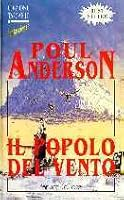
The People Of The Wind.

Admiral Cajal has a crucifix in his room in the middle of the superdreadnaught, Valenderay. When he has spoken bluntly to High Wyvan Trauvay of Ythri, there is a prolonged silence during which:

"Stillness murmured around crucified Christ." (XII, p. 575)

This is a moment in which the wind would usually make itself heard. However, Cajal is in a spaceship conversing with Trauvay by screen. There might be wind outside Trauvay's eyrie on Ythri... But, in Valenderay, stillness murmurs, paradoxically. There will be some slight sound from all the machinery. There has to be something like a sound in the ears or at least in the minds of the characters. 

Crucified Christ graphically represents the suffering threatened to Ythri if it does not yield. Poul Anderson's symbolism is always full on.

Here at Blog Central, we prefer the seated Buddha, the yin-yang symbol or even the fish to the crucifix. The Terran Empire is not officially Christian but Cajal is from Nuevo Mexico. All the people and planets seem real.

What Ythrians Are Like

The People Of The Wind, XI.

An sf series like Poul Anderson's Technic History, or like Star Trek, builds up in its audience a cumulative perception of what certain alien species are like and of how they differ both from humanity and from each other: Ythrians and Merseians; Vulcans and Klingons.

Tabitha Falkayn tells Philippe Rochefort, a prisoner of war on Avalon, that Ythrians:

regard war as an impersonal phenomenon like a famine;

therefore do not hate him;

do not engage in casual conversation;

often play chess.

That non-engagement in casual conversation is common to Merseians. Another datum about Merseians is that imported Terran tea is grown throughout the Roidhunate. I wonder whether Nicholas van Rijn was involved at the start of that.

Imperial Terrans still enjoy or endure mass-produced entertainment whereas human and Ythrian Avalonians do not: no reruns of Star Trek on their screens.

A fan of either series should be able to predict how a member of a particular species will respond to a new situation.

Admiral Cajal thinks:

"These Ythrians are supposed to be satanically proud, but not to the point of lunacy." (X. p. 555)

"Satanic pride," so to call it, is possible but reprehensible in a human being but natural in an Ythrian although also counteracted by reason.

Different alien motivations are a major factor in Larry Niven's Known Space future history series.

The Ways Of Wind

When rereading Poul Anderson's works in order to post about them, I was surprised to realize how often the background sound of the wind underlines significant pauses in the characters' dialogues and effectively comments on their actions. Given this, perhaps it is appropriate that a Technic History novel is entitled The People Of The Wind and that, in that novel, one character refers to winds of change and another explains that the titular Ythrians:

"'...know more about the ways of wind than men and men's computers can imagine.'" (XI. p. 567)

They can make a boat plane without a keel.

Easter Sunday or not, our new garden needs some work. Maybe I will be back here later.

Saturday, 19 April 2025

Real Places

Poul Anderson's The People Of The Wind makes Livewell Street in Centauri on Avalon seem like a real place. The Bishop's Arms pub on Bellmansgatan in Stockholm is a real place. Googling reveals that Stieg Larsson regularly visited this pub which explains why he mentioned it in his The Girl Who Kicked The Hornet's Nest.

It is that time of the evening when I do non-blog-related reading but find connections anyway. Novelists must make places seem real whether the places are fictional or real. Sometimes we don't know which but googling helps.

I did not expect to publish a picture of the Bishop's Arms or to advertise the pub here but any friend of Stieg Larsson deserves our support. I have become a big fan of Sweden.

Winds Of Change

The People Of The WindXI.

We contemplate cosmic time scales in works by Olaf Stapledon and Poul Anderson, then focus on specific details in a single passage in one novel by Anderson but this is precisely what I appreciate: vast spatiotemporal scales combined with minute inexhaustible details.

The President of the Parliament of Man on Avalon tells Admiral Holm:

"'...the winds of change are blowing.'" (p. 567)

- and Holm responds with:

"'-their finest hour-'" (ibid.)

Maybe we can cite this as yet another intervention by the wind in an Andersonian text? I have always found the phrase, "winds of change," extremely evocative and it has a history, revealed by googling.

"-their finest hour-" is meaningful to people in Britain. My parents' generation heard it spoken.

Mistwood

The People Of The Wind, X.

Does "Mistwood" sound Tolkienian?

"Before sunrise, Ferune departed Mistwood." (p. 558)

That is to say that the body of First Marwarden Ferune, who has died defending Avalon, is disposed of according to the rite of the Ythrian New Faith. We gather that it is appropriate to set off while it is still dark.

The text continues:

"That day his home country bore its name well." (ibid.)

The name bears two syllables, each a distinct word, "Mist..." and "...wood." Both are well represented in the following description.

Mist
There is "Fog..." and "Smokiness..." (ibid.) The fog blows cold, wet and blinding from the sea while the smokiness prowls among trees.

Wood
Hammerbranch boles are thick.
Lightningrod trunks soar.
Sword-of-sorrow stems are ringed.
Boomer tree noise rolls beneath Ferune's house and echoes from ancestral shields.
Boomer trees are remnants of Old Avalon.

Mist and Wood
Moisture drips from trees onto fallen leaves and chimes when it strikes pools among ringed stems.

The rest of this passage describes the funeral ceremony. Sons surrounded by their torches-bearing choth carry the body on a litter over the wilderness high enough to see the Weathermother snowpeaks lit by the hidden sun. When the sun rises, the new Wyvan of Mistwood blows the horn and speaks the words. The sons tilt the litter. The choth drop torches. The widow leads the sky dance. Ferune's spirit is always remembered.

Decision And Duty

The People Of The Wind, XI.

High Wyvan Liaw of the Tarns addresses the Great Khruath of Avalon:

"They who speak for you rejected the demand, as was their duty until you could be summoned to decide." (p. 560)

"They who speak..." acted correctly. 

At a trade union conference in Britain, the delegate from a branch was pressured to change the policy of his branch while addressing the conference. He was not empowered to do this but trade union bureaucrats try to ignore or override the views of members.

We watched the film Conclave about a Papal election. I thought that wanting to be Pope should be a disqualification! The guy that they did elect had not wanted it but accepted it. My daughter's partner, Mike, asked why he accepted it if he did not want it. Because he did accept the outcome of the vote!

In the union, if the vote is against strike, then we do not strike but, if the vote is for strike, then we certainly strike. I had the dubious pleasure of standing outside a Town Hall and telling the Principal and Deputy Principal of the Service in which I worked that we were asking people not to go into work. They replied that they had work that they had to get on with but were donating their day's salary to charity. With anyone else, I would have argued the case further but, in that case, I judged that that was sufficient! Even to keep someone arguing is to delay them going into work and I have seen minds changed on the spur of the moment. In any case, the picketing was all above board and legal. Imagine living in a dictatorship where we could not do that.

We have considered:

Khruath
Conference
Conclave

I have not mentioned "Congress" (US) but votes take place there as well. No doubt we all have our distinctive experiences of and attitudes towards democracy.

Radioactive Slag

The People Of The Wind, X.

Futuristic sf reflects the time at which it was written and can become dated but can also remain relevant for quite some time. When the Terran fleet invests Avalon, the Avalonian Admiral Daniel Holm retorts to Terran Admiral Cajal:

"'Standard technique. Eliminate a space fleet and its planet has to yield or you'll pound it into radioactive slag. Nice work that for a man, that, hunh?'" (p. 554)

We still deal only in parts of one planet and our slag is not radioactive - yet. But what does the future hold? Dystopias warn us what to avoid. Space operas and future histories can also.

Fair winds forever.

Friday, 18 April 2025

Cosmic Time Scales

In the previous post, I skipped past Olaf Stapledon because he did not quite fit the sequence. However, Stapledon's Last And First Men is a single-volume future history that transcends Wells because it recounts the entire future of mankind, not just a single historical turning point. Wells' The Time Machine takes us to the end of life on Earth but skips past most of the intervening events. Last And First Men begins mundanely with European wars in the early twentieth century but later records subsequent human species mastering interplanetary travel and migrating first to Venus, then to Neptune. 

Stapledon is relevant here because he is the master of fictional narratives with cosmic time scales. Indeed, his Star Maker is a trans-human cosmic history. In this respect, Poul Anderson is Stapledon's direct successor both in Tau Zero and in Genesis. Stapledon's works have become dated whereas it will be a long time, if ever, before Genesis dates, at least technologically.

Having said that, it is a premise of Genesis that life is rare. Post-organic intelligences spreading from Earth at sub-light speeds have the galaxy and surrounding space to themselves. Maybe that rarity of life is being refuted right now.

Future histories always have to start from present knowledge. They generate the paradox of a history of future histories.