Sunday, 2 February 2025

Who Is Next?

The Boat Of A Million Years, XIII.

With each new chapter, we ask:

Which character(s) will be immortal?
Will a familiar immortal have a new name?
Or will there be a new immortal?
Or both?

The first character to appear here is Matthew Edmonds. The name is unfamiliar but that does not matter. Next is an escaped female slave whom the Edmonds family conceal in their attic. One of the men tracking her tells Edmonds:

"'...she ain't jest any old runaway off a plantation. They's somethin' queer about her, somethin' real wrong.'" (pp. 263-264)

She is our candidate. In fact, she can hardly be anything else but, as far as this blog is concerned, anything else will have to wait until tomorrow. 

Have a good night.

Divine Wind

The Boat Of A Million Years, X.

Some readers might think that I have missed a point, then find that I return to address it. Many readers will know that I have missed a point because I do not know most of this history that Poul Anderson deals with.

Asagoa tells Tu Shan that the Divine Wind wrecked Mongol ships. I already knew that kamikaze meant "Divine Wind" but it was good to read about the historical winds. 

People my age do not remember the War but do remember hearing about it as a recent event. It had a long shadow as I have said here before but maybe eighty years later we are getting out of that shadow. In Ian Fleming's second last James Bond novel, published in 1964, twenty years after D-Day, Tiger Tanaka, the Head of the Japanese Secret Service, tells Bond that he had volunteered for kamikaze but the War ended first. Both Bond and Poul Anderson's character, Manse Everard, had been in the War before their series began. Everard time travels back to 1944. Bond, like most human beings, can only reminisce.

Boat has yet to arrive at World War II.

Shifting POVs

The Boat Of A Million Years, XII.

In the opening paragraph, the omniscient narrator describes young men galloping over the plain. There is yet another bird of prey:

"A hawk rode the airflows..." (p. 241)

In the opening sentence of the second paragraph, the narrator informs us that children see the approaching riders. The second sentence takes us into the viewpoint of the oldest boy who becomes:

"...filled with importance..." (ibid.)

The boy is called Little Hare and we see the last of his pov (point of view) at the end of the third paragraph on p. 242. He has passed the message about the returning hunters to the berdache, Three Geese, who succeeds Little Hare as viewpoint character and relays the information to his father, the shaman called Deathless. We then read a third person account of Deathless walking out to meet the hunters and conversing with their leader, Running Wolf. 

Deathless becomes the pov character when he reenters the stockade:

"Upon his own entry, he found tumult." (p. 246)

"Insight escaped him." (p. 248)

- although most of the narration remains impersonal.

His pov ends when:

"...he slept." (p. 251)

There should then be a double space between paragraphs because the text continues with an external scene and an account of an attack on the village. A man bounding from the lodge, recognizable to us as Deathless, is described in the third person. The rest of the narrative is impersonal, including another dialogue between Deathless and Running Wolf.

Piers And Pier

This is another quick one. (Our granddaughter is visiting. She and Sheila are engrossed in colour schemes for our new house so I have some time to myself.)

I know nothing of Piers Plowman except the title. However, I do recognize when another author is having a joke at his expense:

"'...a Breton trader named Pier, of Ploumanac'h...'"

- was a former identity of our friendly neighbourhood immortal, Hanno.

I see that Piers Plowman refers to the Robin Hood literary tradition. For the relevance of that tradition to Poul Anderson, see British Mythology.

In whichever direction we look, we find literary links and conceptual connections. This seems to be literally endless.

Four Rivers

The Boat Of A Million Years, XII

"The village stood on a bluff overlooking a broad, shallow river and the cottonwoods along the banks." (p. 244)

"...the broad brown river and its trees..." (p. 253)

Compare the locations of the Time Patrol Academy in the Oligocene and the main base of Havig's group in the Pleistocene, both here, and a river in an emulation, here.

Time is like a river.

Deathless says:

"'Time has overtaken me.'" (p. 256)

- and:

"'If I have learned anything in my lifetimes of years...it is that there is no 'always.'" (ibid.)

He departs. Another immortal wanders the world. And Chapter XIII takes us somewhere else.

Change

The Boat Of A Million Years, XII.

"Change" is both a noun and a verb. Thus, we can write: "Change changes." And it does. In X, Tu Shan and his villagers knew cyclical seasonal changes but not unprecedented historical changes. In XII, the immortal shaman, Deathless, has known the births and deaths of generations who hunted buffalo that approached to within walking distance of their dwellings but now sees the greater kills and the consequent tribal expansion caused by young men who have learned to hunt on horseback.

Youthful Deathless tells his aged son:

"'Yes, my son, I have known change. I have felt time rush by like a river in flood, bearing the wreckage of hopes downstream out of sight'" (p. 250)

He has tried to protect his people from the flood but now cannot. An elder is appalled when Deathless tells him that he does not seek omens because:

"'The future has become too strange...'" (p. 253)

That is the message of science fiction. The future is unknowable but will be different.

Saturday, 1 February 2025

Deathless And A Berdache

The Boat Of A Million Years, XII, The Last Medicine

Starting to read or reread a new chapter means adjusting to a whole new period as well as to a new location. This makes demands on the reader. XII features someone called "Deathless" who is:

"...the mightiest of all shamans..." (p. 241)

- so we start to infer where we are and also to expect to meet another immortal.

A boy asks a berdache (unrecognized by my computer) to carry a message to the shaman. The President of the United States has just decreed that there are only two gender identities. There is a continual interplay between Poul Anderson's works and what is happening on Earth Real while we are reading them.

We will have to tackle the sixteen pages of XII tomorrow, Sunday, when we might have time to learn what Deathless has to deal with which I have completely forgotten. It will be very different from the issues addressed by Richelieu, Tu Shan and others back through the history of the world. We are racing through history into futurity as the Time Traveler put it.

The Reasons Why Not

The Boat Of A Million Years, XI.

Richelieu points out to Hanno first that publicity about immortals would destabilize an already unstable period even further and secondly that most existing rulers would cage or kill immortals especially if anyone suggested that the latter might make good philosopher kings! Sf readers remember what happened when the Howard Families came out about their longevity in Methuselah's Children. Different novels, different authors, different periods, different timelines - but one sf discussion about speculative and extrapolative ideas like longevity and immortality. Hanno would like more time to argue his case but Richelieu, aged, unwell and extremely preoccupied, does not have more time. (Sickness, old age and death are three of the four sights in Buddhism.) Richelieu does well to let Hanno leave unmolested instead of caging or killing him there and then.

The natural punctuation of their discussion continues:

"The wind and the river rustled." (p. 236)

"The clock ticked, the wind blew, the river flowed." (p. 239)

When Hanno has left, Richelieu sits and thinks while sunlight lengthens. The kitten has its own life unaware of these issues.

(One of Olaf Stapledon's Last Men says that a First Man transported to Neptune would be as unaware of most of what was happening around him as a cat in London is of finance.)

Hanno's attempts to join with Aliyat and to gain patronage from Richelieu have failed. He has time to persevere. 

Reiteration

I have only got a moment so will just use it to reiterate:

4 volumes about the League;
1 volume about Ythrians;
1 volume about both League and Ythrians;
3 stories about neither League nor Ythrians -

- and 3 stories make 1 more volume. These 7 to be followed by the 9-volume Flandry Period and its 1-volume sequel. So I stand by 17 volumes for Poul Anderson's Technic History. 

Back to current concerns soon.

Silence And Sounds

The Boat Of A Million Years, XI, The Kitten and the Cardinal.

When Hanno has urged Richelieu to accept his request and offer:

"Silence fell again, except for the wind, the river, a ticking clock and the kitten..." (p. 233)

Silence underlines a significant stage in the dialogue. The wind is present because it always is. A ticking clock explicitly means the passage of time. Time has been compared to a river. The kitten is a trademark of the Cardinal as also indicated by this chapter's title.

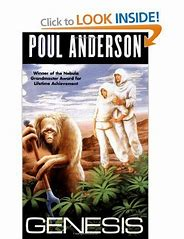
I unreservedly recommend eBay. It is so easy to order that it can almost be done by accident. My copy of Poul Anderson's Genesis has gone astray during a house move. It will probably come to light but meanwhile I have ordered and received an identical copy in better condition. My original paperback The Earth Book Of Stormgate has all but disintegrated, although I will keep it, but I have now ordered an original hardback.

Welcome everyone to the month of February.