Showing posts sorted by date for query Roger Elwood. Sort by relevance Show all posts

Thursday, 10 September 2026

Elwood's Continuum

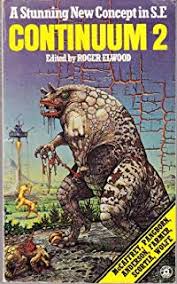
Yes. I checked. See Sequel. Continuum, 1-4, edited by Roger Elwood, was a series of anthologies of new additions to already existing series written by their respective authors. See here. Poul Anderson's four additions to his already existing Rustum History were later collected in New America and the new instalments by the other authors were likewise collected so that the original Continuums have become redundant.

This explains some odd features of the Anderson stories. Written to order, they are uncharacteristically didactic. In these four successive instalments, Danny/Dan/Daniel Coffin systematically ages, solves problems of qualitatively different kinds - technical, scientific, personal, economic and political - and steadily grows in social stature, out of the shadow of his imposing father into the most important single individual in the Rustumite lowlands.

Elwood has been accused of editing mediocre anthologies but we are glad that he facilitated the writing of two excellent short stories that fitted into the chronology of Anderson's Technic History.

Friday, 4 September 2026

Sequel

I do not know the circumstances behind the publication of Roger Elwood's Continuum anthologies. Was Poul Anderson asked to continue an already existing series or just to contribute four new stories in which case it was he who decided that these contributions would constitute four additional Rustum History instalments, thus doubling the length of this series?

In any case, the first story in New America is a logical sequel to the fourth and concluding story in Orbit Unlimited:

Danny Coffin is no longer a small boy but a teenager;

Danny had a harrowing experience in the Rustumite lowlands so does not want to return there;

however, unlike most Rustumites, he is able to live comfortably in lowland conditions, therefore he is in demand there!;

thus, a human problem in an sf setting.

I certainly appreciate both the setting and the problem but would not have been able to create a story based on them whereas Poul Anderson was. Our next step here is to reread this fifth Rustum History instalment maybe some time this weekend.

Computer And Continuum

Hi. My current computer problem is that I cannot publish comments in the combox but can publish posts like this one (I hope). This is a quick post before going out again in half an hour.

Poul Anderson stories first published in anthologies of original stories edited by Roger Elwood:

Technic History
"Wingless" (1973)
"How To Be Ethnic In One Easy Lesson" (1974)

time travel, non-series
"the Little Monster" (1974)

Rustum History
"My Own, My Native Land" (1974)
"Passing the Love of Women" (1974)
"A Fair Exchange" (1974)
"To Promote the General Welfare" (1975)

The four Rustum stories were first published in Continuum I-IV, respectively, and are collected in Poul Anderson, New America.

Ad astra.

Saturday, 29 August 2026

Three Achievements And One Disappointment

When an editor asks an author to contribute to an anthology of original stories, he does not know what he is going to get. Does he?

Poul Anderson's Technic History
"How To Be Ethnic In One Easy Lesson" IN Future Quest, ed. Roger Elwood, 1974.

"Lodestar" IN Astounding: The John W. Campbell Memorial Anthology, ed. Harry Harrison, 1973.

"Rescue on Avalon" IN Children of Infinity, ed. Roger Elwood, 1973.

Clifford Simak's City future history
"Epilog" IN Astounding... (see above)

(We are talking about only two editors and two authors here.)

We already know what outstanding additions to his Technic History those three stories by Anderson are.

"Epilog" (this should be my last reference to City): the Ants, who have covered most of the Earth with a single Building, and the robots who had helped them have died. The deathless robot Jenkins learns this when the Building begins to crumble and he is able to enter it for the first time. All that it contains is a lot of now dead ant hills. Coincidentally, when the Building begins to crumble, some wild robots who had left Earth in interstellar spaceships visit and take Jenkins away with them. End. Point?

Addendum: There is a serious omission in this post which will be addressed. The title should have been "Four Achievements..."

Later: Now see here. 

Monday, 2 February 2026

Publication Histories

Short stories published, and novels serialized, in sf mags can be or become instalments of future history series. John W. Campbell's Astounding/Analog was the starting point for Robert Heinlein's Future History and Poul Anderson's Polesotechnic League series among others. 

Future histories can also incorporate instalments with surprisingly dissimilar publication histories.

Heinlein's Future History
four stories from the Saturday Evening Post
+ one each from:
Argosy
Town and Country
Boy's Life
the American Legion Magazine
Scientific American

(10 out of 24 or so instalments.)

Anderson's Technic History (incorporating the Polesotechnic League)
two from original juvenile sf anthologies edited by Roger Elwood

two from Boy's Life

one from Astounding: The John W. Campbell Memorial Anthology, edited by Harry Harrison

one written for Four For The Future, a themed anthology edited by Harrison, although first published in Galaxy

(6 out of 43 instalments.)

Thus, Elwood, Boy's Life and Harrison between them give us six Technic History instalments. 

Tuesday, 29 April 2025

Youth And Age

Each of us experiences youth and age successively but at every moment they coexist. Poul Anderson shows us the passage of generations.

Time Patrolman Carl Farness interacts with four generations of a single Goth family from 300 to 372.

Emil Dalmady is a young man on his first job for Solar Spice & Liquors when he confronts Nicholas van Rijn in "Esau" but Emil's daughter, Judith, is in her high old age when she writes a fictionalized account of a teenage adventure of Nat Falkayn, son of Nicholas Falkayn who is a son of David and Coya Falkayn and thus a great-great-grandson of Nicholas van Rijn. Tabitha Falkayn is their descendant although we do not know by how many generations.

We ought to be grateful to Roger Elwood for editing original anthologies that resulted in Poul Anderson enhancing his Technic History with the juvenile adventures, "How To Be Ethnic In One Easy Lesson" and "Wingless," the latter about Nat Falkayn.

Wednesday, 6 September 2023

1951-'52 And 1972-'73

"Wingless" (Boy's Life, July, 1973)
"Rescue on Avalon" (Children of Infinity, ed. Roger Elwood, 1973)
"The Star Plunderer" (Planet Stories, September, 1952)
"Sargasso of Lost Starships" (Planet Stories, January, 1952)

These four stories are collected between Mirkheim and The People of the Wind in The Technic Civilization Saga, Volume III, Rise of the Terran Empire. The stories form two pairs with widely different places and dates of publication. Yet all these stories and thirty nine other works are incorporated into a single future history series. The first two Dominic Flandry stories were published in 1951, the first of them in Planet Stories.

Everything that Poul Anderson wrote about Ythrians was published in 1973 except "Wings of Victory," which was published in 1972. Thus, here are two very different creative periods for Anderson:

1951-'52 Empire
1972-'73 Ythrians

The Technic History stretches from 1951 to 1985 in terms of publication.

Tuesday, 25 October 2022

Four Short Stories In One Future History Series


When an sf writer has created a future history timeline, he is then free to add new instalments of any length and type and at any point along that timeline. The history can be enhanced by the addition of stories written for different markets. Asked for a story on the theme of redemption, Poul Anderson wrote "The Sharing of Flesh"/"The Dipteroid Phenomenon," set during the Long Night/Allied Planets period of his Technic History.

"How To Be Ethnic in One Easy Lesson," about Adzel's student days on Earth, and "Rescue on Avalon," set during the colonization of the Coronan continent on Avalon, were each first published in a different anthology of juvenile short stories edited by Roger Elwood. "Wingless (on Avalon)," set during the colonization of the Hesperian Islands on Avalon, was first published in Boy's Life. Adzel will become a member of Nicholas van Rijn's first trade pioneer crew led by David Falkayn and "Wingless" features Falkayn's grandson.

The three juvenile stories enhanced the Technic History further when they were incorporated into The Earth Book Of Stormgate and therefore acquired informative introductions fictitiously written by the Earth Book editor, Hloch of Stormgate Choth on Avalon.

We are glad that Anderson took these opportunities to enlarge his Technic History rather than to write unrelated stories. 

Monday, 7 March 2022

Time As A Burning Bridge

Orbit Unlimited.

Time is a hunter, a burning bridge, an ever-rolling stream, an old gypsy man, money, the great healer and what else? 

An extraordinary consequence of the mid-flight crisis is that Joshua Coffin judges himself to be no longer worthy as a spaceship captain so instead intends to join the Rustum colony. Thus, he will recur as a character later in this volume. Some characters remain on Earth and are never seen again. Others weave in and out of Poul Anderson's narrative of events off Earth.

The difficulty of even arriving on the surface of an extra-solar planet is emphasized by the fact that we are not shown the surface of Rustum until the concluding story of Orbit Unlimited. Fortunately, however, four further stories were added in Roger Elwood's Continuum anthologies. Meanwhile, remember:

"You aren't alone, Joshua, she wanted to call. Time is the bridge that always burns behind us." (p. 70)

Friday, 4 March 2022

Future Cities

Roger Elwood also edited an anthology called Future City although that was not one to which Poul Anderson contributed. However, Anderson described many future metropolises. We notice two features of the built-up area where Svoboda's departmental tower is located.

First, even from here, nature is visible. Although the tower extends as far as he can see:

"...through airborne filth...past the floating docks, on the world's eastern edge, he could see the mercury gleam that was the open Atlantic.
"Dusk was creeping over the planet. Spires etched themselves black against the surly red remnants of sundown." (1, pp. 8-9)

Secondly, the social division between Lowlevel and upper-level exactly corresponds to the physical levels of the city's architecture:

"Highlevel walls and streets began to glow. Lowlevel was a darkness beneath, and a muted unending growl of belt-ways, generators, autofactories, sparks to show a window waking to life or a pedicar headlamp or the flashbeams of men going in cudgel-armed parties for fear of the Brotherhood." (p. 9)
 
This same social-physical hierarchy exists in the megalopolis of Niyorek in Anderson's The Corridors Of Time.

The Rustum History

While rereading Poul Anderson's Maurai series, we noticed that the third story, "Windmill," was originally published in an anthology edited by Roger Elwood. Remembering that two Technic History stories were also originally published in different anthologies edited by Elwood, we checked and found that four Rustum stories were originally published in the anthologies, Continuum I-IV, edited by Elwood.

The Rustum History comprises:

four stories collected as Orbit Unlimited and culminating in the colonization of the extra-solar planet, Rustum;

the four stories originally published in Continuum I-IV and later collected in New America;

"The Queen of Air and Darkness," set on another planet, Roland, in the same timeline and also collected in New America;

thus, nine stories that could be collected in a single volume as The Rustum History.

Thursday, 3 March 2022

From Anthologies To Collections

I do not go for original anthologies, themed or otherwise. I might get a copy of such an anthology for one story by one author and not read the rest. So it is good when a story written for such an anthology is republished in a collection by its author. Look how good Poul Anderson's seven Roger-Elwood-edited stories are:

the two Technic History stories are in The Earth Book Of Stormgate;

the one Maurai story is in Maurai And Kith;

the four Rustum stories are in New America.

Three collections are more convenient than seven anthologies.

The Technic History is enhanced by the inclusion of two juvenile short stories, one in the Polesotechnic League sub-series, the other in the Ythrians sub-series. The four Continuum contributions double the length of the history of Rustum. The Maurai story, the third in the series, again set generations later, presents further progress because the Maurai now have some jet aircraft whereas such aircraft had been legendary at the time of the second story, "Progress."

Roger Elwood

We owe Roger Elwood some good Poul Anderson stories that were first published in original anthologies edited by Elwood. 

The Technic History
"How To Be Ethnic In One Easy Lesson," Future Quest (1974)
"Rescue in Avalon," Children of Infinity (1973)

The Maurai History
"Windmill," Saving Worlds (1973)

The Rustum History
"My Own, My Native Land," Continuum I (1974)
"Passing the Love of Women," Continuum II (1974)
"A Fair Exchange," Continuum III (1974)
"To Promote the General Welfare," Continuum IV (1975)

Wednesday, 5 January 2022

The Holms

"Rescue on Avalon."

"'I'm Ivar Holm.'" (p. 313)

There have been three ways to read this. story:

(i) in its original appearance;
(ii) in The Earth Book Of Stormgate;
(iii) in The Technic Civilization Saga, Volume III, Rise Of The Terran Empire.
 
(i) The Acknowledgements in the Earth Book and in Rise... state that "Wingless on Avalon" was first published in the original anthology, Children Of Infinity, edited by Roger Elwood, 1973, and that "Rescue on Avalon" was first published in Boy's Life, July 1973, whereas Sandra Miesel's Chronology of Technic Civilization places "Wingless..." in Boy's Life and "Rescue..." in Children Of Infinity.
 
Either way, in its original publication, the surname "Holm" is of no significance.

Interruption. Continued later.

Friday, 22 January 2021

Three Volumes Of Ythrians

"Wingless."

Avalon's:

"...mysteries had barely been skimmed by the original explorers..." (p. 411)

That is to say by the characters in "The Problem of Pain," published in the same year as "Wingless" and collected earlier in the Earth Book. The publication history of the "Ythrians" sub-series of Poul Anderson's Technic History is as follows:

"Wings of Victory," ASF, April 1972;
 
"The Problem of Pain," FSF, February 1973;
 
"Lodestar," Harry Harrison (Ed.), Astounding: John W. Campbell Memorial Anthology (Random House, 1973);
 
"Wingless," Roger Elwood (Ed.), Children Of Infinity (Franklin Watts, 1973);
 
"Rescue on Avalon," Boy's Life, 1973;
 
The People Of The Wind (New York, 1973);
 
The Day Of Their Return (New York, 1973).
 
They were all written together, almost, although "Wings of Victory," the earliest, is set in the period of the first Grand Survey whereas The Day Of Their Return, the latest, is set in the Flandry period of the Terran Empire. All five short stories are in the Earth Book, a companion volume to The People Of The Wind, whereas The Day Of Their Return is integral to the nine-volume Flandry period.

"As Far As We Know..."

Poul Anderson, "Wingless" IN Anderson, The Earth Book Of Stormgate (New York, 1979), pp. 409-420.

The text of this story begins:

"As far as we know..." (p. 411)

Thus, the narrative viewpoint is that of an author addressing her contemporaries in Technic civilization. Hloch's introduction to the story (pp. 409-410) identifies the author as a daughter of Emil Dalmady ("Esau").  Writing in "...her high old age...," (p. 411) Judith Dalmady/Lundgren recounts an experience of David and Coya Falkayn's young grandson, Nat. Never has a future history series been so strongly bound together across its fictional timeline.

Astounding Science Fiction was renamed Analog Science Fiction/Science Fact. In both versions, it is abbreviates as ASF. Thus, of the twelve works collected in the Earth Book:

six were originally published in ASF;
one in an Astounding Memorial Anthology;
one in The Magazine of Fantasy and Science Fiction -
 
- and four are juvenile short stories originally published elsewhere:

"How To Be Ethnic In One Easy Lesson" in Future Quest, ed. Roger Elwood;
"Wingless" in Children of Infinity, ed. Roger Elwood;
"The Season of Forgiveness" and "Rescue on Avalon" in Boys' Life.

We are grateful to Roger Elwood and to Boys' Life for giving Poul Anderson these opportunities to extend his Technic History in unexpected directions:

"How To Be Ethnic..." features Adzel, David Falkayn's future team member;
"Wingless" features Falkayn's grandson;
"The Season of Forgiveness" is set on a planet previously visited by Falkayn;
"Rescue on Avalon" cameos an ancestor of Daniel and Christopher Holm.

Monday, 24 February 2020

Texts In Contexts

A single text can bear different meanings not only to different readers but also to a single reader when read in a different context. Despite dissimilar contents, texts in differing contexts include the following:

in the Hebrew Bible, the Prophets immediately follow the Law and apply it to history, whereas, in the Christian Bible, they immediately precede the New Testament and prophesy the Messiah;

The Protocols Of The Elders Of Zion can be read either as a factual account of a secret meeting or as an insight into the mental processes of a conspiracy theorist;

I first read Poul Anderson's "The Game of Glory" without as yet any knowledge either that this story was part of a Dominic Flandry series or that that series was part of a future history series.

As I have said before, a prequel might not only be written later but also be meant to be read later. Readers like to be told what happened before. Thus:

having read about visits to Narnia, now we read about how such visits began;

having read an account of She, ending in her death, now we read Allan Quatermain's account of his earlier meeting with her;

having read Watson's accounts of Holmes' cases while they were together, now we read about Holmes' initiatory case before he met Watson;

having read about Nicholas van Rijn's trade pioneer crew, now we read about one team member's student days.

One text in three contexts:

"Adzel talks a lot about blessing in disguise, but this disguise was impenetrable."
-Poul Anderson, "How To Be Ethnic" IN Roger Elwood (Ed.), Future Quest (Avon Books, 1974).

"Adzel talks a lot about blessings in disguise, but this disguise was impenetrable."
-Poul Anderson, "How To Be Ethnic In One Easy Lesson" IN Anderson, The Earth Book Of Stormgate (New York, 1979), pp. 49-67 AT p. 51.

"Adzel talks a lot about blessings in disguise, but this disguise was impenetrable."
-Poul Anderson, "How To Be Ethnic In One Easy Lesson" IN Anderson, The Van Rijn Method (Riverdale, NY, 2009), pp. 175-197 AT p. 177.

If we just read Future Quest, then "How To Be Ethnic" is just a one-off story.

If we are reading Anderson's Technic History in its original order of publication, then we have read about the trade pioneer crew, including Adzel, in "The Trouble Twisters," Satan's World and Mirkheim before reading "Adzel talks...," the opening words of "How To Be Ethnic...," whereas, if instead we are reading the Technic History in chronological order of fictitious events as presented in Baen Books' seven-volume The Technic Civilization Saga, of which The Van Rijn Method is Volume I, then Adzel means nothing to us as yet when we read his name at the beginning of "How To Be Ethnic..." We will read about the trade pioneer crew later, in Volumes II and III, although only in the first of the six works collected in Vol III. History is bigger than organizations or civilizations.

So which is the better way to read it? Search me.

Friday, 31 May 2019

Sources

In In The Hesperian Islands, I referred to the original publications of the two juvenile Avalon stories, "Wingless" and "Rescue on Avalon." Then I corrected what I had written. Then I noticed a discrepancy.

I refer to:

Poul Anderson, The Earth Book Of Stormgate (Berkley Books, New York, 1979);

Poul Anderson, Rise Of The Terran Empire (Riverdale, NY, 2011).

In the Earth Book, p. v is "ACKNOWLEDGMENTS"; pp. ix-xii are "A CHRONOLOGY OF TECHNIC CIVILIZATION."

According to the Acknowledgments:

"Wingless" (as "Wingless on Avalon"), Children of Infinity, Roger Elwood, ed., Franklin Watts, 1973. Copyright 1973 by Franklin Watts, Inc.

"Rescue on Avalon," Boy's Life, July 1973. Copyright 1973 by The Boy Scouts of America.

According to the Chronology:

"Wingless on Avalon," Boy's Life, July, 1973.

"Rescue on Avalon," in Children of Infinity, ed. Roger Elwood, Franklin Watts, 1973.

Rise Of The Terran Empire:

includes both these stories;

presents "Acknowledgements" on p. V and "CHRONOLOGY OF TECHNIC CIVILIZATION COMPILED BY SANDRA MIESEL" on pp. 663-672;

reproduces the discrepancy.

Sunday, 24 February 2019

New America

I should have said that SM Stirling's Theater Of Spies includes oblique allusions to at least two other Stirling alternative histories.

The contents of Poul Anderson's Orbit Unlimited originally appeared in Astounding and Fantastic whereas the four Rustum stories in the sequel volume appeared in Continuum I-IV, edited by Roger Elwood, a name we have met before. In the first story, Dan Coffin, now a teenager, must come to terms with his fear of the Rustumite lowlands and thus joins the ranks of Andersonian juvenile heroes on another colonized planet, Avalon.

Tuesday, 4 September 2018

Poul Anderson's Juveniles II

See Poul Anderson's Juveniles.

"The Faun," Boys' Life, September, 1968. Copyright The Boy Scouts of America.

The above item should have been on the list.

Is "The Year of the Ransom" a juvenile? This is partly a matter of how it was marketed (I am not sure) and of how it struck us (it struck me as juvenile or at least Young Adult).

Four installments of the Technic History are juveniles and Anderson was more imaginative than just to present, e.g., a teenage Dominic Flandry. We should be grateful to the editor, Roger Elwood, and to the magazine, Boy's Life, for making possible these different aspects of the Technic History. A future history series needs to be as diverse and as many-angled as possible.