Showing posts sorted by date for query Nyanza. Sort by relevance Show all posts

Saturday, 5 September 2026

Ayres And Eyre

Lady Varvara, widow of the Imperial resident on Nyanza, is an:

"'...Ayres [scroll down] of Antarctica.'"
-Poul Anderson, "The Game of Glory" IN Anderson, Captain Flandry: Defender Of The Terran Empire (Riverdale, NY, February 2010), pp. 303-339 AT II, p. 310.

Our daughter's partner, Mike, is a Eyre of Birmingham.

Ayres and Eyre sound similar despite their two spelling differences.

The multiracial, multicultural British city, Birmingham, prefigures Poul Anderson's multispecies Terran Empire - although I now suspect that multispecies civilizations are in the realm of fantasy rather than of hard sf.

Merseians and Ythrians are akin to trolls and elves.

Got to finish second coffee and move.

Wednesday, 29 July 2026

Magnusson's Background

The Game Of Empire, CHAPTER THREE.

Admiral Olaf Magnusson:

was born on Kraken whose spacefolk trade as far as Betelgeuse or Merseia;

enlisted young in the Marines;

at Syrax, took command of a crippled ship;

was sent to the Foundry, the Navy officer school in Sector Aldeberan, which is where he was during the civil war;

helped to suppress two later rebellions and to negotiate with the Merseians (we read elsewhere that he speaks three Merseian languages, including Eriau, fluently);

married a Nyanzan heiress.

Regular readers of Poul Anderson's Technic History recognize multiple background details:

Kraken
Betelgeuse
Merseia
Syrax
Sector Aldeberan
the civil war
(Eriau)
Nyanza

- but not the Foundry which is introduced here.

Each instalment of a future history series builds on the foundation provided by earlier instalments and adds more - but we know that by now.

Thursday, 25 June 2026

Details On Aeneas

Extrasolar terrestroid planets colonized by human beings in Poul Anderson's Technic History - there are a few:

Hermes
Avalon
Dennitza
Aeneas
Nyanza
Altai
Unan Besar
Vixen
Imhotep
Daedalus

Some are realized in minute detail. Frex, in Nova Roma on Aeneas:

"...the gray ashlars bore a veneer of carefully chosen and integrated slabs, marble, agate, chalcedony, jasper, nephrite, materials more exotic than that; and often there were carvings besides, friezes, armorial bearings, grotesques; and erosion had mellowed it all, to make the old part of town one subtle harmony."
-Poul Anderson, The Day Of Their Return IN Anderson, Captain Flandry: Defender Of The Terran Empire (Riverdale, NY, February 2010), pp. 74-240 AT 3, p. 87.

There is much more - statues and plants among fishponds and fountains in vitryl-roofed courts, cramped and twisted streets where countryfolk ride horses or stathas - but I don't want to quote lengthy paragraphs. As I always say, read Anderson.

Tuesday, 10 February 2026

Loa And Other Planets

Loa is the name of a moon of the planet Nyanza in Poul Anderson's Technic History and the name of a planet in his "The Chapter Ends." See blog search result for Loa. (Scroll down.) The planet Loa is "...jeweled with islands..." (p. 256) These posts also mention other planets. 

In "The Chapter Ends," the Galactics evacuate Terrans to an unnamed planet which is:

"'...the most Earthlike world we could find that wasn't already inhabited.'" (p. 261)

However, its trees, grasses, soil, fruits, animals, birds, fish and every sensation are subtly different because no two planetary evolutions can be identical.

Here, we are:

writing this post over breakfast;
about to drink a second coffee after beans on toast;
reading Colin Dexter's fourth Inspector Morse novel;
preparing to visit Andrea above the Old Pier Bookshop for most of the afternoon;
appreciating existence.

Onward and upward.

Monday, 8 December 2025

In Gaiian

"Lodestar."

Coya Conyon:

"...found she could control her thoughts, somewhat, but not the tingle through her blood." (p. 342)

Can she control her thoughts? In zazen, we practice awareness, not control, but that is one vast topic.

Scottish ancestry has gone to Hermes, African to Nyanza, and both have returned to Earth in Malcolm Conyon, father of Coya. We are already doing this, as far as we can, on Earth. Andrea, whose parents came from Italy to Morecambe (instead of New York) via Glasgow knows about Italian Scots.

"Sprawled in a lounger, [van Rijn] waved a two-liter tankard of beer he clutched in his hairy left paw." (ibid.)

See "More Beer!"

Have we begun a new thread about references to beer or should we just take it as read that van Rijn does drink a lot of beer?

I will shortly resort not to a temple of Bacchus but to the historic Lancaster Quaker Meeting House where our meditation group hires an upstairs room. Tomorrow: Andrea has told us that he will cook a curry and maybe bake a cake. Life continues to be good for some Earthlings some of the time. 

Wednesday, 28 May 2025

Interstellar Imperialists?

The Game Of Empire, CHAPTER SIX.

Tachwyr reflects that human beings might regain their:

"...universe-spanning ambitions..." (p. 268)

"Or a different but allied species might, the Cynthians, or the Scothani for example." (ibid.)

  The Scothani, yes. They have already tried to build an interstellar empire although, on that first attempt, they were easily sabotaged by one Terran, Flandry. But the Cynthians! They were introduced as a species only so that Chee Lan could serve as a comical intelligent squirrel in van Rijn's first trade pioneer crew, a counterpoint to Adzel's serene massiveness. Cynthians as interstellar imperialists would strain willing suspension of disbelief beyond its breaking point. But Tachwyr does not know that.

The Cynthian village, Lulach, with its houses under or even in trees, reads like the setting for a completely different kind of narrative. But then we must expect that different kinds of beings and settings would coexist in an interstellar civilization, like the horned, sword-wielding, humanoid Scothani as against the human colonists of Nyanza in two early Flandry stories.

Tuesday, 13 May 2025

Future Forms Of Christianity

Jerusalem Catholicism
Jean Broberg was brought up as a Jerusalem Catholic in the mid-twenty-first century. That form of Christianity should be starting about now. In the Terran Empire, Philippe Rochefort and Fr. Axor are Jerusalem Catholics and the latter, a Wodenite convert, seeks evidence for a non-human Incarnation.

Unspecified Catholicism
Nicholas van Rijn with his Martian sandroot statue of St. Dismas.
The Nuevo Mexicans: Admiral Cajal with his crucifix.
Djana who recites the Ave Maria and imagines a Merseian Christ.

Others
Peter Berg from Aeneas.
Christmas on Ivanhoe.
"Christian variants" on Nyanza: no information given.
OrthoChristianity on Dennitza.
Bible-and-blaster backcluster Christians on Aeneas. (I borrow this description from James Blish's The Triumph Of Time.)

Monday, 26 August 2024

Multiple Perspectives

When the planets Avalon and Freehold successfully resist the Terran Empire, the implication of Poul Anderson's texts is that these are good outcomes whereas, when the planets Ansa and Aeneas unsuccessfully resist the Empire, the implication is that these are also good outcomes. However, when the planet Brae unsuccessfully resists the Empire, the implication is that brutal military conquest is just business as usual for the Empire. Dominic Flandry participates without any qualm of conscience. Immediately afterwards, he thwarts Merseian subversion on Nyanza but Brae and Nyanza are not comparable. The Braean High Temple merely wants to remain independent and has not become a tool of Terra's enemy, Merseia. For these reasons, we commend Anderson's Technic History series for its multiple perspectives on what reads like authentic history.

Friday, 2 February 2024

Tabitha Falkayn And Philippe Rochefort

The People Of The Wind.

Tabitha captures a Terran. We recognize him:

"He was tall, swarthy by Avalonian measure...people with such chromosomes generally settled between stronger suns than Laura...." (IX, p. 550)

( - like the sun of Nyanza.) 

We realize that Draun has killed Helu but Tabitha has rescued Rochefort. The latter reminds us of a later Terran:

Rochefort:

"...he stretched to the limit the tolerance granted officers regarding their dress uniforms - rakishly tilted bonnet bearing the sunburst of Empire, gold-trimmed blue tunic, scarlet sash and cloak, snowy trousers tucked into low boots of authentic Terran beef-leather." (IV, p. 487)

Flandry:

"...his bonnet was tilted more rakishly on his seal-brown hair than a strict interpretation of rules would have allowed; his frame was draped in a fantastic glittergold version of dress tunic and snowy trousers rucked into handsome beefleather halfboots; the cloak that fluttered behind him glowed with phosphorescent patterns through the chill dusk..."
-Poul Anderson, A Circus Of Hells IN Anderson, Young Flandry (Riverdale, NY, January 2010), pp. 193-365 AT CHAPTER TWO, p. 203.

Contrast Admiral Cajal:

"His uniform was as plain as his rank allowed." 
-The People Of The Wind, VII, p. 514.

We value human diversity.

On p. 667 of The People Of The Wind, Sandra Miesel's CHRONOLGY OF TECHNIC CIVILIZATION informs us that:

"A descendant of Falkayn and an ancestor of Flandry cross paths." 

Rochefort is a precursor of Flandry but is not known to be his ancestor.

Wednesday, 17 January 2024

Atlantis Weed

"The Problem of Pain."

We are rereading the story that introduces Avalon, looking for information about the planetary environment. The Ythrian couple, their two children and the human couple are not the only explorers in the base on the southern Coronan coast but it is they that go out in a boat to explore the life that swarms in the gulf. Marine monsters graze immense floating islands of densely interwoven vegetation which probably also support many smaller plant and animal species. Olga Berg calls the interwoven vegetation "atlantis weed," a name that will stick. I think that the monsters are later called "kraken" but might be confusing them with sea beasts on Nyanza or even on Kraken. A storm blows the explorers onto an island which I think must be part of the Oronesian archipelago. There, like some much later Terran invaders, they will encounter lethal aspects of the Avalonian environment. The Ythrian and Avalonian narratives are fully coherent, having been written in quick succession.

Wednesday, 22 November 2023

Another Summary II

"Afterword: The Price of Buying Time."

Sandra Miesel presents a comprehensive list of motives for extra-solar colonization:

adventure
profit
advancement
social and political experimentation
preservation of cultural heritage

She adds that the cultural motivation was paramount in the cases of:

Russo-Mongol Altai
African Nyanza
Slavic Dennitza

I think that, in the case of Nyanza, Miesel goes beyond what Anderson's texts tell us but nevertheless, in this context, her extrapolation is legitimate as when she discusses alien influences on humanity:

"These exotic stimuli sparked the creative energies of Technic civilization to new peaks of excellence because they broadened the range of options available to each individual." (p. 238)

In "How To Ethnic In One Easy Lesson," the Festival of Man is a reaction against alien influences. Later, in The People of the Wind, human beings on Avalon are strongly influenced by their fellow colonists from Ythri to such an extent that many young people join choths and adopt an entirely Ythrian lifestyle. 

Saturday, 28 October 2023

The Conversation In The Crystal Moon

We Claim These Stars, CHAPTER II.

Aycharaych congratulates Flandry on l'affaire Nyanza, a touch of Fransai in the Anglic, and informs him that:

"'Not even excepting Xingu, [Richard] Strauss is the most misunderstood composer of known galactic history.'" (p. 12)

I had to google to confirm that Xingu was not a Terran composer. Aycharaych refers to known galactic history. Most of the galaxy is unknown.

Aycharaych visited Terra clandestinely to walk in certain forests and see certain paintings and graves. Knowing him, he probably did more than that.

When Aycharaych sees violet as black, Flandry deduces that he sees further into the red and that his sun is cooler and redder than Sol. That does not identify it but every datum helps.

Thursday, 17 August 2023

Poul Anderson And Frank Herbert

In Poul Anderson's Technic History:

the planet Aeneas resembles Frank Herbert's Dune in that it is a dry, humanly colonized planet that is a potential flashpoint for an interstellar jihad;

the planets Satan and Mirkheim resemble Dune in that they are single sources of unprecedented wealth - except that Dune is more so (see the combox here).

Herbert's Dune series focuses on a single fictional planet whereas the Technic History presents:

Ythri
Avalon
Ivanhoe
Ikananka
Merseia
Satan
Mirkheim
Hermes
Dennitza
Chereion
Daedalus
Imhotep
Diomedes
Babur
Suleiman
Cain
Trillia
Gorzun
Starkad
Talwin
Wayland
Aeneas
Freehold
Alfzar
Brae
Nyanza
Vixen
Altai
Dido
Unan Besar
(not a complete list)

Tuesday, 25 April 2023

Terra In "The Game of Glory"

In "The Game of Glory," I, Dominic Flandry has leave on Terra where he spends three months at the perpetual banquet of the Lyonid family and fights a duel with someone's husband but that does not exhaust the information on Terra in this story. In II, we learn that the widow of the murdered Terran resident on Nyanza, Lady Varvara, was born an Ayres of Antarctica and that some of her bodily features also show the Chinese strain in the Ayres pedigree. She welcomes Flandry because he is straight from Terra and informs him that associating only with an inferior class has rubbed off on her and made her soul greasy. An interesting social throwback.

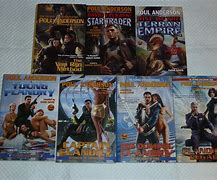
(An unfamiliar and inappropriate cover image. Commander Flandry is an alternative title of The Rebel Worlds. Flandry is a Captain in "The Game of Glory.")

Monday, 17 April 2023

Substantial Planets Visited Only Once

Suleiman: where Emil Dalmady outwits Baburites.
Babur: sub-Jovian.
Tametha: turning point for Falkayn.
Starkad: doomed to destruction.
Scotha: newly industrialized; subverted by Flandry.
Alfzar: a planet of Betelgeuse.
Brae: where Terrans are conquerors.
Nyanza: mostly water.
Dido: tripartite intelligences.
Dennitza: where Flandry would have settled...
Chereion: Aycharaych's home planet.
Ramnu: Miriam Abrams was in rapport with a native.
Imhotep: where the Starkadians are settled.
Daedalus: no horizon; home of the Zacharians.

This is not a complete list. Blog readers will think of other examples. Every planet deserves to be remembered.

Wednesday, 14 December 2022

Merseian Influence

To generalize, a series hero has a continuing villain, whether individual or collective, who does not appear in every instalment. Thus, when Russian intelligence chiefs review Bond's file, they note that they had not been involved when he had tackled trans-Atlantic diamond smugglers the previous year. Similarly, Merseians were involved in events on Altai and later on Nyanza but not on Unan Besar although they might have been. A sufficiently insidious villain can always be shown to be lurking somewhere in the background. Flandry reflects that, if Nias Warouw hypnoprobes him, then Warouw will gain a lot of information about the Empire and about Terran Intelligence that he would be able to sell to the Merseians who could easily deploy one or two cruisers to make Unan Besar a protectorate.

Another collective villain is the barbarians, previously represented by the Scothanians. If Warouw helped other groups of barbarians to raid Terran planets, then he would share in their loot. (In the film of Thunderball, SPECTRE receives a consultation fee from the Great British Train Robbers.) 

Thursday, 8 December 2022

Tramp Ships, Flitters And The Hooligan

Despite representing the Terran Empire, Dominic Flandry had travelled to Altai as a passenger in a Betelgeusean merchant ship. When Terran Navy ships arrived to rescue him, he could have returned at least as far as Catawrayannis in one of them but instead preferred to travel in another Betelgeusean ship to the Imperial port at Spica VI. From there, he would have returned to Terra in the luxury liner, the Empress Maia. However, the second merchant ship stopped at Orma where Flandry learned about the self-isolating human colony planet, Unan Besar, and hired a space flitter to go and investigate. On a later mission, he took a high-speed flitter to travel from Brae to Nyanza. The main point here is that Flandry did not as yet have his private spaceship, the Hooligan.

Shortly after returning home from Nyanza, Flandry is in possession of the Hooligan and is served by the Shalmuan, Chives, whom, we later learn, he had acquired, initially as a slave, while outside the Solar System. I deduce that Flandry had acquired Chives before going to Altai, that Chives had remained on Terra while Flandry was on Altai and Unan Besar and that Flandry completed the purchase of the Hooligan shortly after returning from Nyanza.

Tuesday, 29 November 2022

Flandry Reading Order

The Technic Civilization Saga, Volume V ends with:

"Honorable Enemies"
"The Game of Glory"
"A Message in Secret"

Volume VI begins with:

"The Plague of Masters"
"Hunters of the Sky Cave"

Volume V should end with:

"Honorable Enemies"
"A Message in Secret"
"The Plague of Masters"

Volume VI should begin with:

"The Game of Glory"
"Hunters of the Sky Cave"

"Hunters..." comes immediately after "The Game..." which makes an early reference to the events of "Honorable Enemies." Two years elapse between the very beginning of "The Game...," when a monster flees from Conjumar, and the main narrative of that story, when Flandry is on Brae, then Nyanza. "Honorable Enemies" occurs in that two-year period. "A Message in Secret" and its sequel, "The Plague of Masters," must also occur then.

After "The Plague..." and "Hunters...," Volume VI concludes with:

"The Warriors from Nowhere"
A Knight Of Ghosts And Shadows

"The Warriors..." was revised to be a prequel to A Knight... Although written much earlier, "The Warriors..." fits with "Hunters..." and A Knight... because all three feature Flandry's Shalmuan servant, Chives, and his private spaceship, the Hooligan. However, "The Warriors..." should also have been revised to recognize Flandry's knighthood in its opening sentence.

Tuesday, 15 November 2022

Looking Forward

"'If we ever fall, [Freehold]'ll carry on something of what was ours.'"
-Poul Anderson, "Outpost of Empire" IN Anderson, Captain Flandry: Defender Of the Terran Empire (Riverdale, NY, February 2010), pp. 1-72 AT p. 69.

"'Aeneas ought to outlive Empire.'"
-Poul Anderson, The Day Of Their Return IN Captain Flandry..., pp. 74-238 AT 21, p. 236.

"'I'd like to have Nyanza well populated. When the Long Night comes for Terra, somebody will have to carry on. It might as well be you.'"
-Poul Anderson, "The Game of Glory" IN Captain Flandry..., pp. 303-339 AT p. 339.

"'You frontier people are the healthy ones. You'll be around - most of you - long after the Empire is a fireside legend. I envy you that.'"
-Poul Anderson, "Hunters of the Sky Cave" IN Anderson, Sir Dominic Flandry: The Last Knight Of Terra (Riverdale, NY, March 2012), pp. 149-301 AT VIII, p. 206.

"'...this was for the future, not the poor wayworn Empire but a world he too could believe in, the world of their own blood."
-Poul Anderson, A Knight Of Ghosts And Shadows IN Sir Dominic Flandry..., pp. 339-606 AT XVI, p. 543.

"'So Dennitza stays in the Empire... Between us, my friend, I dare hope myself that what I care about will still be there when the Empire is gone.'" 
-ibid., XX, p. 604.

"'The sophont races will survive. In due course, they'll build fascinating new civilizations. Cultures of mixed species look especially promising. Consider Avalon already.'"
-Poul Anderson, A Stone In Heaven IN Anderson, Flandry's Legacy (Riverdale, NY, June 2012), pp. 1-188 AT VI , p. 75.

The "frontier people" referred to in the fourth quotation are the Vixenites. The world referred to in the fifth quotation is Dennitza. Thus, the planets that are expected to survive are:

Freehold
Aeneas
Nyanza
Vixen
Dennitza
Avalon

Monday, 17 October 2022

Long Night And Night Face

Like any instalment of a future history series, Poul Anderson's "A Tragedy of Errors" refers to information from previous instalments and also introduces new information. Thus, the planets, Lochlann, Kraken, Hermes and Sassania, have already been referred to but Nike is new.

Old small planets lose their atmospheres. However, Nike, although old, is so small that it has only recently outgassed its atmosphere.

Dagny from Kraken was:

"...bred in salt winds and unrestful watery leagues..." (p. 484)

This description might have contributed to my impression that Kraken, like Nyanza, was mainly covered by ocean.

"A Tragedy of Errors" is set during the Long Night and is followed, in Flandry's Legacy, by Anderson's Introduction to The Night Face. This Introduction also refers to the Long Night although, in the text, interstellar order has been restored on a small scale.

The Introduction refers back not only to Nicholas van Rijn, David Falkayn and Dominic Flandry but also to Chrisopher Holm, not a series character on the same scale as the other three but one of the several view-point characters in The People Of The Wind and, fictitiously, a co-author of The Earth Book Of Stormgate.

Some introductions are fictional, e.g., by Hloch, whereas others are by the real-world author, Anderson. We read a multi-layered sequence of texts with seemingly inexhaustible content.