Showing posts sorted by date for query List Descriptions. Sort by relevance Show all posts

Thursday, 27 August 2026

Anderson And Simak

individual flying vehicles replacing road vehicles
robots
Martians
enhanced animals
mutants
telepathy
exploration of Jupiter
an interstellar space drive
parallel worlds
suspended animation

I am trying to list ideas which:

have become standard in sf;
are in Poul Anderson's works;
are also in Clifford Simak's City which I am still rereading.

Anderson: enhanced seals;
Simak: enhanced dogs and ants;
Anderson: mutant time travelers and immortals;
Simak: a hyperintelligent mutant. 

There might be more. But some of Simak's ideas are impossible, even cartoonish, like an anthill with chimneys as the ants, with no increase in brain size, smelt ore.

(Ray Bradbury's The Martian Chronicles is another sf work that takes some standard ideas, like telepathy, robots and time travel, and then does something more with them.)

Simak's descriptions of wind and sunsets recall Anderson's:

"The wind talked harshly in the crouching trees and ripped the long grass in sudden gusts. The last rays of the sun struck fire from the distant peaks."
-City, II, p. 46.

"The sun sank in a lake of crimson, hushed finally to the glow of a fire burned low."
-ibid., p. 48.

"They sat for long minutes in silence broken only by the crackling of the fire, by the ghostly whisper of an autumn wind in the trees outside."
-ibid., III, p. 71.

(As in Anderson's works, natural sounds do not interrupt but underline conversational silence.)

"...in the west the green-tinged glow that marked the passing of the sun was fading into night."
-ibid., p. 81.

Somewhere in there, a couple of sounds become one with the wind. I will quote those passages if I can re-find them but right now other activities call.

Thursday, 16 October 2025

Some Details In Tyre

"Ivory, and Apes, and Peacocks."

Warm, windless weather;
creaking, splashing sweeps;
coxswain's drumbeat;
blue wavelets, glittering, chuckling and swirling;
dazzling water blurring sight;
"...trade through the known world..." (p. 230);
multi-storey houses of stone or cedar;
bustling piers;
list descriptions of men and their activities;
Tyrian dyes;
rolling sounds;
overwhelming vitality;
crippled beggars;
ancient Eastern smells.

There is more.

Monday, 28 July 2025

List Descriptions And Three Senses

Conan The Rebel, XII. 

See previous list descriptions (scroll down).

Traffic into the Stygian capital, Luxur:

foot
cart
litter
chariot
horse
ox
donkey
camel
loinclothed labourers
ragged-tunic-clad drovers
robed desert nomads
colourfully garbed merchants
gossamer-clad courtesans
soldiers
hawkers
strolling performers
housewives
children
foreigners

They:

crowd
jostle
chatter
quarrel
scream curses
yelp laughter
importune
haggle
intrigue
shout
wail
croon

Dirty, littered, cobbled streets smell of:

smoke
grease
dung
roast meat
oils
perfumes
drugs
humanity 
beasts

This is all in Poul Anderson's continuous prose. I have merely extracted lists of nouns and verbs.

Monday, 17 June 2024

Fiction And Literature

Value judgements can be individual or collective. An example of an individual value judgement would be if someone said something like, "I think that the literary qualities of Poul Anderson's A Midsummer Night's Tempest are so outstanding that this novel counts as 'literature.'" However, a collective value judgement is shown by which works of poetry, prose fiction or drama are permanently in print. For present purposes, I refer to the permanently in print as "literature." All science fiction is fiction but how much of it is "literature"? Frankenstein and The Time Machine definitely are. They are also pre-genre science fiction. The Frankenstein theme is continued in Poul Anderson's Genesis and time travel in several of Anderson's works that we do not need to list yet again.

The Time Machine owes its status, I think, to:

its discussion of the nature of Time (I disagree with everything that is said but the point is that there is a discussion);

its vivid descriptions both of time travelling and of several future periods;

its vision of the future and sunset of mankind;

its characterization;

its hints at curious possibilities of anachronism and of utter confusion;

its final mystery about when the Time Traveller went and whether he will return;

its poetic descriptions of the past ages when he might have gone.

Enthusiasts for time travel fiction rightly value Poul Anderson's several contributions to this sub-genre although these works have not become "literature."

Friday, 8 March 2024

Military Men

"High Treason."

Here is a list of names that continues into a fictional future. The narrator mentions four military men:

Alexander
Caesar
Napolean
Malanowicz

Googling discloses some Malanowiczes but not this one. According to their descriptions as given here, Alexander was headlong, Caesar was methodical, Napoleon stumped and Malanowicz used computers. The point being made is that military men have to be intellectuals. In the interstellar period, they have to understand machines, other intelligent species and mankind.

The narrator quotes one of his Academy instructors:

"'An instrument can be misused. A hammer can drive a nail or crush a skull.'" (p. 50)

A very good point. Think how existing technology could be used to clothe, house, feed and educate everyone on Earth and a lot of people off it. When enough people want this, they will make it happen.

Wednesday, 11 May 2022

Keldorgard


War Of The Gods, XXXI.

Andersonian list-descriptions.

Tasks
milking
stabling
cleaning
cooking
brewing
chopping
shearing
slaughtering
spinning
dyeing
weaving
nailing
forging

Sounds
clatter
thud
creak
crash
human and animal voices

Smells
smoke
sweat
meat
hides
hay
dung

Pleasures
tales
riddles
verses
songs
ring dances
races
wrestling
ball games
draughts
drunkenness
carving
fishing
lads and lasses
heaped trenchers
flowing ale
days of merriment

Everyone happy but ambitious Ulfhild.

Sunday, 13 June 2021

Faustina

The script of a play or, very occasionally, the text of a novel is preceded by Dramatis Personae, a list of characters' names and descriptions in the order of their appearance. Thus:

"GHOST of Hamlet, the late King of Denmark"

In James Blish's Doctor Mirabilis:

"ROGER BACON of Ilchester, clerk."

In Larry Niven's and Jerry Pournelle's Lucifer's Hammer:

"TIMOTHY HAMNER, amateur astronomer"

In Poul Anderson's "Rokuro," a No play of the future:

"A priest (waki)"

These are the first Personae in four such lists.

Sometimes, an early passage in a prose text previews the action by citing the names of as yet unknown characters that, we understand, are due to "enter" shortly, e.g.:
 
"...Trevelyan Micah, Murdoch Juan, Smokesmith, red Faustina..."
-"The Pirate," p. 137.

Faustina, Murdoch's mistress, is a rough character from New Mars. At the climax, Murdoch has to restrain her when she threatens Trevelyan. However, Faustina becomes the focus for the moral of the tale. She asks why they cannot be allowed to enrich themselves by exploiting the depopulated planet, Good Luck. Trevelyan, holding her hands, explains that the dead have rights - they should be studied and known. Then the invisible narrator resumes and concludes, informing us that she does not understand:

"...the unspoken Pact between the living, the dead, and the unborn..." (p. 165)

"...they shall all be kept one in the oneness of time." (ibid.)

Thursday, 11 March 2021

Ulfan-gryf, Avalrik And Ydwyr

A Circus Of Hells, CHAPTER FOURTEEN.

Djana thinks about:

"...the good beings like Ydwyr and Nicky and Ulfan-gryf and Avalrik and, well, yes, all right, in his fashion, Morioch...." (p. 305)

Nicky is Dominic Flandry and we know Ydwyr and Morioch but this is the only time that we ever read about either Ulfan-gryf or Avalrik. Thus, Djana gives us two more Merseian names. I tried to compile a complete list but they are hidden within the texts like lucky charms in a Christmas pudding.

The room in Ydwyr's quarters that other Merseians see contains "...an alcove shrine..." (p. 299) What is in it? We know of no Merseian images. Instead, we are told that they reach:

"...for infinity and for a God beyond infinity..." (p. 296)

Ydwyr's inner room, which Djana sees, contains skulls, a carved monolith and other objects that "'...speak of pagan cults and witchcraft...'" (p. 301) but presumably none of these are in the outer room.

A film of this novel would have to present many new visual details consistent with Poul Anderson's descriptions.

Monday, 18 January 2021

Gods And Devils On Diomedes

The Man Who Counts, XVII.

Wace thinks of miserly gods (p. 258) and the flying, fighting Diomedeans resemble "Bat-winged demons..." (p. 255)  Thus, the Diomedean sea battle suggests a battle in Hell and such a battle, i.e., in Hell, does occur in Poul Anderson's Operation Chaos:

 
Parallel sf and fantasy narratives, Anderson addressing every option. 

Thursday, 3 September 2020

List-Descriptions And Scene-Setting In Medieval Paris

Poul Anderson, "Death and the Knight," IN Anderson, Time Patrol (Riverdale, NY, 2010), pp. 737-765 AT PARIS, TUESDAY, 10 OCTOBER 1307.

At last, a Time Patrol story that begins by stating place, day of the week, day of the month, month and year, but it is the last published Time Patrol story.

City Din
wind booming through streets, whining in galleries
footfalls
hoof-beats
creaking wheels
thudding hammers
chattering voices
songs
prayers
ringing church bells

Stenches
offal
horse droppings
privies
graves
smoke

Other Senses
low, racing, iron-hued clouds
whirling dust
chill

People
housewife
artisan
priest
mountebank
blind beggar
merchant
apprentices
man-at-arms (drunk)
student
foreigner
carter
a Knight Templar
a boy at his heels
no time traveler yet (that we know of)

Saturday, 22 August 2020

List-Descriptions In Tyre

Poul Anderson, "Ivory, and Apes, and Peacocks" IN Anderson, Time Patrol (Riverdale, NY, 2010), pp. 229-331.

On p. 228, Everard concludes a case that had involved Neldorians. On p. 229, he begins a case that will also involve time criminals but this time they will turn out to be the much more sophisticated Exaltationists who in turn will become the continuing villains of the series.

Visiting Ships
Phoenician
Philistine
Assyrian
Achaean
stranger yet

Harbor Activities
bustle
loading
unloading
fetching
bearing off
repairing
outfitting
dickering
arguing
chaffering

Sounds
talk
laughter
shouts
braying
neighing
footfalls
hoofbeats
hammerbeats
groaning wheels and cranes
twanging music

Smells
smoke
dung
offal
sweat
tar
spices
savory roasting
dye
murex-shell middens

We are told and believe that:

"The vitality was well-nigh overwhelming." (p. 232)

Thursday, 21 May 2020

List Descriptions

Operation Chaos, XXXIII.

Let me quote Poul Anderson's text but rearrange it as a list:

"Outside, noise swelled -
"stamp,
"hop,
"clang,
"howl,
"whistle,
"grunt,
"gibber,
"bubble,
"hiss,
"yelp,
"whine,
"squawk,
"moan,
"bellow.
"The door reverberated under
"fist,
"feet,
"hoofs." (p. 267)

Despite the literally Hellish conditions, the Matucheks are doing OK, partly because of the demons' general disorganization. See Evil Never Intelligent? Does Anderson make this raid on Hell seem a bit too easy? 

Monday, 11 May 2020

A Bit Of The Milky Way

We have a list of descriptions of the Milky Way here and a list of objects seen against the Milky Way here. Next we find another celestial object compared to a bit of the Milky Way:

"...the supernova nebula, thirty parsecs off, was only an irregular blur, a few minutes across, among the constellations opposite, as if a bit of the Milky Way had drifted free."
-"The Pirate," p. 148.

Poul Anderson writes as if he had been there. Now mankind needs to go there.

Monday, 4 May 2020

Great Curdled Rush

From his spaceship, the At Venture, Davis Bertram sees:

"...the great curdled rush of the Milky Way and the far cold coils of the galaxies..."
-Virgin Planet, CHAPTER III, p. 21.

I might some day complete the list of Poul Anderson's descriptions of the Milky Way.

Bertram, like Dominic Flandry, regularly exercises in double gravity despite the boredom because a fit body is an asset. It surprises us that he is also an artist and has adorned an academy mess hall wall with a mural - details that I had completely forgotten, of course.

Monday, 28 October 2019

Tjorr And The Milky Way

The Golden Slave, XI.

Eodan sees:

"...Tjorr blocky against the Milky Way." (p. 150)

We have collected:

Andersonian descriptions of the Milky Way here;

objects seen against or across the Milky Way here.

To our editorial surprise, Tjorr now joins the latter list.

It feels as if we are getting right inside Poul Anderson's ways of thinking and perceiving. This passage links Tjorr to Aycharaych and to many other Andersonian characters who share a common galactic background. It is all one multiverse.

Friday, 24 May 2019

Embarrassment And The Milky Way

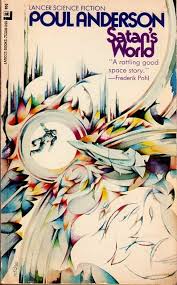
Satan's World.

I started out looking for insights into van Rijn but have got diverted into discussing every other aspect of Poul Anderson's Technic History but here is a good one. Thea Beldaniel, domesticated by the Shenna, stares fixedly at the approaching Shenn ships. Van Rijn cannot name the feeling that he gets while seeing her like that:

"'Embarrassment, probably,' the Wodenite suggested.
"'Oh, is that how it feels?'" (XX, p. 537)

Next, Adzel watches the nearest approaching ship:

"Its gaunt high-finned shape was partly silhouetted black upon the Milky Way, partly asheen by the distant orange sun." (ibid.)

That joins our list of descriptions not of the Milky Way, here, but of objects seen against the Milky Way, here.

Van Rijn hopes to negotiate with the horrible Shenna on behalf not just of the Solar Spice & Liquors Company but of Technic civilization.

Saturday, 15 December 2018

Progress

Poul Anderson, Vault Of The Ages, Chapter 9.

After participating in a battle here and discussing theology here, Carl creeps out of the camp:

"Looking upward, he saw the [guard] go past, a dim sheen of metal against the Milky Way. Snakelike, he writhed over the line." (p. 97)

The list of items seen against the Milky Way is shorter than the list of descriptions of the Milky Way but is growing.

Carl intends to defy taboo by learning the secrets of the ancients and using them against the otherwise invincible invaders. Hence, his creeping around in the dark.

Carl seeks knowledge only in response to an external threat. Things must get worse before they get better? People began to cultivate plants and herd animals only because climatic changes made hunting and gathering no longer viable? If threats to survival instigate progress, then the present period is potentially very progressive.

Sunday, 29 July 2018

Starting The Jumps

Is that what a Betan looks like? Reading prose sf, I mostly forget how the aliens have been described. In a visual medium, they would be in front of us all the time.

I reread and posted about The Avatar in June 2012. See the posts from "An Elder Race?" to "The Avatar VIII." However, I am pausing on more details this time.

In XXVII, Brodersen's ship, Chinook, has made its first random jump. I previously summarized the jumps here and here.

After the jump, the stars as seen from space are so numerous that an untrained eye cannot see how the constellations have altered:

"...nor did the argence of the Milky Way pour through channels greatly different from those above Earth or Demeter." (p. 233)

In XXIV, Caitlin had seen:

"...the Milky Way stream past Fidelio's head." (p. 208)

We have one list of descriptions of the Milky Way and another of objects seen against the Milky Way.

Sunday, 10 June 2018

A List Of Absences

(Istanbul.)

Poul Anderson's list descriptions often present dynamic urban life. However, one negative list evokes the opposite. Constantinople on 13 April, 1204, has no:

slap of buskins;
clop of hoofs;
rumble or squeal of cartwheels;
ringing bells;
voices;
children's games.

Instead, there is:

stillness;
the distant roar of shrieks and a fire;
a dog's desperate bark.

Poul Anderson, There Will Be Time (New York, 1973), X, p. 105.

Anderson always emphasizes the suffering caused by war. However, this is not a war but a massacre of Eastern Christians by Western Crusaders:

"So perished much classical art, and nearly all classical writing, which Constantinople had kept safe until these days. It was not true that the Turks of 1453 were responsible. The Crusaders were there before them.
"Afterward came the great silence, broken by furtive crying, and the stench, and the sickness, and the hunger.
"In this wise, at the beginning of that thirteenth century which Catholic apologists call the apogee of civilization, did Western Christendom destroy its Eastern flank. A century and a half later, having devoured Asia Minor, the Turks entered Europe." (IX, pp. 100-101.)

Anderson comments on conflicts in the twentieth century - and in the thirteenth.

To this day, I understand, Muslim jihadists describe their Western antagonists as "Crusaders." We live with history but can transcend it.

Friday, 23 February 2018

The Milky Way From The Dronning Margrete

We began to collect together Poul Anderson's descriptions of the Milky Way in The Milky Way and then started to add to the list in Mirkheim Miscellany. Here is another:

"...the Milky Way was a shining smoke..."
-Poul Anderson, Ensign Flandry IN Anderson, Young Flandry (Riverdale, NY, 2010), pp. 1-192 AT Chapter Nine, p. 85.

The characters have left Starkad but not yet reached Merseia so Chapter Nine recounts two conversations in the spaceship, the Dronning Margrete. Hauksberg and Abrams drink wine while Hauksberg's butler goes to bed and Flandry and Persis look at the stars while no one else is in the officers' lounge...

Dronning Margrete means "Queen Margaret." The ship belongs to Ny (New) Kalmar and is used as a yacht by the current viscount, who is currently Hauksberg.

 Chapter Ten is set in Ardaig on Merseia.