Showing posts sorted by date for query Beta Crucis. Sort by relevance Show all posts

Sunday, 8 November 2026

Fully Realized Fictional Worlds

See the previous post and its combox here.

This opening passage of the first Wing Alak story, originally published in 1949, addresses political and military relationships between planetary governments and a Galactic government but does not describe any particular planet's physical environment or galactic location. The viewpoint character is on an extrasolar planet but also in a hotel room which could just as well have been in future New York. In that kind of sf, other planets were effectively empty stages for human-alien or even just human-human interactions.

Yet to come were the days when:

human beings explore Ythri out beyond Alpha and Beta Crucis;

Ythrians, employing some human beings, explore Gray, later renamed Avalon, which is in the same region of space;

human beings and Ythrians jointly colonize Avalon, first the Hesperian Islands, then the Coronan continent;

at last, Avalon is fully populated by both species and is part of the Domain of Ythri which is attacked by the Terran Empire;

thus, there are political and military interactions but between fully realized fictional worlds;

human beings have also colonized Hermes, Dennitza and other planets which are as fully realized as Ythri and Avalon.

I did not set out to post about the Technic History but have wound up doing so. But Wing Alak is still on our radar.

Thursday, 29 October 2026

Setting The Stage

Poul Anderson, The Earth Book Of Stormgate (New York, 1978).

"Then came the Terran War, and when it had passed by, ruined landscapes lay underneath skies gone strange." (p. 14)

A major event, a war, has happened but it is finished. Either we have read about the Terran War in the previous volume or we must wait to learn more. Our human author, Poul Anderson, has to allow for either of these two possibilities. Meanwhile, however, the Ythrian author of this passage has identified himself on the preceding page:

"It is Hloch of the Stormgate Choth who writes, on the peak of Mount Anrovil in the Weathermother." (p. 13)

Another scene-setting sentence greets us on the facing page:

"Our part in the Grand Survey had taken us out beyond the great suns Alpha and Beta Crucis." (p. 15)

This is a human, not an Ythrian, narrator. The Ythrians are just about to be discovered. The phrase, "...great suns...," evokes great events to come and indeed great events will occur in Sector Alpha Crucis many centuries later.

It is worthwhile to possess copies both of the Earth Book and of the Saga even though the entire contents of the former are reproduced in the latter. We keep looking both forwards and backwards in time.

Thursday, 15 January 2026

First Contact

The two most recent posts have shown the position of Ythrians in Poul Anderson's Technic History. Their first story is about first contact when initially nothing was known about this species. Indeed, initially, it was difficult even to identify the dominant species on an obviously inhabited planet.

A Star Trek-parallel scenario: 

the (first) Grand Survey;

the starship, Olga, under Captain Gray, on a five-year mission beyond Alpha and Beta Crucis in the constellation Lupus, 278 light-years from Sol;

a golden G9 dwarf star of half Solar luminosity;

a terrestroid planet, smaller than Earth, with 0.75 G, a thin, dry but humanly breathable atmosphere, some small oceans and two small moons.

The Olga:

verifies by neutrino analysis that there is no artificial atomic energy anywhere in this planetary system;

enters orbit around the terrestroid planet;

gains every possible datum by remote observation before dispatching robot probes to uninhabited regions where the probes establish that life is chemically similar to Earth's and that microorganisms are safe.

There are woods, lakes, plains, mountains, clusters of buildings without defensive walls or streets, primitive mines and evidence of both Stone Age and Iron Age cultures.

This planet will later wage interstellar war against Terra. But not yet.

Thursday, 28 November 2024

One Bachelor And Several Admirals

Poul Anderson, The Rebel Worlds IN Anderson, Young Flandry (Riverdale, NY, January 2010), pp. 367-520.

"...at the opposite end of Terra's domain, twinned Alpha and bachelor Beta of the Southern Cross." 
-CHAPTER TWO, p. 386.

In what sense is Beta Crucis a bachelor?

The red giant star, Betelgeuse, with its large inhabited planetary system, lies between the Terran Empire and the Merseian Roidhunate. Sector Alpha Crucis is at the opposite end of the Empire. Beyond that Sector, there are only barbarians with spaceships and atomic weapons acquired from civilization.

Vice Admiral Sir Ilya Kheraskov orders Lieutenant Commander Flandry to report to Rear Admiral Yamaguchi. Later in his career, Flandry will be a Fleet Admiral. What are all these kinds of Admirals? A Wikipedia article explains all, here. Somewhere in there, I found the explanation that a Rear Admiral is indeed to be found at the rear of a fleet.

Kheraskov explains to Flandry that, while the Merseians are pushing at Jihannath, there is repression and potential rebellion in Sector Alpha Crucis. The sense of troubled times is palpable. Flandry's career accelerates.

Wednesday, 24 July 2024

Two Wealth-Generating Planets

David Falkayn:

made a discovery that led to the discovery of the rogue planet, Satan, falling toward Beta Crucis;

made an enquiry that led to the realization that large scale transmutation of elements will become possible on Satan as it swings around Beta Crucis;

discovered Mirkheim where large scale mining of supermetals is possible.

Because there is faster than light interstellar travel, these planets cause conflicts between planetary civilizations.

Falkayn's employer, van Rijn, profits from Satan but not from Mirkheim. This is where Falkayn draws a line and addresses the inequalities in Technic civilization. His contributions are greater than those of van Rijn and Dominic Flandry combined.

Non-Stop Action

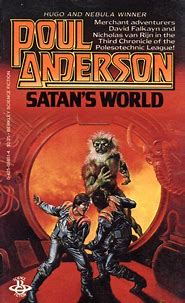
Satan's World.

Life is lived at a fast pace. Chee Lan rescues David Falkayn on the Moon and both must immediately travel to the rogue planet, Satan, currently swinging around Beta Crucis. When, near Satan, an interrogated prisoner discloses the coordinates of the enemy planet, Dathyna, Chee Lan and Falkayn must immediately go there as spies while the Dathynans still believe that the location of their home planet remains a secret. Van Rijn deduces that his trade pioneer crew members have located Dathyna and have gone there to spy. In fact, he counts on this when he allows himself and Adzel to be taken prisoner by the Dathynans/Shenna. Even if Adzel and he cannot escape, they might be able to relay military intelligence to the other two. Long shots pay off. Two rescue two. Fortuna audentes iuvat.

Monday, 22 July 2024

Control Of The Universe?

"STAR WANDERER
"CAST OFF FROM ITS FELLOW BITS OF CONDENSING MATTER AT THE BIRTH OF THE GALAXY, THE PLANET HAD NEVER KNOWN ANOTHER STAR; FOR ALL OF TIME IT SWUNG FREE IN THE VASTNESS OF INTERSTELLAR SPACE. NOW MERE CHANCE WAS BRINGING IT CLOSE TO THE STAR BETA CRUCIS...A CHANCE SO IMPROBABLE THAT THE ODDS AGAINST THE MEETING WERE ALMOST INCALCULABLE. AND AS IT DRIFTED INTO THE SPHERE OF MEN, THE SECRETS OF THE WANDERER WERE VALUABLE ENOUGH TO UNLEASH FORCES THAT AIMED FOR NOTHING LESS THAN THE TOTAL CONTROL OF THE UNIVERSE!"
-Blurb on Poul Anderson, Satan's World (New York, 1972), back cover.

All accurate except for the concluding six words! Surely the novel is dramatic enough without adding a falsehood about control of the universe? Poul Anderson frequently emphasizes that Technic civilization is confined to a single volume of space at the far edge of one spiral arm of one galaxy. Other galaxies are seen but that is all. Controlling the whole universe, if that idea is even conceivable, would be an entirely different story. If such a narrative could be made coherent, then Anderson would have been able to tell it but he did not.

Friday, 19 July 2024

Satan In-Fall


Satan's World, XI.

The surface of the rogue planet, Satan, is covered with frozen oceans and by ten to twenty metres of frozen atmosphere. Its temperature is close to absolute zero. Nevertheless, the magnetic field indicates that part of the planetary core is still molten. As in Norse mythology, the dialectical opposites of heat and cold interact. Mantle, crust and frozen surface insulate core heat. 

As Satan falls toward Beta Crucis, its cryosphere dissolves. Glaciers melt into torrents which boil into winds. Melting ice moves masses. Mountains rise. Shifting intra-global pressures release energy that melts rocks. Thousands of volcanoes erupt. There are geysers, hail, rain and boulders whirled aloft by gales/tempests/hurricanes.

Some of the drama in Poul Anderson's works is in natural events alone. The novel is mainly about the industrial potential of a re-energized uninhabited planet. Without a nearby technological civilization, the transformation of Satan would have passed unnoticed with no extraplanetary consequences.

Norse-Technic Interfaces

Van Rijn arranges weregild for the families of Gorzuni mercenaries.

He quotes, "Bare is brotherless back.'" (Satan's World, X, p. 99)

Burning with fury, David Falkayn:

"...might have been reliving ancient incarnations as he swung a Viking ax..." (XI, p. 101)

The changes on Satan as it approaches Beta Crucis are compared to Ragnarok.

Dominic Flandry sees time as the snake gnawing the root of Yggdrasil.

Ginnungagap is referenced both in "The Saturn Game" and in "Starfog."

Those are seven examples. Anderson readers can turn back to Hrolf Kraki's Saga etc.

Tuesday, 16 July 2024

Falkayn's Earlier Adventures

Poul Anderson's Technic History has seventeen volumes if it includes The Saturn Game and other stories (suggested). In this reading order, Volume II, The Trouble Twisters, presents David Falkayn in action on Ivanhoe, at Beta Crucis and on Ikrananka whereas Volume III, Satan's World, refers to his activities at Beta Crucis, on Ikranaka and on Merseia. We must wait until Volume VII, The Earth Book Of Stormgate, to be shown Falkayn on Merseia, where this story, "Day of Burning," is presented on a "now it can be told" basis.

In The Technic Civilization Saga, which comprises seven omnibus collections presenting this entire future history series in chronological order of fictional events, Volume I, The Van Rijn Method, shows Falkayn on Ivanhoe and at Beta Crucis whereas Volume II, David Falkayn: Star Trader shows him on Ikranaka and on Merseia, then incorporates Satan's World. At last everything is in the correct order although I have got confused a couple of times trying to summarize all this accurately.

Similarly, the seventeen-volume series passes directly from Satan's World to Volume IV, Mirkheim, whereas the intermediate story, "Lodestar," about the discovery of Mirkheim is first collected in the Earth Book, again on a "now it can be told" basis. In the Saga, Volume II ends with "Lodestar" and Volume III, Rise Of The Terran Empire, opens with Mirkheim.

Read the seventeen-volume version, then reread the series in the Saga.

Monday, 15 July 2024

Two Details In SATAN'S WORLD

Poul Anderson, Satan's World (New York, 1972).

My copy of The Technic Civilization Saga, Volume II, David Falkayn: Star Trader has fallen apart through over-use so I am now rereading Satan's World as a single volume. See above.

Two points:

"Men can alter a world, or ruin one; but they cannot move it one centimeter off its ordained course. That requires energies of literally cosmic magnitude.
"So you couldn't ease this planet into a suitable orbit around Beta Crucis. It must continue its endless wanderings." (III, p. 30)

What is impossible in some universes is possible in others. James Blish's Earthmen move a planet between galaxies faster than light. (Yet another comparison between future histories.)

Secondly, Chee Lan's companion:

"...knew Espanish, not Anglic." (IV, p. 35)

English has become Anglic. French has become Fransai. Here we learn that Spanish has become Espanish. Is every major language reproduced in Technic civilization? This might be the only mention of Espanish.

Wednesday, 12 June 2024

Fictional And Real Astronomical Objects

The rogue planet, Satan, orbits around Beta Crucis and back out.

In "Lodestar," the trade pioneer crew is on the planet Tametha. The nearest major League base is on Irumclaw which, later, is on the Terran frontier of the Betelgeuse sector. When leaving Tametha, Falkayn looks at the Crab Nebula which is over a thousand parsecs away.

We are trying to get some sense of where Poul Anderson's fictional locations are in relation to each other and also to real astronomical objects. So far, in our comparisons, the real objects, working backward for convenience, have been:

the Crab Nebula
Betelgeuse
Orion
Taurus
Rigel
Alpha Crucis
Beta Crucis
Beta Centauri
Antares
Hercules
Arcturus
Pegasus
Lupus
the Milky Way
Polaris

That is more than we might have expected, fifteen so far, and might give an astronomer some sense of a vast three dimensional space with fictional spacecraft moving around in it instead of just a list of names.

Sectors Pacis And Alpha Crucis

Continuing from the end of the preceding post, Avalon is about eighty light-years from Ythri and joins the Domain of Ythri which stretches across about 80 light-years as against the Terran Empire's 400. Imperial Sector Pacis, centred on the star, Pax, and its colonized planet, Esperance, is close to the Domain and the Empire attacks the Domain from there.

Also close to the Domain is Imperial Sector Alpha Crucis, centred on the star, Virgil, and its colonized planet, Aeneas. Ythri is about 100 light-years from Aeneas toward Beta Centauri. Alpha and Beta Crucis are close enough to Aeneas to cast shadows on its surface at night. I think that someone looking at the Aenean night sky sees the stars of the Empire and beyond them those of the Merseian Roidhunate but am having trouble finding that passage. Part of the reading experience is remembering but sometimes uncertainly.

Addendum: To be more precise, Sector Alpha Crucis is governed from the city of Catawrayannis on the planet Llynathawr and Sector Navy HQ is on the planet Ifri in another system but the McCormac Rebellion of the Sector against the Empire is led by the Firstman of Ilion on Aeneas. (As complicated as real life.)

Tuesday, 11 June 2024

Galactography Summary

Summing up so far:

a trade route between Earth and Sector Antares

Suleiman and Babur beyond Antares

Per Stenvik's apprenticeship in the Hercules region

Nuevo Mexico beyond Arcturus

Cain out Pegasus way

Freya in an uncharted region of this galactic arm

other planets in unspecified regions

Small details add up to a bigger picture. Someone with astronomical knowledge will be able to tell us where some of these planets are in relation to Earth and to each other. It should be possible to add to the list. In fact, "Wings of Victory" informs us that Ythri is beyond Alpha and Beta Crucis in the constellation of Lupus but I have only just started to look beyond the van Rijn stories and will now definitely stop for tonight! Good night.

Friday, 13 October 2023

Astronomical Terminology And Merseian Nomenclature

The Game of Empire, CHAPTER ELEVEN.

"A dozen light-years off, the twin blue giant suns that were Alpha Crucis dominated heaven." (p. 305)

According to Poul Anderson' text, Alpha Crucis is a double star. These two stars are, of course, not Alpha and Beta but Alpha A and Alpha B. Apparently, "Acrux" (Alpha Crucis) is a multiple with six components. See here.

This chapter is entirely about Merseians attacking Gorrazanians and can be regarded as an instalment of the Merseian future history that parallels the human future history.

We meet Cyntath Gadrol Cannonshield, Vach Ynvory. Thus:

rank: Cyntath
personal name: Gadrol
nickname: Cannonshield
Vach: Ynvory

- also:

rank: Qanryf
personal name: Bryadan
nickname: Arrowswift
Vach: Hallen

- and:

rank: Afal
personal name: Uroch
nickname: the Lucky
Vach: Rueth

These three individuals are all of the dominant Wilwidh culture. There are other Merseians who have surnames but not nicknames and who do not belong to Vachs.

Wednesday, 13 September 2023

A Change Of Scene

Poul Anderson, The Rebel Worlds IN Anderson, Young Flandry (Riverdale, NY, January 2010), pp. 367-520.

This novel is a change of scene: no Merseians - they will return later. First, an unentitled prologue is narrated from a Didonian point of view - incomprehensible on first reading. Secondly, in CHAPTER ONE, a prison satellite orbits around the planet, Llynathawr, and above the city, Catawrayannis. Through the viewport in his cell, Hugh McCormac sees Alpha and Beta Crucis - the latter the location of Satan.

McCormac:

remembers his home planet, Aeneas - the towers of Windhome; the Wildfoss pouring from the Ilian Shelf onto the Antonine Seabed;

recalls a conversation with a wise Wodenite;

is rescued by a team including a grinning, battle-axe-wielding Donarrian;

realizes that he must lead a revolt.

This time, the Empire's problems are internal - although there is simultaneous off-stage conflict with the Merseians. Flandry comes on-stage in CHAPTER TWO.

Sunday, 20 August 2023

The First Grand Survey

"Our part in the Grand Survey had taken us out beyond the great suns Alpha and Beta Crucis."
-Poul Anderson, "Wings of Victory" IN Anderson, The Van Rijn Method (Riverdale, NY, December 2009), pp. 75-102 AT p. 79.

Participants in the first Grand Survey do not know that it is the first such interstellar survey just as participants in the Great War did not know that it was the First World War. The Terran Empire will have a Sector Alpha Crucis. The rogue planet, Satan, will swing round Beta Crucis. Rereading the earlier Technic History instalments, we appreciate their later significance.

After three years, the Olga under Captain Gray, discovers Ythri. Poul Anderson's Technic History series might have included a Grand Survey collection that would have constituted a "higher and greater Star Trek." This is a description that the British publisher, Charles Monteith, applied to James Blish's Cities in Flight but the Grand Survey comes even closer to the Enterprise's five-year mission.

"A ship of the first Grand Survey noted [Valenderay's] existence."
-Poul Anderson, "Day of Burning" IN Anderson, David Falkayn: Star Trader (Riverdale, NY, March 2010), pp. 209-272 AT p. 211.

Valenderay is the supernova that threatens Merseia.

"When the Survey team arrived [on Merseia], the Wilwidh culture stood on the brink of a machine age."
-ibid., p. 232.

Merseia, dominated by old Wilwidh, will be the main opponent of the Terran Empire.

"They found [Paradox] during the first Grand Survey."
Poul Anderson, "A Little Knowledge" IN David Falkayn: Star Trader, pp. 599-630 AT p. 601.

Paradox is not major player but is a fascinating detail of the Technic History. Hloch, compiler of The Earth Book of Stormgate, compares "A Little Knowledge" to a dewdrop reflecting the glade wherein it lies.

Have I missed any Grand Survey references? 

Wednesday, 16 August 2023

Violent Environments

A planet like Satan or Mirkheim has a physical environment with industrial potential and therefore also political implications. An sf novelist has to present every such aspect from dissolving cryosphere on Satan and supermetal-coated surface on Mirkheim to the wars for possession of both planets. Satan's transit of Beta Crucis could have occurred unobserved. There would then have been no consequences in the experience or actions of conscious beings. It matters, first, whether there is an interstellar civilization and, secondly, what kind of civilization it is. The discoverers of Satan had only a scientific interest in its environmental transformation but, when human beings and the Shenna became involved, Satan mattered.

On that planet, heat not only rains down from the approaching blue giant star but also emerges when released from the still molten core. Glaciers melt into torrents which boil into stormwinds. Thousands of volcanoes and geysers erupt. Natural violence outweighs intelligent violence.

Tuesday, 15 August 2023

Wealth And Evil

Satan's World, XIII.

Ahriman, Loki and Lucifer have each had a planet named after them. We see the planet Lucifer in "The Problem of Pain." As a rogue planet falls around Beta Crucis, its environment becomes turbulent and lethal, full of fire and ice. David Falkayn names it "Satan." Chee Lan comments that mythological antigods can bestow wealth but that it is unwise to bargain with them. The Satanic environment will indeed become a source of vast industrial wealth but will it also wreak disproportionate harm? Falkayn responds:

"'We'll see.'" (p. 458)

Both Chee Lan and Falkayn seem to accept that mythological discourse can apply to a newly discovered material environment. The insights expressed in the myth might still be valid. 

Saturday, 22 April 2023

On Satan

The Rebel Worlds, CHAPTER TEN.

The rogue planet, Satan, recedes from Beta Crucis on its hyperbolic orbit:

a sphere blurred by gas
vaguely shimmering clouds and oceans
lands seen as blacknesses
desolation
raw mountains
gashed valleys
naked stone plains
chill, stagnant seas
unrelieved night
rare lamps
blue phosphorescence
dreary wind-skirl
rushing sterile waters
still-toiling robots, computers and automata
a dragon's hoard of wealth for the first Imperial aristocrat to send down a self-piloting freighter