Saturday, 22 July 2017
Resonance
When Everard persuades Carl that he must return to the Gothic period in order to play the role of Odin betraying his followers, this is because, in their timeline, that betrayal has already occurred.
Thus, if Carl refuses to return, the first problem will be the arrival in the twentieth century of that Carl who did appear in the Gothic period and enact the betrayal. Carl’s current intransigence would have prevented his departure from the present but not his arrival in the past because that had happened earlier. I quote the rules of time travel taught in the Academy.
Everard tells Carl that an incipient causal loop can set up a resonance which can produce catastrophically multiplying historical changes. He does not tell us what a resonance is but could it mean this? - Carl’s refusal to conduct the mission of betrayal duplicates Carl; then, if either Carl travels further into the past than the Gothic period, there is the danger that, when he returns to the twentieth century, it will be to the twentieth century of a timeline in which Odin’s descendants were not betrayed, did defeat their enemy and did bring it about that an entirely different story was recorded in the Volsungasaga, thus preventing the history in which a Carl Farness sets out to track down the origin of the story of Odin’s betrayal.
-copied from here.
I have copied an earlier attempt to answer a question asked in current posts. Manse Everard says that an incipient causal loop can set up a resonance that can produce catastrophically multiplying changes of history. Can it? Does the Patrol know this? How often has it happened? How was it rectified? Or is Manse's statement mainly theoretical?
In physics, resonance is a phenomenon in which a vibrating system or external force drives another system to oscillate with greater amplitude at specific frequencies. Frequencies at which the response amplitude is a relative maximum are known as the system's resonant frequencies or resonance frequencies.
-copied from here.
A resonance is an interaction between two systems or between a force and a system. Catastrophically multiplying changes of history must mean that one change would cause so many other changes that it would be difficult or impossible for the Patrol to identify and counteract the original change.
Thursday, 2 September 2021
Collision And Resonance
The Stars Are Also Fire, 20.
Edmond Beynac and others explore an asteroid composed of metals that were once fused and therefore were part of a body large enough to melt and form a core. The flat surface on one side is the fracture line where a collision broke this particular asteroid loose from the larger body. The evidence suggests not that the collision shattered that original body but only that several large fragments like the present asteroid were broken from it. The original body, if still in the Solar System, should now be in an eccentric orbit. Beynac's son, Temerir, a Lunarian astronomer, will:
"...search after the great planetoid Father dreamed of..." (p. 275)
This sub-plot has legs.
Beynac's death motivates his sons to:
"'...break the ban of the overlords and set Luna free in space." (p. 273)
Their mother, Dagny, agrees to help politically, another reason to call her "the Mother of the Moon."
Beynac's death:
"What caused the disaster was a shaped minicharge. It should simply have split an anomalous plumbic vein, to produce recoverable specimens. Instead the explosion found a resonance. Weaknesses unstressed for billions of years gave way... A dozen huge, a hundred lesser chunks fell." (p. 270)
Beynac's helmet is smashed open.
That resonance rang a bell:
Monday, 28 July 2014
Resonance
"'An incipient causal loop is always dangerous...It can set up a resonance, and the changes of history that that produces can multiply catastrophically. The single way to make it safe is to close it. When the Worm Ouroboros is biting his own tail, he can't devour anything else.'"
-Poul Anderson, Time Patrol (New York, 2006), p. 449.
"An incipient causal loop..." must mean a potential causal circle that needs action by the Time Patrol to complete it but what is a resonance? Carl Farness visiting the fourth century Goths has been mistaken by them for Odin. Their literature relates that Odin appeared in a battle and betrayed his followers. In the twentieth century, Everard tells Carl that he must travel back once more to enact that betrayal.
If Carl refuses, then history cannot and will not retroactively change because of his refusal. He and Everard are conversing in a timeline where the betrayal did happen and was recorded in literature. However, the first consequence of his refusal would be that the Carl who did perform the betrayal will return to the twentieth century. To prevent that duplication of himself, the Carl who is talking to Everard must travel back to the fourth century in order to be the Carl who appeared and betrayed his followers.
The second consequence might be that anyone returning from a period earlier than the fourth century could arrive in an altered timeline where the betrayal had not happened. Is this potential double consequence what is meant by "a resonance"?
Tuesday, 25 September 2018
Resonance
"...the transmitter was emitting the carrier pattern of a functioning receiver: the 'resonance' or 'awareness' effect which beat the inverse-square law, a development of Einstein's great truth that the entire cosmos is shaped by what momentarily happens to each of its material parts." (p. 124)
"'...a positron in motion through a crystal lattice is accompanied by de Broglie waves which are transforms of the waves of an electron in motion somewhere else in the universe. Thus if we control the frequency and path of the positron, we control the placement of the electron - we cause it to appear, so to speak, in the circuits of a communicator elsewhere. After that, reception is just a matter of amplifying the bursts and reading the signal.'"
-James Blish, The Quincunx Of Time (New York, 1983), CHAPTER SIX, p. 59.
Firmly grounded in physics, Anderson's characters use resonance for interstellar teleportation and Blish's use it for instantaneous communication.
Monday, 23 May 2022
Mutable Time Theory
Causal loops are subtle. An incipient causal loop is dangerous because it can set up a resonance which can cause changes of history that multiply catastrophically. The loop is made safe by closing it.
In "Star of the Sea":
Causal loops often have a powerful and subtle force. It is necessary to prevent a causal loop from developing into a causal vortex.
Saturday, 8 August 2015
Temporal And Causal Vortices
"'Often a causal loop has a powerful and subtle force to it. What we've got to do is prevent it from developing into a causal vortex." (p. 600)
What is a temporal or causal vortex and how can a causal loop become one?
"'An incipient causal loop is always dangerous, you know. It can set up a resonance, and the changes of history that that produces can multiply catastrophically. The single way to make it safe is to close it. When the Worm Ouroboros is biting his own tail, he can't devour anything else.'" (p. 449)
What is a resonance? Changes multiplying catastrophically sound like a "vortex." When the Patrol realizes that a causal circle has started, Patrol agents must ensure that the circle is completed. Otherwise, the events can become a causality violation.
"...he knew their whole reality for a spectral flickering, diffraction rings across abstract, unstable space-time..." (p. 480)
I think that space-time is concrete enough even if unstable.
"...reality is conditional. It is like a wave pattern on a sea. Let the waves - the probability-waves of ultimate underlying quantum chaos - change their rhythm, and abruptly that tracery of ripples and foam-swirls will be gone, transformed into another." (p. 671)
Here Anderson approaches the idea, made explicit in The Shield Of Time, that temporal changes can occur without time travelers' intervention. The future tense of "...abruptly...will be gone..." clearly refers to a second temporal dimension.
Saturday, 22 July 2017
Carl And Manse III
What would happen if Carl refused to play this role? The Teurings attacked Ermanaric in 372 (Time Patrol, pp. 450-455) whereas Carl and Manse Everard discuss that attack and its consequences in 1935 (pp. 446-450). Thus, Carl and Manse have their discussion in the twentieth century of a timeline where Carl had already appeared and betrayed his descendants 1563 years earlier. That Carl would return to New York in 1935 and would find there/then the Carl who had refused to do the job. Such duplication is to be avoided. However, that is the only consequence that I can deduce.
Manse says:
"'An incipient causal loop is always dangerous, you know. It can set up a resonance, and the changes of history that that produces can multiply catastrophically. The single way to make it safe is to close it. When the Worm Ouroboros is biting his own tail, he can't devour anything else." (p. 449)
I do not know what "resonance" means in this context. And the loop has already been closed, is no longer "incipient." Otherwise, Manse and Carl would not be there to discuss it.The painful point for Carl, though, is that that job is still ahead of him on his own world line.
Friday, 30 September 2016
"Very Messed Up" III
In the combox for "Very Messed Up," we got onto what would have been the consequences if Carl had not time traveled pastward to betray his followers. I wanted to discuss this further but found that I had already done so in some earlier posts. See the above links.
Long before people started to think about time travel, they had already become familiar with three kinds of sequences:
chronological - A happened before B;
causal - A caused B;
logical - if Socrates is a human being and if all human beings are mortal, then Socrates is mortal.
Causal is one kind of chronological.
In time travel:
familiar chronological sequences can be reversed, e.g., a man might die before he was born;
effects can precede their causes;
the question arises whether an effect preceding its cause might cause it or even prevent it;
people tend to think of different times as different places existing at the same time, thus causing endless conceptual confusion, e.g., it might be thought that, if I travel from 2016 to 1889 to prevent the birth of Hitler, then as soon as I prevent Hitler's birth, the world of 2016 changes into one in which there had never been a Hitler who was the Fuhrer of Germany.
However, there is no way that time travel can negate logical relationships, e.g., time travel cannot bring it about that, although all human beings are mortal and although Socrates is a human being, Socrates is immortal.
Monday, 28 July 2014
Resonance II
I suggested that a refusal by Carl Farness to complete a causal circle might have two consequences but now I doubt the second consequence.
We are imagining a timeline in which:
in 372 AD, Carl, in the role of Odin, appears on his timecycle, a metal-boned "...skeletal horse..." (Time Patrol, p. 454), and betrays his Gothic followers;
Manson Everard, roving the period from end to end, confirms that the Volsungasaga story of Odin betraying his followers originated specifically in this action by Carl;
in 1935, Everard tells Carl that he must travel to 372 to betray his followers.
Carl complies but the question is: what would have happened if he had refused?
1st Consequence
The Carl who had appeared and enacted the betrayal in 372 arrives in 1935, so Carl has duplicated himself. Patrol members have to avoid this kind of paradox.
2nd Consequence (which I now doubt)
Anyone traveling to a date earlier than 372 and returning futureward might arrive in a timeline in which history was different because the betrayal had not happened.
But I now think that, if someone travels pastward along a timeline in which the betrayal happened, then he should return futureward along that same timeline unless, while he is 372 or earlier, he does something (I don't know exactly what) to prevent Carl from making the betrayal. (Our hypothetical new time traveler might prevent Carl's/Odin's followers from attacking King Ermanaric so that they would not be present in Ermanaric's hall when Odin appeared in order to betray them?)
However, this is all speculative. What the Patrol definitely wants to do is, first, to prevent the paradox of Carl duplicating himself and, secondly, as far as possible, to prevent even the slightest possibility of a timeline in which the betrayal did not happen. Both these purposes are served by getting Carl to leave 1935 with the intention of appearing in 372 and betraying his followers. This completes the circle and prevents anything else from happening.
But this leads me back to the question; what does Everard mean by "...a resonance..."? (p. 449)
Wednesday, 9 January 2019
James Blish On Poul Anderson IV
In More Issues...
On pp. 43-44, Blish, discussing sf "energy screens," writes that:
EE Smith thought of the screens "...as stationary wave fronts...," (p. 43), as if light from a star stopped in space and prevented "...outside light of identical frequencies..." (p. 44) from passing;
"Such effects are often seen in wave-guides and in other phenomena of that general field, which is called resonance..."; (ibid.)
either resonance without a resonator or the Standing Wave of gravity theory would generate such effects in space;
Poul Anderson has written at length (?) about the Standing Wave. See here. (Scroll down.)
And, in some works by Blish, the FTL drive is called the Standing Wave. See the above link.
Monday, 24 August 2020
Causal Loops
Merau Varagan rescues his younger self. Chaim Zorach says that this is dangerous. Why?
Everard says that the dangers include:
"'...that he would make himself never have existed.'" (p. 281)
How?
Everard reflects that occupying two places simultaneously involves:
"...the chance of starting a causal loop that might expand out of control..." (p. 296)
How might bilocation start a causal loop and how might such a loop expand? A loop is closed, not expansive.
"'An incipient causal loop is always dangerous, you know. It can set up a resonance, and the changes of history that that produces can multiply catastrophically.'"
-"The Sorrow of Odin the Goth" IN Time Patrol, pp. 333-465 AT 1935, p. 449.
What is a resonance and how might it change history?
A closed causal loop is put forward not as a problem but as a solution:
"'The single way to make [an incipient causal loop] safe is to close it. When the worm Ourboros is biting his own tail, he can't devour anything else.'" (ibid.)
"'No, this is no slight ripple in the time stream. This is a maelstrom abuilding. We've got to damp it out, and the only way to do that is to complete the causal loop, close the ring.'"
-"The Sorrow of Odin the Goth," p. 450.
Everard retrieves all of Stane's belongings:
"...except the fuel chest. That had to be left, so that up in the future he would learn of this and come back to stop the man who would be God."
-"Time Patrol" IN Time Patrol, pp. 1-53 AT 5, p. 42.
A loop that isn't closed isn't a loop.
Friday, 30 October 2015
Light On Waves
"Light flew like laughter over small waves, aglint and aglimmer in a hundred shifting hues, blue, green, tawny, foam-white. They murmured and chuckled as they played tag with the shadows of hurrying snowy clouds. Birds wheeled, soared, swooped, swam, swung again aloft, in their thousands, gull, guillemot, cormorant, puffin, razor-bill, curlew, kittiwake, skua, fulmar. Their cries brought alive a breeze in which something of summer's warmth lingered on into the fall."
-Poul Anderson, Mother Of Kings (New York, 2003), Book Three, Chapter VI, p. 206.
The paragraph begins with light and ends with warmth. We must wait for the third sense but it comes. "Light...like laughter...," "...aglint and aglimmer...," "...soared, swooped, swam, swung...," "...again aloft...," "...something of summer..." and some of the birds' names are alliteration. There are three list-descriptions: colors; birds' movements; birds. The birds' cries provide sound but we have already had murmuring, chuckling waves.
We remember other descriptive passages featuring moving cloud shadows and there may be a further resonance. In Anderson's Time Patrol series, changeable wave patterns at sea are a metaphor for the quantum randomness that can change the course of temporal events. Here, we are in a single historical period but we might also remember the Patrol that guards history.
Tuesday, 3 March 2026
Phases (Or Phrases)
In Anderson's Psychotechnic History, "hyperspace" is an increase in phase velocity, made possible by the frequency of the engine's oscillators, or is a tachyon mode.
In The Peregrine, part of the Psychotechnic History, when the spaceship is in the fringes of a trepidation vortex:
"'Components of the vibration have the ship's resonance frequencies. They'll shake us apart, atom by atom.'" (CHAPTER XIII, p. 114)
The solution is to:
"'...get the ship as a whole in phase with the major space-pulsations -...'" (pp. 114-115)
- so Coordinator Trevelyan, having glanced at the ship's instruments, then subconsciously computed gravitational and electric potentials, gradients, magnetism, gyration, frequencies and amplitudes, directs the engine room how to:
"'Pulse the hyperdrive, sinusoid - here, I'll give you the figures.'" (p. 115)
It all sounds very similar.
When I worked in a labouring job at the Royal Lancaster Infirmary, (see also Hospital) a member of the domestic staff informed me that a then current building project within the Infirmary was "Phrase One." We wondered how many Phrases there were going to be.
Saturday, 27 November 2021
Forever Lost
Thursday, 26 August 2021
Sea And Space
Thursday, 11 October 2018
Death And Aftermath
See On An Asteroid III.
Nkuhlu and Oliveira take samples and a sounding from the eagle's beak which is not familiar rock but intricately alloyed metal with tangled layers, encysted lumps and vacuoles. (Wiki article on "Vacuole" does not seem to match Anderson's use of the word.) Samples cut with an ion torch can generate white-hot gobbets. Sonic pulses make footing tremble. When a minicharge finds a resonance, the beak breaks and rubble kills Beynac.
His Lunarian sons plan vengeance. The expedition had traveled in an inadequately equipped ship borrowed from Fireball because the Federation forbids Lunarians to build spaceships. Their vengeance will be to defy that ban. The approaching and inevitable era of the Selenarchs has been hastened by Beynac's death.
Saturday, 20 December 2014
Planets In Mirkheim
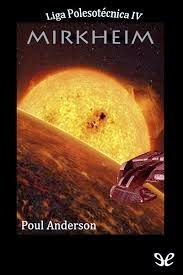
Mirkheim
Babur
Hermes (see also here, here and here)
Ivanhoe
Diomedes (see also here)
Woden
Valya
Luna
Vanessa (see also here)
Merseia (see also here and here)
Cynthia (see also here)
Gorzun (see also here and here)
Ikrananka:
Tidal action has forced one hemisphere of the small, eccentrically orbiting, librating planet Ikrananka to face its red dwarf sun but such slow rotation generates a weak magnetic field so that the planet retains an atmosphere although most of its water has frozen on the cold side making the warm side a slowly deteriorating desert whose inhabitants, struggling for survival in their season-less, rhythm-less environment, regard nature as hostile, believing in demons but not in gods, whereas dwellers on the edge of the Twilight Zone, with rain, snow, day, night and constellations, more conventionally believe in an annually dying and rising god and a single devil whose power can be neutralized. The latter are easier to trade with.
Vixen:
In the Cerulian system, resonance with the jovoid planet Ogre has multiplied perturbation and brought the eccentricity of the terrestroid Vixen's orbit close to one-half so that, with a 24 degree axial tilt and midsummer nearly at periastron, once every eighteen month year the northern hemisphere is scorched with four times the radiation that Terra receives from Sol - snow melts, rivers overflow, lakes bake dry, storms rage, fires break out, erosion prevents mountain formation, hot wind blows dust and ash across dry plains.
- Ikrananka and Vixen copied from here.
Monday, 14 July 2025
Two Changes
(i) a transformation inside each conscious organism on Earth, particularly inside each individual human being;
(ii) a transformation of human society. (Should we use the word, "revolution"? I just did.)
In the novel, (i) causes (ii). A really big change within individuals would change the relationships between them and thus society. At the same time, a really big change in social conditions changes individual perceptions, expectations and aspirations. Someone condemned to continual struggle for his physical survival becomes increasingly suspicious and hostile whereas that same person assured of physical security and comfort develops a very different perspective.
(i) has two stages. First, a significant increase in intelligence. That alone changes society. Secondly, this increased intelligence brings about a resolution of the conflict between reason and emotion, an even bigger change.
The changes start small -
a rabbit figures how to escape from a trap;
a low IQ manual worker suddenly understands how easy it is to drive a car and realizes the significance of the statement that stars are remote suns;
a boy who likes algebra starts to invent differential calculus before breakfast;
a physicist who has:
"'...been trying to build a phase analyzer for intermolecular resonance bonds in crystal structure...'" (2, p. 14)
- wakes up "'...with an idea that might work.'" (ibid.);
his wife, left to her own devices, reads his copy of Lord Jim instead of a detective story and forgets about lunch;
a labour organizer wakes up with a reorganization plan that will halve his paperwork;
people on the subway are quieter and more thoughtful...
A great day is about to dawn.
Monday, 25 August 2014
The Intelligence Revolution
A rabbit escapes from a trap.
An owl hoots in fear and bewilderment.
An agricultural worker previously unable to drive a car contemplates the stellar universe.
A ten year old boy leaves his model plane unfinished and starts to invent differential calculus.
Peter Corinth wakes up with a possible solution to his problem of how to build a phase analyzer for intermolecular resonance bonds in crystal structure.
Sheila Corinth becomes engrossed in a serious novel instead of reading a detective story, shopping or eating lunch.
Felix Mandelbaum, union organizer, wakes up with an idea for a reorganization plan that will halve the paper work and outlines a chart before leaving for work.
A dog in a basement opens a deep freeze, drags out meat and eats it when it has thawed.
A lift attendant decides to start a night course.
Corinth's colleague Grunewald has a parallel idea for a circuit that might work.
The usually quiet Johansson contributes eagerly as the three men draft their plans.
Everyone is jumpy.
Young Roberts comes up with even wilder ideas than usual.
Nat Lewis, studying neurones, finds that they are reacting faster than normally and with intenser signals...
Thursday, 26 February 2015
The Peshawar Lancers: First Impressions
(i) An evocative cover with a British military theme suggesting a personal or at least sexual relationship and an airship visible through the window.
(ii) ...Lancers is copyright 2002. The twenty first century is no longer the future. (Of course it isn't but this has a particular resonance in science fiction.)
(iii) The dedication is In Memoriam: Poul Anderson 1926-2001. (Contemplate world events and changes in that three quarters of a century.)
(iv) Acknowledgements for inspiration start with Kipling.
(iv) The novel quotes from The Golden Road and Hassan by James Elroy Flecker. (I got interested in Flecker anyway. Then quotations from Flecker were one of the parallels that I found between Poul Anderson and Neil Gaiman. Further, both Anderson and Gaiman quote from The Golden Road.)
(v) The novel concludes with five Appendices of background information and a list of King-Emperors. Victoria I's reign ends earlier than in our timeline. Elizabeth II's dates, 1989-2005, differentiate her from our current Queen.
(vi) The book contains no maps of the altered world but these are to be found on the Internet.
(vii) So far, then, quite fascinating.
Meanwhile, I am still carefully rereading Anderson's Fire Time. That novel remains on the blogging agenda to which ...Lancers has now been added.