A spaceship in the normal mode can be tracked by:
Showing posts sorted by relevance for query tachyons. Sort by date Show all posts
Tuesday, 17 February 2026
Tachyons
amplified sight;
thermal radiation;
radar;
neutrinos from its powerplant.
- on the tachyon mode by:
"...a weak emission of super-light particles..." (p. 219)
When Trevelyan Micah and Smokesmith in the Genji followed Murdoch Juan and his crew in their Campesino, Murdoch's crew detected the Genji's tachyons while faster-than-light and her neutrinos while slower-than-light.
Tachyons are faster-than-light particles. (Theoretical, as yet.) When in the tachyon mode, a spaceship emits super-light particles/tachyons. But what is the "tachyon mode"? Are the ship and its contents transformed into tachyons? Or, at least, are they endowed with whatever property of tachyons makes them move faster than light?
Have there been two hyperdrives in the Psychotechnic History, the first involving multiple dimensions and discontinuous psi functions, as in "Gypsy," and the second involving tachyons, as in "The Pirate"?
Who can possibly say?
Tuesday, 12 November 2024
Tachyons
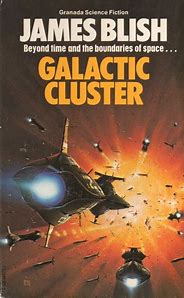
The term, "tachyon," was coined in 1967. See here. Gerald Feinberg who coined it was inspired by "Beep" by James Blish. Poul Anderson's "The Pirate" was published in 1968. In it, hyperdrive is described as:
"...the tachyon mode..."
-Poul Anderson, "The Pirate" IN Anderson, The Complete Psychotechnic League, Volume 3 (Riverdale, NY, July 2018), pp. 137-165.
In that mode, a spaceship can be tracked only by:
"...a weak emission of superlight particles..." (ibid.)
Thus, retroactively, all previously published references to the hyperdrive in Anderson's Psychotechnic History were to this "tachyon mode."
How does it work? Transforming all the particles in a spaceship into tachyons would make the whole ship move faster than light, if not also backwards in time, but would also make it undetectable.
"The Pirate" is in one way the summit of the Psychotechnic History since it was the last instalment to be published and spells out the ethos of the Coordination Service.
Now I am bound for the two-storey apartment above the Old Pier Bookshop, the view of Morecambe Bay, pizza, superhero videos and an analysis of world affairs. I will think about sf as well.
Sunday, 10 May 2020
The Tachyon Mode
The text in this image says "Detected in linear accelerator experiments" where the Wikipedia "Tachyon" article says:
No experimental evidence for the existence of such particles has been found.
Next we turn to:
Poul Anderson, "The Pirate" IN Anderson, The Complete Psychotechnic League, Volume 3 (Riverdale, NY, 2018), pp. 137-165 -
- where Trevelyan Micah and Smokesmith in the Coordination Service speedster, Genji, track the cruiser Campesino. When the latter has "...gone over to the tachyon mode...," (p. 143) she can be tracked only by "...a weak emission of superlight particles..." (ibid.)
This newly introduced terminology of "tachyon mode" applies to the "...hyperdrive..." (p. 142) which is an already established feature of Poul Anderson's Psychotechnic History.
Although "The Pirate" (1968) first appeared over a decade after the second last Psychotechnic History installment to be published, "Virgin Planet" (1957), it, "The Pirate," is set earlier than The Peregrine (1956). See Psychotechnic History Publication Dates. "The Pirate" and The Peregrine describe two incidents in the career of Trevelyan Micah. Thus, "The Pirate" cannot be allowed to contradict the level of technology as shown in The Peregrine. Otherwise, the tachyon mode might have been a new means of propulsion, superseding the hyperdrive. Instead, we have to assume that the hyperdrive has involved tachyons all along even though they were not mentioned before.
Future history series are uneven. A later written story will show signs of being written later even when it is set earlier.
No experimental evidence for the existence of such particles has been found.
Next we turn to:
Poul Anderson, "The Pirate" IN Anderson, The Complete Psychotechnic League, Volume 3 (Riverdale, NY, 2018), pp. 137-165 -
- where Trevelyan Micah and Smokesmith in the Coordination Service speedster, Genji, track the cruiser Campesino. When the latter has "...gone over to the tachyon mode...," (p. 143) she can be tracked only by "...a weak emission of superlight particles..." (ibid.)
This newly introduced terminology of "tachyon mode" applies to the "...hyperdrive..." (p. 142) which is an already established feature of Poul Anderson's Psychotechnic History.
Although "The Pirate" (1968) first appeared over a decade after the second last Psychotechnic History installment to be published, "Virgin Planet" (1957), it, "The Pirate," is set earlier than The Peregrine (1956). See Psychotechnic History Publication Dates. "The Pirate" and The Peregrine describe two incidents in the career of Trevelyan Micah. Thus, "The Pirate" cannot be allowed to contradict the level of technology as shown in The Peregrine. Otherwise, the tachyon mode might have been a new means of propulsion, superseding the hyperdrive. Instead, we have to assume that the hyperdrive has involved tachyons all along even though they were not mentioned before.
Future history series are uneven. A later written story will show signs of being written later even when it is set earlier.
Saturday, 13 April 2024
Ten Years After
"The Ways of Love" opens:
"Ten of their years before, we had seen that being come through the transporter into our ship and die." (p. 117)
We realize that:
this story is a sequel to Poul Anderson's The Enemy Stars;
it is narrated by the alien who had carried David Ryerson's body back through the mattercaster near the end of that novel;
this alien uses the Star Trek term for a teleporter/mattercaster, "transporter."
We also learn that his transporter transmits not a gravitic beam, as in The Enemy Stars, but a "...modulated tachyon beam..." (p. 118)
Is this a technological, terminological or theoretical difference?
We remember that tachyons made a similar unexpected appearance in a later-written Psychotechnic History instalment. See also:
Sunday, 12 May 2013
The Ways Of Love
If I buy an anthology because it contains a story by James Blish or Poul Anderson, I do not read the entire anthology but, if I buy an Anderson collection, I expect to read any stories in it that I have not already read elsewhere.
Despite this, Explorations (New York, 1981) has been on my shelf for years yet I have no memory of ever reading "The Ways Of Love" and either had not known or had completely forgotten that this story is a sequel to Anderson's The Enemy Stars.
A logical sequel: the novel climaxes with First Contact so how was that contact perceived by the other side? And what happened next?
"Sometimes a vessel in transit gets used as a relay station by a couple or a party bound for too distant a world to make it in a single jump. Then they stop for a short visit. This would happen in Fleetwing, she being on our uttermost frontier and bound onward into strangeness." (p. 118)
Meaning and context make it clear that the word "not" should be inserted between "...would..." and "...happen..."
In the novel, human matter transmission is by instantaneous gravitational propagation whereas, in the short story, the Arvelans use a "...modulated tachyonic beam..." (p. 118). Tachyons, although not instantaneous, are faster than light with no upward speed limit so they would clearly be able to serve the same purpose.
The Arvelan process of child-nurturing fully involves both parents, ensuring that:
they are naturally monogamous;
their basic social unit is the nuclear family;
remarriage would mean becoming a different person;
they become killing machines if their partners are threatened (Terrestrial kidnappers do not know what has hit them);
they have never had nation-states! (This is a revolutionary idea - make love, not war - that the Terrestrial Protectorate all too understandably wants to suppress.)
It is good to see what had happened to two human characters after the events of the novel. The sole survivor of a space expedition married his shipmate's widow although this shocks their Arvelan friends.
Despite this, Explorations (New York, 1981) has been on my shelf for years yet I have no memory of ever reading "The Ways Of Love" and either had not known or had completely forgotten that this story is a sequel to Anderson's The Enemy Stars.
A logical sequel: the novel climaxes with First Contact so how was that contact perceived by the other side? And what happened next?
"Sometimes a vessel in transit gets used as a relay station by a couple or a party bound for too distant a world to make it in a single jump. Then they stop for a short visit. This would happen in Fleetwing, she being on our uttermost frontier and bound onward into strangeness." (p. 118)
Meaning and context make it clear that the word "not" should be inserted between "...would..." and "...happen..."
In the novel, human matter transmission is by instantaneous gravitational propagation whereas, in the short story, the Arvelans use a "...modulated tachyonic beam..." (p. 118). Tachyons, although not instantaneous, are faster than light with no upward speed limit so they would clearly be able to serve the same purpose.
The Arvelan process of child-nurturing fully involves both parents, ensuring that:
they are naturally monogamous;
their basic social unit is the nuclear family;
remarriage would mean becoming a different person;
they become killing machines if their partners are threatened (Terrestrial kidnappers do not know what has hit them);
they have never had nation-states! (This is a revolutionary idea - make love, not war - that the Terrestrial Protectorate all too understandably wants to suppress.)
It is good to see what had happened to two human characters after the events of the novel. The sole survivor of a space expedition married his shipmate's widow although this shocks their Arvelan friends.
Subscribe to:
Posts (Atom)