Thursday, 7 March 2013
Remote Galaxies
A remote galaxy is said to have a relative velocity that is "...a goodly fraction of c." (p. 7) Surely even remoter galaxies have relative velocities just under c? A ship in galaxy 1 accelerates to the relative velocity of galaxy 2, then jumps to galaxy 2 where it can rest and resupply in a starport. From this base of observation, it can establish the position and relative velocity of galaxy 3, then accelerate enough to jump to galaxy 3. Thus, the entire universe is accessible. With aging ended by the antithanatic, a spaceman might visit every galaxy? Unfortunately, Anderson does not develop this idea further, writing only this one novel about an expedition to a planet in intergalactic space.
The crew of the Meteor (as identified in Chapters III and IV):
Felipe Argens, captain;
Hugh Valland, gunner, second deck officer;
Yo Rorn, electronician;
Enver Smeth, chemist;
Alen Galmer;
Chu Bren;
Galt Urduga;
two others.
Like Robert Heinlein's Lazarus Long, Valland is probably the oldest member of the human race. Like Heinlein's Jetman Rhysling, he is both a spaceman and a singer. He discloses that, five centuries previously, he had composed a song that is known to Argens. Differences from Rhysling: Valland is not blind and plays an "omnisonor," not an accordion. Cover artists have depicted the omnisonor.
Unfortunately, Heinlein went on to write hundreds of pages of drivel about Long. Also unfortunately, Anderson wrote nothing more about Valland, although he did give us another immortal, Hanno, in The Boat Of A Million Years. Hanno crosses interstellar distances at relativistic speeds and agrees to meet fellow immortals again in another million years. Even Anderson was not able to envisage such a meeting.
Wednesday, 15 March 2017
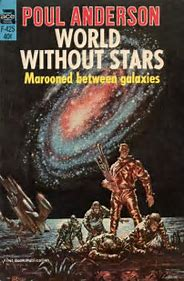
An Accurate Cover
the galaxy is overhead;
the blurb is factually accurate;
the spaceship has crashed in a lake;
the number of men escaping from the ship is correct;
Hugh Valland holds his omnisonor;
his spacesuit reflects the light of a red dwarf sun.
I have a copy of the "First Book Publication," which has this cover. The only anomaly here is a strange object on the left which is not on my copy.
Hugh Valland's fiancee lived from 2018 to 2037 and he is nearly three thousand so the novel is set around 5000, long after what would have been the period of the Terran Empire if we want to compare chronologies.
Do I seem to go off at tangents? Yes, I seem to go off at tangents. But anything that has been interrupted will be returned to. I enjoy the total freedom of blogging not by committee but by individual whim. Posting about SF Premises led to rereading passages of Poul Anderson's World Without Stars.
Monday, 11 March 2024
Images
World Without Stars.
Every detail in the attached cover image is accurate:
Monday, 27 August 2018
God And Galaxy
Ya-Kela, the leader of the group of Azkashi, has:
"...a representation of the galaxy tattooed on his forehead." (VII, p. 49)
Hugh Valland deduces that:
"'...they waited for the galaxy to rise; it's a god or whatnot to them, and then they felt safer against our mana.'" (ibid.)
Omnicompetent Valland uses his omnisonor for Azkashi sounds that human beings cannot utter. (He has also been "'...several kinds of engineer, now and then...'" (VII, p. 47), the best possible man to have in an emergency.)
Meanwhile, ya-Kela reserves judgment. Ya-Valland seems to have claimed "...to be the emissary of God.'" (VIII, p. 52) yet he has "...curious weaknesses." (ibid.)
Is communication really proceeding as well as is hoped?
Tuesday, 21 July 2020
Sound Effects
Film music changes pace appropriately although a more realistic kind of screen drama deploys hand-held cameras and improvised dialogue without musical accompaniment.
Sound effects are impossible in prose fiction although Poul Anderson often gets the wind or the weather to punctuate dialogue or inner reflections. See Hunnish Midnight.
Anderson does arrange musical accompaniment in his second Man-Kzin Wars story. When Tyra Norbo tells Robert Saxtorph that her father and his kzinti companion departed never to be seen again thirty years ago:
"By sheer coincidence, the musician changed to a different tune... The army song of mourning.'" (p. 190)
Saxtorph responds with shock as the readers, or a cinema audience, should.
Earlier, again probably at an appropriate moment, the man playing the "musicomp" had set it "...to violin mode with orchestral backing..." (p. 184)
The musicomp joins the "omnisonor" and the "omniplayer" as a future musical instrument.
Friday, 13 July 2018
Future Historical References
SM Stirling's Black Chamber references 1984 as does his Draka History. For the latter, see here.
It is generally thought that the British made a mistake by executing the leaders of the 1916 Dublin Rising. (For where the Rising happened, see image.) Stirling's Theodore Roosevelt persuades them not to.
A few diverse historical references over breakfast.
Thursday, 16 March 2017
Poul Anderson's Heroes
Van Rijn is an entrepreneur whereas Valland is a competent crew member and natural leader who seeks paid work but otherwise preserves his personal freedom so that he is able to return home between expeditions.
These are just two of Anderson's many heroes. We might write similar paragraphs summarizing Falkayn, Flandry, Everard, Guthrie, Havig etc - but not right now.
Tuesday, 21 November 2017
The Future Of Music
A Kithwoman plays a "polymusicon" and sounds a bugle call from it.
Heinlein's Rhysling plays an accordion but he lives in the early twenty first century when there has not yet been time for any new musical technology.
Spock has some kind of Vulcanian instrument, I think.
James Blish's "A Work of Art" (see here) is about the future of music, including musical technology.
There is multi-sensory art in Anderson's The Peregrine.
Anything else?
Sunday, 26 August 2018
Senses On The Intergalactic Planet
In the camp at night:
blackness;
a blue glow from the plankton energizer;
warm, dank, softly booming wind;
swamp odors;
whirring generator;
a beast's distant hoot;
lapping lake water;
rustling reeds;
Valland's omnisonor;
clear sky;
galactic glow, reflected by clouds, sheening on the lake;
the galaxy itself clearing the horizon;
Earth's spiral arm visible;
three other planets in this system;
no other heavenly bodies.
Tuesday, 12 March 2024
Valland's Versatility
World Without Stars.
The natives bring a meat animal as a gift but the stranded spacemen do not know whether it will poison them so what should they do? When Valland burns it, the natives understand that this is how strangers from the galaxy accept an offering. To communicate with the Azkashi, Valland supplements his own voice with his omnisonor to reproduce any humanly unpronounceable Azkashi phonemes. He is enough of a poet to generate "...meaningful phrases." (VII, p. 51)
But mutual understanding is not always straightforward. The following chapter, narrated from the point of view of Ya-Kela, the One of the Pack, reveals that, by claiming to have come from the galaxy, ya-Valland has implied that he is "...the emissary of God." (VIII, p. 52) Yet his many physical weaknesses contradict such a claim. Is Valland putting himself at risk by accompanying the natives back to their home? Read on.
Wednesday, 15 March 2017
Hugh Valland
Robert Heinlein's Jetman Rhysling because he is a singer of the spaceways;
Heinlein's Lazarus Long, Anderson's Hanno and James Blish's John Amalfi because he was been alive for a long time and longer than anyone else.
However, Valland has more going for him even than that. When he is communicating with an alien, Valland's musical instrument, the omnisonor, enables him to form sounds that are impossible for a human throat. Thus, his musical ability can be adapted to another purpose.
Of these and some other fictional "immortals," Valland is the only one who needs to use technology to edit memories in order to prevent memory overload leading to insanity. Thus, after living for nearly three thousand years, he retains only the memories of a normal lifetime.
Valland's fiancee, born in 2018, dies in 2037, just too soon to benefit from the antithanatic. In Amalfi's timeline, the antiagathics begin to be developed in 2018.
I have just watched a Smallville TV episode where Clark Kent, time traveling forward to 2017, is horrified to see that his future self is a straight-looking guy in a business suit wearing large glasses!
We in the early twenty first century live at a Crossroad of Time.
Wednesday, 29 August 2018
Interests And Inspirations
"The Ai Chun had no interest in a spaceship as such. Their gangs had been stripping away metal for more prosaic uses." (XIII, p. 92)
That statement alone is sufficient condemnation of Ai Chun culture.
"Where the West had soared from the rock of Earth like a sequoia, the Soviets spread like lichens over the planet, tightening their grip, satisfied to be at the bases of the pillars of sunlight the West had sought to ascend."
-James Blish, Earthman, Come Home IN Blish, Cities In Flight (London, 1981), pp. 235-465 AT PROLOGUE, p. 238.
Hugh Valland has been more than one kind of engineer, has considerable xenological skill, has soldiered more than once, can work as a gunner, teaches the Azkashi unified command and action under doctrine and inspires them both with bagpipes sounds from his omnisonor and by using a scientific instrument to demonstrate that God, the galaxy, is still overhead even when invisible to normal eyesight. Valland's abilities match van Rijn's. See Van Rijn's Inspirations.
Wednesday, 6 March 2024
Another Song
"God was rising in the west..." (I, p. 5)
"God," it will transpire, is our galaxy seen from a planet orbiting a star in intergalactic space. When rereading such a novel, it is easy to skip the two-page opening chapter when we know that the human point of view begins in Chapter II. This, like the concluding chapter discussed in the preceding post, is extremely evocative:
"On another evening, very far away, I had heard another song. This was when I got back to City." (II, p. 7)
The first person narrator explains that he had conducted some business on the surface of the planet Landomar, then returned in his space boat to the centuries-old satellite appropriately named "City" with its glowing towers, parapets, domes and ports. On p. 7, he hears the music played on an omnisonor by Hugh Valland whom he then meets for the first time although, writing his autobiography at a later date, he has already referred to Valland as somehow unique among spacemen a few paragraphs earlier.
But why did Guild Captain Felip Argens, as he turns out to be called, begin by referring to another song on another evening very far away? The answer is that what we read is an excerpt from the published autobiography. Thus, before we began reading, Argens had already referred to some song heard on some evening that we learn nothing about, an evening some time later than this one in City. These characters live for centuries, even, in Valland's case, for millennia, so their experience is longer than we can possibly learn about. They share this fate with the mutant immortals in The Boat Of A Million Years and also with Anderson's Time Patrollers. Surely they would cease to be human in any recognizable sense?