Showing posts sorted by relevance for query Valenderay. Sort by date Show all posts

Sunday, 27 December 2020

Valenderay And Merseia

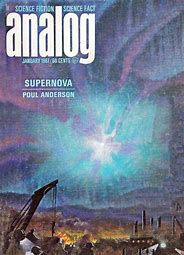
In Poul Anderson's "Supernova"/"Day of Burning" the planet Merseia is threatened by radiation from the supernova, Valenderay.

In Anderson's "Lodestar," Epsilon Aurigae, Sirius B and Valenderay are listed as famous supernovae.

In his The People Of The Wind, the Terran High Admiral's super-dreadnaught flagship is called Valenderay.

Part of the pleasure of reading a future history series is recognition of such background references to events in earlier installments.

More significant than Valenderay is Merseia:

needing League help in "Day of Burning";

discontented Merseians in Mirkheim;

the Merseian Rhoidunate growing in The People Of The Wind;

the Roidhunate a major threat to other civilizations in the Flandry series;

however, some Merseians have settled peacefully on the human colony planet, Dennitza, in the Flandry novel, A Knight Of Ghosts And Shadows.

Wednesday, 19 November 2014

Valenderay

Poul Anderson's sf takes into account that stars move. Valenderay, the massive star whose supernova nearly wrecked Merseia:

"...was older than normal for its type in this region, must indeed have wandered in from other parts."
-Poul Anderson, David Falkayn: Star Trader (New York, 2010), p. 211.

This sounds familiar from other Anderson scenarios. In fact, the entire Cloud Universe cluster has an eccentric orbit that takes it through the gas clouds near the galactic center so that its composition is unexpected and unpredictable.

What is unusual is that a League ship passes near when Valenderay explodes. Its hydrogen has been exhausted. Its outer layers collapse. New atomic fusions create transuranic elements. Neutrons and neutrinos are radiated. The star briefly outshines the galaxy. There is drama not only in stellar empires but also in stellar processes.

Even between quantum hyperjumps, the ship's crew receive a dangerous level of radiation and must depart but scientific observers will return and Merseia, three light years away, provides an ideal base. Valenderay is between Betelgeuse and Rigel. We know that Merseia is beyond Betelgeuse and Rigel is often mentioned as a remote stellar frontier.

Wednesday, 20 January 2021

Valenderay

Poul Anderson, "Day of Burning" IN Anderson, The Earth Book Of Stormgate (New York, 1979), pp. 318-367.

The purpose of the first Grand Survey:

"...was to get some hint about this spiral arm which we inhabit." (p. 318)

So how much of this spiral arm did the Survey ships explore physically? Long after both the Polesotechnic League and the Terran Empire have come and gone, human civilizations will spread through several spiral arms but that is millennia in the future. (A millennium is a long time in this context only because of the hyperdrive.)

The Survey ship that noticed the massive star, Valenderay, did not notice that it was older than others of its type in this region and therefore must have wandered in from elsewhere. Thus, as in the concluding Technic History installment, "Starfog," the timescales of stellar movements become relevant to the plot of the story. A Polesotechnic League scout ship happened to pass near Valenderay as it exploded. Because the Technic History version of hyperspace comprises many quantum jumps per second, the crew were not killed outright but were nevertheless touched by a dangerous amount of radiation between jumps and therefore withdrew:

"...to the scientific colony on Catawrayannis..." (p. 319)

- which would be able to send a craft to study the supernova.

For the second time in the Earth Book, Catawrayannis is referred to as if it were a planet, not a city on a planet. See:

 
To observe the supernova, scientists need a base on a planet where suitable instruments can be produced to order. Survey records confirm that, two centuries earlier, a nearby planet was inhabited and on the verge of its scientific-industrial revolution. All this information is necessary to introduce Falkayn On Merseia.

Tuesday, 30 January 2024

Valenderay And Duty

The People Of The Wind
, VII.

"Cajal sat alone in the middle of the superdreadnaught Valenderay." (p. 514)

That is an excellent future historical detail because this superdreadnaught flag vessel is named after the supernova that had been the ultimate cause of Merseian resentment of Terrans in the trader team story, "Supernova"/"Day of Burning."

Admiral Cajal is safe going into battle because Valenderay stretches for kilometres around him! Also, most of the Terran fleet precedes the flag vessel toward the enemy.

"Man's duty in this life, [Cajal] thought, is to choose the lesser evil." (ibid.)

This is almost word for word the teaching of Krishna in the Bhagavad Gita. Recently, the British Prime Minister, giving evidence to a public enquiry, swore on the Gita. I was not sure whether this was a Hindu practice but googling confirms that, at least for a while in India, Muslims swore on the Koran and Hindus on the Gita. Cajal, of course, would be a Bible man. He prays before a crucifix. Poul Anderson, like some other future historians, imagines the major Terrestrial religions exported to colonies on extra-solar planets. If human beings go there, then so will their beliefs.

Andrea, whom I visited today, is an expert amateur military historian and very pessimistic about the immediate future of this planet.

Sunday, 29 June 2014

Terran Naval Craft

Poul Anderson refers to classes of Terran Naval spaceships as though they were familiar to the reader. The smallest is a Meteor, for example the Hooting Star with its crew of three:

a Lieutenant (j.g.) from Terra as its captain-pilot;
a CPO from Cynthia as its fire control officer;
a CPO from Huy Braseal as its engineer-computerman.

(A Terran, an alien and a colonial.)

"A Meteor was designed for high acceleration under both relativistic and hyperdrive conditions; for accurate placement of nuclear-headed torpedoes; and for no more comfort than minimally necessary to the continued efficiency of personnel."
-Poul Anderson, Rise Of The Terran Empire (New York, 2011), p. 479.

Vodan of Stormgate Choth, defending Avalon, will proudly fight in:

"'One of the new torpedo launchers, rather like a Terran Meteor, hai, a beauty, a spear. Proud I was to emblazon her hull with three golden stars.'" (p. 506)

- in honor of his betrothed, whose Planha name "Eyath" means "Third Star." The Hooting Star and the Three Stars will have a fatal meeting.

"...the Planet-class cruisers Thor and Ansa..." are said to "mother...Comet- and Meteor-class boats..." (p. 477). Thus, Comets are intermediate between Planets and Meteors whereas a Nova class dreadnaught is "...monstrous as a mountain..." -Poul Anderson, Sir Dominic Flandry: The Last Knight Of Terra (New York, 2012), p. 266.

So do the Terrans have any class of ship other than Nova, Planet, Comet or Meteor? Maybe. The Valenderay is a "...superdreadnaught..." -Rise, p. 514.

Addendum: Valenderay is a Supernova. -Rise, p. 531.

Wednesday, 20 January 2021

Three Dual Discoveries

The Grand Survey spaceship Olga discovered the inhabited planet, Ythri, and the uninhabited planet, Avalon. We know how these planets later interacted.

An unnamed Grand Survey spaceship discovered the massive star, Valenderay, and the inhabited planet, Merseia. The Valenderay supernova threatened Merseia with both immediate and long-term consequences.

A second unnamed Grand Survey spaceship discovered the massive planet, Paradox. The follow-up expedition to Paradox also visited the nearby inhabited planet, Trillia. Consequently, Trillia started interstellar travel and the peculiar properties on the Paradoxan atmosphere enabled a wily Trillian to trap three human pirates.

When discovered, Ythrians had some Stone Age and some Iron Age cultures whereas Mersia and Trillia were each undergoing their first Industrial Revolution. Trillians developed a primitive form of interstellar travel whereas Ythri and Mersia were able to buy into Technic civilization.

Thursday, 13 July 2017

Supernovae

Concerning supernovae:

"Epsilon Aurigae, Sirius B and Valenderay were simply among the most famous examples."
-Poul Anderson, "Lodestar" IN Anderson, The Earth Book Of Stormgate (New York, 1979), pp. 368-408 AT p. 386.

Here Poul Anderson seamlessly blends current cosmology with his own science fiction. Epsilon Aurigae and Sirius B are real stars. Valenderay is the Eriau name for the supernova that threatened to destroy Merseian civilization in the earlier story, "Day of Burning."

Finally, "Lodestar" is about the search for the supernova that created Mirkheim.

Wednesday, 12 June 2024

Orion And The First Grand Survey

The planet t'Kela is a hundred light-years from the Solar System and in about the centre of the Orion constellation if we have understood van Rijn correctly:

"'...poor Nicholas van Rijn must come out on his own selfs, a hundred light-years in the direction of Orion's bellybutton he must come...'"
-Poul Anderson, "Territory" IN Anderson, David Falkayn: Star Trader (Riverdale, NY, March 2010), pp. 1-76 AT p. 9.

There is an Esperancian mission to t'Kela so we infer that t'Kela is not very far from Esperance.

Between Rigel and Betelgeuse, the star Valenderay, becomes a supernova. A passing exploratory Polesotechnic League scout ship alerts the scientific base at Catawrayannis on Llynathawr. A little over one parsec from Valenderay is the G-type star, Korych, with its inhabited planet, Merseia.

Paradox And Trillia, a hundred parsecs from Sol, are close to each other and not far from Avalon.

Planets Discovered During The First Grand Survey
Ythri (by the Olga)
Gray/Avalon (also by the Olga)
Paradox
Trillia (I checked on this before adding it to the list)
Merseia

Tuesday, 11 September 2018

War In History And Future History

"Cajal sat alone in the middle of the superdreadnaught Valenderay. Communication screens surrounded him, and humming silence, and radial kilometers of metal, machinery, weapons, armor, energies, through which passed several thousand living beings."
-Poul Anderson, The People Of The Wind IN Anderson, Rise Of The Terran Empire (Riverdale, NY, 2011), pp. 437-662 AT p. VII, 514.

"...Valenderay must not be risked. The whole purpose of all that armament was to protect the command of a fleet."
-op. cit., VIII, p. 531.

Rewind to the early twentieth century, with apologies for a longer than usual quotation:

"At this point, I should like to dwell for a moment on a question the reader must already have asked himself several times: When a man is in charge of a whole army, has he the right to expose himself to the danger of actual fighting? My answer is that there are no absolute rules of conduct, either in peace or in war. Everything depends on circumstances. Officers who accompanied me in my trips along the front frequently would remark: 'In the old days, even divisional commanders never poked their noses into places like these.' The bourgeois journalists wrote of this as a 'pursuit of self-advertisement,' and in this way translated into their familiar language something that was beyond their ken. In point of fact, the conditions under which the Red Army was created, its personal composition, and the very nature of the civil war demanded exactly this sort of behavior. Everything was built up anew - discipline, fighting tradition, and military authority. Just as it was not in our power, especially in the first period, to supply the army with all its needs from a single center and according to plan, just so were we unable by means of circulars or semi-anonymous appeals to inspire this army, got together under fire, with revolutionary enthusiasm. It was necessary to win authority in the eyes of the soldiers, so that next day one could justify to them the stern demands of the higher command. Where tradition is lacking, a striking example is essential. Personal risk was the unavoidable hazard on the road to victory."
-Leon Trotsky, My Life (New York, 1970), Chapter XXXV, pp. 429-430.

Thus:

Nelson was killed (see image);
Trotsky nearly was;
Cajal is safe deep within his superdreadnaught.

Sunday, 20 April 2025

Crucifixion


The People Of The Wind.

Admiral Cajal has a crucifix in his room in the middle of the superdreadnaught, Valenderay. When he has spoken bluntly to High Wyvan Trauvay of Ythri, there is a prolonged silence during which:

"Stillness murmured around crucified Christ." (XII, p. 575)

This is a moment in which the wind would usually make itself heard. However, Cajal is in a spaceship conversing with Trauvay by screen. There might be wind outside Trauvay's eyrie on Ythri... But, in Valenderay, stillness murmurs, paradoxically. There will be some slight sound from all the machinery. There has to be something like a sound in the ears or at least in the minds of the characters. 

Crucified Christ graphically represents the suffering threatened to Ythri if it does not yield. Poul Anderson's symbolism is always full on.

Here at Blog Central, we prefer the seated Buddha, the yin-yang symbol or even the fish to the crucifix. The Terran Empire is not officially Christian but Cajal is from Nuevo Mexico. All the people and planets seem real.

Friday, 31 March 2023

More Everyday Moments And Historical Continuity

Everyday Moments

(i) Conversation in  a wood-panelled waterfront tavern in Boseville on the River Flone on the planet Aeneas in The Day Of Their Return.

(ii) Diana sitting on the tower of St. Barbara watching the market in Olga's Landing on the planet Imhotep in The Game of Empire.

(iii) The Wodenite Axor having to sprawl on the floor at the Sign of the Golden Cockbeetle which is also frequented by miners, joygirls and a Tigery in The Game of Empire.

Historical Continuity

Later instalments of a future history series incorporate understated background references to earlier instalments. In "Day of Burning," the Polesotechnic League, represented by David Falkayn, arranges to protect the planet Merseia from the radiation effects of the supernova, Valenderay. In The People of the Wind, the superdreadnaught that is the flagship of the Terran armada is called Valenderay. This and similar connections enhance our appreciation of the series provided that we notice them.

Monday, 7 November 2016

In The Valenderay

Admiral Cajal thinks that the Ythrians, numerically weaker, will:

"'...try to maintain hedgehog positions.'" (Rise Of The Terran Empire, p. 512)

Cajal's superdreadnaught, named after the supernova near Merseia, Valenderay, comprises:

"...radial kilometers of metal, machinery, weapons, armor, energies, through which passed several thousand living beings." (p. 514)

In the middle of this massive artifact, Cajal, surrounded by screens and silence, sees darkness and stars including Laura, the sun of Avalon, gold and shining. He prays for forgiveness for the destruction that he is about to unleash.

And we are bound to ask why all that power and technology must be used for death and destruction.

Sunday, 20 August 2023

The First Grand Survey

"Our part in the Grand Survey had taken us out beyond the great suns Alpha and Beta Crucis."
-Poul Anderson, "Wings of Victory" IN Anderson, The Van Rijn Method (Riverdale, NY, December 2009), pp. 75-102 AT p. 79.

Participants in the first Grand Survey do not know that it is the first such interstellar survey just as participants in the Great War did not know that it was the First World War. The Terran Empire will have a Sector Alpha Crucis. The rogue planet, Satan, will swing round Beta Crucis. Rereading the earlier Technic History instalments, we appreciate their later significance.

After three years, the Olga under Captain Gray, discovers Ythri. Poul Anderson's Technic History series might have included a Grand Survey collection that would have constituted a "higher and greater Star Trek." This is a description that the British publisher, Charles Monteith, applied to James Blish's Cities in Flight but the Grand Survey comes even closer to the Enterprise's five-year mission.

"A ship of the first Grand Survey noted [Valenderay's] existence."
-Poul Anderson, "Day of Burning" IN Anderson, David Falkayn: Star Trader (Riverdale, NY, March 2010), pp. 209-272 AT p. 211.

Valenderay is the supernova that threatens Merseia.

"When the Survey team arrived [on Merseia], the Wilwidh culture stood on the brink of a machine age."
-ibid., p. 232.

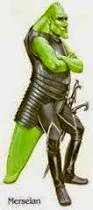
Merseia, dominated by old Wilwidh, will be the main opponent of the Terran Empire.

"They found [Paradox] during the first Grand Survey."
Poul Anderson, "A Little Knowledge" IN David Falkayn: Star Trader, pp. 599-630 AT p. 601.

Paradox is not major player but is a fascinating detail of the Technic History. Hloch, compiler of The Earth Book of Stormgate, compares "A Little Knowledge" to a dewdrop reflecting the glade wherein it lies.

Have I missed any Grand Survey references? 

Tuesday, 29 December 2020

A Cosmos Of Enemies

Mirkheim, VI

Sheldon Wyler, a human being, works for the Baburites because he has no loyalty either to the Solar Commonwealth or to the Polesotechnic League. We, the readers, know that Wyler previously worked for Stellar Metals, a member company of the Seven In Space cartel. However, Falkayn and his companions, who might have found this fact significant, do not know it.

Several Merseians, like Blyndwyr of the Vach Ruethen, have enlisted in the new Baburite space navy. Wyler comments:

"'Mostly they belong to the aristocratic party at home and have no love for the League, considering how it shunted their kind aside and dealt instead with the Gethfennu group. You know, not many League people seem to understand what a cosmos of enemies it's made for itself over the years.'" (p. 96)

In the trader team story, "Day of Burning," the Gethfennu, organized crime, were the only international network on Merseia capable of a coordinated response to the imminent threat of radiation from the supernova, Valenderay.

If this were an ERB novel, then the Good Guys would have many enemies, all of whom would be personally despicable and morally reprehensible: cowardly, spiteful, dishonorable etc. (In one of ERB's Land That Time Forgot novels, an IWW member works for the Germans during WWI and hates all Americans.) Poul Anderson shows us good and bad on both sides when the League encounters its "...cosmos of enemies..." 

Sunday, 5 November 2017

Two Details In "Day Of Burning"

When Valenderay goes supernova:

"New elements came into being, not only those which may be found in the planets but also the short-lived transuranics; for a while, technetium itself dominated that anarchy."
-Poul Anderson, "Day of Burning" IN Anderson, David Falkayn: Star Trader (Riverdale, NY, 2010), pp. 209-272 AT p. 212.

Is "technetium" an element named after Technic civilization? No. It already exists. See image and here.

On Merseia:

"A balcony gave on a view of the palace gardens, whose austere good taste was reminiscent of Original Japanese, and on the city." (p. 223)

For a comparison on this blog of Merseians with Japanese, see "Merseians And Russians," combox here.

Tuesday, 16 December 2014

Continuing The Early Technic History

In the previous post, I set out an agenda: to continue reading the Poul Anderson's Planet Stories ebook, but have not found time for this as yet. I also celebrated the contents of the opening five short stories of Anderson's History of Technic Civilization and added that we all know what happens next. To recapitulate yet again -

Companies of the Polesotechnic League variously:

remain independent and practice free trade, e.g., Nicholas van Rijn's Solar Spice & Liqors;
exploit extrasolar beings and arm barbarians;
form a cartel, the Home Companies, that merges with the state of the Solar Commonwealth;
form a rival cartel, the Seven in Space, that controls extrasolar governments and secretly arms the Baburites.

David Falkayn:

was a younger son of an aristocratic family on Hermes;
became apprenticed to Martin Schuster on Earth, then Ivanhoe;
next was a journeyman and factor for van Rijn on Garstang's;
then was a Master Merchant leading a trade pioneer crew for van Rijn;
led the mission that saved Merseia from the effects of the radiation emitted by the nearby supernova, Valenderay;
saved Technic Civilization from the external threat of the Shenna;
became rich from the indutrialization of the rogue planet, Satan, but continued pioneering;
found Mirkheim, then founded the Supermetals Company, to help the planets that were being excluded from the benefits of Technic Civilization;
married van Rijn's granddaughter, Coya Conyon, then stopped pioneering to raise a family;
saved Technic Civilization from the internal threat of the Baburite War;
led the joint human-Ythrian colonization of Avalon.

The League was dissolved.
The Commonwealth fell.
Barbarians raided Earth and enslaved Terrestrials.
Manuel Argos led a slave revolt and founded the Terran Empire.
And we all know what happened after that...

What a history! And such a summary makes clear that Falkayn's historical achievements are greater than either van Rijn's or Flandry's.

Tuesday, 18 November 2014

Falkayn And Merseians

Anyone who starts to read Poul Anderson's History of Technic Civilization now can read the entire series in chronological order of fictitious events in Baen Books' seven-volume The Technic Civilization Saga, compiled by Hank Davis. Many of us in the past have of necessity read later installments before earlier installments. Anyone who followed the entire series as it was first published (before it was even recognized that many of its parts did belong to a single series) read of:

Dominic Flandry and Merseians in 1951;
Flandry's first encounter with Merseians in 1966;
David Falkayn's centuries-earlier encounter with Merseians in 1967.

Thus, when Falkayn conversed with Morruchan Long-Ax, the Hand of the Vach Dathyr, we were already familiar with Merseian personal names, nick-names, Vachs and Hands. It was as if an entire section of the Dominic Flandry/Terran Empire series had intersected with the Polesotechnic League/David Falkayn/trader team series whereas, to anyone reading the series chronologically now, this is their first knowledge of Merseians.

Morruchan has to be persuaded that the nearby supernova, Valenderay, poses a threat. He says:

"'The radiation, when it comes to us, will equal a mere one-third of what comes daily from Korych. And in some fifty-five days' (Terrestrial) 'it will have dwindled to half...'"
-Poul Anderson, David Falkayn: Star Trader (New York, 2010), p. 218.

The omniscient narrator intervenes awkwardly at this point. We know that Morruchan speaks Eriau whereas we read English. The author wants us to know that the radiation will be halved in the equivalent of fifty-five Terrestrial days even though "fifty-five" is not the number spoken by Morruchan. Another way to do this would have been for Morruchan to state the number of Merseian days and for Falkayn, the viewpoint character of this passage, to recalculate mentally.

Falkayn spells out the effects of radiation on electronics. And the story began with the omniscient narrator's account of the supernova and its generation of transuranic elements, including technetium, which may be appropriate for the Technic History?

Having said that, this is not really an omniscient narrator because he states:

"This was the first chance in our history to observe a new supernova." (p. 212)

Two words, "...our history...," make him one of us. He is someone living later in the Technic History and reflecting back on this period.

Monday, 24 November 2014

The Early Technic History

The Chaos
Humanity survives its current crises.
A more humane global order emerges.
English becomes Anglic and the main international language.
There is no dark age although there may be conversion tyrannies.
However, the main, historically unprecedented, factors are scientific method and knowledge and technology. (Note: Wellsian.)
Space technologies provide resources and energy.
Technic civilization succeeds Western civilization and its rivals.

The Breakup
With hyperdrive, human beings found extrasolar colonies to preserve cultural identities or to try social experiments, for example on Hermes. The Solar Commonwealth governs the Solar System although not the colonies.

The Grand Survey...
...discovers Ythri, Gray/Avalon, Merseia etc. Ythrians and Merseians acquire hyperdrive from Technic civilization. However, the Merseians are not revisited for centuries and then only because of Valenderay. Their resentment endures.

Sunday, 17 December 2023

Morning And Night

We first see Brechdan Ironrede when it is morning at Castle Dhanghodan on Merseia whereas we last see Tachwyr the Dark when:

"Winter night lay over the South Wilwidh Ocean."
-The Game of Empire, CHAPTER TWENTY-TWO, p. 445.

Brechdan stands and salutes the dazzling light of the sun Korych whereas Tachwyr sits in a stony room beneath the flying moon Neihevin, the lurid light of the Valenderay nebula, the speeding glints of satellites generating forcefields to guard against supernova radiation and a few forlorn stars.

Brechdan from his terrace sees morning mists, distant glaciers and a wheeling fangryf whereas Tachwyr in his islet stronghold hears crashing seas and shrilling wind.

Pathetic fallacy gone mad!  

Thursday, 8 February 2018

The Growing Merseian Threat

(i) In  "Day of Burning" (originally "Supernova"), the Solar Spice & Liquors trade pioneer crew led by David Falkayn negotiates with the Merseians so that the Polesotechnic League will be able to shield Merseia from the radiation of the supernova, Valenderay.

(ii) In Satan's World, the Serendipity computer associates Falkayn's name with several episodes including the one involving Merseia.

(iii) In Mirkheim, members of the Merseian aristocratic party have enlisted in the Baburite space navy because they resent how the League cooperated with the criminal Gethfennu instead of with them.

(iv) In The People Of The Wind, the Merseian Roidhunate is distant but growing.

(v) In the Dominic Flandry series, the Rodhunate is the Terran Empire's main adversary.

(vi) In the post-Imperial periods, the Roidhunate, like the Empire, has declined and no longer exists.

Mirkheim is the second installment of the Technic History to feature a Merseian.