Showing posts sorted by relevance for query Lir. Sort by date Show all posts

Wednesday, 31 October 2012

Lir III


In Gallicenae (London, 1988) by Poul and Karen Anderson, the God Lir personifies the sea.

"Lir" is a personification because the personal pronoun "He" is used and His "...wrath..." is referred to (p. 135).

However, it is also recognised that the Being referred to as "Lir" is impersonal:

" '...Lir wears no human face...' " and is not prayed to (p. 135).

However, Lir is sacrificed to and obeyed. Paganism can have it both ways. Is His "wrath" anything more than the unpredictable, impersonal destructiveness of the sea? It is the other, anthropomorphic, Gods Who seal the Pact that makes Ys hostage to Lir/vulnerable to the sea.

Yet again, we are shown Pagan religious experience of Gods in and through nature. The Lir Captain says:

" 'In storm, in fog, in dead calm and sea-blink through endless silences: I have known the Dread of Lir...'" (p. 135).

To learn the will of the God, Lir Captain sails alone out of sight of land, fasts, thirsts and remains sleepless, then remembers something relevant to the question that he has in mind, after which a breeze blows him home. Fasting and thirsting weaken the body, causing euphoria and hallucinations. To learn, I suggest, following the Buddha's teaching, keep the body healthy, reflect and meditate.

Saturday, 27 October 2012

Lir


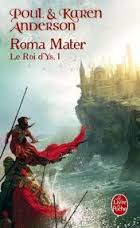
Roma Mater
(London, 1989) by Poul and Karen Anderson confirms on page 271 that, as their names suggest, the Ysan sea god, Lir, is indeed the father of the Irish sea god, Manannan mac Lir. This gives an even greater unity to Poul Anderson's historical fantasies. There are two generations of gods:

the father is active in the Ys tetralogy;

the son is a character in two of the five "Viking" novels, The Broken Sword and The Demon Of Scattery.

What is Lir's parentage? The vestals sing:

" 'Lir of Ocean, dawn-begotten...' " (p. 124).

A summary of the origins of Ys suggests that Lir as a deity might have pre-existed his association with the sea:

"Lir, whose cult was more ancient than colony or tribe, took unto Himself the awe and dread of the sea." (p. 212)

Manannan is humanoid (see image) whereas Lir, never anthropomorphized, is sometimes described as three-legged and single-eyed but only to evoke "...something strange and terrible." (p. 122)

Of the Ysan Triad, Belisama, "the Brightest One," incorporating Ishtar-Isis, is the most comprehensive. She:

leads Taranis back from the dead to reconciliation with Lir;
is present at the act of generation;
ts the triple goddess;
leads the dead in the Wild Hunt.

These are most of the functions of a deity?

Thursday, 5 May 2016

Divine Politics

Hannon Baltisi, Lir Captain in Ys, assesses three Gods.

(i) Christ denies other Gods. This is bad.
(ii) Mithras puts Himself above other Gods. This is not as bad.
(iii) Lir preserves the status quo. This is good.

Hannon is conservative, opposing monotheism and any intermediate position.

(i) Although it is unfortunate that a Christian priest is "'...mewling...'" in Ys:

"'...no true man or woman 'ull pay any heed.'" (Gallicenae, p. 134)

(ii) Mithras "'...is no bad God like yon Christ. He stands for uprightness, manliness, and He'll let other Gods abide.'" (ibid.) (Hannon sounds like an ancestor of Scottish Presbyterians.) However, Mithras as the Bullslayer and the Comrade of the Sun, sets Himself above all others and lays His own law on His worshipers. This causes friction when a Mithraist becomes the avatar of Taranis.

(iii) As long as Ysans sacrifice, obey and do not anger Lir, Ys will survive. He needs neither prayers nor tears. He already has enough salt water.

King Gratillonius, now called "Grallon" in Ys, wants to found a Mithraeum. The Council of Suffetes do not let him buy land and dig a cave because the earth is Belisama's and Mithraism is men only. The second proposal is that he convert an unused warehouse by the harbor. Hannon instead proposes an unused windowless basement below water level in the seaward Raven tower:

it is a veritable cave;
the raven is sacred to Mithras;
the Mithraeum, like Ys, will be hostage to Lir.

Is this placing Mithras under Lir or Mithras accepting a temple from Lir while acknowledging that Lir is a patron of Ys, respect between Gods? - and between their factions. Lir Captain and the Speaker for Taranis ask Queen Lanarvilis to persuade the other Queens to persuade Grallon. Politics indeed, but on behalf of the Gods - and their factions.

To the Andersons and their readers, this is a fictional exercise whereas, to the characters, all of these Gods are real Beings.

Thursday, 28 April 2016

Lir Way

(Today, we visited Birmingham Central Mosque.)

According to pp. 137, 144 of Roma Mater (London, 1989) by Poul and Karen Anderson, Lir Way, the main east-west avenue of Ys, stretches from an arch by Skipper's Market to High Gate which opens onto Aquilonian Way. However, the map of Ys on p. 11 shows Taranis Way in this position and Lir Way crossing it at right angles in the Forum at the city centre, thus stretching from north to south.

According to the text, Gratillonius and Quinipilis, one of his Nine Queens, leave Quinipilis's house, which opens directly onto a street, and walk along the street until it joins Lir Way. Near the end of the street, they can see Elven Gardens and the adjoining temple of Belisama. Lir Way (or maybe it is Taranis Way) brings them to High Gate, Warriors' House and Dragon House. There they climb the stairs to the top of the city wall and to the tower called the Gaul. Walking south, they pass the Roman tower. They see Point Vanis to the north, Cape Rach to the south, many rooftop catch basins, a storage tower for water from the canal and buildings of as many as fifteen stories.

Taranis Way is said to run from Aurochs Gate to Northbridge Gate whereas the map shows Lir Way doing this. Gratillonius and Quinipilis pass Goose Fair by Aurochs Gate. The description gives us two other senses:

"Savouriness drifted in smoke from foodstuffs, merchants cried their wares from booths." (p. 141)

From the Raven Tower, they see bastions and the sea portal. They descend and pass the shipyard. p. 149 says that they turn left towards the temple of Lir although the map suggests that they would turn right at this point. They climb back up by the Gull Tower and continue to walk around the city wall, passing Northbridge Gate, Star House and the Water Tower that is used as an observatory. They reenter the city at the Gaul.

"In Ys the idea was current that consciousness resided in the head." (p. 151)

Where else would consciousness reside except behind the eyes, nose and palate and between the ears. Animal life might be located in the stomach but surely not awareness and thought? - although I have read that the Biblical phrase "hardness of heart" means lack of understanding, not lack of compassion.

Wednesday, 24 October 2012

The Approach To Ys


In Roma Mater, (London, 1989) Poul and Karen Anderson carefully over several chapters establish the uncanniness of Ys. A nearby military commander agrees that it is odd that curiosity has never made him visit the city. But then he mentions damnable strangeness, grisliness, witch-queens and black magic and concludes, " '...I don't want to talk about it.' " (p. 86)

By contrast, Gratillonius is drawn towards the city without knowing quite what its "...marvels..." are. (pp. 82-83) It gives him an "...eerie thrill..." when, traveling through Gallia, he realizes that some unfamiliar local words must be Ysan in origin:

"They resembled none he had heard before, but stirred vague memories in him of names he had met when studying the history of the Punic Wars." (p. 97)

The Punic Wars are relevant because he has been told that the city was a Carthaginian colony. Before this, and shortly after Gratillonius has been told that Ys has "...nine witch-queens...," we read the short Chapter V in which the Nine are active on their "...desert island..." and we learn their names - Forsquilis, Vindilis, Bodilis, Quinipilis, Fennalis, Lanarvilis, Innilis, Maldunilis and Dahilis. (pp. 86, 89)

The Ysan boundary is marked by two ten foot granite pillars, the southern column inscribed in the Ysan alphabet, which Gratillonius cannot read, the northern in Latin, which he can. The latter invokes Venus, Jupiter and Neptunus. One of Gratillonius' men asks whether those old Roman gods still have power in this place but the Centurion explains that the Latin names are merely the nearest Roman equivalents to the Three of Ys, whose real names we read in Chapter V: Belisama (see image); Taranis; Lir.

Belisama is equated to Ishtar, Isis, Ashtoreth, Aphrodite, Venus and Nerthus and called "the Star of the Sea." This title, like the name "Nerthus" and the references to the Punic Wars, resonate for readers of Anderson's Time Patrol Series.

Chapter II, set in Hivernia, mentions the Irish sea god Manandan and the Notes give his full name, Manandan maqq Leri, later Manannan mac Lir. Under the latter name, this god is a character in Poul Anderson's The Broken Sword. "Mac Lir" means "son of the sea." The Ysan sea god is simply "Lir" - father of Manandan? Unlike Manandan, Lir is "...never given human shape..." and the description of "...three legs and a single eye, in the middle of His head...was only a way of bespeaking something strange and terrible." (p. 122)

Here we see at least two stages of religious development:

first, the worship of terrifying, uncontrollable natural forces (in the Bible, the sea represents pre-cosmic chaos, controllable only by divine power);

secondly, the deification of female and male humanity.

The stages are shown in the relative ages of the divine images. Belisama and Taranis are Roman-commissioned Greek sculptures whereas:

"The emblem of Lir was immensely older, a rough granite slab engraved with Celtic spirals." (ibid.)

When Gratillonius first sees Ys, he reflects that it is strange that he and his father had traded so close yet he had never glimpsed the city till now. These continual references to people not visiting Ys when they could have done turn out to be significant because the city is supernaturally "Veiled."

When he first sees the high, narrow, brightly mosaiced towers shining in gold, glass and copper, made dream-like by an oceanic haze:

"He could scarcely believe that human beings dwelt yonder, not elves or Gods." (p. 104)

- a fitting culmination to all the mysterious hints in previous chapters.

In Ys, Gratillonius, a Mithraist, can do what a Christian could not, marry nine women simultaneously and become the Incarnation of Taranis. However, there are tensions between Mithras and the Three and eventually an irreconcilable conflict.

Where do the Three, or other pantheons, go when they have withdrawn? Alan Moore gives us a joke realm, the Bide A Wee Dimension for Retired Deities, but Neil Gaiman's The Sandman series presents a more serious answer, involving the realms of Dream and Death. See here.

Monday, 29 October 2012

Lir II


Having established earlier that one god, Lir, was the father of another, Mananaan, I then asked about Lir's parentage but established only that he was " '...dawn-begotten...' " (Poul and Karen Anderson, Roma Mater (London, 1989), p. 124). That could have meant either "begotten by the dawn" or only "begotten in the dawn" but read further and the answer is given.

The Symposium, meeting in Star House, has a discussion that we recognize as a curious fusion of philosophy and mythology. They set out to discuss " '...the nature of God and Spirit, the meaning and destiny of Creation...' " (p. 324). First, it is explained that:

" '...we who are educated, do not take ancestral myths for literal truth, as if we were Christians. They are symbols. As different languages, or different words in one language, may denote the same thing - albeit with subtle variations of aspect - so, too, may different Gods represent the same Being. They change with time as languages do, They develop according to the evolving needs of their worshipers. The very heavens change through the aeons; nevertheless, the reality of Heaven endures.' " (p. 326)

I agree with most of that. In particular, the resurrection of a deity is a symbol, not a literal truth. In that context, we learn that in the Beginning, Tiamat, the Serpent of Chaos, Who threatened to destroy Creation but was slain by Taranis, had been the mother of Lir who therefore killed Taranis, plunging heaven and earth into darkness, until Belisama descended into the underworld to ransom Taranis and brought Him back to make peace with Lir. Taranis dies and is reborn every year until the End of All Things. Ysans enact this mystery because Taranis dies in the defeated King and is resurrected in the victor who fathers new life on the Nine who are chosen by the Goddess. It all makes sense, almost.

Other Ysan families claim legendary descent from other Gods. There is a mystery about what happens to the dead. The Temples of Mithras and Cybele have cooperated, as I suggested earlier, but Gratillonius dislikes the Cybelean cult and thinks that Christ is a better God for women.

Saturday, 14 May 2016

Two Shrines

The Ysan Shrine of Ishtar is:

a smaller Temple of Belisama;

i.e., an earlier home of the same Goddess under a different name;

in Lowtown;

small;

rammed earth with a slate roof;

on a small plot marked by boundary stones;

plain inside, with clay floor, rough altar, polished Mirror and murals of Star and Moon;

open twice a year, in spring and autumn;

then staffed by a single priestess who prays and waits for supplicants whom she blesses or guides.

Another Ysan place of worship is:

called Lir Shrine on the map (Gallicenae, p. 10);
called the Temple of Lir in the text (p. 254);
under the Gull Tower;
neither Greek like Belisama's nor Roman like Taranis's;
small;
ancient;
dark;
stone with a slate roof;
plain inside, with an altar block inside a whale's jawbones;
staffed by a different ship's captain every day.

Every Ysan captain is an ordained priest of Lir. Hannon Baltisi, Lir Captain, presides over their guild and speaks for it and its cult in the Council of Suffetes. Before the King locks or unlocks the sea gate, he enters the Temple, kneels, receives on his tongue a pinch of salt and asks Lir to withhold His wrath.

This has to be the most primitive form of religion: mere fear of a nature god. The Christian minister calls the Ysan Gods demons. In John Milton's Paradise Lost, the fallen angels, released from Hell, do indeed go about the Earth and receive worship as the pagan deities.

Saturday, 11 February 2023

Details In "The Pirate" II

"The Pirate."

The Stellar Union has a "'...Scorpian march...'" (p. 151) (We are familiar with marchmen in the Terran Empire of Poul Anderson's Technic History.)

There is a Service base at "'...Lir...'" (p. 150) The sea god Lir is one of the Three of Ys in Poul and Karen Anderson's The King of Ys and his son, Mananaan mac Lir, is a character in Poul Anderson's The Broken Sword. Planetary names link hard sf to mythology and fantasy. The Lir base has been "'...busy with the Storm Queen affair.'" (ibid.) We know nothing of this affair. "Storm Queen" is not the name of a spaceship because it is not italicized.

"The Pirate" twice refers to the planet Nerthus. 

"Ship Harpsong of Nerthus..." (p. 137)

On p. 151, Nerthus is mentioned as a planet that was colonized before it was learned that there was native intelligent life. This reference, relevant to the plot of "The Pirate," is a good example of a future history instalment building on the foundation laid down by earlier instalments.

Two future histories could feature the same alien species. Humanity appears in alternative futures so why not other species? The inhabited planet Lithia is destroyed in 2050 in Volume III of James Blish's After Such Knowledge but still exists millennia later in Book Four of Blish's The Seedling Stars. However, the usual rule is that, if Nerthusians exist in Anderson's Psychotechnic History, then they do not also exist in his Technic History.

Tuesday, 1 November 2016

St Nicholas And The Hanseatic League

On holiday in Britain, I find places relevant to Poul Anderson, e.g.:

Lichfield
Caernarfon
York

Here is another. King's Lynn has a St Nicholas' Chapel. See image. We learned that:

"St. Nicholas is more than the patron saint of sailors. He has been adopted by merchants, brewers and even repented thieves."

Thus, the patron saint not of travelers but certainly of sea travelers. See previous discussion here. According to legend, St Nicholas saved the lives of pilgrims on a storm-tossed voyage to Egypt. Thus, a maritime Chapel of St Nicholas might be an update of the Temple of Lir? Except that Lir must be appeased to dissuade him from killing sea travelers in a storm whereas St Nicholas should be thanked for saving them from a storm. Lir can be regarded as a demon defeated by the saint - if, indeed, Lir stayed around after destroying Ys. In King's Lynn, called "Bishop's Lynn" until Henry VIII:

there was a parish church but merchants, developing new land to the north of town, wanted a closer place of worship so were given a chapel;
Merchant Guilds adopted St Nicholas' Chapel and bestowed side chapels for their members;
sailors could see the spire from sea;
new fishing nets were blessed annually;
there is still a twice yearly service for sailors in the now defunct church;
King's Lynn North Enders can still have funerals there;
weddings can be held with permission from the Archbishop of Canterbury;
the building utilizes solar energy which it shares with the community.

Also, King's Lynn was a Hanseatic port. In 2005, a New Hanseatic League was formed of 173 Northern European cities with cultural and commercial connections and Lynn as the only British member.

Monday, 26 September 2016

Two Gods And One Being

Manannan is humanoid (see image here) whereas Lir, never anthropomorphized, is sometimes described as three-legged and single-eyed but only to evoke "...something strange and terrible." (p. 122)
-copied from here.

Thus, Lir is a shapeless god of the chaotic sea. For more on Him, see here. He seems to have met His match in a Bronze Age sea god imagined by SM Stirling:

"The enemy ships were gliding closer. On each stern was a small platform with a statue on it, a grotesque juju with three legs, six arms, and a single staring eye - Arucuttag of the Sea, Lord of Waves, Master of the Storm, to whom the captains gave gold and man's-blood."
-SM Stirling, Against The Tide Of Years (New York, 1999), Chapter Eighteen, p. 282.

The captains throw gold into the sea? And practice human sacrifice? Some gods need to be reminded that we imagine/create them, not the other way around.

Apart from the arms, the physical descriptions of Lir and Arucuttag are identical: one eye and three legs. One eye means focus. Three legs mean mobility. It would be an easy matter for the Ysans to recognize these two deities as different Gods representing one Being. See here.

Saturday, 23 April 2016

The Council Of Suffetes

Poul and Karen Anderson, Roma Mater (London, 1989).

In Ys, the Council of Suffetes meets in a chamber in the basilica. The chamber is ornamented in stone:

granite;
marble;
serpentine;
onyx -

- and has good acoustics. Tiered, padded benches on two sides of a central passage face a daised throne at the far end. Behind the throne are ten-foot statues of the Triad:

Taranis, male;
Belisama, female;
Lir, a kraken staring from a mosaic slab.

The robed King enters, wearing the Key and carrying the Hammer. Standing before the Throne and raising the Hammer, he says:

"'In the name of Taranis, peace. May His protection be on us.'" (p. 190)

The Nine Queens/priestesses sit on the left at the front. Their leader for the day rises, spreads her arms with palms down and says:

"'In the name of Belisama, peace. May Her blessing be on us.'" (p. 191)

On the right, Lir Captain, in a green and white robe, rises and says:

"'In the name of Lir, peace. May His wrath not be on us.'" (p. 191) -

- and strikes the floor with his trident.

Thus, the Triad personify protection, blessing, wrath and peace.

Apart from the Nine, the Council comprises thirty three men from the thirteen Suffete clans. Entry to the clans is by birth or by marriage for women and adoption for children. Also present is the Speaker for Taranis who, at least when Gratillonius becomes King, also represents the Great House of Timbermen. The Sea Lord, the Lord of Works and the Lord of Gold are ex officio members. There are also guild delegates. The Council meets at equinox and solstice and the King can order a special assembly. At his first meeting, Gratillonius must speak in Latin while others use Latin or Ysan with interpretation as necessary by Queen Bodilis.

There will probably be further posts about the Council and Ys.

Monday, 28 March 2022

Poul Anderson's Past Fantasies

Conan The Rebel is set in a remote and entirely fictional past. In The King Of Ys (with Karen Anderson), The Broken Sword and The Merman's Children, pagan gods and other beings retreat as Christianity advances.

The King Of Ys: the Three end their Covenant with Ys and the last King of Ys converts from Mithraism to Christianity;

The Broken Sword: a Greek faun flees to Northern Europe;

The Merman's Children: Christian priests exile "...with bell, book and candle, all beings of heathendom..." (p. 24) from an island named after Aegir, the sea giant.

However, on a nearby uninhabited islet:

"Enough of the sea god's older power lingered that merfolk could approach from the south and go ashore." (ibid.)

Thus, all of these works read like a single long series. The Three of Ys include Lir, god of the sea, and Mananaan Mac Lir (son of Lir) is in The Broken Sword. 

Thursday, 22 June 2023

Lir And Medb

Roma Mater, XV

It is confusing to operate in an environment with multiple gods. When an unseasonable storm starts to wreck his fleet, Niall wonders whether to give a man to Manadan but an old mariner thinks that the storm is sent by Manandan's father, Lir, who is not to be placated by any human offering.

Niall shouts, 'Medb with us!'" (1, p. 271) and, sure enough, in the heat of battle, after a raven has flown past in a "...violent gust of wind...," Gratillonius sees a titanic woman mowing men with a sickle. (5, p. 283)

Lir and Medb are on opposite sides this time but any divine conflict or alliance is possible.

Tuesday, 4 July 2023

Gods In Ys

Gallicenae, VII, 1.

Imagine believing that various Gods were real and that peace must be kept between them as between human governments.

The Three, Taranis, Belisama and Lir, are the Gods of Ys. Christ denies all other Gods but has a priest in Ys because the city is a subordinate ally of the Roman Empire which is Christian. Mithras does not deny other Gods but does set Himself above Them. Thus, Mithraism seems to be intermediate between Ysan paganism and Christianity.

Gratillonius is:

Roman prefect in Ys, thus the local representative of a Christian state;
King of Ys, thus the current Incarnation of Taranis;
an initiate in the Mystery of Mithras.

A Mithraeum should be in a cave. The Ysans will not let Gratillonius buy land and dig a cave because the earth is Belisama's and Mithras does not accept women. Since Taranis also fructifies the earth, the Mithraeum must be in the city. Gratillonius proposes to adapt a disused warehouse but Lir Captain Hannon proposes a windowless room below the now risen sea level in the Raven Tower. Arguably, this will be appropriate since the room counts as a cave, since the raven is sacred to Mithras and since the Mithraeum, like the whole of Ys, will be hostage to Lir Who gives Mithras a cave while Mithras acknowledges the Three as the Gods of Ys even if not as superior to Himself. Will this work? Imagine proposing it at the United Nations.

Wednesday, 18 May 2016

Seafaring Councillors

The Ysan Council of Suffetes has not only a Lir Captain but also a Mariner Councillor, a Fisher Councillor and a Sea Lord, thus plenty of seafaring representation. Lir Captain Hannon Baltisi argues that Gratillonius should have accepted the second challenge before leading his attack on the Franks. (The challenger was killed in that attack.) However, the Nine, the Speaker for Taranis, the Mariner, Fisher and other Councillors and the people of Ys support the King. The aged Hannon concedes.

The Fisher Councillor claims that he and his Mariner colleague know something about the sea god, Lir's, ways. I should think that they do. And the Christian principle, "Vox populi vox Dei" (The voice of the people is the voice of God), also seems appropriate.

Sunday, 11 November 2012

Where Did The Gods Go?


If Gods existed but stopped either communicating or responding, then our environment would have changed from Pagan polytheist to secular atheist unless meanwhile we had acknowledged a new God Whose power and influence had been increasing.

Whether the Gods have ceased to respond is an experimental question. The vestal Nemeta tries to invoke them but is unsure of the result:

"Something stirred in the forest, unless it was a trick of the wearily climbing moon." (Poul and Karen Anderson, The Dog And The Wolf (London, 1989), p. 46)

Gods used to manifest through forests and moonlight but maybe now there is only a forest and the moon?

Again, this time in a dream:

" 'I know not...Did I see Him, antlered and male, two snakes in his grasp? Were there thunders? I woke cold...' " (pp. 47-58)

Is this a vision of the God or has it now become just a dream with mythological content? And has the nymph fled or is she dead?

Meanwhile, something else is happening. The older, wiser vestal Runa warns Nemeta to be discrete with her invocations because the political balance of power has shifted in favour of the Christians. Here we see the beginning of the Dark Ages and the seeds of the Middle Ages, centuries of enforced uniformity and oppression from which the world has thankfully emerged. Poul Anderson's The Shield Of Time shows the medieval church-state conflict ending indecisively, thus allowing freedom and science instead of either theocracy or autocracy.

Who destroyed Ys? Niall when he opened the sea gates. Lir when he let the sea pour in through the opened gates. Could Lir have held the sea back when the gates had been opened? No, but the Gods, including Lir, had marked Dahut as their next chosen Queen, knowing what must result. Rejected, as she saw it, by her father, Dahut would join forces with Niall whose own Gods had told him to seek the "Queen without a King."

The sign stops appearing on vestals when Ys has been destroyed. The Gods have at least withdrawn if not died.

Niall's morality is childish. He had intended no harm to Ys so Ysans should not have harmed him? He had intended to harm others in Armorica and Ys was part of the Armorican defence system. It is he who is responsible for the loss of his invasion fleet and his eldest son.

Monday, 15 January 2018

An Offering To Mananaan

This evening, I am mainly watching whatever is on television which is such a rare activity that it has novelty value. As ever, something is relevant.

(i) Michael Portillo visited the foreign grave of George Bradshaw.

(ii) The Broighter Horde is believed to have been an offering to Mananaan Mac Lir. (Scroll down.)

Mananaan lived under a Loch in Northern Ireland and had a boat that could travel over land and sea. The boat was also the solar disc. Mananaan and his father, Lir, are important figures in some of Poul Anderson's works. For Lir, see here.

Thursday, 3 January 2013

Mother of Kings II

As expected, Poul Anderson's
Mother Of Kings, which I have as yet read only as far as page 54, turns out to be a longer and more substantial culminating volume for the author's loosely connected Viking era fantasy novels. These five fantasies can be classified either as "heroic" or as "historical," depending on how much real history is incorporated into their plots. Three of them, beginning with the the first of the five, The Broken Sword, feature the god Odin as a character.

When I have read more of Mother Of Kings, I will comment on it as an individual work. Meanwhile, as always, I am overwhelmed by the impression that Anderson really presents a single long series covering many centuries of history:

before the Vikings, Lir was one of the Three Gods of the city of Ys;
Skafloc, bearer of "the broken sword," saw the submerged Ys;
during the quest to reforge the sword, Lir's son told Skafloc of Gunnhild's grandfather;
Book One of Mother Of Kings describes Gunnhild growing up, learning magic and marrying Erik Blood-Ax, son of Harald Fairhair;
the Afterword to Mother Of Kings summarizes the career of Harald Fairhair's great-great-grandson, Harald Hardrede, the title character of Anderson's The Last Viking Trilogy, whom Anderson shows as reflecting on the history of Gunnhild;
Harald Hardrede died failing to conquer England in 1066, the same year in which his remote relative William of Normandy succeeded in the Conquest.

England has been a monarchy, with one brief interregnum, since 1066. Lir's mother was Tiamat, the primordial chaos, slain by a god in Babylonian and Ysan myths. Thus, a slight extension of Anderson's multi-volume narrative generates a story beginning with Tiamat and culminating in the present Queen Elizabeth II, who is expected to be succeeded in due course by her son, grandson and soon to be born great-grandchild.

Sunday, 1 May 2016

Ysan Beliefs

Ancestral myths are not literal truths.

Different Gods represent a single Being just as different words represent a single thing or different aspects of a thing.

Gods, like languages, change over time according to Their worshipers' needs.

In the Beginning, Tiamat, the Serpent of Chaos, threatened to destroy Creation but Taranis killed Her. Therefore, Her son, Lir, killed Taranis. All was darkness until Belisama descended into the underworld, returned with Taranis and made peace between Him and Lir on condition that Taranis should die and return cyclically until the End.

Ys enacts this mystery. The King dies in battle, is resurrected in the victor and begets new life on the Goddess's chosen.

Some Ysan families claim descent from other deities, the Ferriers of the Dead from Lir. The Ferriers somehow carry the souls of the dead to the island of Sena while the bodies are buried at sea. No one knows where souls go in the Beyond.

Gratillonius thinks that Christ is a better deity for women than Cybele.

Source: Roma Mater, pp. 326-328. See also here.

Saturday, 21 May 2016

Nature Personified

Pagan gods are personifications of nature. When the British Christian Budic cries out that the Ysan Gods bring only horror, the traditionalist Maeloch replies:

"'True, they're ofttimes stern, even grim, but so's the world. 'Tis for us to endure without whining. They give us life.'"
-Poul and Karen Anderson, Dahut, Chapter XII, section 1, p. 281.

Nothing supernatural or everlasting, just nature and life. Maeloch is all for live and let live between Gods and men but, when Budic preaches, he retorts:

"'...when Lir sends fair winds and shoals o' fish, Taranis pours down sunlight and summer rain, Belisama brings love and bairns and hope - ask yourself, boy, what's this Christ o' yours ever done for ye?'" (p. 282)

Maeloch accepts the ancient round of life. In paganism, natural forces are personified. In Biblical monotheism, natural and social forces have been personified and unified. Civilization, dependent on agriculture, has moved away from direct involvement in hunting and fishing, from Lir's winds and Taranis' rain.