Showing posts with label Gallicenae. Show all posts

Monday, 5 November 2012

The King of Ys Volume Three


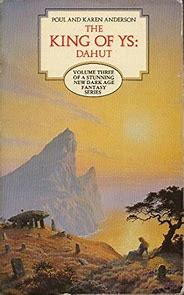
Princess Dahut, born at the end of the King Of Ys Tetralogy Volume One, is the title character of Volume Three and is sixteen years old in Volume Three, Chapter IV (Poul and Karen Anderson, Dahut, London, 1989).

Again, time passes:

"This was the feast of Lug." (p. 25)

The authors' Note tells us that this is 1 August. (p. 468)

"Rain...Wind...Autumn was closing in, with storms and long nights." (p. 27)

"Among Celts, the first evening of Hunter's Moon awakened madness." (p. 30)

- Samhain, the Celtic festival of the dead and turn of the year, 1 November. (p. 469)

"The declaration of King Gratillonius hit the vernal Council of Suffetes..." (p. 33)

The Council meets at the vernal equinox.

"In the dead of winter, people must rise hours before the sun..." (p. 82)

"When the Suffetes met at vernal equinox..." (p. 90)

- again.

"One evening before midsummer, a sunset of rare beauty kindled above Ocean." (p. 117)

Between these festivals and turning points, the Ysans and their King lead everyday lives including many details that are not shown to us.

Saturday, 3 November 2012

Dahilis And Dahut


In The King Of Ys Tetralogy by Poul and Karen Anderson:

Volume I ends with the death of Dahilis and the birth of Dahut;
II with the death of Dahilis reincarnated as a seal;
III with the destruction of Ys and the death of Dahut;
IV with the laying to rest of Dahut's ghost that had haunted the Ysan ruins.

Thus, Dahilis and Dahut, Queens of Ys, unify the Tetralogy.

Also, Gratillonius, King of Ys, husband of Dahilis and father of Dahut, both delivers Dahut and lays her to rest so that he, the title character, further unifies the series.

The Ysan Gods chose Dahut as Queen. If Gratillonius had consummated his marriage with her, then Volume III would have ended differently. However, the Gods had either decided or been obliged to withdraw before the approach of a new God. Consequently, they used Gratillonius' allegiance to another old God, Mithras, to make an impossible demand on him.  


Prefigurements

In Gallicenae (London, 1988) by Poul and Karen Anderson, the authors know how to prefigure important events, including changes in the status of the Gods.

The young Princess Dahut made a sandcastle and called it "Ys," of which it was a good replica, then "...watched the tide come in and wash it away." (p. 214) As a young adult, she will play a central role in the drowning of the real city of Ys. That city, of which her father is both prefect and King, contains the Mithraeum of which he is Father. Thus, the Three of Ys withdraw, Mithras retreats and Gratillonius moves nearer to accepting Christ.

In Hivernia, King Niall anticipates "...Ys under the sea." (p. 318) It is he who, using Dahut, will put it there.

Martinus, later known as St Martin of Tours, is visited by his cousin, Sucat, who has escaped from slavery in Hivernia. The cousin seeks ordination so that he may return to convert the Hivernians. Martinus predicts that Sucat " '...will be Christ's patrician.' " (p. 362) In fact, renamed Patricius, he will evangelize Hivernia, later known as Ireland.

Of the Gods, it is said:

" '...They Themselves are troubled. For the heavens have moved...' " (p. 32)

As above, so below. A sandcastle and some chance remarks prefigure what is to come.

Another Point Of View


Nearing the end of the second volume of their King Of Ys Tetralogy, Poul and Karen Anderson have firmly established:

that in the fourth century AD there is an Armorican city called Ys;

that Gaius Valerius Gratillonius, having never previously visited the city, suddenly and unexpectedly became its King by defeating the incumbent;

that he has several daughters by the nine Queens who, in accordance with the Pact between Ys and its Gods, cannot bear sons;

that he has reigned successfully for well over a decade and now regards Ys as his home.

Having established all that, the authors can now show us Ysan society from an outsider's point of view. As traders from Bordeaux approach, we read one of several descriptions of Ys as seen from the sea:

a dark red sea wall between promontories;

"...a frieze of fabulous creatures..." high on the wall (p. 345);

battlements and turrets on top of the wall;

behind and higher than the wall, skyscrapers ("...spires pierced heaven...") with gleaming glass and fantastically shaped roofs (p. 345).

We might think of New York except that it lacks a wall.

Having checked into a hostel, the captain and his son, the latter the viewpoint character, are, as foreign visitors, summoned to meet the King.

"A big auburn-haired man with rugged features lifted his arm as the new guests entered." (p. 349)

- and introduced himself as centurion, prefect and King.

Having before mostly known Gratillonius' thoughts and feelings, we now learn how he and his environment appear to others, thus giving us a more rounded view of Ysan society.

Judging The Gods II


In Gallicenae (London, 1988) by Poul and Karen Anderson, the King of Ys and the Christian minister to Ys debate. The King:

"...didn't think an eternity of torment was the proper punishment for an incorrect opinion, and saw no righteousness in a God who did." (p. 340)

The minister replies that:

"...mere mortals had no business passing judgement on the Almighty; what did they understand?" (p. 340)

We understand quite a lot and are learning more. Our morality prohibits torture of those who disagree with us. It was some of us "...mere mortals..." who formulated this belief about the Almighty. Some people still have this belief because they inherit it as part of a tradition whereas others question every received tradition.

I made the King's point to an Evangelical who replied, "That's convenient for you!" He thus accused me of intellectual dishonesty, of believing what it suited me to believe whereas in fact I can see no reason to accept his belief and several crucial arguments against it.

In what sense can a being existing in a very remote future be identical with me? This present body will have long since ceased to exist although it could of course theoretically be duplicated. To maintain a sense of identity with me, that future being would have to remember having been me but how often would he be able to recall events of my seven or more decades through his literally infinite duration? Less and less often. Unless, of course, he progressively forgot everything that he had experienced after my life time. But then it would not seem to him that his experience was endless. Also, what a strange and implausible way to organise a universe. If any superior being can give us an extra chance at life, then I trust that he will help us to progress, not subject us to painful consequences and endless recrimination about this single life.

Pagans thought that superior beings existed merely to direct the affairs of Rome or of Ys. Christians thought that a superior being focused his attention on what mortals do during their short life spans. I expect that superior beings would indeed have superior interests and activities of their own, just as a human being does not exist in order to throw stones for his dog. 

Thursday, 1 November 2012

St Corentin


The list of Dramatis Personae in Gallicenae (London, 1988) by Poul and Karen Anderson tells us whether each character is:

fictional or legendary;
historical;
of doubtful or debatable historicity.

The central character, Gratillonius, is fictional and presented as the original of the legendary King Grallon or Gradlon.

Doubtful characters include Corentinus, now known as St Corentin, who in the novel becomes Christian minister to Ys. He is associated with a miracle of a fish which is an event in the novel. Later, he performs the characteristically Christian miracle of walking on water.

Corentinus recognises the Three Gods of Ys as demons empowering their devotees and Pagans cannot deny that Christ is a powerful God. Thus, the world views are not dissimilar. Both recognise many supernatural beings but make different value judgements about them.

Another Christian friend of Gratillonius feels that Ausonius (see a previous post):

"...was a man of antiquity, born out of his time, who accepted Christ with the same impersonal politeness he would earlier have accorded Jupiter." (p. 142)

- a Pagan attitude. Corentinus sees himself as opposed to the Ysan Gods and, if they had still been active, the Olympians. 

Wednesday, 31 October 2012

Lir III


In Gallicenae (London, 1988) by Poul and Karen Anderson, the God Lir personifies the sea.

"Lir" is a personification because the personal pronoun "He" is used and His "...wrath..." is referred to (p. 135).

However, it is also recognised that the Being referred to as "Lir" is impersonal:

" '...Lir wears no human face...' " and is not prayed to (p. 135).

However, Lir is sacrificed to and obeyed. Paganism can have it both ways. Is His "wrath" anything more than the unpredictable, impersonal destructiveness of the sea? It is the other, anthropomorphic, Gods Who seal the Pact that makes Ys hostage to Lir/vulnerable to the sea.

Yet again, we are shown Pagan religious experience of Gods in and through nature. The Lir Captain says:

" 'In storm, in fog, in dead calm and sea-blink through endless silences: I have known the Dread of Lir...'" (p. 135).

To learn the will of the God, Lir Captain sails alone out of sight of land, fasts, thirsts and remains sleepless, then remembers something relevant to the question that he has in mind, after which a breeze blows him home. Fasting and thirsting weaken the body, causing euphoria and hallucinations. To learn, I suggest, following the Buddha's teaching, keep the body healthy, reflect and meditate.

Time Passes II


Again, a period of time elapses. Seasons come and go. Gratillonius lives now permanently in Ys and we cannot be told everything that happens.

Chapter VI:

"Up from the South wandered spring..." (p. 116)

- and the opening paragraph of the Chapter describes the responses of nature and humanity to spring across Armorica.

Chapter VII, section 1:

"At high summer, the rain sometimes fell nearly warm..." (p. 132)

That is a scene in Ys.

Chapter VII, section 4:

"As closely as it followed winter solstice, the Birthday of Mithras gave a glimmer of daylight, barely more than six hours, in a cavern of night." (p. 153)

- appropriate, since Mithras should be worshiped in a cave.

Chapter VIII, section 1:

"The equinoctial gales blew out of Ocean like longings, to wake the soul from winter drowse." (p. 159)

Chapter VIII, section 2:

"Early summer brought a spell of calm, light, warmth." (p. 168)

Chapter VIII, section 4:

"An autumn storm roared, whistled, flung rain and hail, throughout one night." (p. 181)

Chapter IX, section 1:

"Winter's early night had fallen..." (p. 198)

Chapter IX, section 4:

"That year huge rainstorms arrived in succession..." (p. 214)

- affecting harvests throughout Armorica.

Chapter X, section 1, paragraph 2:

"Rainstorms gave way to fog. As summer waned..." (p. 222)

Chapter XI, section 4:

"Often around the autumnal equinox, storms..." (p. 253)

Chapter XII, section 2:

"The months wheeled onward, through winter and spring and again to summer." (p. 269)

Chapter XII, section 3:

"That had been a quiet year in Ys. Yet folk came to believe that mighty things were astir in the womb of time." (p. 273)

- there are cyclical seasonal changes but also a sense of great events approaching.

Chapter XIII, section 3:

"Again the year swung towards equinox. Summer died..." (p. 302)

Chapter XIV, section 1:

"As autumn yellowed leaves..." (p. 307)

Chapter XIV, section 2:

"Forty days after solstice, the diminishing gloom of winter was made bright in Ys." (p. 310)

- by yet another royal birth.

Chapter XV begins with Dahut, twelve, approaching physical maturity.

Chapter XV, section 2, begins:

"Very early in the shipping season..." (p. 327)

Chapter XVI, section 2:

"Summer lay heavy over the land." (p. 351)

Chapter XVI, section 4:

"Midwinter rites and festival...went past solstice." (p. 362)

I have jumped over human and political events to show how the novel moves through the years. I must now return to the beginning of Chapter VII and continue rereading until the end of the concluding Chapter XVII in order to reach the half way point of the tetralogy.

Ausonius


Another real person encountered by Gratillonius in Gallicenae (London, 1988) by Poul and Karen Anderson is Decimus Magnus Ausonius, described in the list of Dramatis Personae as "Gallo-Roman poet, scholar, teacher, and sometime Imperial officer." (p. 424)

Ausonius had corresponded with Bodilis, one of the Nine Witch-Queens of Ys who are married to their King, Gratillonius. Consequently, the latter visits Ausonius when the opportunity arises.

Ausonius thinks that Ys might " '...hold the world's highest civilization..." but is also aware of "That mysterious force which has worked for centuries to erase its name from our chronicles...' " (p. 97)

- which is why we read about it only in legends and works of fiction.

Told that Gratillonius is Mithraist, Ausonius responds:

" '...I'm Christian myself, but hold that to be no grounds for scorning the ancients or any upright contemporaries who believe otherwise. Surely God is too great to be comprehended in a single creed...' " (p. 98)

Did the real Ausonius say anything like this? If so, then we might comment either that he was ahead of his time or that a great deal of Classical Pagan sense counteracted his Christianity. Bishop Martinus and Maximus Augustus would scarcely have agreed that God was not comprehended by the Christian creed.

Father Gratillonius


In Gallicenae (London, 1988) by Poul and Karen Anderson, Gratillonius as Roman prefect in Ys must arrange for the appointment of a Christian minister to the city. As King of Ys, he must participate in rites where he is regarded as the Incarnation of one of the Gods of the city.

His religious position becomes even more complicated when, on an excursion outside of Ys and of necessity concealing his activities from the Roman authorities, he is consecrated as a Father in the Mystery of Mithras.

First, as a Runner of the Sun, he "...concelebrated the Mystery..." (p. 96)

Then, when consecrated, "...for the first time he...lifted the chalice...and drank the blessed wine..." (p. 96)

A Catholic priest, addressed as "Father," does precisely that. And, early in the Catholic liturgy, comes the phrase, "To prepare ourselves to celebrate the sacred mysteries..."

I cannot avoid the perception that this is a single religious tradition changing its forms, including even the name and identity of its deity.

The forms are wider than Mythraic/Christian. As a Teaching student, I visited a Gurdwara and two Synagogues. Of the latter, one had stained glass windows with Biblical scenes including human figures whereas the other had stained glass without images. A Jewish man, not a Rabbi, said that a Christian or a Muslim attending a Synagogue service would not hear anything to disagree with but would be dissatisfied, "No reference to Jesus, no reading from the Koran." A fellow student and I afterwards agreed that this guy had a good grasp of the essence of each religion. Also, when describing how the Rabbi holds up the Torah scroll to be seen by the congregation, he commented, "Shades of the elevation of the Host..."

So rituals influence each other, Mithraic, Christian and Jewish.

One Strong Man?


Could one strong man have saved the Roman Empire? Well, not indefinitely but we can at least argue that some policies would have been better than others. In Poul and Karen Anderson's Gallicenae (London, 1988), Gratillonius is understandably disillusioned with the usurper Maximus whom he had supported.

"He had not strengthened the Empire, he had split it asunder..." (p. 91)

The Empire was already divided between West and East and Maximus divided it further when he had to settle for co-ruling only part of the West.

"...as Roman slew Roman." (p. 91)

Well, that is going to happen in any military seizure of power so maybe it should only have been done if it had first been possible to deploy overwhelming force in order to minimise civil conflict.

"He had not given it peace and prosperity..." (p. 91)

A ruler cannot guarantee prosperity but can try to secure its primary condition, peace. That would have to mean both strong defences against barbarians and openness to trading with them if they could be persuaded that this was preferable to piracy. Thus, turn military force outwards, not inwards.

"...he had raised persecution and fear." (p. 91)

Persecuting non-Christians and fellow Christians. Great achievement, Maximus.

"He had broken pledge after pledge..." (p. 91)

That speaks for itself.

"He proposed to violate the ancient compact with Ys." (p. 91)

Ys wanted to keep to itself. Gratillonius had done an amazing job of persuading Ysans to defend Armorica, not just their own city. But Maximus, if he could, would enter Ys to suppress its religion. Some aspects of that religion were certainly in need of reformation but suppression is never the way.

Judging The Gods


I asked the founder of Brigannti Moot, a Pagan group, "Do the gods exist independently of us or are they are our projections?" He replied, "The gods are our projections and don't let anybody tell you anything different!" When I relayed this to a Dianic, she responded, "That's his opinion!" A Heathen thinks that Odin and Thor exist as discernible presences though not exactly as described in the Eddas. It is not necessary to be Fundamentalist.

A fellow Philosophy graduate student who intended to train for the Presbyterian ministry, and who has since worked in that ministry, thought that Christians need to mount a moral defence of God's actions, not just say that whatever He does must be right. Rudolf Otto's idea was that some gods are awesome but not moral whereas the Biblical God is both, thus "holy."

I think that the gods are our projections and, even if they weren't, they would still be morally answerable. This brings me to Gratillonius assessing the Gods that are known to him in Poul and Karen Anderson's Gallicenae (London, 1988). He thought that:

the Olympians were dead;
the Ysan Gods "...were inhuman";
Christ "was a pallid stranger";
"Mithras alone stood fast, Mithras all alone." (p. 94)

The Olympians had been displaced by Christ. The Three of Ys are respectively feminine, masculine and elemental, thus personal and impersonal, human and inhuman. But Gratillonius perceives their demands on him as inhuman. Jesus would have been dark skinned, not "pallid," so that there is from the outset a difference between the man and the god. Gratillonius will later re-assess Mithras.

From Reality To Myth


To us, the Gods of Olympus and Ys are myths. In Poul and Karen Anderson's King Of Ys tetralogy, Gratillonius, the last King of Ys, directly experiences the power of the Ysan Gods yet, if he were here now, he would agree with us that they are myths. That process had begun:

"...Ys Whose Gods he had in his heart forsworn and Who were fading away into myth." (Gallicenae (London, 1988), p. 88)

These are two powerful premises for works of fantasy -

First premise: the Gods existed exactly as described in all the stories about them.
Second premise: the Gods are myths.
Corollary: Their ontological status has changed.
Conclusion/Story Ideas: Their status has changed because - (fill in the blank).

In The Sandman no 50, "Ramadan," Neil Gaiman presents an ingenious answer to this question asked not about Gods but about the fabulous Age of Baghdad, complete with flying carpets and bottled jinni. That Age now exists only in the realm of dreams and imaginings because Morpheus advised Haroun al Raschid that that was only way that it could live forever. It exists in the mind of a boy hearing a story in ruined Baghdad.

For Gratillonius:

"The Gods of Achilles, Aeneas, Vercingetorix were dead: phantoms at most, haunting glens and graveyards and the dusty pages of books." (p. 94)

Can there be ghosts of gods? Gratillonius here envisages three stages for Jupiter:

on Olympus;
as a phantom;
in books.

The God has reached that third stage in our era. Thus, the text imaginatively reconstructs a mythical age while also recognizing the reality of the current period when Gods are to be found only in books.

Tuesday, 30 October 2012

Calvinus

Calvinus is an interesting character in Poul and Karen Anderson's Gallicenae (London, 1988).

(i) The resemblance of his name to that of John Calvin is coincidental but appropriate.

(ii) The list of "Dramatis Personae" indicates that he is historical and was "An agent of Maximus' secret police. (p. 424) The text says that "...he was high in the Imperial secret service. His agents were everywhere, in every walk of life, with instructions to keep alert for anything the least suspicious and follow it up until they had sufficient clues to warrant full investigation." (p. 76) Thus, he is an opposite number of the Scotian spy of whom we read in Volume One, except that Calvinus has the full force of the state at his disposal.

(iii) What counts as suspicious? Gratillonius has secured the interests of Rome in Armorica - kept the peace, repelled invaders etc - but Maximus, Gratillonius' former Duke of Britain but now a Co-Emperor of the Western Roman Empire, is more concerned about whether his prefect has secured those interests by trafficking with Satan. Furthermore, torture is used in the interrogation. Anything is justified in opposing Satan.

Gratillonius' former colleague tells him:

" 'This town's full of jabber about the First Cause, the Sons of God and the sons of Darkness, spiritual Man, mystical numbers, and I don't know what else, except I was there when a man got knifed in a tavern ruckus that started over whether or not the age of prophecy is over.' " (p. 73)

Those sound like interesting issues to discuss, as Gratillonius did in the Star Tower at Ys, but not questions to be answered by deploying the forces of the state, a secret service and a torture chamber. If that is what was happening, then the Empire was indeed in serious decline. Did it decline because its resources were diverted into nonsense or because it had reached the limits of its ability to extract wealth from slave labour? If the latter, then the retreat into theological dogmatism was an ideological reflection of an irreconcilable contradiction in the economic base of society.

Maximus And Martinus


One pleasure of historical fiction is to read about encounters, interactions and conversations between a fictitious character who is the hero of the novel and real historical figures. Poul Anderson's time traveling characters meet a few kings and other celebrities.

In Poul and Karen Anderson's Gallicenae (London, 1988), Gratillonius en route to an audience with Maximus Augustus meets St Martin of Tours. Since this series is a historical fantasy, its action includes supernatural events, including both Pagan magic and Christian miracles. Thus, the fantastic stories told about Martinus may be true but Gratillonius has seen strange things in his Pagan city of Ys.

Apparently, St Martin and his monks went around destroying Pagan places of worship and erecting Christian sites in their place, an intolerable act which the state should have prevented, not encouraged. At the time, the fact that Martinus could get away with doing this while not suffering any supernatural sanction was regarded as proof that the old Gods were fading and that Christ's power was growing. Times have changed indeed. 

...And Gradlon

This is the sort of detail that is noticed only if looked for. The legendary King of Ys was called either Grallon or Gradlon. In Poul and Karen Anderson's The King Of Ys tetralogy, the Romano-British Centurion Gaius Valerius Gratillonius comes to Ys and becomes that King. Through several stages, the Andersons show us how the Ysans, finding Latin pronunciation difficult, gradually shortened his name to "Grallon."

" '...you, Grallon, fear about you.' She seldom gave him his proper name any more but, like an increasing number of Ysans and Osismii, softened it.' " (Gallicenae (London, 1988), p. 39).

But they incorporate "Gradlon" also. A drunken brigand negotiating with Gratillonius says, "'You're a good fellow, Gra- Gra- Gradlon.'" (p. 59)

That brigand will be important later.