Saturday, 24 August 2019
Vandals And Goths
See Vandal blog search result. (Scroll down.)
SM Stirling's and David Drake's Raj Whitehall thinks:
"Van-dals..."
-The Hammer, CHAPTER EIGHT, p. 444 -
- when a fountain is used as a watering trough.
Goths were a people or are a fashion/subculture.
See Goths blog search result. (Scroll down.)
When I asked Nygel, the great-grandfather of all the Goths in Lancaster, to write for the blog about Goths, he texted:
"They r miserable. That was easy :). I await ur nxt challenge :)"
Words have fascinating histories, carried from history through current usage into future histories.
Goths fight Vandals in some of the linked posts.
Monday, 10 February 2014
Carl And The Teurings II
The West Goths or Visigoths move to the Roman frontier at the Danube. The East Goths or Ostrogoths, including the Teurings, are united under King Geberic.
Dagobert:
marries Waluburg who bears a son, Tharasmund, in the same year that Ermanaric, son of Geberic, is born;
leads the Teurings south from the Vistula to the Dnieper, partly because his occasionally visiting father, the Wanderer, had told him that "...it was the fate of the Goths..." (p. 383);
dies in a battle that drives back an alliance of the troll-like Huns;
is held, while dying, by the Wanderer who appears and descends from his metal horse on the battlefield;
is succeeded as chieftain of the Teurings by the thirteen year old Tharasmund who, later, marries Ulrica, daughter of King Athanaric of the West Goths, and names their sons Hathawulf and Solbern and their daughter Swanhild.
Carl, the Wanderer, has traveled to the fourth century to find the source of a story about two brothers, Hamther and Sorli, who were stoned to death while attacking King Jormunrek of the Goths to avenge their half-sister, Svanhild. Carl has identified Jormunrek with Ermanaric and now says that the names Hathawulf and Solbern will be elided to Hamther and Sorli as the story moves north over time. Thus, he himself is the great-grandfather of the brothers and sister.
If Carl had not intervened, then Jorith, marrying someone else, could still have borne a son who would lead the Teurings; her grandson, marrying a West Goth, could in turn have named his first son Hathawulf from his wife's kin. Thus, although Carl has inserted himself into a central position within the family that he had merely intended to study, it is not necessarily the case that he has simply caused the events in question. Nevertheless, I would have expected both him and his colleagues to be somewhat surprised and concerned about how quickly and easily he has become so entangled in the events that he is simply meant to observe.
Thursday, 8 November 2012
Goths And Gods
However, these Goths inhabit different fictional timelines. Both of the timelines are in most of their historical details indistinguishable from ours but the Alaric of Dahut inhabits a history where gods were real and are becoming mythical whereas the Athanaric and Ermanaric of the Time Patrol Series inhabit a history where gods were mythical and are sometimes identified with time travellers. Magic works in Dahut whereas futuristic technology works for the Time Patrol.
In Dahut, we read a conversation between Corentinus, Christian minister to Ys, and Forsquilis, one of the Nine Witch-Queens of Ys. The premises of this historical fantasy novel include the Pagan idea that all the gods which various people worship exist and that the balance of power between them can change. Thus, Christ gains in power as the Olympians become myths, the Ysan Triad withdraw and Mithras, after intervening in one Ysan-Frankish battle, retreats.
Corentinus describes a revelatory dream. Either its content is symbolic or he sees a region of the hereafter where one of his flock who transgressed and was killed "...wandered naked through an endless dark...," calling his lover's name in a bitter cold wind. (p. 377) Not an Inferno then. That doesn't sound quite so bad, wandering in cold and darkness - for how long? Until what, rebirth, extinction or entry to another realm? Nothing is forever.
Monday, 25 July 2022
Social Changes In 302-330
Winnithar has a house built for Carl and Jorith. Carl keeps one room locked, never stays in it long and no longer visits Tiwaz's Shaw. Once, a wise-woman emerges from that room but cannot save Jorith when Dagobert is born. After Jorith's death, her father, Winnithar, burns the house as an offering to her. Dagobert leads sacrifices at the shrine where Carl decrees that only first fruits should be offered. (Something similar in The Corridors Of Time.) Apples cast into the fire become the Apples of Life... They do not but the Goths are essentially right to belief that Carl has eaten the Apples of Life.
West Goths have migrated to the Danube and the Roman frontier with possibilities of barter but also danger of war if the Romans resolve their civil conflict.
Geberic of the Greutungs becomes the first king of the East Goths, including the Teurings. Henceforth, they pay scot and attend the Great Moot. Geberic's son is Ermanaric.
"...a Roman lord hight Constantine..." (p. 383) unites the Empire.
(Great changes, not necessarily recognized as such.)
The East Goths defeat the Vandals who seek refuge in the Empire.
Dagobert leads the Teurings south.
Tribes are moving and the world is changing.
Tuesday, 13 June 2023
Adrianople, 378; Peace, 381
Wednesday, 5 August 2015
Pathetic Fallacy Continued
When the Wanderer tells Ulrica and Alawin that all the Teurings who attacked Ermanaric's hall have been killed:
"Morning brought rain. Driven on a hooting wind, hail-cold, hail-hard, it hid everything but the thorp that huddled beneath it, as if the rest of the world had gone down in wreck." (Time Patrol, p. 456)
Nature weeps for the Teurings and the hard rain is like the end of the world. This pathetic fallacy works on the reader whether or not s/he recognizes it as such. I would not have been as conscious as I now am of literary devices the first time I read this story.
"'Ermanaric lives, but maimed and lamed, and poorer by two sons.'" (ibid.)
- and will fall within three years. He kills himself as both a storm and the Huns approach. Anderson seems to be unable to stop writing pathetic fallacies...
Anderson has to let Ermanaric win the fight but does not let him benefit or profit from it. Alawin must lead the remnant of the family to join the West Goths, burning Heorot behind him. It will not be remembered that that famous name was used here as well - or Carl would not have used it. The West Goths move to south Gaul and Alawin's descendants help to found the Spanish nation. I saw recently on television that the Arian West Goths who moved to Spain found themselves surrounded by Catholics and therefore adapted to Catholicism. I had wondered what became of the Gothic Arianism.
Thursday, 27 August 2020
A God On A Battlefield
Huns attack Goths. Every word that Poul Anderson has ever used to describe a battle is here. Carrion fowl wheel in the blood-red sunset. Later, Ravens circle low.
The Goths win but Dagobert falls and the timecycle appears. The Wanderer cannot intervene in the battle but will attend his son's death. Dagobert believes that Wodan has come to take him to Valhalla. Carl has neither confirmed nor encouraged this belief but what else will the Goths think when a guy looking like him appears on a battlefield? Carl has begun something that he will have to finish.
Wednesday, 27 July 2022
337 And After
This chapter is an Andersonian battle-scene, historical fiction with one element of sf. The Wanderer arrives on "...his eldritch steed..." (p. 394) but only when the Goths are pursuing the fleeing Huns and their leader, Dagobert, lies dying.
Before that:
Monday, 5 June 2023
The Past In The Time Patrol Series: Goths, 300-372
Historical figures:
Tuesday, 4 August 2015
The Wind II
"Surprised by joy - impatient as the wind."
(That second clause puts rather a different meaning on the line.)
Poul Anderson's "The Sorrow Of Odin The Goth" begins:
"Wind gusted out of twilight as the door opened." (Time Patrol, p. 333)
Carl's dealings with his fourth century Goths end thus:
"He strode through the shadows, out the door, into the rain and the wind." (p. 459)
Earlier, Carl had made a full sensory recording of his meeting with the historical figure, Ulfilas. When he views the recording, he thinks:
"Was it really me looming over him, lean, gray, cloaked, doomed and resigned to foreknowledge - yon figure out of darkness and the wind?" (p. 403)
I think that, in these three passages, the wind signifies the hostile elements of Northern Europe, also human survival despite their hostility. The Wanderer strides through the darkness, rain and wind; they do not overcome him.
However, when he offers to help the Goths against the Vandals but adds that, "'...it must be in my own way...'" (p. 368):
"Nobody cheered. A sound like the wind passed down the shadowy length of the hall." (ibid.)
There is no human response. Instead, something wordless and non-human passes through the hall. The Goths experience the presence of Wodan.
Tuesday, 12 August 2014
Weather And The Seasons
"Winter descended and then slowly, in surges of wind, snow, icy rain, drew back." (Time Patrol, p. 362)
This is because people in former ages lived with the elements:
"Nature - the wilderness, the mysteries of day and night, summer and winter, storm, stars, growth, death - pervaded [this archaic land] and the souls of the folk." (TP, p. 539)
Time travelers can alternate between archaic lands and modern cities. I mentioned Amsterdam in "Star of the Sea." In "The Sorrow of Odin the Goth," Carl Farness travels back and forth between the fourth century Goths upon whom "Winter descended..." and 1930's New York:
"I came out of the New York base into the cold and early darkness of December..." (TP, p. 407)
"Laurie and I went walking in Central Park. March gusted boisterous around us." (TP, p. 422)
And, on a visit to 1980:
"Winter had fallen uptime. Snow tumbled past the windows of [Everard's] apartment, making a cave of white stillness for us." (TP, p. 385)
First century Germans, fourth century Goths and Ysans, experienced the elements in a very different way from that of modern city dwellers. Nevertheless, the descent of winter and the sight of falling snow unite us across the ages.
Wednesday, 19 November 2025
Ulfilas And The Wanderer
Although this passage is set in 1858, Carl Farness shows Herbert Ganz a hologram of himself as the Wanderer conversing with Ulfilas, the Arian Apostle to the Goths, in the fourth century.
Ulfilas:
"...moved in the vanguard of Christendom, the morrow." (p. 403)
Yet Farness, a field agent of the Time Patrol, has physically travelled from a much longer morrow! Ulfilas is canny enough to see that Carl is not an ordinary man and wonders whether he is even human. He is but he works for the post-human Danellians. But none of that can be said.
Goths are willing to offer to Christ in his lands and will convert to Arianism although:
"...from this would spring centuries of trouble." (p. 404)
Would it? I do not know the history of how Arianism was suppressed. Carl can argue neither for paganism nor for Christ.
In the opening paragraph of the following section, headed 344-347, Ermanaric becomes king of the Ostrogoths. We move closer to 372.
Sunday, 9 February 2014
The Sorrow Of Odin The Goth
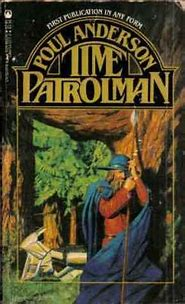
Anderson's Time Patrolman contained two new long Time Patrol stories:
"Ivory, And Apes, And Peacocks"
"The Sorrow of Odin the Goth"
- since subsumed into the omnibus collection, The Time Patrol/Time Patrol.
"Ivory..." and "...Odin..." are different kinds of stories. In the former, Manson Everard tracks down the bad guys. In the latter, Carl Farness must struggle with his feelings towards the people he studies.
"Ivory..." is set entirely in Biblical Tyre whereas the sections of "...Odin..." alternate mainly between the fourth and twentieth centuries. This story introduced the practice, continued in The Year Of The Ransom, The Shield Of Time and "Death And The Knight," of dating each new section of narrative.
Although there are no chapter titles, apart from the dates, the opening phrase or sentence of a section often makes clear whether the point of view is that of a Goth or of a time traveler. The Goths live with the seasons and the elements.
372 "Wind gusted out of twilight as the door opened." (p. 333)
1935 "I didn't change clothes till my vehicle brought me across space-time." (p. 341)
300 "The home of Winnithar the Wisentslayer stood on a bluff above the River Vistula." (p. 347)
1980 "After basic training at the Patrol Academy, I returned to Laurie on the same day as I'd left her." (p. 351)
300-302 "Winter descended..." (p. 362)
2319 "I'd flitted uptime to nineteen-thirties New York..." (p. 374)
302-330 "Carl...watched while her kinfolk laid Jorith in the earth..." (p. 379)
1980 "Manse Everard was not the officer who raked me over the coals..." (p. 384)
337 "Throughout that day, battle had raged." (p. 391)
1933 "'Oh, Laurie!'" (p. 395)
337-344 "Tharasmund was in his thirteenth winter when his father Dagobert fell." (ibid.)
1885 "Unlike most Patrol agents...Herbert Ganz had not abandoned his former surroundings." (p. 399)
344-347 "In the same year that Tharasmund returned...Geberic died..." (p. 404)
1934 "I came out of the New York base into the cold and early darkness of December..." (p. 407)
348-366 "Athanaric, king of the West Goths, hated Christ." (p. 409)
1935 "Laurie and I went walking in Central Park. March gusted..." (p. 422)
366-372 "Tharasmund led his men..." (p. 426)
1935 "I had fled home to Laurie." (p. 446)
372 "Night had lately fallen." (p. 450)
1935 "Laurie, Laurie!" (p. 456)
372 "Morning brought rain." (ibid.)
43 "Here and there amidst the ages, the Time Patrol keeps places where its members may rest." (p. 459)
374 "Ermanaric sat alone beneath the stars. Wind whimpered." (p. 463)
Saturday, 23 July 2022
In 1935
A change of century - from 372 to 1935 - is expected. However, this is the first time in the Time Patrol series that the narration changes from third to first person. We soon understand that the narrator in 1935 was the Wanderer in 372. He leaves his spear strapped to the side of his time hopper. The Goths do not suspect where their gods disappear to, in this case to a warehouse in New York. The Patrol front is a construction company. Farness, the narrator, knows that New York will become "...uninhabitable." (p. 342) When? Anderson describes the fourth and twentieth centuries and hints at future troubles. Disintegration will accelerate, in Farness' opinion, after the 1964 election. A character's opinions are not necessarily those of the author. Sometimes, they are.
The ghosts of the Goths crowd around Farness until the streets and buildings seem unreal. That would make a good cover illustration, conveying both time travel and Pagan ideas of a hereafter.
Patrol antithanatics do not merely slow but arrest the aging process, again implying that agents live until killed by accident or violence.
Sunday, 30 July 2023
What Gratillonius Knows Of The Goths
The Dog And The Wolf, XI, 1.
"Their tribes were divided between a western and an eastern branch.
"Wandering down from Germanic lands, they had settled in regions north of the Danuvius and the Euxinus.
"Later the thrust of a wholly wild and terrible breed, the Huns, caused them to seek refuge among the Romans.
"They proved to be formidable soldiers, especially as cavalrymen...
"...but untrustworthy subjects, apt to rebel.
"Most became Christian...
"...though of the Arian persuasion..." (p. 214)
I have rearranged this passage into discrete data, numbering seven. We can read about these Goths, Huns and Arians in Poul Anderson's Time Patrol story, "The Sorrow of Odin the Goth."
"It was the Birthday of Mithras. Gratillonius rarely saw a calendar, but everybody knew when solstice happened, and from that he could reckon this day." (p. 216)
He and we remember when he celebrated Birthday on the Wall. His entire career as King of Ys has come and gone since then, just as we remember long periods of time when we worked in a particular place.
How many Birthdays of Mithras are mentioned in The King of Ys?
Saturday, 1 August 2015
Carl's Golden Age
"...a blue-cloaked spearman who rode through the sky on a mount that was not a horse." (Time Patrol, pp. 368-369)
He takes the chief's daughter, Jorith, as his leman and becomes "...a great trader." (p. 370) There are ten years of peace with amber, furs, honey and tallow from the North, also wine, glass, metalwork, cloth and pottery from the South and West. However, two years after Jorith's union with Carl, she dies immediately after bearing their son, Dagobert.
This is the period that the Wanderer's Goths look back to. Their chiefs after Winnithar are of divine descent:
Winnithar;
Jorith with Carl;
Dagobert;
Tharasmund;
Hathawulf.
We follow five generations from 300 to 372, a fictional history in a single novel - "The Sorrow Of Odin The Goth" fills 133 pages of Time Patrol. Winnithar and his wife Salvalindis do not join the general migration south but:
"When the wagons had creaked away, the Wanderer sought those two out, one last time; and was kind to them, for the sake of what had been and of her who slept by the River Vistula." (p. 384)
"...what had been..." The ten years of peaceful trade are already a memory.
Monday, 1 August 2022
Goths And Morlocks
Timecycles are like improved Time Machines. Patrol message shuttles recall the model Time Machine. Patrol milieu HQ is based in the period when The Time Machine was published.
In There Will Be Time, mutant time travellers fast forward and rewind the universe like the Time Traveller and one mutant gives the time travel idea to a young British writer.
Time is a direction of extension both in The Time Machine and in The Corridors Of Time.
The moral as ever: read Wells and Anderson.
Friday, 21 July 2017
A Sound Like The Wind
"A sound like the wind passed down the shadowy length of the hall."
-"The Sorrow of Odin the Goth," Time Patrol, 300-302, p. 368.
Like the wind? Is this the passage through the hall of Wodan-Mercury-Hermes who is the Wanderer and "'...the god of the wind...'" (1980, p. 390), with whom Carl will later be identified? Wodan conducts "'...the dead down to the Afterworld...'" (p. 391) and, on a battlefield in 337:
"A breeze flitted cold across gore-muddied earth, ruffled the hair of corpses that lay in windrows, whistled as if to call them hence." (337, p. 392)
As I have said before, the wind is almost one of the characters in Poul Anderson's historical fantasies. The Time Patrol is historical sf but these passages could be fantasy.
Thursday, 27 August 2020
Many Changes
"...in those days, many changes went through the world." (p. 396)
That sounds familiar. There have been many periods of change.
Changes In The Fourth Century
Rome is at peace.
Constantine has divided the Empire.
He has "...declared Christ the single god of the state." (ibid.)
Missionaries convert some Goths.
A wooden church is small but the marble temples are emptying.
The Goths factionalize.
Comments
As I understand it, Constantine did not make Christ the single state god but he paved the way for those who did.
A state should acknowledge all gods or none.
"One state, one god" made sense to a lot of people but a state should protect everyone within its borders.
Monday, 2 July 2018
The Experiences Of Time Travelers
The Very First Draft Of A Science Fiction Story
Mask
Manse Everard and Carl Farness are Time Patrolmen;
Jack Havig is a mutant time traveler;
everyone else mentioned below is an accidental time traveler.
Everard and Duncan Reid share a Midwestern upbringing.
Everard and Havig share a knowledge of the history of science. Both know that Galileo never said:
"'E pu si muove.'"
-Poul Anderson, The Shield Of Time (New York, 1991), 1987 A.D., p. 27;
-Poul Anderson, There Will Be Time (New York, 1973), V, p. 46.
Carl's Goths resist Huns whereas Hun Uldin attacks Goths, both in the fourth century A.D.
Oleg Vladimirovitch sees the "...sun-spilling sky..." (The Dancer From Atlantis, Chapter Two, p. 14) whereas Uldin sees "...huge hawk-haunted heaven..." (p. 15) and recalls the tribal camp on summer evenings -
sounds: creaking wagons, noise, laughter, crackling flames, talk, lays, songs;
smells: smoke, roasting meat etc;
tastes: gluttonous eating and kumiss, fermented mare's milk;
sight: whirling flames showing friends' faces among restless shadows;
sex: after getting drunk on kumiss.
Erissa asks her husband to pour a rhyton of Cyprian wine for her eldest son whose father was a god, Duncan. Kneeling, signing herself and praying at the household shrine, Erissa prefigures later visions and practices:
"Cradling Her Son in Her arms, Our Lady of the Ax seemed in the uncertain light to stand alive, stirring, as if Her niche were a window that opened upon enormous reaches." (p. 17)
Time travelers lead colorful lives even before they time travel.