Showing posts sorted by relevance for query Fourre. Sort by date Show all posts

Tuesday, 31 March 2020

Fourre Versus Reinach

"Marius."

Because, in his private discussion with the disarmed Fourre, Reinach does not agree to resign, Fourre does not blow his whistle and the planned mutiny goes ahead. We are to understand that the longer term future of mankind is secured.

Fourre has maneuvered Reinach's supporters out of town:

Brevoort to establish relations with the Ukraanian revolutionary government;

Ferenczi to collect merchant ships from Genoa;

Janosek fighting the bandits in Schleswig.

We read the argument between Fourre and Reinach and are also told that Valti's equations support Fourre but I think that we are persuaded by Fourre's arguments in any case?

Thursday, 17 October 2013

Etienne Fourre II

When I summarized Fourre's career, my sources were:

"Marius" (published 1957; set approximately 1964);

"Un-Man" (published 1953; set approximately 2004).

What I omitted was the point of "Marius":

Fourre forcibly replaces Reinach with Valti as chairman of the European Council;

this is to prevent Reinach from becoming another Marius, a general who wins a war but is a disastrous politician;

also, according to Valti's equations, leaving Reinach in power would have led to World War IV and probably an end of humanity in another fifty years.

Fourre appeared in "Un-Man," then Anderson wrote the prequel, "Marius." Are they consistent?

According to "Un-Man," Fourre was in the French Resistance of World War II and was "...high in the Western liaison with the European undergrounds of World War III...," entering the occupied countries on several missions (The Psychotechnic League, New York, 1981, p. 54);

according to "Marius," he represents France in the European Council after World War III.

OK. This can fit together. He was in France during World War II and after World War III but was based in Britain or the US during World War III?

Of Fourre, Naysmith thinks:

"Such a man...would in earlier days have stood behind the stake and lash of an Inquisition, would have marched at Cromwell's side and carried out the Irish massacres, would have helped set up world-wide Communism...Thank God he's on our side!" (pp. 54-55)

Do we want such a man on our side? He arranges an assassination and a coup. But the assassinated man is a dictator, not a campaigner or reformer. The overthrown regime was anti-UN, not anti-US! And "UN" here means a peaceful, rational world government, not the institution with which we are familiar.

So maybe Fourre was the man for his time, after all?

Wednesday, 16 October 2013

Etienne Fourre

The future that we try to imagine is being formed now. One way to show this in speculative fiction is to present a character in a near future scenario who shares a past with the author and his readers. Thus, in Poul Anderson's Psychotechnic History, Etienne Fourre:

in World War II, was in the French Resistance;

in World War III, liaised with the European undergrounds;

after World War III, was chief of the Maquisard Brotherhood, therefore also French representative in the Supreme Council of United Free Europe;

in the Years of Hunger, fought with the liberals against the neofascists;

in the Years of Madness, fought with the gendarmerie against the atomists;

ran a spy system that suppressed the Great Jehad;

fought with UN troops in the Near East;

became head of the UN Inspectorate secret service;

engineered a successful coup against the anti-UN Argentinian government;

thwarted a faked Mongolian revolution;

had the Chinese dictator assassinated;

initiated the Rostomily Brotherhood.

Fourre first appeared as head of the secret service in "Un-Man," (1953) then as chief of the Maquisard Brotherood in the prequel, "Marius." (1957) "Marius," although set in the near future, presents the all too familiar environment of a war-torn Europe as a prelude to the high tech future of subsequent stories.

Fourre, appearing only twice, is a seminal figure, remembered centuries later:

"'Times have changed. If Fourre were alive today, he would agree that action is necessary.'
"'It's always convenient to use a dead man for a character witness, isn't it?'
"'What?'
"'Never mind.'" (Cold Victory, New York, 1982, p. 254)

Sunday, 22 September 2024

Fourre

There are biographical details about Etienne Fourre in "Marius" and in "Un-Man." Are they consistent? Does it matter? I have suddenly realized that it does not. If we imagine that the instalments of Poul Anderson's Psychotechnic History are written by different authors in later periods of that fictional timeline, then any of those authors might have got some of the details wrong or alternatively might have written a fictionalized account in which he was obliged to improvise to some extent because he had not known what all of the details had originally been in any case. Thus, as long as we receive a reasonably consistent account of Fourre as a character, there is scope for some divergence in the accounts.

Fourre is the viewpoint character in "Marius" but is seen from the outside by Naysmith in "Un-Man." This difference alone provides the opportunity to present a more rounded account. Unfortunately, that is the last that we see of Fourre because history moves on. The Technic History presents the best of two worlds: long character-based series and a long future history series. Poul Anderson is unique in that we can move from one of his future history series to another.

Wednesday, 13 September 2017

"Marius": Some Further Details II

See "Marius": Some Further Details.

"Marius" was published in Astounding, June 1957 (see image).

The text displays the sensibility of an sf writer in its opening sentence:

"It was raining again, with a bite in the air as the planet spun toward winter." (p. 13)

Sf writers remember that we inhabit a planet even when they are not yet writing about travel between planets. That will happen in the next instalment.

There are two reasons to classify "Marius" as sf:

it is set in the near future, after World War III;

it postulates a scientific innovation - although the innovation is a predictive science of society, not a new gadget.

Apart from that, its soldiers fight with rifles, not with blasters, and they might as well be survivors of WWII. At the same time, there is also an indication that automation has advanced and is hastening the reconstruction.

Two more indications of the extent of the post-War devastation:

a very ill secretary works with files written on laundry bills, flyleaves and other scraps of paper;

an officer is still in his teens yet "...shrivelled into old age..." (p. 16)

When Fourre says that Europe is heading:

"'Toward war... Another nuclear war, fifty years hence.'" (p. 20)

- and adds:

"'It isn't certain the human race can survive that.'" (ibid.)

- nature responds accordingly:

"Rain stammered on the windowpanes, falling hard now, and wind hooted in the empty streets." (ibid.)

When nuclear war is mentioned, the rain changes from "thin" (p. 14) to hard and our old friend, the wind, adds its voice. Anderson writes the Pathetic Fallacy as naturally and easily as other authors write their grammar and punctuation.

How should we balance immediate (present) concerns against hypothetical (future) dangers? (Valti's symbolic sociology makes the future less hypothetical.) Anderson's works present two concrete statements of this dilemma.

First, Reinach, the titular "Marius," says:

"'...[Valti]'s senile now, I tell you. Babbling of the future, of long-range trends - Can we eat the future? People are dying of plague and starvation and anarchy now!'" (pp. 19-20)

"'You are theorizing about tomorrow... The rats are already here.'" (p. 23)

"'...hell take your misty futures! We'll meet the future when it gets here.'" (p. 24)

Fourre can only reply that Valti has instructed him in the elements of the new science and that it was theorists who discovered atomic energy.

Secondly, and in Anderson's second future history, the President of the Parliament of Man on Avalon complains:

"'...Give you military your heads, and you'd build bases in the fourth dimension to protect us against an invasion from the future.'"
-Poul Anderson, The People Of The Wind IN Anderson, Rise Of The Terran Empire (Riverdale, NY, 2011), pp. 437-662 AT p. 490.

- to which the First Marchwarden of the Lauran System replies:

"'We are always being invaded by the future... The next part of it to arrive will not be pleasant.'" (ibid.)

Nice one, Ferune!

Valti has a theory about "...the 'pivotal decision.'" (p. 21)

- to which Reinach responds, "'Bah!'" (ibid.)

Have you heard anyone say this? I heard a Maths teacher say it once. In any case, there may be, and probably are, pivotal decisions even in a timeline without a Time Patrol to guard them.

Fourre says that people in the mass do not learn. He cites the Hundred Years War and Hiroshima. People in his timeline had not learnt from Hiroshima. People in ours so far have. I find it remarkable that, despite all the stockpiling and posturing, the use of nuclear weapons has been avoided so far - since the US tested them on Japan.

Another inter-cosmic comparison:

"...[Fourre] had seen too many men spilling their guts on the ground and screaming." (p. 23)

"Everard...had seen men scream on the ground as blood and bowels spilled from them..." (The Shield Of Time, p. 74)

At the very end of "Marius," rain slants in through a broken window and we read Fourre's thoughts about his dead friend.

Tuesday, 12 May 2020

"Marius" And "Brake"

A while back, I analyzed all the fight scenes in "Brake" (see The Politics Behind All The Fighting) and really don't want to go through all that again so there might be limited value in rereading this story. However, "Brake" has a surprisingly long Wikipedia article (see here) which makes some good points:

The story was written and published within two months of "Marius" and they were clearly written as companion pieces - the dawn and sunset of the same culture (later stories of this Future History would be set in the further future, when a still newer civilization would arise from the ruins of what would be called "The Second Dark Ages").
Marius and Brake are linked by various common themes - one featuring the first appearance of the maquis Stefan Rostomily, the other having the last appearance of Rostomily's cloned "sons"; in one Étienne Fourre appears for the first time, in his heroic effort to restore the shattered world, in the other the memory of Fourre is abused and his legacy is claimed by one of the militant factions busily working to shatter it again. In fact, it is Captain Banning, the story' protagonist, who is Fourre's true heir, bravely striving to preserve, for as long as possible, what Fourre and his companions had built.
-copied from the Wikipedia article. See the above link.

Friday, 20 September 2024

Into Night

"Marius."

It is night and Reinach sits with his back to a closed but un-curtained window, showing rain and darkness. He asks Fourre:

"'...what way are we heading?'
"Fourre looked past him into night. 'Toward war,' he said quite softly. 'Another nuclear war, some fifty years hence. It isn't certain the human race can survive that.'
"Rain stammered on the windowpanes, falling hard now, and wind hooted in the empty streets." (p. 20)

Observations
Clearly, Fourre looks into two nights: the darkness outside the window and the Long Night, so to say, for the human race. Fourre is like an Ythrian seeing the shadow of God the Hunter across the future.

I had meant to stop there but the pathetic fallacy continues. Not only does the rain speak - stammers hard - as the human character speaks but also the omnipresent Andersonian wind hoots in the appropriately empty streets. The elements underline and punctuate Poul Anderson's dialogues. Readers who do not consciously reflect on these background sound effects must nevertheless be affected by them.

Saturday, 13 October 2012

Marius


Poul Anderson deploys historical knowledge to dramatic effect in both historical fiction and science fiction. In the second century BC, the Cimbrian barbarians devastated Europe, defeated Roman armies and invaded Italy where, however, an army led by the Roman general Marius annihilated them. Anderson describes that battle in The Golden Slave.

In his short story, "Marius," two powerful men, Fourre and Reinach, meet to discuss the way forward for a devastated near future Europe. Fourre addresses Reinach as "Marius" and explains this nickname by describing the Roman general's victory over the Cimbri. Reinach is puzzled but flattered.

However, almost immediately, Fourre, in a carefully planned mutiny, deposes Reinach and explains this action by again referring to Marius. It seems that Marius used his military prestige to go into politics where he got it all wrong, unintentionally paving the way for Caesarism and the end of the Republic.

Fourre comments over Reinach's corpse, " 'I would like to think that I helped spare Jacques Reinach the name of Marius.' " (1)

(1) Anderson, Poul, The Psychotechnic League (New York, 1981), p. 28.    

Tuesday, 15 December 2015

With Trevelyan Micah

The first three novels written (not published) by Poul Anderson were:

The Broken Sword (fantasy);
Vault Of The Ages (juvenile sf);
Star Ways/The Peregrine (a volume of his first future history).

A future history is event-driven, not character-driven. In this, the Psychotechnic, future history, three characters appear twice and that is it as far as character continuity goes:

"Un-Man," about clones of the dead but well remembered Stefan Rostomily, cameos Fourre;

"Marius," written later but set earlier is about Fourre and cameos Stefan;

in Star Ways, Trevelyan Micah of the Stellar Union Coordination Service bids farewell to Braganza Diane before departing on a mission;

in "The Pirate," written many years later but set a few years earlier, Micah again bids farewell to Diane before departing on a mission.

Thus, Fourre, Micah and Diane each appear twice.

Trevelyan refers to the Second Dark Ages which happened between "Brake" and "Gypsy." When he visits Port Nevada, we read one of Anderson's list-descriptions:

"...humans and nonhumans hustled, jostled, chiseled, brawled, clashed, stole, evangelized, grew rich, grew poor, came, went, and were forgotten..."
-Poul Anderson, Starship (New York, 1982), pp. 213-214.

Trevelyan's nonhuman colleague says of the man whom they are investigating:

"'Our information concerning his world line is fragmentary, and zero about its future segment.'" (p. 220)

Of course information about the future is zero! But does Smokesmith imply that his species does sometimes have information about future segments of world lines? The very fact he (?) discusses a man in terms of his world line is suggestive.

"...the mother-of-pearl iridescence on [Smokesmith's] rugose torso was lovely to watch." (p. 221)

(I took "rugose" to mean "red.")

Nerthus, like Tyrfing, is a name that links Anderson's hard sf to his mythological fiction.

Friday, 20 September 2024

Disarming And Frisking

"Marius."

Commanders are disarmed before they meet the Chairman because:

"...everyone had grown far too used to settling disputes violently." (p. 17)

I think that that was why there was a Civil War after Partition in Ireland instead of just two massive rival political campaigns.

But also:

"The officer frisked him, and that was a wholly new indignity, which heated Fourre's own skin. He choked his anger, thinking that Valti had predicted as much."  (ibid.)

A British soldier frisked me once in Northern Ireland during the Troubles. I cooperated by moving my arms out so that he could feel beneath them but felt that I was handled like an inanimate object, not acknowledged or respected as a human being. I was neither thanked nor even looked at. When asked later by someone else how I felt about this experience, I said, "OK," but realized that some, perhaps many, would have reacted like Fourre - not that I had read about Fourre back then but the character represents a particular human response.

All human life is here in the future histories.

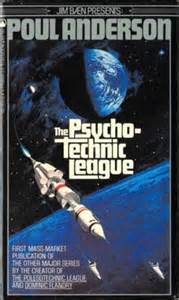
(Which Poul Anderson work is represented by the attached cover image?)

Sunday, 5 April 2020

Men Of Darkness

"Un-Man."

When one of Naysmith's captors threatens him with prefrontal lobotomy, he thinks:

"Yes, this is the enemy. These are the men of darkness who in other days sent heretics to burning, or fed the furnaces of Belsen, or stuffed the rockets with radioactive death. Now they're opening skulls and slashing brains across." (XI, p. 80)

But, earlier, Naysmith had thought exactly this about his own superior, Fourre:

"Such a man, thought Naysmith, would in earlier days have stood behind the stake and lash of an Inquisition, would have marched at Cromwell's side and carried out the Irish massacres, would have helped set up world-wide Communism - a sternly religious man, for all his mordant atheism, a living sword which needed a war." (V, p. 40)

So what is the difference? Well, one difference is that, according to Naysmith, Fourre would have done such things in earlier days. He is not doing them now. Naysmith adds:

"Thank God he's on our side!" (ibid.)

Fourre's aims are world unity and peace, not continued division and war, and his means are not as reprehensible as those of his enemies.

Physically, light and darkness are both good. We sleep in darkness. Metaphorically, we ask to be led from darkness to light.

Saturday, 12 December 2015

Atomists

Another reference to "atomists," albeit without a capital initial. Section V of "Un-Man" informs us that Etienne Fourre:

was in the French Resistance during World War II;
liaised with the European undergrounds of World War III;
fought fascists in the Years of Hunger;
fought atomists in the Years of Madness;
fought jihadists in the Near East;
became head of the UN secret service;
initiated the Rostomily Brotherhood;
assassinates opponents.

Although we still do not know what the "atomists" stood for, we receive confirmation that they belong on the list of enemies between Communists and Americanists.

The incorporation of World War II into Fourre's career neatly links twentieth century history with future history. Fourre is still active at eighty, thanks partly to medical advances. But is his strategy of coups and assassinations the right way forward? Can any good ends be attained by such means?

Thursday, 2 April 2020

Chronology And Progress

"Un-Man."

The Un-Men are clones of Stefan Rostomily but there is more going on even than that. Trying to spot an undercover agent, Naysmith considers:

"...the little girl skipping rope in the park across the way. She might not be what she seemed: the biological laboratories could do strange things, and Fourre had built up his own secret shops -" (VI, p. 45)

Hold on there, Fourre! What are you doing now? And, having kicked themselves back with a nuclear war, can the people of this fictional timeline have progressed that far that fast? Sandra Miesel's "Chronology of Future" dates "Un-Man" to 2004. It cannot be much later because Fourre, who was young in 1945, is still alive, aged eighty. Also, this Chronology is based in part on one compiled by Poul Anderson and published in Starling Stories in 1955. Is there any extant information on that Chronology?

Friday, 10 April 2026

At Tharsis

The Fleet Of Stars, 9.

Kinna and Elverir, flying into the Martian wilderness towards Tharsis, pass above Guthrie Head and the Sisters. 

Outside their flitter:

"The landmarks dropped behind like time itself..." (p. 115)

Inside Kinna's mind:

"Fragments of the history blew past her like dust on the wind." (ibid.)

Two good comparisons: landmarks like time; history like dust on the wind. (That ubiquitous Andersonian wind.)

The Lunarians are not only physically but also psychologically different from Terrans and, in a previous volume, devised their own language. Elverir will introduce Kinna to those Martian Lunarians who call themselves neither brigands nor guerillas but Inrai. Why, in such a high tech society, would anyone:

rob caravans;
wreck machines;
kill sophotects and men?

Some explanation will be given but we must read on.

Elverir might just have told Kinna that the Inrai cause was just but Poul Anderson wants to convey some linguistic nuances. Thus, Elverir uses the adjective, "douris," (p. 113) which we are told means "natural" or "unwarped" rather than "just" or "righteous." Elverir's "'...zailin...'" (p. 119) with the Inrai was maybe his initiation rather than his indoctrination or training. 

Will the Inrai, who want their freedom from the Synesis, receive help from Proserpina? In Anderson's Technic History, will Aeneas receive help from Ythri or Merseia or will Diomedes receive help from Ythri? (We are not about to answer those questions here.)

The Inrai want a sovereign Lunarian Mars and Luna back. Kinna recognizes irredentism. 

"'Carthagalann stole Egypt, our rightful possession.'
"'Italia irredenta,' murmured Everard.
"'Hunh?'
"'Never mind.'"
-Poul Anderson, "Delenda Est" IN Anderson, Time Patrol (Riverdale, NY, December 2010), pp. 173-228 AT 6, p. 210.

Elverir acknowledges that one of his comrades is "'...not wholly sane...'" (p. 119) about their cause. Shivering but not from cold, Kinna reflects:

"History said that causes brought forth such people. But the murderous great causes belonged only to history, didn't they? They were centuries extinct, weren't they?" (ibid.)

Here again, this late future history reminds us of Anderson's earlier Psychotechnic History:

"There was something of the fanatic about Etienne Fourre.'"
-Poul Anderson, "Un-Man" IN Anderson, The Psychotechnic League (New York, September 1981), 31-129 AT V, p. 54.

In the wake of World War III, Fourre fights nationalism and builds the UN world government although the title character, Naysmith, thinks that in earlier days that same Fourre would have been with the Inquisition or Cromwell.

The spirit of the Psychotechnic History creeps closer when:

"The room was growing dark. [Kinna] imagined the specter of the nation-state walking in through the wall, from the cold and unbreathable wind outside, followed by war and war and war." (p. 125)

The Inrai began when, during a dispute about access rights, one Lunarian killed three sophotects and one man, then fled into the wilderness with fellow rebels. They are supported by independent Lunarian cities, rob caravans for supplies and fire at constables to keep them off. The cybercosm works towards a destiny whereas the Inrai want freedom from destiny.

The universe is big enough for both.

Saturday, 9 January 2016

Rise And Fall

To recapitulate from several earlier posts:

Poul Anderson's Psychotechnic History is a future history series of twenty installments;

eleven installments are set during the period of slower than light (STL) space travel whereas the remaining nine are set during the later period of faster than light (FTL) space travel;

the entire History could be collected in two omnibus volumes corresponding to these periods;

the STL period subdivides into four episodes set during the period while the UN is becoming a world government and seven works set within the Solar Union, an alliance between the governments of the Earth-Luna system and the Martian and Venusian colonies;

the FTL period has two stories set during a period of early interstellar exploration and colonization, six (of which most of us have read only four) set in the Stellar Union and one set in a much later Galactic civilization;

no installments are set either during the Second Dark Ages, which separate the Solar Union from the early interstellar period, or during the Third Dark Ages, which separate the Stellar Union from at least two interstellar Empires, then the Galactic civilization;

(this contrasts with the later History of Technic Civilization which has one pivotal story during the Time of Troubles separating the Solar Commonwealth from the Terran Empire and one set during the Long Night separating the Terran Empire from the Allied Planets and later civilizations);

the STL period begins with Europe recovering from World War III and ends with Earth, although not the entire Solar System, sliding into the Second Dark Ages;

the important figure of Fourre, who had fought in World War II, appears in the opening two stories of the History and is invoked in "Brake," the concluding story of the Solar Union period;

Fourre's man, Stefan Rostomily, appears in the opening story but dies before the second;

however, Rostomily's clones continue to work for Fourre and a later clone even appears in "Brake";

the even more important figure of Valti remains off-stage although he initiates the science of psychotechnics which is still practiced in the later Galactic civilization;

in the STL period, there is a rise to an almost utopian economy but then a fall to the Second Dark Ages;

in the FTL period, there is a rise to the Stellar Union, a fall to the Third Dark Ages and interstellar imperialism, then a rise to the vast and powerful Galactic civilization.

Saturday, 14 December 2013

Social Chaos

Poul Anderson's "The High Ones" posits a future world-wide Soviet dictatorship. Usually, a story with such a premise would describe oppression on Earth. Instead, we are shown how the Terrestrial regime affects the crew of a spaceship exploring another planetary system, although one crew member reminisces about his childhood in Soviet-dominated North America.

Reading "The High Ones" made me reflect on the social upheavals that led to the establishment of the Soviet regime - a tidal wave of world events overwhelming any group trying to achieve a positive outcome. Anderson conveys exactly that feeling in his Psychotechnic Future History and in the parallel text, Planet Of No Return.

The first Psychotechnic story, "Marius," begins inauspiciously for a future history. It is raining and cold and the street lights have not been restored. There is dusk between ruined walls where tattered people dwell among rubble. This is the aftermath of a World War III so close to the "present," the time of writing, that the viewpoint character, Etienne Fourre, chief of the Maquisard Brotherhood and French representative in the United Free Europe Supreme Council, had been a partisan in World War II.

Fourre's coup, described in the story, leads to the social application of the new science of psychotechnics and the Psychotechnic Institute's uphill struggle against mass irrationality is described in "The Sensitive Man" but the Institute is later overwhelmed by social upheavals that are meticulously described in four pages of The Snows Of Ganymede. In "Brake," a world in turmoil plunges down towards the Second Dark Ages.

Saturday, 21 September 2024

Night

In the opening story of Poul Anderson's Psychotechnic History, Etienne Fourre, chief of the Maquisard Brotherhood, therefore French representative in the Supreme Council of United Free Europe, looks past his Commandant into night. 

In Anderson's Technic History, the Long Night after the Fall of the Terran Empire is delayed but not prevented. 

OK. Night is coming. One passage more than any other has directly addressed me in the works of CS Lewis. The author as viewpoint character and first person narrator inadvertently enters the mind of a young woman where he hears:

"...a voice at whose sound my bones turned to water: 'Child, child, child, let me in before the night comes.'
'Before the night comes'..."
-CS Lewis, "The Shoddy Lands" IN Lewis, The Dark Tower and other stories (London, 1983), pp. 104-111 AT p. 110.

Personified reality penetrates the "shoddy lands" of a closed mind. Before meditating each morning, I ask, "Please help me to let you in..."

Meanwhile, for Fourre, for Flandry, for all of us, the night approaches.

Thursday, 26 September 2024

More Future Jobs

"Un-Man."

Prior, secretly working for the UN, is officially:

"...a semantic analyst for a large trading outfit..." (V, p. 53)

Robert Naysmith is officially a cybernetic analyst. His degrees are in epistemology and communications theory and he describes his work as:

"'...basic-theoretical consultant. Trouble-shooter in the realm of ideas.'" (p. 56)

Fourre comments that this also makes him "'...something of a linguist...'" (ibid.)

Naysmith is too old to have received Synthesis training so an epistemologist or semanticist is the closest approach to an integrating synthesist. Naysmith's knowledge of language, psychology and the sciences should enable him to integrate information and derive a larger picture, Fourre hopes. That seems to be asking a lot.

Peter Christian, a younger Brother with Synthesis training, is able to estimate with 80% probability that Besser, chief of international finance, is the head of the secret anti-UN gang. This estimate is based on:

Besser's past history;
his known character;
his country's recent history;
the necessary communications for a planet-wide least-effort anti-UN organization;
other data.

It is also highly probable that Roger Wade, president of Brain Tools, Incorporated, and prominent Americanist Party supporter, is the anti-UN chief for North America.

Assuming that Besser will act logically and on a survival axiom and also taking into account his insufficient understanding of modern socio-theory and his personal bias, Christian calculates the best course of action for his Brothers to apprehend the leaders of the gang.

Wednesday, 13 September 2017

"Marius" Revisited

I will have to get The Complete Psychotechnic League. See here.

I am learning how this blog works. Something happens to get me interested in rereading some part of Poul Anderson's works even though I have posted about it more than once before. Recently, it was the concluding Dominic Flandry novels. Currently, comparing future histories has focused my attention on Anderson's Psychotechnic History. I will probably reread and post about at least the opening three stories of this series, while at the same time checking what I have already posted about them, e.g., Scene-Setting.

The opening story is "Marius." However, searching the blog for "Marius" brings up references to the Roman general of that name and also some mere lists of titles including "Marius" as well as more substantial information about the contents of the story, e.g.:

Etienne Fourre
Etienne Fourre II
Future History Continuity
Valti, Desai And Seldon

Even apparently straightforward Anderson stories are dense with information and content. 

Monday, 14 October 2013

The Psychotechnic Institute II

I got one point wrong a couple of posts back here. Poul Anderson's Psychotechnic History does include one story specifically about the Psychotechnic Institute.

The first four stories, collected as The Psychotechnic League (New York, 1981), are:

"Marius";
"Un-Man";
"The Sensitive Man";
"The Big Rain."

"Marius" introduces Valti (off-stage), Fourre and Rostomily. In "Un-Man," Fourre runs the UN Secret Service whose agents, the Un-Men, include a "Brotherhood" of Rostomily clones. Another Un-Man, not a Brother, stars in "The Big Rain." Valti's work is continued by the Psychotechnic Institute and "The Sensitive Man" is about two members of that Institute. Thus, the second, third and fourth stories follow, directly or indirectly, from the first.

However, the Institute works on two levels. It tries to change individuals and society:

"'The Institute is trying to do two things - create such a citizenry [intelligent, alert and tough enough to defend freedom against power] and simultaneously to build up a society which itself produces men of that kind and reinforces those traits in them. It can be done, given time.'" (p. 173)

The story dramatizes one changed individual, the title character, but otherwise, like other installments of the series, discusses changing society in the abstract. This is why I had not remembered any particular story as specifically focusing on the Institute. The Sensitive Man owes his enhanced powers to Tighe System training which can be discussed apart from the rest of the Institute's work.

In the later story, "Brake," a single character is a member of the Order of Planetary Engineers and of the Rostomily Brotherhood and has Tighe System training but is not a psychotechnician.