Showing posts sorted by relevance for query "Wind whooped. Sort by date Show all posts

Monday, 10 November 2025

Whooping, Sobbing Wind And Hissing Rain In 1137

Poul Anderson, 1137 A. D. IN Anderson, The Shield Of Time (New York, 1991), pp. 374-380.

Everard, Tamberly and Volstrup discuss weighty matters on their bleak December day. When Volstrup's face pales:

"Outside wind whooped and a dash of rain blew from wolf-gray heaven." (p. 376)

When he moistens his gullet for a second time:

"The wind sobbed." (p. 378)

When Everard stares into shadows:

"Rain hissed down the walls. Chill sneaked beneath clothing." (p. 379)

After "...wind whooped...," I read to the end of the chapter confidently expecting more such references and of course found some.

This chapter also reminds us of some of the details of the history guarded by the Time Patrol:

heretics burned;
Jews ghettoized, massacred or expelled;
peasants who claimed any rights treated in the same way.

I know someone who thinks that it would have been better if consciousness had never evolved. A time criminal could travel far enough back to prevent the emergence of life on Earth, killing himself at the same time.

Tuesday, 24 November 2026

Wind Whoops And Speaks

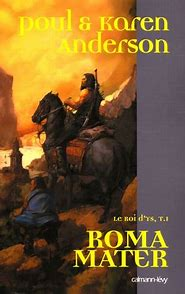
Roma Mater, XII, 3.

Wind whoops often in Poul Anderson's works but here is an instance that we have not quoted yet:

"Wind whooped above glittery waters, made sails dance, drove white pennons across a blue field. It stung tears from the eyes of Gratillonius when he squinted into it." (p. 227)

For once, this is perhaps just a physical description without any pathetic fallacy? The scene is boisterous: whooping wind; glittering water; dancing sails; whiteness; blueness. Gratillonius' tears are merely a physical reaction to the strong wind. There is no parallel sorrow or grief. However, once alerted by the wind, we expect it again. But it returns only once more in this section. However, it then confirms our impression that the ubiquitous Andersonian wind is often an active participant in the dialogue:

"For a moment the wind alone gave tongue." (p. 228)

What does it say? We don't know but the action always cries out for some kind of comment. This wind is from the sea. Gratillonius and Eppillus are inspecting the sea defences and they will be needed soon.

Monday, 9 November 2020

Wind And Waves

Orion Shall Rise, CHAPTER SIXTEEN, 4.

Because of his relationship with Ronica, Iern commits to the Northwest Union:

"'Iern, Iern, Iern!' She toppled into his arms. 'Iern, together we'll see Orion rise.'
"Wind shrilled, waves marched, the North Pole circled toward winter." (p. 290) 

Pathetic fallacy again: whatever Orion is, it is immediately associated with shrilling, marching and polar winter.

And wind stays with us in the opening sentence of CHAPTER SEVENTEEN:

"Another wind whooped off the sound, whirled through city streets, dashed rain against houses." (p. 291)

Human conflict is matched by elemental violence.

Sunday, 25 June 2023

A New Age

Roma Mater, XXI, 3.

Gratillonius and Soren Cartagi converse - and, of course, the wind.

"Wind whooped." (p. 364)

Gratillonius stares out at the wind and, after heated argument:

"Again he turned away to the window and the wind." (p. 365)

Gratillonius, although King of Ys with sacral duties in the city, must travel around Armorica on Roman business:

"'...Rome must have one master, and he an able man. Can you not see?'" (p. 364)

"'A new age is upon Ys, upon the world.
"'Enough of provincial selfishness and dragging of feet.'"  (p. 365)

But the new age will sweep everything away, including Ys and Rome. Gratillonius will prepare for the defence of his part of Europe after the destruction of Ys and the withdrawal of Rome. Describing changes at work between 1989 and 2012, I once said that, beyond the oncoming tsunami, there was a colliding planet. 

Saturday, 25 June 2022

Seething City And Whooping Wind

The Shield Of Time, PART SIX, 1137 A. D.,, pp. 374-380.

"...Palermo seethed with tidings. Each newcomer brought a new story." (p. 374)

But the stories confirm that King Roger is victorious so:

"Sicily rejoiced." (ibid.)

The Patrol cannot rejoice yet. Manse Everard must ask even more than before of agent-in-place Emil Volstrup. While Volstrup's face pales:

"Outside, wind whooped and a dash of rain blew from wolf-gray heaven." (p. 376)

The sky is a threatening colour. A dash of rain could be the start of a downpour. While the city seethes, wind whoops. Of course. Poul Anderson knows how to set the scene for the greatest temporal crisis yet.

Friday, 25 September 2020

December Bleakness And Whooping Wind


The Shield Of Time, PART SIX, 1137 A.D.

Everard, Wanda and Volstrup are in an unaltered 1137 but with a beta alteration ahead of them. Their mood is:

"...as bleak as the December day outside." (p. 374)

The weather always obliges. I have found an image of Palermo with clouds instead of a blue sky.

When Volstrup agrees to answer Everard's questions, his reply is "...barely audible..." and:

"In the gloom his nutcracker face showed pale. Outside, wind whooped and a dash of rain blew from wolf-grey heaven." (p. 376)

The wind never lets up. A dash of rain could mean an approaching storm and a wolf-colored sky suggests a celestial menace.

Saturday, 25 June 2022

Wind And Sea

The Shield Of Time, II37 A. D.

The Beta timeline lacks the strong Pope Gregory with the result that the Popes become the Emperor's puppets. When Volstrup relates this to Everard and Tamberly:

"The wind sobbed." (p. 378)

That wind works overtime. It whooped when demands on Volstrup increased. Now it sobs for the weakened Papacy. Time Patrol agents are not (all) Papists but they need a Papacy that can resist the Empire just as they need an Empire that resists the Papacy. They need a Cyrus the Great that ends Jewish captivity in Babylon and Nazis that can be defeated, but must first exist, in the twentieth century.

By the end of this novel, the Patrol has ensured the growth of science and of "'...the first strong ideal of liberty.'" (1990 A. D., p. 434)

- and, when a Danellian points this out:

"The wind cried, the sea growled nearer." (ibid.)

Tuesday, 13 February 2018

Alliterative Prose

We have discussed alliterative verse and even prose. See here. (Scroll down.) There is a short passage in Mirkheim:

"'Impossible.' Sandra walked from him, back to the window. Wind whooped, rain rushed, thunder went like enormous wheels. Winter was on its way to Starfall."
-Poul Anderson, Mirkheim IN Anderson, Rise Of The Terran Empire (Riverdale, NY, 2011), pp. 1-291 AT Chapter XVII, p. 239.

Or is this more verse disguised as prose? It seems to have that sort of rhythm but I cannot quite rearrange it into lines of verse.

Anderson is describing weather, as often before:

"...thunder resounded..." (Chapter XVII, p. 232);
Sandra heard the trumpet of wind and the march of rain "...as if Pete rode by..." (ibid.);
"Rain struck the garden like spears..." (p. 233);
"Lightning flared...thunder rolled..." (ibid.);
by p. 241, there is "An early snow..." when Sandra's yacht leaves Hermes.

The weather, of course, reflects what is happening to the characters. I think that the early snow evokes a renewed purity (or something) as Sandra and Falkayn escape from their occupied planet.

Wednesday, 29 May 2019

An Ax

Mirkheim.

Nicholas van Rijn, Sandra Tamarin and Eric Wace struggled, suffered and survived together on the planet, Diomedes. Shortly after that, Sandra bore van Rijn's son, Eric Tamarin. Wace drops out of the picture but is remembered in a name.

Sandra's conference chamber on Hermes displays a "...Diomedean battle-ax." (XVII, p. 233)

"When at last [David Falkayn] stopped and regarded her, it was strangely right that he stood beneath the ax." (p. 238)

Very right. The unity of action between the first van Rijn novel, The Man Who Counts, and this concluding van Rijn-Falkayn novel, Mirkheim, is being affirmed. If we approach the Technic History in chronological order, then we have read The Man Who Counts long before reaching Mirkheim whereas, in the original order, we read Mirkheim as the culmination of the Polesotechnic League Tetralogy, then, two volumes later, encounter The Man Who Counts as part of the Avalonian history, The Earth Book Of Stormgate.

In this chapter, we appreciate some weather. The storm makes the conference chamber a gloomy cave but:

"Freshness blew in, though, loud and raw. Rain struck the garden like spears and hid sight of the world beyond its wall. Lightning flared, making every bare twig on the shrubs leap forth under a sheet-metal sky; thunder rolled across unending reaches while murk returned." (p. 233)

"Wind whooped, rain rushed, thunder went like enormous wheels. Winter was on its way to Starfall." (p. 239)

See also Alliterative Prose.

Saturday, 12 September 2015

Beginning To Understand The Beta Timeline

On p. 375 of Poul Anderson's The Shield Of Time (New York, 1991), Manse Everard refers to Sherlock Holmes. His hearer, a Dane born in 1864 but also a member of the Time Patrol, understands the reference, which could be to a fictional character. You might ask, "Surely it is?" Not in the Time Patrol universe. However, whenever Everard sees or refers to the real Holmes, he avoids using the name. And, when he does use the name, as here, it could be a reference to the fictional character known to us.

Everard is referring to the detective work that will be necessary to trace the origins of the beta timeline. To Time Patrolmen, the emergence of a divergent timeline is like a temporal storm and sure enough, while they talk:

"Outside, wind whooped and a dash of rain blew from wolf-gray heaven." (p. 376)

The pathetic fallacy yet again. The beta timeline has no Pope Gregory IX (see image). Why not? That is too complicated to unravel at this time of night.

According to the Danish Patrolman, thirteenth century medieval society lost its earlier freedom, tolerance and social mobility. Heretics burned. Jews and rebellious peasants were massacred, expelled or ghettoized. The Patrol protects this history.

Monday, 18 April 2022

A Silver Band And More Weather

The Merman's Children.

"On a calm night, stars filled the jet bowl above until it was well-nigh hidden, save for the silver band across it." (Book Four, I, p. 194)

"...the silver band..." is yet another description of the Milky Way which we seem to have missed before.

"...it was a sweet spring day. The common which they were crossing was vivid with new grass; in the distance, leaves made a green mist across the top of a woodlot. Against overarching blue, storks were returning, harbingers of summer, bearers of luck. The breeze was fresh, loud, full of damp odors. Hoofs thudded on drenched soil with almost unhearable softness." (V, p. 216)

Four senses: the breeze alone is felt, heard and smelled. We are beginning to notice birds as part of the pathetic fallacy. These storks harbing summer and bear luck. (I tried "harbing" as a verb but my laptop does not recognize it.)

"Rain sluiced from heaven, brawled across roofs, made rivers of streets. Lightning flared, thunder went on huge wheels, wind whooped." (p. 217)

A good time to be indoors and, sure enough, the following paragraph describes:

a stove heating the main room of a house;
candles lighting wainscot, hangings and carved furniture;
closed doors giving privacy.

As usual, weather punctuates dialogue. When Eyjan complains:

"Ingeborg watched her for a while that was silent except for the storm battering at shutters." (ibid.)

(Today has been a busy Easter Monday, combining a friend's birthday with a community activity and an evening outing. Reading time has been almost zero.)

Monday, 2 November 2026

Superiority

Poul Anderson's "Wings of Victory" and "Turning Point" are spaceship stories. One criterion for such a categorization is that they could be adapted as episodes of Star Trek although, of course, they are better as they are.

In "Turning Point," the problem - at least it is perceived as such - is a humanoid planetary population whose every member from the youngest to the oldest is many times more intelligent than Einstein or even than whichever individual currently possesses the highest IQ on Earth. 

Having rapidly learned technology from humanity, these Jorillians can be expected to build an interstellar civilization that we will neither understand nor be able to participate in. I would say let them get on with it but the human characters believe that such a development would demoralize mankind. I have been told that, in Battlestar Galactica, parts of the galaxy are inhabited, or at least used, by vastly advanced beings whom the regular characters simply avoid. Peaceful coexistence seems perfectly possible. Human beings used to believe that they shared their Terrestrial and cosmic environments with superior beings. Maybe in future they can live with that as a fact?

Familiar Andersonian touches -

Biblical quotation: "'...what is man that Thou art mindful of him?'" (p. 278)

A dramatic pause in a conversation is punctuated or underlined by the wind:

"There was a stillness. I heard the forest sough in the night around us." (p. 279)

The night signifies: no answer yet.

A problem is solved by a sudden moment of realization:

"Haraszthy stiffened. He sat like stone for an entire minute before he raised his face and whooped aloud.
"'Why not?'" (p. 282)

Four stages: stiffening; stillness; whooping; solution revealed later.

Possible solutions: Exterminate or quarantine the Jorillians? Something else?