Friday, 20 September 2024

Goethe And Valti

"Marius."

The Supreme Council of United Free Europe, representing Free France, the Nordic Alliance, Italy, Poland and Germany, meets in Strasbourg where:

"The University was almost unscathed, and so became the headquarters of Jacques Reinach. His men prowled around on guard; one wondered what Goethe would have thought could he have returned to the seat of his student days." (p. 15)

(Reinach is "...the Commandant, Chairman of the Council." (p. 16))

In my student days, I read about someone that I thought was called "Go-eth" and heard about someone that I thought was called "Gurter." Fortunately, I realized their identity before I spoke the name. This story also refers to Rouget de l'Isle, Hitler, de Gaulle, Marius and Caesar. Future history is rooted in past history.

This future history includes Professor Eino Valti:

"...Valti's matrices were not concerned with a man's heart. They simply told you that given such and such conditions, this and that would probably happen." (p. 16)

Is "probably" good enough?

(Going out for the evening.)

Out Of The East

It is impossible to reread Poul Anderson without finding some passage for quotation or comment. Here we find similar pathetic fallacies in two different periods of two different timelines:

"Night rolled out of the east, like a message from Soviet lands plunged into chaos and murder."
-Poul Anderson, "Marius" IN Anderson, The Psychotechnic League (New York, 1981), pp. 13-28 AT p. 14.

"The last thing he heard was thunder. It sounded like the hoofs of horses bearing westward the Hunnish midnight."
-Poul Anderson, "The Sorrow of Odin the Goth" IN Anderson, Time Patrol (Riverdale, NY, December 2010), pp. 333-465 AT 374, p. 465.

Night from the east. Usually, we think of the sun as coming from there:

"Out of the east, the morning behind them, rode the Anses into the world."
-Poul Anderson, "Star of the Sea" IN Time Patrol, pp. 467-640 AT II, p. 557.

"Above the cliffs, a few eastern clouds turned red."
-Poul Anderson, Mirkheim IN Anderson, Rise Of The Terran Empire (Riverdale, NY, March 2011), pp. 1-291 AT XXI, p. 291.

Light from the east, morning; but also sunset colours signifying the end of this novel and of an era.

Wisdom also comes from the east except for Chinese Buddhists whose wisdom came from India, the West! We have gone off the point here. Unless the point is the symbolism of directions - up, down, east, west.

Thursday, 19 September 2024

Two Beginnings

Poul Anderson's Psychotechnic History opens during recovery from World War III in the 1960s in a still devastated Europe where street lights have not yet been restored, tattered people dwell in caves in the rubble, Liberators wear patchwork uniforms of a dozen armies, river pirates waylay barges and the Americans will ship a new blight preventative next year whereas the same author's Technic History opens during recovery from the Chaos in the mid-twenty-first century with exploration of the Saturnian System.

So there can be progress in future histories. What a contrast between these two beginnings. In both cases, history eventually progresses to interstellar civilizations unimaginable to those living at the beginnings.

Will we survive the Chaos and avoid World War III?  

Sandra Miesel's Summary Of The Build-Up To Poul Anderson's Psychotechnic History

1956. Eisenhower dies. Nixon becomes President in June. US aids Hungarian rebels. Soviet Union backs Egypt in Suez crisis. Middle East war leads to Russian control of northern Iran. Tito assassinated. Soviet Union regains Yugoslavia. Conflict between Krushchev, Bulganin and Zhukov.

1958. Soviet Union threatens Berlin blockade. China seizes Nationalist-held islands. Pre-emptive strike against the West on Christmas Eve. Capitals and military bases destroyed but other territory spared for conquest. US counter-strike more damaging. USSR crosses the Rhine but cannot supply armies. Mutinies within USSR. War of attrition liberates Europe. Conflict continues in Asia. Social conflicts break out in the US and Europe. Worldwide economic collapse.

1964. New possibilities.

Mature Cultures

HG Wells' The War In The Air, predicting an alternative, civilization-destroying, Great War, is narrated from the perspective of a much later:

"...world state, orderly, scientific, and secured..."
-HG Wells, The War In The Air (Penguin, Harmondsworth, Middlesex), Chapter 11, p. 228.

The World State is built in Well's The Shape Of Things To Come.

Robert Heinlein's Future History Time Chart ends with:

"...the end of human adolescence, and beginning of first mature culture."
-Robert Heinlein, The Man Who Sold The Moon (London, 1963), p. 7.

A U.N. world government is established in 1965 in Poul Anderson's Psychotechnic History Chronology of the Future but does not last.

However, Sandra Miesel's Foreword to the Psychotechnic History, Volume I, is written:

"From the standpoint of our mature integrated culture..."
-The Psychotechnic League (New York, 1981), p. 10.

In these futures, mankind is going somewhere.

Back To The Multiverse

Regular blog readers will remember that I recently bought a copy of the Foundation Trilogy, Volume III, Second Foundation, by Isaac Asimov, bypassing Volumes I and II. The purpose of the purchase was not to reread this book but just to quote and analyze certain passages because of their parallels with certain recently reread or remembered passages in Poul Anderson's Psychotechnic and Technic Histories. There my renewed interest in Asimov ends, at least for the time being. This intellectual exercise was both interesting and entertaining, especially since I had completely forgotten some of the relevant details and also because it was necessary to reread the text very carefully in order to uncover exactly what it was that Asimov was or was not saying. There were some surprises. Poul Anderson does not tie himself in such philosophical knots and writes more convincing fictional history in any case.

Having, I think, concluded any renewed engagement with Asimov at least for now, my attention is left hovering between the two mentioned Andersonian future histories and, by implication, between several other future history series by Anderson and his contemporaries. Imagine their respective time chats displayed in parallel on a wall-sized sheet or screen. We notice comparisons and contrasts. World War III occurs in the Psychotechnic History but not in the Technic History. Seeing the timelines in parallel, we are bound to wonder about any interaction between them: not only spaceships and time machines but also inter-timeline machines? Rhysling from Heinlein's Future History and van Rijn from Anderson's Technic History do both make it into Anderson's inter-universal inn, the Old Phoenix. A much greater story remains to be told here.

Anderson Avoids Asimovian Absurdities

This blog is principally about Poul Anderson but we also contextualize him in relation to other sf writers.

Anderson does not draw a straight line from nuclear forces to physiologies to psychologies to sociology. In Isaac Asimov's future history, Seldon's psychohistorical Plan is upset, although only temporarily, by a single mutant whereas Anderson's Psychotechnic Institute is, much more realistically, overwhelmed by the chaos of world events. And it is the science of psychotechnics, not any particular organization, that survives into the Galactic future.

The Foundation series remains throughout with a handful of individuals directing the destinies of quintillions whereas Anderson's Psychotechnic History is a genuine future history series with different kinds of stories about diverse one-off characters set in successive periods of a single long timeline.

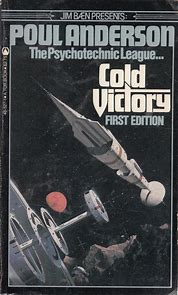
The Psychotechnic League should be entitled The Psychotechnic Institute or The Psychotechnic History, Volume I. This series should be republished in a uniform edition between Robert Heinlein's Future History and Anderson's Technic History. This is the main line of development of American future history series.

Anderson And Asimov On Individual And Society

See The Application Of Science To Society.

In Poul Anderson's fictional psychotechnics, there is a distinction between equations for human relations and discoveries about individual psychometrics. We found the same distinction between social and mental science in Asimov's Second Foundation. (At least, I thought that we did. See more on this below.)

Regarding the individual psychometrics:

"'A lot's been learned since Freud, both from the psychiatric and the neurological angle. Ultimately, these two are interchangeable.'"
-Poul Anderson,"The Sensitive Man" IN Anderson, The Psychotechnic League (New York, 1981), pp. 131-198 AT p. 196.

They are not interchangeable. A description of a neurological state is not a description of a mental state. Might someone with sufficient knowledge be able to deduce or infer a mental state from the corresponding neurological state? But each mental state is momentary and unique. Neurological states are objective and therefore empirically observable whereas mental states are subjective and directly experienced only by each individual. One observable neurological state causes and explains another but how does either explain something that is not observable?

Poul Anderson's Psychotechnic History was based on Robert Heinlein's Future History but is Anderson's equivalent of Isaac Asimov's Foundation Trilogy insofar as Valti's sociosymbolic logic parallels Seldon's mathematical equations. Anderson's Technic History parallels Foundation in a different way because it describes the rise and fall of an interstellar empire.

Both Foundation and the Psychotechnic History address the questions: what is the scientific basis of consciousness and what is the relationship between individual and society? By analyzing both works, we study how these issues were treated in sf back then. (Decades ago.)

Asimov tells us that:

"...scientists with a psychological orientation..."

- are:

"...men whose fundamental conception of scientific philosophy is pointed in an entirely different direction from all of the orientations we know. The 'psychology' of scientists brought up among the axioms deduced from the observational habits of physical science has only the vaguest relationship to PSYCHOLOGY.
"Which is about as far as I can go in explaining colour to a blind man - with myself as blind as the audience."
-Isaac Asimov, Second Foundation (London, 2016), Part I, FIRST INTERLUDE, p. 17.

Slow down there, Asimov. Axioms are not deduced from habits. Axioms are primary and deductions are made from them. If a conception is:

entirely different from anything we know;
not observational;
not a form of physical science;
as inconceivable to us as colour is to a blind man -

- then how is it a form of science? Is he referring to spirituality?

We proceed to a later chapter. The science of the Second Foundation:

"...dealt with mathematical concepts only..."
-Part II, 8, p. 95.

Maths only? OK. But that is not entirely different from anything we know. We are told that this science is similar to ancient, pretechnological speculations and that it has no gadgets but also that it has a remarkable gadget called the Prime Radiant which the present Second Foundationers use but do not understand. 

My observation: Pure mathematics is pre-scientific if, by "science," we mean empirical science.

Paraphrasing:

men transmitted thoughts and emotions through speech;

but speech degenerates mental delicacies into "...gross and guttural signalling." (p. 96);

therefore, men never really understand each other;

therefore, there is isolation, conflict and suffering;

semantics, symbolic logic and psychoanalysis refine or bypass speech;

Seldon truly developed psychology by mathematically understanding "...neural physiology and the electro-chemistry of the nervous system..." (p. 97);

generalizing psychology from individual to group mathematicized sociology;

as an aside, it is emphatically stated that neural physiology and nervous system electro-chemistry "...had to be, had to be, traced down to nuclear forces..." (ibid.) (Asimov's emphasis);

the Second Foundationers do not communicate with speech because their training enables them to deduce each other's thoughts from facial expressions and slight gestures (!)

My Observations
The mental delicacies of abstract thought are possible only because we have internalized symbolic communication.

Despite what I thought before, psychohistory is generalized from individual psychology. Psychohistory is statistical but the statistics are applied to astronomical numbers of fully understood physiologies.

The Second Foundationers fully understand each other? So they have transcended isolation, conflict and suffering? That is not borne out by later volumes. (A later volume also shows Second Foundationers transmitting thoughts across interstellar distances, which is supposed to be impossible to them or even to the Mule, but I am not going to look that up now.)

No one can deduce thoughts from expressions and gestures! Thoughts need symbols.

Everything having to be traced down to nuclear forces is reductionist and contradicts the idea of a science that is supposed to be completely different from physics.

Everything is not traceable to nuclear forces. New properties, and particularly consciousness, emerge at more complex levels of material organization. Such properties are not reducible to the properties of less complex, including nuclear, levels. They have their own laws and have to be understood on their own terms. Psychology cannot be understood simply by understanding neurons, physiology and electro-chemistry. We cannot understand Hamlet merely by understanding ink and paper.

Wednesday, 18 September 2024

Three Future Historians And Consciousness

Robert Heinlein
The Future History: future history, a future revolution, immortality, a generation ship.

Poul Anderson
The Psychotechnic History: all of the above.
Also: other future histories and immortality in two other novels.

Isaac Asimov
I, Robot: robots.
Foundation: future history, psychohistory, the Fall of the  Galactic Empire and its aftermath.

Poul Anderson
The Psychotechnic History: psychotechnics and one robot.
The Technic History: the Fall of the Terran Empire and its aftermath.

Foundation
Psychohistory: a predictive statistical science of (very) large populations.
Mental science: theoretical and practical understanding of individual psychology, enabling new means of communication.
Mental control of other minds and their bodies by the Mule and the Second Foundationers.

(These are three different concepts. Mental control is not an application of mental science which in turn is not an application of psychohistory although Asimov's readers might get these impressions.)

Psychotechnics
A predictive science of society but also a means of understanding and enhancing physiology.

My Philosophical Observation
Hello. This is me speaking now. Being has become conscious. It experiences itself through individual psychophysical organisms, both animal and human. Being is one but experience divides into subjective and objective. Science is objective. Can scientists also study subjectivity?

The concept, "soul," is objectified subjectivity. Subjectivity is a property of conscious organisms, not an independent substance. Our understanding must be neither dualist nor reductionist. There will be more on this when I have carefully reread what Asimov and Anderson wrote about mental science and psychotechnics, respectively.

Tuesday, 17 September 2024

We In The Galaxy

We noticed a single understated instance of first person narration in Poul Anderson's far future "Starfog":

"We know that other branches of humanity have their distinctive ways, and hear rumors of yet stranger ones. But so vast is the galaxy - these two or three spiral arms, a part of which our race has to date thinly occupied - so vast, that we cannot even keep track of our own culture, let alone anyone else's."
-Poul Anderson, "Starfog" IN Anderson, Flandry's Legacy (Riverdale, NY, June 2012), pp. 709-794 AT p. 718.

This narrator, whoever s/he is, is speaking/writing/communicating at the time when the story is set: "..to date..." S/he is a member of "...our race...," which seems to be the human race. This was not necessarily going to be the case. An earlier Technic History narrator, Hloch, was an Ythrian. The "Starfog" narrator is a member of the group that s/he addresses: "We know..." S/he identifies with a particular branch of humanity and with a particular culture as against other human ways which are "distinctive" and sometimes strange.

We - I refer now to twentieth/twenty-first century readers - contrast this tightly controlled narrative point of view with clumsier ones in other works of sf. Isaac Asimov's Second Foundation opens with an italicized quotation from an Encyclopedia Galactica article on the Mule. As soon as the unitalicized text of Chapter 1 begins, its narrator does not commence his narration but instead criticizes the article just quoted as:

"...not germane to the issue at immediate hand, and most of it too dry for our purposes in any case."
-Isaac Asimov, Second Foundation (London, 2016), p. 3.

The article addresses only economic issues but discusses neither the speed of the Mule's rise nor the sudden cessation of his expansion.

"We therefore abandon the Encyclopedia and continue on our own path for our own purposes..." (p. 4)

Who are "We..." and what are our "purposes"? The edition of the Encyclopedia quoted:

"...was published in 1020 F.E...." (p. 3)

It follows that this narrator writes several centuries, at least, after the events described and also during (or even after?) the Second Galactic Empire. OK. We do not know the circumstances of the narrator or of his/her audience so that there is an element of mystery here. 

However, when this same narrator describes a session of the Executive Council of the Second Foundation, things go awry, I think. We are told that:

"To us they are merely voices." (p. 16)

However - now I paraphrase -, an exact reproduction of the session would sacrifice comprehensibility. These psychologists understand each other so well both by general theory and by application of their theory to individuals, that they communicate fully by sentence fragments, gestures, grunts, facial twitches and even careful pauses. Really? They are not telepaths but something else.

"Which is about as far as I can go in explaining colour to a blind man - with myself as blind as the audience." (p. 17)

"We" has become "I." Plural has become singular. One commentator that I read objected to this sudden intrusion of an unexpected and unexplained first person narrator into a far future narrative. As far as that goes, I welcome any layers of mystery added by not-fully-explained narrative perspectives. However, this "I" reads suspiciously not like a far future narrator living during or even after the Second Empire but instead like the author, Asimov, directly addressing his twentieth century readers back when this story was first published. Thus, the text is not sufficiently integrated into the period when it is supposed to be written.